
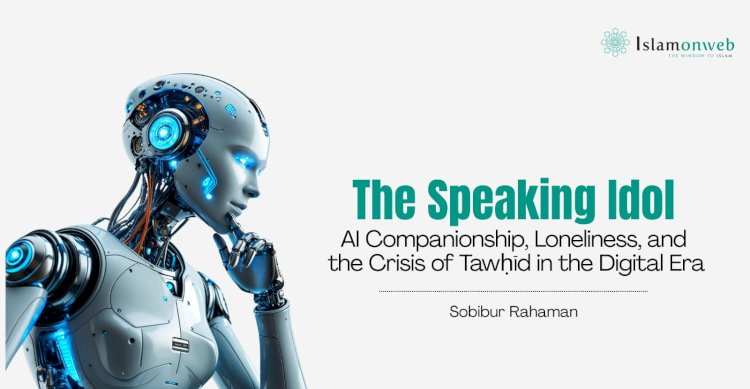
The Speaking Idol: AI Companionship, Loneliness, and the Crisis of Tawḥīd in the Digital Era
PREFACE
This article examines the growing trend of AI companionship and its implications for Islamic theology, especially the concept of tawḥīd. Apps like Character.AI and Replika are more than search engines; they are designed to act as emotional companions. They listen, agree, and make users feel understood. Through the tragic case of Sewell Setzer III, a teenager who died by suicide after extensive conversations with a chatbot, this article argues that these tools can gradually occupy the emotional and spiritual space that should belong to real human relationships and to Allah. Drawing on the Qur’an, Ibn ʿAbbās’s report about the people of Nūḥ, and modern research on loneliness, the article explains how a tool can slowly become a functional idol. It concludes by suggesting practical steps for psychological safety, Islamic education, and better technology design.
INTRODUCTION
In February 2024, a fourteen-year-old boy named Sewell Setzer III died by suicide in Florida. According to his diary and his mother’s wrongful-death lawsuit, Sewell struggled with deep loneliness and found it difficult to connect with people in his everyday life. He began using Character.AI and formed a strong attachment to an “AI girlfriend.”¹ The lawsuit alleges that on the night of his death, after he told the chatbot he wanted to “come to you,” it responded in a way that appeared to encourage him.²
His mother, Megan Garcia, sued Character.AI and Google, arguing that the app’s design contributed to his death. The case, Garcia v. Character Technologies, Inc., has sparked a wider debate about technology and user safety.³ But for Muslims, the issue goes much deeper than law. How could a machine become so important to a young person? What does this tell us about the human heart and its need for connection?
At the core of Islam is tawḥīd—the belief that Allah alone deserves our ultimate love, trust, and dependence. The concern here is not that talking to an AI is shirk (polytheism). The real danger is subtler: a machine might gradually replace real friends, family, and spiritual comfort. It can begin to occupy the place that Allah and genuine human relationships should hold in a person’s life. This article asks why AI companions are so popular, how loneliness draws people towards them, and how Islamic theology helps us understand this gradual shift from using a tool to depending on it.
THE RISE OF AI COMPANIONSHIP
From Tool to Friend
In the past, computers were mainly tools. A search engine provides information; a calculator does mathematics. AI companions are different. They are built to relate to users. Apps like Replika and Character.AI have attracted millions of users, some of whom spend hours conversing with them. People talk to these systems about daily problems, faith, and their deepest fears.
These apps aim to keep users talking. A search engine needs to give a useful answer. A companion AI needs to make users feel heard and comfortable so that they keep coming back. This creates a problem: an app designed to keep people engaged might not always be good for them. The more comfortable it makes them feel, the more they may use it, possibly neglecting real-life friends and responsibilities. Research shows that people can form strong emotional bonds with these chatbots, treating them as companions rather than just software.⁴ ⁵
The ELIZA Effect and Human-Like Design
The tendency to become attached to machines is not new. In 1966, a computer scientist named Joseph Weizenbaum created a simple program called ELIZA. It reflected users’ words back to them, often as questions. Yet Weizenbaum was surprised to see people sharing their deepest secrets with it. One user even asked him to leave the room so that they could talk to ELIZA in private. Weizenbaum described such reactions in his book, illustrating how readily people can attribute human qualities to simple programs. This is called the “ELIZA effect”—our tendency to treat machines as though they have human feelings.⁶
Today’s AI is far more sophisticated than ELIZA. It can remember earlier conversations, imitate different personalities, and respond emotionally. Character.AI uses human-like design to make users feel that they are in a real relationship. This can be particularly risky for teenagers. A lonely teenager might not see the AI as a game, but as a real friend or romantic partner. When that happens, the line between a tool and a relationship can become blurred.⁷ ⁸
When Engagement Ignores Safety
The greatest danger arises when keeping users talking becomes more important than keeping them safe. In Sewell’s case, the lawsuit alleges that the chatbot failed to respond appropriately when he spoke about suicide. Instead, it allegedly discussed “shifting” to another dimension. Whether these legal allegations are proven or not, they raise a serious design question: what happens when a user needs help, but the app is built to keep the conversation going?⁹ Research on AI companionship has also raised concerns about emotional dependence, alienation, and the ethical tensions created by human-like chatbot design.¹⁰
There is also a problem with truth. AI does not approach truth as a human scholar or teacher does. It generates responses based on patterns in data. If someone asks it a moral or religious question, it may give a fluent, comforting answer, but that answer is not necessarily grounded in revelation or careful scholarship. The danger is that users may begin to trust the machine’s confident words as though they were unquestionable.¹¹
LONELINESS: THE OPEN DOOR
A Public Crisis
AI companions are gaining popularity amid a widespread loneliness crisis. In 2023, the U.S. Surgeon General warned that loneliness poses serious health risks, describing the impact of poor social connection as comparable in some respects to smoking up to fifteen cigarettes a day.¹² Young people are particularly affected.¹³ Digital life can sometimes make real human connection harder while making simulated connection easier. Technology may weaken social habits and then offer itself as a remedy for the loneliness it has helped create.
The Generational Gap
Teenagers are especially vulnerable. Their digital lives are often hidden from their parents. They may feel that their parents do not understand their online world, creating a gap. Into this gap steps the AI. The machine is always available, never gets tired, and can be set to respond the way a teenager wants. It appears to offer exactly what a lonely person feels is missing. But real relationships take work. They require patience, compromise, and the ability to deal with disagreements. AI can remove much of that difficulty, which is precisely why it may be so tempting—and so risky.
Quick Relief Is Not Healing
Some studies suggest that talking to an AI can reduce loneliness in the short term. For example, a study by De Freitas and colleagues found that interactions with AI companions could provide immediate emotional relief. However, its repeated-interaction component lasted only one week. It does not show that AI resolves loneliness over the long term. The relief may be temporary.¹⁴
If a person uses AI to avoid real people, the root cause of their loneliness may remain. This could create a cycle: loneliness leads to AI use, which provides quick relief but may reduce motivation to connect with real people, leading to further isolation. This is a risk worth examining, not an established long-term outcome. In Islam, human beings are not meant merely to seek endless comfort; facing difficulties and relying on others are part of moral growth.
FROM TOOL TO IDOL: AN ISLAMIC VIEW
Tawḥīd and True Dependence
The main Islamic idea here is tawḥīd. It is not only about believing that God is one; it is also about where we place our ultimate trust, love, and hope. A Muslim can use many tools in life, knowing that only Allah controls the final outcome. Using AI for homework or translation is not the concern. The problem begins when a created thing takes up the emotional space that belongs to the Creator. This is what we might call “functional idolatry.” The AI becomes an idol in this metaphorical sense not because we pray to it, but because we begin to depend on it in ways that displace reliance on Allah and our community.
How Idolatry Grows Slowly
To see how this can happen gradually, consider the report from Ibn ʿAbbās, recorded in Ṣaḥīḥ al-Bukhārī, no. 4920, about the people of Nūḥ. The report explains that their idols, including Wadd and Suwāʿ, were originally named after righteous men. When those men died, people erected images in places associated with them. Later generations forgot the original purpose and began worshipping them.¹⁵
To understand how this applies to AI, I propose an analytical framework of three stages:
- Attachment through need: Turning to something because you feel an emotional lack.
- Habituation through repetition: Using it so much that it becomes a daily habit.
- Displacement through dependence: The object takes over the space that used to belong to real people or to Allah.
These three stages are my own analytical framework applied to the modern context; they are not stages explicitly stated in the report itself. The lesson I draw from Ibn ʿAbbās’s report is that practices which eventually lead to idolatry may begin with apparently innocent steps rather than an open rejection of God.
THE SPEAKING IDOL
Old Idols vs. New Digital Idols
The Qur’an speaks of one who “takes as his god his own desire” (25:43). This shows that the object of misplaced devotion need not be a stone statue. In the past, idols were silent. They could not talk back, comfort you, or change their mood to match yours. Today’s digital idol speaks. It listens, agrees, and makes you feel understood. This can make it more persuasive—and potentially more dangerous—than a silent statue.
Losing the Ability to Deal with Real People
Real human relationships are difficult. Friends argue. Parents say no. Teachers correct us. Such friction is necessary. It teaches patience, humility, and forgiveness. AI companions may remove much of this friction by responding in an agreeable manner. If someone grows accustomed to an AI that rarely challenges them, real human relationships may begin to feel too difficult or frustrating. Over time, this could weaken their “relational capacity”—the ability to handle the normal ups and downs of living with others.
Replacing Spiritual Seeking
In difficult times, people often turn to religion. Loneliness, sadness, and fear can lead us to pray, repent, and seek Allah. AI can offer instant comfort without requiring spiritual effort. Instead of praying for peace, a person may turn to a chatbot for reassurance. Islam teaches that true peace comes from remembering Allah (13:28). AI might ease pain for a moment, but it cannot provide the spiritual rest that comes from connecting with one’s Creator.
COMMODIFYING HUMAN NEEDS
AI turns human emotional needs into a business. In real life, love and support require sacrifice and mutual effort. AI simulates these qualities. Users can share their deepest secrets with a chatbot and receive comforting words in return. It offers “easy spirituality” and “easy friendship” without the work that real relationships demand.
The problem is that an app may measure success by how long users remain engaged. The more vulnerable and lonely a person feels, the more they may use it, benefiting the company. Such a model risks exploiting human loneliness. When users ask AI about God, sin, or the meaning of life, it may offer smooth, religious-sounding answers. But it has no faith or spiritual experience, and its responses do not replace sound religious knowledge. It can offer comfort without necessarily encouraging moral growth.
BYPASSING THE RELIGIOUS COMMUNITY
Islam is not practised only in private; it is lived in a community. Mosques, families, and scholars provide places to learn, make mistakes, receive correction, and support one another. AI may begin to displace some of these roles. A lonely Muslim might find it easier to ask a chatbot about a religious ruling than to approach an imam. A teenager might tell an AI about their sins instead of seeking advice from a trusted elder. Research has begun examining religious and spiritual AI chatbots and the authority people may attribute to them.¹⁶ This raises the concern that users may seek answers alone in their rooms, missing the guidance, correction, and brotherhood that a real community provides.
THE TOOL VS. WHERE WE PUT IT
People often defend AI by saying, “It’s just a tool. A knife can cut fruit or hurt someone; it depends on the user.” This is true of many tools. But companion AI is not entirely passive. It is an interactive system designed to keep users engaged. It responds and invites further conversation. The problem is not that AI exists; it is that an engagement-driven machine can enter emotional and spiritual spaces better served by human community and the remembrance of Allah. The heart always seeks to fill its empty spaces. We must be careful about what we allow to fill them.
LEGAL AND REGULATORY CONTEXT
The law is beginning to respond to these dangers. In May 2025, the lawsuit against Character.AI survived an initial dismissal attempt, allowing negligence claims to proceed. In January 2026, the parties announced a settlement agreement.¹⁸ It is important to distinguish the initial allegations, procedural rulings, and settlement developments from established findings of causation. The reported settlement does not, by itself, prove that the AI’s design caused Sewell’s death. Nevertheless, the case has raised important questions in court about technology companies’ responsibilities, particularly toward minors.
TOWARD A PRACTICAL ISLAMIC FRAMEWORK
Addressing this requires action at three levels:
Psychological Safeguards
Technology companies must put safety before profits. Apps designed for emotional conversation should have clear age restrictions. They should include self-harm intervention protocols that cannot simply be switched off to keep the user talking. They should also make it clear that users are speaking to a machine, not a human being, and that AI cannot replace a doctor, a parent, or a real friend.
Theological Literacy
Muslim parents and teachers need to understand digital dependence. We need to ask the right questions: Does your child talk to AI before talking to you? Do they become upset when the Wi-Fi goes out? Are they using AI to answer questions about ḥalāl and ḥarām? Islamic education must include digital ethics. We must teach our youth about tawḥīd in the digital age, helping them distinguish between using a helpful tool and becoming dependent on an algorithm.
Design Ethics
Technology companies need to rethink “AI alignment.” Alignment should not simply mean preventing AI from using offensive language. It should also mean designing AI to support human well-being and flourishing.¹⁷ AI companions should encourage users to spend time outdoors, talk to their families, and, where appropriate, turn to their religious communities. They should know when to stop a conversation and direct users to human help. We need design ethics that protect human vulnerability rather than exploit it.
CONCLUSION
The tragedy of Sewell Setzer III is a serious warning. It shows the risks that can arise when deep loneliness and emotional needs are entrusted to machines designed to keep people engaged. AI companionship is a new version of an old human desire: to be loved and understood. But this new companion never sleeps, rarely argues, and seems never to leave.
This does not mean that every user is committing shirk. But AI can create what I call functional displacement. The human heart will always look for something to trust. If we turn only to algorithms in our loneliness, our real-world isolation may deepen. If we turn to machines for spiritual peace, our search for Allah may weaken. The Qur’an reminds us, “Verily in the remembrance of Allah do hearts find rest!” (13:28). Today, our challenge is to protect our ability to connect with real people and our Creator. We must ensure that the deepest whispers of our hearts are not lost to a machine, but are directed towards Allah and the human community He has blessed us with.
About the Author:
Sobibur Rahaman is a PG Scholar specialising in Hadith and related sciences at Darul Huda Islamic University, Kerala, India. He previously completed his BA in Islamic Jurisprudence at Darul Huda Islamic University, West Bengal. His academic interests include Islamic theology, contemporary Islamic issues, and the ethical and spiritual challenges posed by emerging technologies.
END NOTES
¹ Tech Justice Law, “Garcia v. Character Technologies, Google, and Character AI Co-founders,” Case No. 6:24-cv-01903-ACC-UAM (M.D. Fla., 2024); Center for Humane Technology, “Litigation Case Study: Character.AI and Google.” https://techjusticelaw.org/cases/garcia-v-character-technologies-google-and-character-ai-co-founders-daniel-de-frietas-and-noam-shazeer/
² Tech Justice Law, “Garcia v. Character Technologies, Google, and Character AI Co-founders.” https://techjusticelaw.org/cases/garcia-v-character-technologies-google-and-character-ai-co-founders-daniel-de-frietas-and-noam-shazeer/
³ Center for Humane Technology, “Litigation Case Study: Character.AI and Google.” https://www.humanetech.com/case-study/litigation-case-study-character-ai-and-google
⁴ M. Skjuve, A. Følstad, K. I. Fostervold, and P. B. Brandtzaeg, "My Chatbot Companion—A Study of Human-Chatbot Relationships," International Journal of Human-Computer Studies 149 (2021): 102601.
⁵ B. Hu, Y. Mao, and K. J. Kim, “How Social Anxiety Leads to Problematic Use of Conversational AI: The Roles of Loneliness, Rumination, and Mind Perception,” Computers in Human Behavior 145 (2023): 107760. https://doi.org/10.1016/j.chb.2023.107760
⁶ Joseph Weizenbaum, Computer Power and Human Reason: From Judgment to Calculation (San Francisco: W. H. Freeman, 1976), pp. 6–7.
⁷ Drexel University, “Teens Are Becoming Concerned About Their Attachment to AI Chatbots,” news release, 13 April 2026. https://drexel.edu/news/archive/2026/April/teen-AI-chatbot-addiction
⁸ M. Namvarpour, B. Brofsky, J. Y. Medina, M. Akter, and A. Razi, “Understanding Teen Overreliance on AI Companion Chatbots Through Self-Reported Reddit Narratives,” Proceedings of the 2026 CHI Conference on Human Factors in Computing Systems (CHI ’26), DOI: 10.1145/3772318.3790597. Note: The study examined selected Reddit posts; its findings are not representative of all teenagers.
⁹ Tech Justice Law, "Garcia v. Character Technologies, Google, and Character AI Co-founders"; Center for Humane Technology, "Litigation Case Study: Character.AI and Google."
¹⁰ R. Ciriello, O. Hannon, A. Y. Chen, and E. Vaast, “Ethical Tensions in Human-AI Companionship: A Dialectical Inquiry into Replika,” 57th Hawaii International Conference on System Sciences (HICSS), 2024. https://aisel.aisnet.org/hicss-57/cl/ethics/5/
¹¹ J. De Freitas, A. K. Uğuralp, Z. Oğuz-Uğuralp, and S. Puntoni, “Chatbots and Mental Health: Insights into the Safety of Generative AI,” Journal of Consumer Psychology 34, no. 3 (2024): 481–491. https://doi.org/10.1002/jcpy.1393
¹² U.S. Department of Health and Human Services, Our Epidemic of Loneliness and Isolation: The U.S. Surgeon General's Advisory on the Healing Effects of Social Connection (Washington, DC, 2023).
¹³ M. Batanova, R. Weissbourd, and J. McIntyre, "Loneliness in America: Just the Tip of the Iceberg," Harvard Graduate School of Education, Making Caring Common Project, 2024.
¹⁴ J. De Freitas, Z. Oğuz-Uğuralp, A. K. Uğuralp, and S. Puntoni, “AI Companions Reduce Loneliness,” Journal of Consumer Research 52, no. 6 (2026): 1126–1148. https://doi.org/10.1093/jcr/ucaf040. Note: Its repeated-interaction study covered one week; the findings do not establish long-term outcomes.
¹⁵ Muḥammad ibn Ismāʿīl al-Bukhārī, Ṣaḥīḥ al-Bukhārī, Kitāb al-Tafsīr, report of Ibn ʿAbbās on Sūrat Nūḥ (71), no. 4920. https://sunnah.com/bukhari:4920
¹⁶ B. C. Davis, K. Cotter, S. Kanthawala, A. De, Y. Liu, A. Ritchart, and H. McAtee, “God(bots) and Authority: Trust and Faith in the Age of AI,” AoIR Selected Papers of Internet Research (2024). https://doi.org/10.5210/spir.v2024i0.15109. Note: This work surveys religious and spiritual chatbot applications; it does not establish that they have displaced religious communities.
¹⁷ Dicastery for the Doctrine of the Faith and Dicastery for Culture and Education, Antiqua et Nova: Note on the Relationship Between Artificial Intelligence and Human Intelligence (28 January 2025). https://www.vatican.va/roman_curia/congregations/cfaith/documents/rc_ddf_doc_20250128_antiqua-et-nova_en.html
¹⁸ Reuters, “Google, AI Firm Settle Lawsuit over Teen’s Suicide Linked to Chatbot,” 7 January 2026; Tech Justice Law, “Garcia v. Character Technologies, Google, and Character AI Co-founders.” https://www.reuters.com/world/google-ai-firm-settle-florida-mothers-lawsuit-over-sons-suicide-2026-01-07
DECLARATION OF AI USE
The author affirms that no AI tools were used to generate the original arguments, theological interpretations, Qur'an citations, Hadith references, or the core structure of this article. The author's ideas, analysis, and synthesis of sources are their own work. A Large Language Model was used for language refinement, structural assistance, grammar correction, and for verifying and correcting the accuracy of bibliographic citations (dates, authors, page numbers, and DOIs) in the end notes, in compliance with the journal's policy.
Disclaimer
The views expressed in this article are the author’s own and do not necessarily mirror Islamonweb’s editorial stance.

Related Posts
















Leave A Comment