
The Begums of Bhopal: Reform, Patronage, and the Politics of Accommodation
Origins of a Dynasty: Bhopal Under the Nawābs
Pre-independence India had a large number of princely states. Among them, the Begums of Bhopal occupy a distinctive place in the history of India. The Begums of Bhopal maintained close relations with the British and received privileges and assistance in administrative and developmental activities, including irrigation. Their cooperation with the British, however, was not without political controversy. The dynasty was spread across 11,200 square kilometres, with a population of 700,000 during 1908.[1]
The founder of this dynasty was Dost Muḥammad Khān, an Afghan noble from the Mirza clan. He came to Malwa in 1708 and helped the Rani of Gonds against a Rajput Thakur, and after the Rani’s death he became the ruler. In 1723, he became the Nawāb. After him, Sulṭān Muḥammad Khān became the ruler, but he was forced to resign by his brother Yār Muḥammad Khān, who took control of the state with the support of the Niẓāms of Hyderabad[2]. Yār Muḥammad Khān died leaving his son Faiz Muḥammad Khān and his wife Mamola. Mamola conducted the affairs of the state from 1754 to 1794. Besides Faiz, there was another claimant, Yār’s brother Sulṭān Muḥammad Khān. When Faiz died childless in 1777, there was Faiz’s younger brother Ḥayāt Muḥammad Khān and a second claimant, Sharīf Muḥammad Khān, one of the grandsons of Dost Muḥammad Khān. There was also a woman, Ṣalāḥa Begum, Faiz’s widow, who tried to usurp power. In 1787, Sharīf attacked Bhopal and was killed in that battle. Ḥayāt died in 1808, and at that time Wazīr Muḥammad Khān, the son of Sharīf Muḥammad Khān, became one of the major contenders for the throne. He rose to the title of Nawwāb, but he was not able to rule because Ghawth Muḥammad Khān, the son of Ḥayāt, strongly prevented him. Therefore, Wazīr allied with Amīr Khān, an old partner of his. After Wazīr’s death in 1816, his younger son Nazar Muḥammad Khān rose to power, and he married Qudsiyya Begum. Nazar was also known for signing the Treaty of Raisen in 1818, which served as the foundation for Anglo-Bhopalese relations. In accordance with Nazar’s will, Qudsiyya Begum became the ruler, which began the reign of the Bhopal begums: Qudsiyya Begum (1819–1837), then Sikandar Begum (regent from 1844 and recognised ruler from 1860 to 1868), Shāhjahān Begum (1868–1901), and Sulṭān Jahān Begum (1901–26).[3] After Jahān Begum, power was transferred to the male member Ḥamīdullāh Khān, who was the son of Jahān Begum. In 1949, Bhopal was merged into the Indian Union. After Ḥamīdullāh, Sājida Sulṭān became the successor and was married to the Nawāb of Pataudi.[4]
Mosques and Monuments: The Begums as Patrons of Architecture
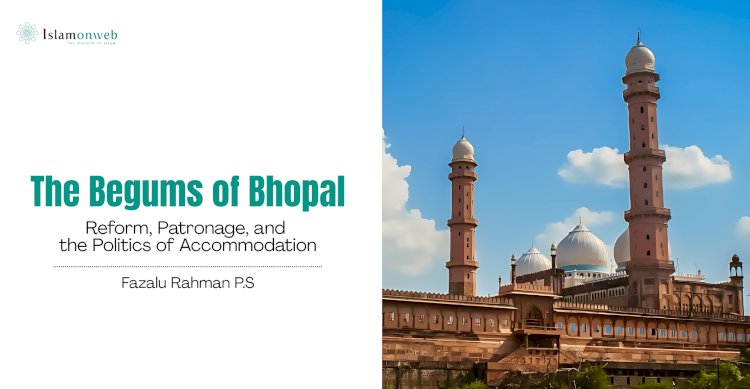
The begums built a large number of mosques. According to Louis Rousselet, “Each District has its mosque, which sometimes is merely a little paved yard, (…)” and sometimes is “(…) an imposing edifice of grand proportions surmounted by elegant minarets.”[5] Among them, three great masjids, the Jāmiʿ Masjid, Moti Masjid, and Tāj al-Masjid, illustrate their religious patronage. Qudsiyya Begum built the Jāmiʿ Masjid in 1833; Shāhjahān Begum’s Tāj al-Iqbāl Tārīkh Bhopal mentions this masjid as the finest one.[6] She was also a patron of religious activities; it is said that she spent 20 thousand rupees on religious endowments.[7] The Moti Masjid was built by Sikandar Begum to the south west of the Jāmiʿ Masjid and was modelled on Delhi’s Jāmiʿ Masjid.[8] The Tāj al-Masjid, built by Shāhjahān Begum, also made provision for women worshippers using the “Zanana gallery.”[9] Shāhjahān Begum built three palaces in Mughal style for her personal use, which include ʿAlī Manzil, Benaẓīr Palace, and the Tāj Maḥal Palace. Similarly, Jahān Begum built the Sardār Manzil, a palace.[10] These contributions show the importance of architecture in the Begums’ religious patronage and royal life.
Statecraft and Learning: Administrative and Educational Reforms Under the Begums
Qudsiyya Begum initiated the construction of the Bhopal waterworks, including the establishment of pipelines. She allocated 6 lakh rupees to erect a pumping station.[11] Sikandar Begum also introduced several administrative reforms. She sought to strengthen Bhopal’s centralised administration. She paid off a total debt of 23 lakhs,[12] and administered the state by dividing it into three districts and twenty-four taḥṣīls. The eastern district had its headquarters at Raisen, and the western district’s headquarters was at Doraha. Every district was supervised by nāẓims, who were responsible for overseeing the administration of criminal justice. The police force was reformed, made up of thanadars who supervised the force; the army was reformed by dividing the infantry into wilāyatīs, constituted of soldiers of Afghan origin, and another constituted of Hindustanis.[13] She reformed the educational sector by introducing new Urdu and Hindi schools in each pargana, and the madrasa system of Bhopal was renewed by the establishment of a new madrasa called Madrasa-i-Sulaymāniyya, where maths, Urdu, Persian, Arabic, and English were taught. The madrasa also held half-yearly examinations. She also built a new school named Victoria School for orphans.[14] According to the cited account, the literacy rate increased from about 12 percent to 15 percent during this period.[15] The begum herself was also a writer, who wrote the Safar-nāma-i-Ḥijāz as a travelogue of her pilgrimage to Mecca.[16] The educational reforms and religious activities, including the invitation of several personalities to Bhopal such as Zayn al-ʿĀbidīn ibn Muḥsin al-Ḥudaydī from Yemen, who worked as a Qāḍī, contributed to Bhopal’s development in education, welfare, and religious life at a time when many Muslim communities were facing difficulties following the uprising of 1857.[17]
The later begums also followed the same pattern of development in education and other fields. Shāhjahān Begum also contributed to these reforms. Beginning with the judiciary reforms she introduced, she established a new ministry named “Tanẓīmāt-i-Shāhjahāngīrī,” and she also made a state penal code named the “Tanbīhāt-i-Shāhjahāngīrī.”[18] The educational reforms included the affiliation of the Madrasa-i-Sulaymāniyya to the University of Calcutta in 1892.[19] She also compiled two dictionaries named “Khizānat al-Lughat” (Treasure of Language) and “Lughat-i-Shāhjahāngīrī.”[20] She was also deeply influenced by the Ahl-i-Ḥadīth movement because of her second husband, Ṣiddīq Ḥasan Khān; members of this movement also gained positions in the Bhopal court. For example, Saʿd ibn Ḥamd ibn ʿAtīq came to Bhopal from Najd because his father was a supporter of the Ahl-i-Ḥadīth.[21] During Shāhjahān Begum’s tenure, there were also disputes concerning her second marriage.[22] A major development during Shāhjahān Begum’s reign was the Bhopal State Railway, completed in 1885.[23] Jahān Begum followed these reforms by establishing the Ḥamīdiyya Library, and she was the only woman chancellor of Aligarh Muslim University.[24] She also established the Āṣifiyya School and the Lady Minto Nursing School.[25] Furthermore, the begums were active in taking welfare measures for the citizens. Like other Indian rulers of their period, the Begums employed enslaved people as domestic servants. Their position and treatment within the princely establishment are examined in the cited study by Eugenia Vanina.[26]
Bhopal and the British: The Uprising of 1857 and the Begum’s Intervention
Bhopal’s political relationship with the British was consolidated through the Treaty of Raisen in 1818. In 1857, when the First War of Independence was ongoing, Sikandar Begum supported the British, although some mawlawīs and Qudsiyya Begum opposed this position. Her interventions helped the state maintain its administration during the unrest.[27] She tried to secure the regular payment of her soldiers and treated them with consideration, and she also checked the circulation of seditious writings. There were also some rebels in Bhopal, Fāḍil Muḥammad Khān and ʿĀdil Muḥammad Khān, who planned to plunder Sehore and to seize at least four guns of the officers. Fearing a revolt, the political agent, Major Richards, left Sehore accompanied by twenty Europeans, and Sikandar Begum provided an escort for the group to Hoshangabad.[28] This incident illustrates Sikandar Begum’s cooperation with the British, who formally recognised her as ruler in 1860.[29]
The post-1857 uprising had a catastrophic effect on Muslims, resulting in the seizure of great masjids such as the Delhi Jāmiʿ Masjid, among others. British authorities held many Muslims responsible for the uprising, although participation and political loyalties differed across communities.[30] British reprisals included the seizure and closure of mosques and contributed to the difficulties faced by sections of the Muslim community in education and public life.
During this uprising, Sikandar Begum was the ruler of Bhopal. Even though she did not take part in the revolt, the begum intervened in the case of the masjid seizure issue. It is also reported that Nawwāb Sikandar Begum was the one who requested the British to reopen Delhi’s Jāmiʿ Masjid. Sultan Jahan Begum’s Gohur-i-Ikbal reproduces an account attributed to an 1862 communication from Captain Hutchinson, the political agent of Bhopal, stating that “it was at the request of Nawab Sikandar Begam that it was once more opened to the public. (…) on its being reopened the Begam was the first person to enter and perform her prayers.” [31]Even though they intervened in the case of the Jāmiʿ Masjid, some other masjids were still destroyed and neglected. The reprisals following the uprising had serious consequences for sections of the Muslim community, including their religious institutions and opportunities for education and advancement.
Conclusion
The developments discussed above indicate that the Bhopal begums were aware of the needs of the population as well as the religious needs of the Muslim community. As discussed earlier, their cooperation with the British brought political advantages. Despite their support for the British, they also intervened on issues affecting Muslims, as in the case of Delhi’s Jāmiʿ Masjid. The Begums introduced reforms and institutions while cooperating with the British, although the political implications of this cooperation, particularly during 1857, remain open to debate. Although Bhopal was a princely state under British paramountcy, its development under these women rulers remains significant. Bhopal later became the capital of Madhya Pradesh.
About the Author:
Fazalu Rahman P.S. is a B.A. Political Science student at Indira Gandhi National Open University (IGNOU). Originally from Vaduthala in Alappuzha district, Kerala, he is an active researcher and writer with a specialised focus on the history of South India and the Deccan region. His primary research interests encompass Islamic history, cultural interactions, and regional heritage. Through his academic pursuits, Fazalu aims to deepen the understanding of historical narratives and highlight their enduring relevance to contemporary society.
Bibliography
Preckel, Claudia. Begums of Bhopal. New Delhi: Lotus Collection, Roli Books, 2000.
Sharma, Jyoti Pandey. “Sacralizing the City: The Begums of Bhopal and Their Mosques.” Creative Space 1, no. 2 (January 2014): 145–65.
Sultan Jahan Begum. Gohur-i-Ikbal (An Account of My Life). Translated by C. H. Payne. London: John Murray, 1912.
Vanina, Eugenia. “Servitude in a Princely Establishment: Bhopal, Nineteenth to Early Twentieth Century.” Studies in People’s History 11, no. 1 (2024): 68–82.
Reference:
[1] Claudia Preckel, Begums of Bhopal (New Delhi: Lotus Collection, Roli Books, 2000), 11.
[2] Preckel, Begums of Bhopal ,14.
[3] Jyoti Pandey Sharma, “Sacralizing the City: The Begums of Bhopal and Their Mosques,” Creative Space 1, no. 2 (January 2014): 147.
[4] Claudia Preckel, Begums of Bhopal (New Delhi: Lotus Collection, Roli Books, 2000), 215.
[5] Sharma, “Sacralizing the City,” 154.
[6]Sharma, “Sacralizing the City,” 156–57.
[7] Preckel, Begums of Bhopal, 37.
[8] Sharma, “Sacralizing the City,” 157.
[9] Sharma, “Sacralizing the City,” 160.
[10] Preckel, Begums of Bhopal, 120.
[11] Preckel, Begums of Bhopal, 37.
[12] Preckel, Begums of Bhopal, 49.
[13] Preckel, Begums of Bhopal, 50.
[14] Preckel, Begums of Bhopal, 67.
[15] Preckel, Begums of Bhopal, 68.
[16] Sharma, “Sacralizing the City,” 154.
[17] Preckel, Begums of Bhopal, 70.
[18] Preckel, Begums of Bhopal, 116 (where the code’s name is spelled “Tambihat-i-Shahjahangiri”).
[19] Preckel, Begums of Bhopal, 118.
[20] Preckel, Begums of Bhopal, 121.
[21] Preckel, Begums of Bhopal, 125.
[22] Preckel, Begums of Bhopal, 115.
[23] Preckel, Begums of Bhopal, 148.
[24] Preckel, Begums of Bhopal, 185.
[25] Preckel, Begums of Bhopal, 198.
[26] Eugenia Vanina, “Servitude in a Princely Establishment: Bhopal, Nineteenth to Early Twentieth Century,” Studies in People’s History 11, no. 1 (2024): 82.
[27] Sharma, “Sacralizing the City,” 147.
[28] Preckel, Begums of Bhopal, 57.
[29] Preckel, Begums of Bhopal, 62.
[30] Sharma, “Sacralizing the City,” 152–53.
[31] Sultan Jahan Begum, Gohur-i-Ikbal (An Account of My Life), trans. C. H. Payne (London: John Murray, 1912), 11.
AI Usage Declaration
I used an artificial intelligence–based tool only for language refinement, grammar correction, and structural assistance in reorganising paragraphs under thematic headings. The research, historical arguments, and interpretations in this article are my own, and no AI tool was used to generate arguments, religious interpretations, quotations, or references. I take full responsibility for the accuracy, originality, and integrity of this manuscript, including its sources and citations.
Disclaimer
The views expressed in this article are the author’s own and do not necessarily mirror Islamonweb’s editorial stance.
1 Comments
-

It's a nicely framed article that is quite refreshing in terms of its originality and thoroughness. The researcher beautifully organised each single piece of information in its right place and the most striking part of the article is that it's truly a jargon-free that kept me fully glued and it'll do the same to readers altogether.

Related Posts
















Leave A Comment