
Sporting Culture in Islamic Civilization – Part 2: Spectators, Rivalries, and Ball Games
[This article is the second part of the series, Sporting Culture in Islamic Civilization. Read the first part here:Sporting Culture in Islamic Civilization - Part 1 ]
Spectatorship and Team Loyalty
Encouragement from spectators and the role of an audience in shaping the spirit of competition were present from the earliest period of Islam. The first example to mention here is the Prophet’s ﷺ encouragement of one team against another in archery. In the earlier ḥadīth of Salamah ibn al-Akwaʿ, the Prophet ﷺ said: “Shoot, and I am with the sons of so-and-so.” One of the two teams then held back their hands and stopped shooting. The Messenger of Allah ﷺ asked: “What is the matter with you that you do not shoot?” They replied: “How can we shoot while you are with them?” The Prophet ﷺ then said: “Shoot, for I am with all of you.”
Here, we see that the Prophet’s ﷺ encouragement of a particular team—despite his noble rank and his fatherly care for all—caused the opposing team to stop playing. At that moment, he ﷺ committed himself to neutrality out of concern for the feelings of the other side.
If the two teams in the match attended by the Prophet ﷺ were formed on the basis of lineage, Islamic history later witnessed the emergence of sporting teams whose rivalry was based on affiliation to cities and regions. This came after the expansion of Muslim lands and the establishment of major urban centres, and it resembles the same principle upon which many modern sporting bodies organise competition today.
One example is mentioned by al-Ṣafadī (d. 764 AH/1363 CE) in Aʿyān al-ʿAṣr, in his account of the rivalry between the two amīrs, Nāṣir al-Dīn ibn al-Jawkandār (d. after 715 AH/1315 CE) and ʿAlāʾ al-Dīn Qaṭlījā (d. 720 AH/1320 CE). Al-Ṣafadī says: “We used to watch them, and people would say: Nāṣir al-Dīn is the master ball-player of Egypt, and Amīr ʿAlāʾ al-Dīn is the master ball-player of Damascus. Amīr Nāṣir al-Dīn was more agile on horseback and quicker in movement, while Amīr ʿAlāʾ al-Dīn Qaṭlījā, when he took the ball with his mallet, needed only a single strike to send it to its limit”—that is, to score the goal.
This was despite the fact that ʿAlāʾ al-Dīn himself was known for extraordinary athletic agility. It was said of him that “he would drive the horse forward, take half a quince from its branch, and leave the other half in its place, all while the horse was running at full speed, something impossible for anyone else.”
Perhaps the strangest form of sporting support recorded in history is support based on sectarian affiliation. One revealing example is recounted by the judge al-Muḥassin al-Tanūkhī, who reports that the Buyid ruler of Iraq, Muʿizz al-Dawlah (d. 356 AH/967 CE), paid close attention to several sports, including running, wrestling, and swimming. He spent money on them, organised teams, and spread them among the people. Running, however, received the greatest share of his attention and patronage, because “he needed runners to make them couriers between himself and his brother Rukn al-Dawlah (d. 366 AH/997 CE) in al-Rayy”, modern-day Tehran, “so that they could cover that long distance in a short time. He offered generous rewards for excellence in running, and the young men of Baghdad became eager for it.”
One result of this officially supported and publicly popular racing culture was that people “became deeply absorbed in it and handed their children over to it.” Two runners then emerged for Muʿizz al-Dawlah: one known as Marʿūsh and the other as Faḍl. Each of them could run “more than thirty farsakhs”, approximately 200 kilometres, “in a single day, from sunrise to sunset.” Muʿizz al-Dawlah “appointed people at every farsakh along the road to urge them on, and they became the leaders of the runners in Baghdad. Other runners affiliated themselves with them, and people became partisan in their support for them,” according to al-Tanūkhī.
Abū Ḥayyān al-Tawḥīdī (d. after 400 AH/1010 CE) tells us how deeply people became occupied with supporting these two runners. In al-Imtāʿ wa al-Muʾānasah, he says: “Look at Faḍl and Marʿūsh, how people became obsessed with them and partisan in supporting them, until everyone in Baghdad became either Marʿūshī or Faḍlī.” The matter reached such a point that when the chief judge entered one of the districts of Baghdad, “some of these jesters held onto the bridle of his mule and said: O judge, tell us: are you Marʿūshī or Faḍlī?”
Ibn al-Athīr gives the picture an even clearer dimension by pointing out that this sporting partisanship concealed a sectarian tendency. He says that of the two runners, “one was the runner of the Sunnis, Faḍl and the other was the runner of the Shīʿah, Marʿūsh.”
Love, Rivalry, and Sporting Factionalism
If competitors were stirred by the presence of a crowd, the encouragement of women could carry an even greater emotional force—especially when the woman watching was a beloved whose admiration mattered as much as victory itself. Imām Ibn Qutaybah al-Dīnawarī (d. 276 AH/892 CE), in al-Shiʿr wa al-Shuʿarāʾ, records a telling story involving two celebrated love poets: Tawbah ibn al-Ḥumayyir (d. 85 AH/705 CE) and Jamīl ibn Maʿmar (d. 83 AH/703 CE).
Ibn Qutaybah says: “Tawbah had travelled to al-Shām and passed by Banū ʿUdhrah. Buthaynah saw him and began looking at him, which upset Jamīl, though his love for her had not yet become known. Jamīl said to him: ‘Who are you?’ He replied: ‘I am Tawbah ibn al-Ḥumayyir.’ Jamīl said: ‘Would you like to wrestle?’ He said: ‘That is up to you.’ Buthaynah then threw him a cloak dyed with wars, and he wrapped it around his waist. Jamīl wrestled him and threw him down. Then he said to him: ‘Would you like to compete in archery?’ He replied: ‘Yes.’ So Jamīl competed with him in archery and defeated him. Then he said: ‘Would you like to race?’ He replied: ‘Yes.’ So Jamīl raced him and beat him. Tawbah then said to him: ‘You are only doing this through the spirit of encouragement coming from this woman sitting here! But come down with us to the valley.’ So they both descended to the valley, and Tawbah threw him down, outran him, and defeated him in archery.”
Thus, Jamīl won when he competed on his own ground and before his audience, represented by his beloved Buthaynah. But when he lost both ground and audience, he was defeated.
Wherever public alignment begins in support of players, it can eventually turn into sporting fanaticism and obsessive partisanship. For this reason, al-Jabartī (d. 1237 AH/1825 CE), in his history ʿAjāʾib al-Āthār, explains the origin of the division of Egyptian soldiers at the beginning of the Ottoman period into the Faqāriyyah and the Qāsimiyyah. He states that the Ottoman Sultan Selim I (d. 926 AH/1520 CE) ordered the soldiers “to divide all of themselves into two groups: one group whose leader would be [Amīr] Dhū al-Faqār (d. after 922 AH/1517 CE), and the second whose leader would be his brother [Amīr] Qāsim al-Karrār (d. after 922 AH/1517 CE). He assigned most of the Ottoman horsemen to Dhū al-Faqār and most of the brave Egyptians to Qāsim. He distinguished the Faqāriyyah by wearing white garments, and ordered the Qāsimiyyah to distinguish themselves by red in their clothing and riding gear.”
Al-Jabartī then describes the heated atmosphere of the contests between the two teams. He says that the Sultan “ordered them to ride in the arena in the form of warriors and in the appearance of opponents and adversaries. They submitted to the command, mounted their steeds, moved with their horses, and rushed down like a flood, racing one another and charging in succession. They took turns in combat and advanced like mountains. They rode through the pathways, stirred up dust, played with spears, and faced one another with broad swords. Voices rose, shouts multiplied, and killing and fighting nearly broke out. At that point, a call was made among them to separate.”
One result of this intense form of play was that the land of Egypt witnessed something like an “Ahly” and “Zamalek” rivalry nearly five centuries before their modern time. Their fan bases, colours, and forms of sporting partisanship seem to have gone even beyond what we see today. Al-Jabartī tells us: “From that day, the amīrs and soldiers of Egypt split into two factions and divided through this game into two parties. Each of them continued to love the colour in which he had appeared and to dislike the other colour in everything they used—even the vessels from which they ate and drank. The matter continued to spread, increase, and be inherited by masters and servants until it took shape, grew, and blood was shed over it. How many lands were ruined, noble men killed, houses demolished, and palaces burned because of it. This state of affairs continued until the beginning of the twelfth century.”
The Rise of Ball Games in Islamic Civilization
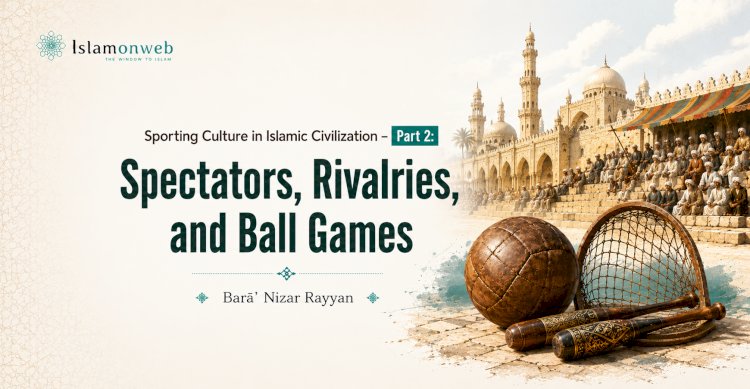
The ball games were among the most famous games in Islamic history, and perhaps the one that received the greatest attention from both elites and ordinary people—much as it does in people’s lives today. It was played on horseback, and the mallet used to strike the ball was called the ṣawlijān, also known as the jawkān. Abū Manṣūr al-Azharī (d. 370 AH/981 CE), in his lexicon Tahdhīb al-Lughah, defines this instrument by saying: “The ṣawlijān is a stick whose end is bent, with which the ball is struck from upon riding animals. As for a stick whose end is naturally curved in the tree, that is a miḥjan.” He adds that ṣawlijān is an Arabised word from Persian.
The scholar Ibn al-Amshāṭī (d. 902 AH/1497 CE), in his commentary on Ibn al-Nafīs’s (d. 687 AH/1288 CE) al-Mūjaz fī al-Ṭibb—as quoted by Aḥmad Taymūr Pasha (d. 1348 AH/1930 CE) in Laʿib al-ʿArab—provides an important clarification: the word ṣawlijān later came to refer not only to the mallet itself, but to the ball game as a whole. Describing it, he says: “Among us, ṣawlijān refers to playing with the ball played by horsemen. It is a large ball placed on the ground. The rider comes toward it on horseback and strikes it with a rod that has at its end a piece of wood about a span long. When he strikes it, the horsemen rush toward it, each seeking to hit it. Whoever reaches it first and strikes it with the rod in his hand is the winner.”
As for the ball itself, Ibn al-Amshāṭī says that common people called it al-ṭāb. To this day, people in al-Shām still call a ball ṭābah. From Ibn al-Amshāṭī’s explanation, it is clear that this game was an early form of what is known today as polo. It also appears that the game was recommended in earlier medical writings. Ibn Abī Uṣaybiʿah (d. 668 AH/1269 CE), in ʿUyūn al-Anbāʾ fī Akhbār al-Aṭibbāʾ, mentions that Galen (d. 216 CE) wrote a book titled Kitāb al-Riyāḍah bi al-Kurah al-Ṣaghīrah—The Book of Exercise with the Small Ball. Ibn Abī Uṣaybiʿah says: “This book is a single short treatise in which Galen praises exercise with the small ball and playing with the ṣawlijān, and gives it preference over all other forms of exercise.”
As for Ibn al-Nafīs, Aḥmad Taymūr Pasha attributes to him the following statement in al-Mūjaz fī al-Ṭibb: “Playing with the ṣawlijān is an exercise for both the mind and the body, because of the joy that comes with victory and the anger that comes with defeat.” According to historians, the Arabs adopted this game from the Persians, as several historians mention it was played before the Persian king Ardashīr ibn Bābak (d. 242 CE).
The ball was also a favourite game among caliphs, kings, and princes. Sibṭ Ibn al-ʿAjamī (d. 884 AH/1479 CE), in Kunūz al-Dhahab, states that the first caliph to play ball was Hārūn al-Rashīd (d. 193 AH/809 CE). His son, Muḥammad al-Amīn (d. 198 AH/814 CE), inherited this love of the game from him, to the point that it became one of his earliest concerns after assuming power. Imām al-Suyūṭī (d. 911 AH/1506 CE), in Tārīkh al-Khulafāʾ, says that al-Amīn, “on the second day after he was pledged allegiance as caliph, ordered the construction of a field beside the palace of al-Manṣūr for playing ball.”
The Game of Princes and Statesmen
Among the rulers deeply attached to this game was the founder of the Ṭūlūnid state in Egypt, Amīr Aḥmad ibn Ṭūlūn (d. 270 AH/883 CE). His passion for ball games remained alive in Egypt for many centuries after him. When the historian Ibn Taghrī Birdī (d. 874 AH/1470 CE), in al-Nujūm al-Zāhirah, records the history of this ruler, he says: “Ibn Ṭūlūn built a large palace containing his field in which he played ball, and he named the entire palace al-Maydan.”
Perhaps the most famous ruler to play the game after the early period was the martyred Sultan Nūr al-Dīn Maḥmūd Zankī (d. 569 AH/1173 CE), who was passionately fond of it and highly skilled in it. Abū Shāmah al-Maqdisī (d. 665 AH/1266 CE), the historian of his state, says in Kitāb Tārīkh al-Rawḍatayn that Nūr al-Dīn was never seen “on horseback with anyone more graceful than him, as though he had been created upon it, without moving or shaking. He was among the finest people in playing ball and one of the most capable at it. His jawkān [mallet] was never seen rising above his head. At times, he would strike the ball while the horse was running, catch it from the air with his hand, and throw it to the far end of the field. His hand would not be seen while holding the jawkān; rather, it remained inside the sleeve of his coat, as though he considered the game effortless.”
Despite this great sultan’s strong interest in ball games, they did not distract him from worship, jihād, governance, or the welfare of his subjects. Rather, he regarded them as part of his martial discipline and as training for horses in rapid advance and retreat. Al-Dhahabī mentions in Tārīkh al-Islām that he “fasted often, had regular devotional practices by night and day, and frequently played ball. One of the righteous men wrote to him criticising him, saying: ‘You exhaust the horses without benefit.’ He replied in his own handwriting: ‘By Allah, I do not intend play. We are stationed on a frontier [before the Frankish Crusaders], and a cry of alarm may suddenly be raised [because of an enemy attack]. The horses will then already be accustomed to quick turning in advance and retreat.’”
It is remarkable that Ṣalāḥ al-Dīn al-Ayyūbī’s (d. 589 AH/1193 CE) closeness to Nūr al-Dīn, at the beginning of his rise to power, was also partly due to his own skill in playing ball. Imām Ibn Kathīr tells us that Nūr al-Dīn brought Ṣalāḥ al-Dīn close to him “and made him one of his special companions, never leaving him in residence or travel, because he was handsome in appearance and skilled in playing ball.”
After all this, it may not be surprising to learn that Nūr al-Dīn’s final illness followed a heated incident connected to the game. Ibn Kathīr mentions that one day “he played ball,” and became angry with one of the amīrs—something that was not part of his usual character. He then hurried to the citadel while still extremely angry, became disturbed, entered into a state of bodily imbalance, and became occupied with his pains and illness. His senses and temperament changed, and he withdrew from people until he passed away after a short period.
Some rulers even fixed specific days for playing ball, with regular schedules. One example was the Mamluk Sultan al-Nāṣir Muḥammad ibn Qalāwūn (d. 741 AH/1340 CE), who excelled in the game. Ibn Taghrī Birdī tells us that he “built the field beneath the Citadel of the Mountain, brought water to it, planted palms and trees in it, and played ball there every Tuesday with the amīrs, the khāṣṣakiyyah [the sultan’s close retinue], and the sons of kings. Sultan al-Nāṣir mastered the game of ball to such a degree that no one in his time came close to him in it.”
This article is translated and adapted from the Arabic article “ʿĀlam al-Riyāḍah fī al-Ḥaḍārah al-Islāmiyyah” by Barāʾ Nizār Rayyān, originally published on IslamOnline. The present article covers the first part of the discussion, while the second part will follow in a subsequent publication. The original Arabic article can be accessed here -
Disclaimer
The views expressed in this article are the author’s own and do not necessarily mirror Islamonweb’s editorial stance.


Related Posts















Leave A Comment