
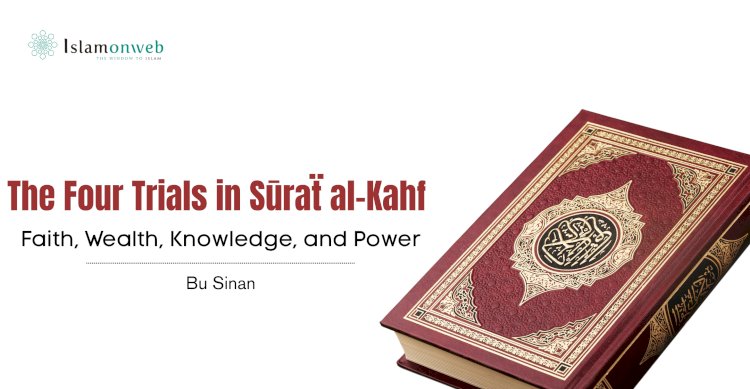
The Four Trials in Sūraẗ al-Kahf: Faith, Wealth, Knowledge, and Power
Anyone who observes the life of individuals and nations, communities and states, will notice a recurring human instinct: whenever danger intensifies, people search for shelter. In times of war, conflict, and civil unrest, nations build underground bunkers and protective shelters, almost like modern caves, to save lives from destruction. This physical search for safety reflects a deeper spiritual reality. Human beings do not only need protection from bombs, weapons, and external threats; they also need protection from the storms that strike the heart, disturb the mind, shake faith, and corrupt moral judgement.
In the Qur’anic worldview, such storms are part of what may be called fitnah. The word fitnah carries several meanings: trial, test, temptation, disturbance, and a process through which the truth of a person’s faith is exposed. Just as gold is tested by fire to separate its purity from impurity, human beings are tested through circumstances that reveal the strength, weakness, sincerity, or instability of the heart. Fitnah, therefore, is not always open persecution; it may also come through comfort, wealth, knowledge, power, desire, doubt, or the slow pressure of social life.
Our age is crowded with such trials. The human soul is exposed to confusion, anxiety, ideological pressure, material obsession, misinformation, and the intoxicating pull of status and power. What once came through kings, idols, markets, and empires may now arrive through screens, algorithms, political systems, social pressure, and the culture of endless comparison. The believer, therefore, needs a “cave” not merely made of stone, but made of guidance, light, remembrance, and certainty.
It is in this context that Sūraẗ al-Kahf holds a special place in the spiritual life of Muslims. Every Friday, Muslims are encouraged to renew their relationship with this Sūrah. The Prophet ﷺ said: “Whoever recites Sūraẗ al-Kahf on Friday, a light will shine for him between the two Fridays.” Reported by al-Ḥākim, al-Mustadrak, 2:399; and al-Bayhaqī, al-Sunan al-Kubrā, 3:249). This light, as scholars explain, may be understood as spiritual illumination: a light that guides the believer, protects the heart from sins, and grants clarity amid confusion. It may also refer to a real light granted by Allah on the Day of Resurrection.
The Sūrah begins with praise of Allah, who revealed the Book without any crookedness, and ends by directing the believer towards sincere faith and righteous action. Between this opening and conclusion, it presents a series of powerful stories: the People of the Cave, the owner of the two gardens, Mūsā and Khiḍr, and Dhū al-Qarnayn. They form a Qur’anic map of the major trials that repeatedly confront human beings in every age.
Through these four stories, Sūraẗ al-Kahf addresses four central fitan: the fitnah of religion and faith, seen in the story of the People of the Cave; the fitnah of wealth and worldly attachment, seen in the owner of the two gardens; the fitnah of knowledge and human limitation, seen in the journey of Mūsā with Khiḍr; and the fitnah of power, authority, and leadership, seen in the story of Dhū al-Qarnayn. Each story reveals a danger, but it also offers a path of salvation.
This four-fitnah framework should be understood as a thematic reading drawn from the moral arrangement of the Sūrah, especially in an age when these same trials continue to appear in new forms. The young believer still faces pressure upon faith. The wealthy still face the illusion of self-sufficiency. The learned still face the temptation of arrogance. The powerful still face the danger of forgetting that authority is an amānah.
In this sense, Sūraẗ al-Kahf is a shelter to be entered. It is a weekly cave of light, where the believer pauses, reorients the heart, and learns again how to survive the fitan of life without losing faith, humility, gratitude, or justice.
The First Fitnah: The Trial of Faith and Religion
The first major trial presented in Sūraẗ al-Kahf is the fitnah of religion: the pressure placed upon a believer’s faith, conscience, and spiritual identity. The Sūrah introduces this trial through the story of the People of the Cave, a group of young believers who lived in a society that had turned away from tawḥīd and embraced false worship, worldly dominance, and inherited forms of misguidance.
The Qur’an presents them as fityah — young men — whose hearts were awakened by faith. Allah says: “Indeed, they were youths who believed in their Lord, and We increased them in guidance” (al-Kahf 18:13). This description is significant. They were not prophets, rulers, or public scholars. They were young believers who recognised falsehood in their society and refused to surrender their faith to the pressure of the majority. Their courage was not based on numbers, wealth, or worldly strength, but on certainty in Allah.
When the pressure became severe and their religion was at risk, they chose to withdraw. It was a conscious act of preserving what was most precious. Palaces without faith, wealth without faith, social acceptance without faith, and worldly security without faith all lose their meaning. For a believer, religion is not an accessory added to life; it is the very foundation that gives life its direction, dignity, and final purpose.
Thus, the youths took refuge in the cave. Outwardly, the cave was narrow, dark, rough, and frightening. It had none of the comforts of their homes and none of the beauty of worldly life. Yet because they entered it for the sake of Allah, it became a place of mercy. Allah says: “When the youths took refuge in the cave and said, ‘Our Lord, grant us from Yourself mercy and prepare for us from our affair right guidance’” (al-Kahf 18:10). Their first concern was not food, safety, or comfort, but mercy and rushd — sound guidance.
When divine mercy descends, even a dark cave becomes wider than a palace. A prison, a place of exile, or a moment of isolation can become a garden of tranquillity if Allah opens a door of mercy within it. This meaning is beautifully expressed in the verse: “So seek refuge in the cave; your Lord will spread out for you of His mercy and prepare for you from your affair ease” (al-Kahf 18:16). The wording “will spread out for you of His mercy” is deeply comforting. It suggests that even a portion of Allah’s mercy is enough to transform hardship into protection, fear into serenity, and isolation into divine care.
The story also teaches the importance of righteous companionship. The youths were saved together. They strengthened one another, reminded one another, and stood together when the society around them was spiritually collapsing. This is one of the practical cures for the fitnah of religion. Faith is harder to protect in isolation, especially when surrounding influences pull the heart towards heedlessness. For this reason, the Sūrah later commands: “And keep yourself patiently with those who call upon their Lord morning and evening, seeking His Face. And let not your eyes pass beyond them, desiring the adornment of worldly life. And do not obey one whose heart We have made heedless of Our remembrance, who follows his desire and whose affair is ever neglected” (al-Kahf 18:28).
This verse gives a clear method of protection: patience with righteous company, regular remembrance of Allah, resistance to the glitter of worldly adornment, and distance from those whose hearts have become heedless. The fitnah of religion often begins not with open rejection of faith, but with slow companionship with heedlessness, constant exposure to desire, and the gradual weakening of the heart’s attachment to Allah.
In our own time, the trial of religion appears in many forms. In some places, Muslims face direct hostility, restriction, or pressure because of their faith. In other contexts, the trial is softer but equally dangerous: the pressure to dilute religious identity, to feel embarrassed about Islamic teachings, to follow dominant cultural trends without reflection, or to treat religion as something private with no authority over one’s choices. Sometimes the cave needed today is not physical isolation, but disciplined spiritual protection: choosing good company, guarding prayer, learning the foundations of faith, controlling what enters the heart through media, and returning regularly to the Qur’an.
The Second Fitnah: The Trial of Wealth
The second major trial presented in Sūraẗ al-Kahf is the fitnah of wealth, shown through the story of the owner of the two gardens. Allah says: “And present to them an example of two men: We granted to one of them two gardens of grapevines, and We bordered them with palm trees and placed between them crops. Each of the two gardens produced its fruit and did not fall short thereof in anything, and We caused to gush forth within them a river” (al-Kahf 18:32–33).
The scene is one of beauty and abundance: fertile gardens, flowing water, ripe fruits, and complete prosperity. Such blessings should have led to gratitude and recognition of the Giver. Wealth, when joined with faith, becomes a means of worship, charity, service, and benefit. But when wealth is separated from faith, it may become a veil over the heart.
This was the garden owner's mistake. Instead of seeing his wealth as an amānah from Allah, he turned it into a measure of superiority. He said to his companion: “I am greater than you in wealth and mightier in numbers” (al-Kahf 18:34). His words reveal the first sign of the fitnah of wealth: comparison, pride, and the belief that material possession gives one greater worth.
The trial then deepened. He entered his garden and said: “I do not think that this will perish, ever. And I do not think the Hour will occur. And even if I should be brought back to my Lord, I will surely find better than this as a return” (al-Kahf 18:35–36). Here, wealth distorted his view of both the world and the Hereafter. He imagined permanence in what was temporary and assumed that worldly prosperity was proof of lasting honour.
His believing companion corrected him by reminding him of his origin, his dependence upon Allah, and the proper attitude towards blessings. He said: “And why did you, when you entered your garden, not say, ‘What Allah willed has occurred; there is no power except in Allah’?” (al-Kahf 18:39). The phrase mā shāʾ Allāh, lā quwwata illā billāh (‘What Allah willed has occurred; there is no power except in Allah’) is not merely a statement of admiration; rather it a declaration of the worldview that blessings exist by Allah’s will, remain by His permission, and can disappear by His command. It breaks the illusion of self-sufficiency and restores the heart to humility.
But arrogance often refuses advice until loss becomes its teacher. The gardens were destroyed, and the man was left turning his hands in regret over what he had spent on them. Allah says: “And his fruits were encompassed, so he began turning his hands about in dismay over what he had spent on it, while it had collapsed upon its trellises, and said, ‘Oh, I wish I had not associated with my Lord anyone.’ And there was for him no company to aid him other than Allah, nor could he defend himself” (al-Kahf 18:42–43).
The story then widens into a general lesson about worldly life. Allah compares the world to rain that brings forth vegetation, only for it to become dry remnants scattered by the wind. Then He says: “Wealth and children are the adornment of the worldly life, but the enduring good deeds are better to your Lord for reward and better for hope” (al-Kahf 18:46). Wealth and children are not condemned; they are called adornments. The danger begins when adornment is treated as the purpose of life.
In our time, the fitnah of wealth appears through consumerism, status competition, luxury culture, and the belief that success is purely self-made. It may lead a person to neglect zakāh, ignore the poor, cross the limits of halal and haram, or look down on others. The Qur’anic cure is gratitude, lawful earning, charity, humility, and constant remembrance that wealth is a trust, not a guarantee of honour.
The Third Fitnah: The Trial of Knowledge
The third major trial presented in Sūraẗ al-Kahf is the fitnah of knowledge. Knowledge is among the greatest gifts Allah grants to human beings. It enables people to understand, build, heal, organise, and distinguish between truth and falsehood. Yet knowledge itself can become a trial when it is separated from humility, faith, and submission to Allah.
This lesson appears in the story of Prophet Mūsā and Khiḍr عليهما السلام. According to the well-known narration, Mūsā عليه السلام was once asked whether there was anyone more knowledgeable than him. He answered according to what he knew, but Allah taught him that knowledge must always be referred back to Him. He was then directed to a servant of Allah at the meeting point of the two seas.
The Qur’an describes this servant as one whom Allah had specially taught: “And they found a servant from among Our servants to whom We had given mercy from Us and had taught him from Us a knowledge” (al-Kahf 18:65). When Mūsā عليه السلام met him, he did not approach with pride, although he was a great prophet and among the messengers of firm resolve. Rather, he said with the humility of a sincere seeker: “May I follow you on the condition that you teach me from what you have been taught of sound judgement?” (al-Kahf 18:66).
This moment is central to the Qur’anic treatment of knowledge. Mūsā عليه السلام teaches that the true seeker of knowledge is not ashamed to learn from another when Allah has given that person a form of knowledge he does not possess. The higher a person rises in knowledge, the more he should recognise the vastness of what he does not know.
Khiḍr عليه السلام warned him: “Indeed, with me you will never be able to have patience. And how can you have patience over what you do not encompass in knowledge?” (al-Kahf 18:67–68). This warning reveals one of the deepest causes of confusion in human life: people often judge events before they understand their hidden wisdom. The eye sees the surface, while Allah knows the complete reality.
The journey then unfolds through three incidents: the damaged ship, the killing of the boy, and the repair of the wall. At first, each action appears strange, even troubling. Mūsā عليه السلام questions them because, from the outward view, they seem difficult to understand. Later, Khiḍr عليه السلام explains that the ship belonged to poor people and was damaged to save it from a tyrant king; the boy would have burdened his believing parents with rebellion and disbelief; and the wall concealed a treasure belonging to two orphans whose father had been righteous. He concludes by saying: “And I did not do it of my own accord. That is the interpretation of that over which you could not have patience” (al-Kahf 18:82).
The story teaches humility before Allah’s wisdom and caution before judging matters whose full reality is hidden from us.
This is especially relevant in an age where human knowledge has expanded rapidly. Scientific and technological achievements have opened remarkable possibilities, but they have also led some people to imagine that human reason alone is sufficient, that the material world is the only reality, and that the unseen can be dismissed as beyond measurement. In such a mindset, knowledge ceases to be a path to gratitude and becomes a path to arrogance.
The same trial can also affect religious knowledge. A person may study sacred sciences but fail to purify the heart. Knowledge may then become a means of argument, reputation, rivalry, or worldly gain. Instead of increasing humility, it may increase self-admiration. Instead of leading to worship, it may become a tool for twisting meanings, following desires, or looking down upon others.
Sūraẗ al-Kahf offers the cure through the manners of Mūsā and Khiḍr عليهما السلام. Mūsā teaches humility in seeking knowledge, patience in learning, and willingness to travel for truth. Khiḍr teaches that true knowledge is from Allah and must be attributed to Him, not to the ego. His final words — “I did not do it of my own accord” — return knowledge to its source.
The Fourth Fitnah: The Trial of Power and Authority
The fourth major trial presented in Sūraẗ al-Kahf is the fitnah of power. Few trials expose the human soul as clearly as authority. Wealth may make a person proud, knowledge may make him arrogant, but power may give him the means to oppress others. For this reason, the Qur’an presents the story of Dhū al-Qarnayn as a model of strength guided by faith, justice, and humility.
Dhū al-Qarnayn was a righteous servant whom Allah granted authority and means. The Qur’an says: “Indeed, We established him upon the earth, and We gave him to everything a way” (al-Kahf 18:84). When he reached a people over whom he had authority, he did not act according to desire, revenge, or personal pride. His rule was based on moral distinction between wrongdoing and righteousness. Allah says: “We said, ‘O Dhū al-Qarnayn, either you punish them or else adopt among them a way of goodness.’ He said, ‘As for one who wrongs, we will punish him; then he will be returned to his Lord, and He will punish him with a terrible punishment. But as for one who believes and does righteousness, he will have the best reward, and we will speak to him from our command with ease” (al-Kahf 18:86–88).
This is the first mark of righteous authority: justice. Dhū al-Qarnayn neither used power blindly nor showed weakness before wrongdoing. He punished oppression, honoured righteousness, and remembered that final judgement belongs to Allah. His authority was therefore not detached from the Hereafter. He ruled with the awareness that every ruler is also ruled by Allah's command.
The second major scene shows his concern for the vulnerable. When he reached a people threatened by the corruption of Yaʾjūj and Maʾjūj, they asked him to build a barrier in exchange for payment. Dhū al-Qarnayn did not exploit their fear or turn their weakness into a business opportunity. Instead, he said: “That in which my Lord has established me is better, so assist me with strength; I will make between you and them a barrier” (al-Kahf 18:95).
This response reveals a powerful model of leadership. True leadership does not merely rescue people; it mobilises them, organises their abilities, and turns scattered fear into collective action.
The construction of the barrier also shows the proper use of material resources and technical skill. He used iron and molten copper, combining planning, labour, and available means to protect people from harm. The Qur’an says: “Bring me sheets of iron” until, when he had levelled them between the two mountain walls, he said, “Blow,” until, when he had made it fire, he said, “Bring me molten copper to pour over it” (al-Kahf 18:96).
When the work was completed, Dhū al-Qarnayn did not glorify himself, advertise his achievement, or claim historical greatness. He said: “This is a mercy from my Lord. But when the promise of my Lord comes, He will make it level, and the promise of my Lord is ever true” (al-Kahf 18:98). In a single sentence, he returns the achievement to Allah, describes it as mercy, and remembers that even the strongest human structure will one day fall by Allah’s command.
This is the Qur’anic cure for the fitnah of power: justice, service, humility, and accountability. Power becomes dangerous when it is used for domination, self-glorification, or exploitation. It becomes righteous when it protects the weak, restrains corruption, establishes justice, and remains conscious of Allah.
In the modern world, power appears in many forms, including political authority, institutional leadership, wealth-backed influence, religious position, media reach, and even control within families and communities. Each form of power raises the same question: is it being used to serve truth or the ego? The story of Dhū al-Qarnayn teaches that authority is not a throne for self-display, but an amānah to be discharged before Allah.
Thus, Sūraẗ al-Kahf closes its cycle of fitan with a vision of power purified by faith. Dhū al-Qarnayn had strength, but he was not intoxicated by it. He had resources, but he did not worship them. He had achievements, but he attributed them to Allah.
Finally
These four trials continue to appear in every age. Faith is tested by pressure and doubt, wealth by pride and heedlessness, knowledge by arrogance, and power by injustice. The Sūrah does not only expose these dangers; it also shows their cure: steadfastness in faith, gratitude in wealth, humility in knowledge, and justice in authority.
The greatness of this Sūrah becomes even clearer through its connection to protection from the gravest fitnah to face humanity: the fitnah of al-Dajjāl. The Prophet ﷺ said: “Whoever memorises ten verses from the beginning of Sūraẗ al-Kahf will be protected from al-Dajjāl.” (Reported by Muslim) In another narration, the protection is linked to the last ten verses of the Sūrah.
The fitnah of al-Dajjāl gathers all these four forms of deception: deception in religion, temptation through worldly gain, confusion through extraordinary knowledge and skills, and domination through power and fear. A believer who has internalised the lessons of Sūraẗ al-Kahf is trained not to be dazzled by appearances, not to measure truth by material success, not to surrender judgement before confusing events, and not to submit the heart to false authority.
Therefore, our relationship with this Sūrah should go beyond weekly recitation. It calls for reflection, memorisation, and practical transformation. In an age where fitan come in many attractive forms, Sūraẗ al-Kahf remains a cave of light: protecting faith, guiding the heart, and reminding the believer that true safety lies in the guidance of Allah.
Disclaimer
The views expressed in this article are the author’s own and do not necessarily mirror Islamonweb’s editorial stance.
Related Posts











Leave A Comment