
Zuhd: Relocating the Heart’s Centre of Gravity
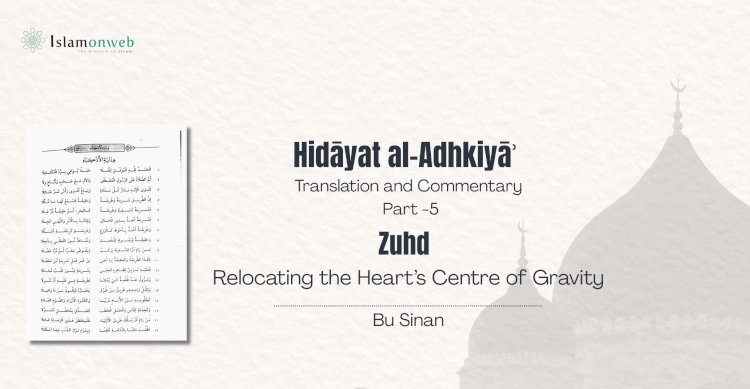
[This article is fifth part of a series presenting an English translation and brief explanation of Hidāyat al-Adhkiyāʾ ilā Ṭarīq al-Awliyāʾ by Shaykh Zayn al-Dīn ibn ʿAlī al-Malībārī]
٢٣. واقنع بترك المُشتهى والمفاخرِ من مطعمٍ وملابسٍ ومنازِلَا
٢٤. مَن يطلبنْ ما ليس يعنيهِ فقدْ فاتَ الذي يعنيهِ من غير ائتلا
٢٥. وازهدْ وذا فقد تعلَّق قلبُك بالمال لا فقد له ذاك اعتقلا
٢٦. والزهدُ أحسنُ منصب بعدَ التقى وبه يُنالُ مقامُ أربابِ العُلا
٢٧. ومحبُّ دنيا قائلٌ أين الطريقُ أين الخلاصُ كمُسكرٍ شربَ الطِّلا
- Be content to leave what passions crave, what pride displays
In feasts, in robes, in palaces held high. - Who chases what concerns him not will lose
What truly was his own, without excuse. - Practice detachment; bondage lies not in wealth possessed,
But when the heart by wealth is bound and pressed. - For zuhd is the noblest rank after taqwā’s light—
Through it the heights of honour come in sight. - The lover of this world cries, “Where’s the way?
Where is escape?” like one in drunken sway.
Meaning
In this part, the poet then urges zuhd, clarifying that detachment is not the mere absence of wealth, but the absence of attachment to it; a heart chained to money remains imprisoned even in poverty, while a heart free from it remains liberated even in abundance. Such ascetic detachment is the noblest station after taqwā, and through it one rises to the rank of those who occupy lofty spiritual stations. In contrast, the lover of this world resembles a drunken man, staggering and repeatedly asking, “Where is the path? Where is salvation?” while his intoxication itself prevents him from seeing clearly.
Zuhd: The Migration of the Heart
Zuhd is often translated as asceticism, meaning detachment from worldly abundance. It is not the abandonment of the world, but the release of the heart from its captivity. Zuhd means that the dunya remains in the hand, not in the heart; that a person uses what Allah has granted without allowing it to define his worth, disturb his peace, or distract him from his Lord. It is a conscious preference for what endures over what fades, a deliberate migration of the heart from attachment to the temporary toward longing for the eternal. It is the relocation of the heart’s centre of gravity — from the transient to the eternal. Thus, the true zāhid is not the one who owns little, but the one whom little owns.
The scholars described the true zāhid as the most intelligent of people, because he prefers what remains over what perishes. The world fades; the Hereafter endures. Thus, real intelligence lies in investing in what outlives the investor. As it was said, the ascetic is not foolishly abandoning life; he is wisely choosing permanence over illusion.
The early masters were clear: zuhd is not the absence of wealth. It is the absence of attachment. One who lacks wealth but longs for it obsessively is not a zāhid. Likewise, one who possesses wealth yet treats it as a servant, not a master, may indeed be among the ascetics.
Imām al-Ghazālī defined zuhd as the heart’s turning away from the world despite having the ability to attain it, choosing the Hereafter consciously. Merely abandoning what one cannot obtain is not zuhd. True zuhd is renunciation in the presence of capacity.
If a person lacks access to comfort, luxury, or provision, his condition may reflect hardship not necessarily asceticism. There is no spiritual merit in lacking what one cannot obtain; the merit lies in restraining oneself despite capacity.
This distinction was beautifully illustrated when Mālik ibn Dīnār was asked whether he was a zāhid. He replied, humbly dismissing the label, and said that the true ascetic was ʿUmar ibn ʿAbd al-ʿAzīz, to whom the world came willingly, yet he turned away from it. The point is clear: zuhd is not defined by poverty, but by refusal.
Similarly, Bishr al-Ḥāfī (d. 227 AH) described the people of virtue:
“They did not eat for indulgence, nor dress for luxury. This is the path of the people of the Hereafter, the prophets, the righteous, and those after them.”
A person is not rewarded simply for abandoning what Allah has permitted unless that abandonment frees him for something greater. The early master Abū Sulaymān al-Dārānī (d. 215 AH) said:
“The ascetic is not the one who casts off the burden of the world and rests; that is merely comfort. The ascetic is the one who casts off his burden and strives for his Hereafter.”
The Three Degrees of Zuhd
The scholars of the early generations did not treat zuhd as a single, flat concept; they understood it as a ladder of spiritual refinement. Among the clearest articulations of its stages is the statement of Imām Aḥmad ibn Ḥanbal رحمه الله, who divided zuhd into three levels:
- Abandoning the unlawful (ḥarām) — this is the asceticism of the general believers (zuhd al-ʿawām).
At this level, the servant restrains himself from what Allah has prohibited. Though this may seem basic, it is the indispensable foundation. No claim to asceticism has meaning while one remains entangled in sin. This level reflects obedience and fear of accountability. - Abandoning excess of the lawful (fuḍūl al-ḥalāl) — this is the asceticism of the elect (zuhd al-khawāṣ).
Here, the servant moves beyond mere legality and begins to consider spiritual impact. He avoids unnecessary indulgence, even in permissible matters, when they burden the heart or distract from remembrance. The concern shifts from “Is this allowed?” to “Is this beneficial for my Hereafter?” - Abandoning whatever distracts from Allah — this is the asceticism of the knowers (zuhd al-ʿārifīn).
At this highest degree, the criterion is no longer legal category but spiritual effect. Anything — even lawful comfort, praise, status, or attachment — that veils the heart from Allah is relinquished. The heart becomes so oriented toward Divine proximity that distractions lose their appeal.
This concise framework from Imām Aḥmad gathers the dispersed insights of earlier masters into one comprehensive structure. Its base is obedience; its summit is presence. The journey begins with lawful restraint and culminates in inward absorption.
The early sages also spoke of three intensities:
- The one who restrains himself while still desiring the world.
- The one who leaves it willingly for something greater.
- The one who sees it as insignificant altogether — like someone discarding a pebble to gain a jewel.
The highest form is not merely leaving the world, but seeing it for what it truly is: temporary shade on a passing road.
Ibrāhīm ibn Adham (d. 162 AH), one of the renowned ascetics of the Tābiʿīn, divided zuhd into three categories: zuhd al-farḍ (obligatory asceticism), zuhd al-faḍl (virtuous asceticism), and zuhd al-salāmah (protective asceticism). Obligatory zuhd is abstaining from what is unlawful — this is binding upon every believer, for leaving the prohibited is not optional but required. Virtuous zuhd consists of refraining from excess of what is lawful — it is commendable but not obligatory, since abandoning permissible matters cannot be imposed as a duty. Shaykh al-Islām Ibn Taymiyyah beautifully summarised this level by defining legislated zuhd as “leaving what does not benefit in the Hereafter,” meaning abandoning surplus permissible matters that do not assist one in obedience. As for protective zuhd, it is the avoidance of doubtful matters (shubuhāt), and its ruling fluctuates between obligation and recommendation: whatever leads to the unlawful must be abandoned, while what does not directly entail sin is better left out of scrupulous caution (waraʿ).
Zuhd and Divine Connection
The Prophet ﷺ summarised the secret of zuhd in a concise statement:
“Be detached from the world, and Allah will love you; be detached from what is in people’s hands, and people will love you.” (Ibn Mājah)
Here, zuhd becomes the gateway to two loves: Divine love and human respect. When a person does not compete with people for their possessions, he frees himself from rivalry and earns their affection. And when he does not compete with the world for its dominance, he earns nearness to Allah.
Abū al-Dardā’ wrote to one of his brothers:
“I advise you to have taqwā of Allah, to detach from the world, and to desire what is with Allah. If you do so, Allah will love you for your longing for what is with Him, and people will love you for leaving their world to them.”
When a servant truly detaches, several fruits emerge:
- Wisdom is placed in his heart.
- His tongue speaks clarity.
- He sees the defects of the world.
- His limbs incline naturally toward worship.
It is reported that the Prophet ﷺ said:
“When a servant detaches from the world, Allah plants wisdom in his heart, makes his tongue speak it, shows him the faults of the world and its ailments, and brings him out of it safely to the abode of peace.” (Baihaqi)
Salmān al-Fārisī said:
“When a servant detaches from the world, his heart becomes illuminated with wisdom and his limbs assist him in worship.”
What Zuhd Is Not
Zuhd is not forbidding what Allah made lawful. The Prophet ﷺ was the most ascetic of people, yet he did not prohibit for himself what Allah permitted. He married, traded, ate, dressed well when appropriate — yet his heart remained unattached.
Likewise, many of the greatest ascetics possessed wealth: Sulaymān and Dāwūd عليهما السلام ruled kingdoms; ʿUthmān, ʿAbd al-Raḥmān ibn ʿAwf, and al-Zubayr رضي الله عنهم were wealthy; al-Ḥasan ibn ʿAlī loved beauty and marriage; Ibn al-Mubārak and al-Layth ibn Saʿd had substantial assets. Their wealth did not negate their asceticism because their hearts were not governed by it.
Ibn al-Qayyim summarised the essence beautifully:
Zuhd is to be more confident in what is in Allah’s hand than what is in your own, and to desire the reward of a trial more than the trial’s removal.
The true zāhid, therefore:
- Is content with what Allah has given.
- Does not grieve excessively over what he missed.
- Does not attach his heart to other than his Lord.
- Turns away from whatever distracts him from worship.
Al-Fuḍayl ibn ʿIyāḍ said:
“The foundation of zuhd is being pleased with Allah.”
And he added:
“Contentment is zuhd, and it is true richness.”
Thus, zuhd is not external austerity, but it is inward certainty. When yaqīn (certainty) settles in the heart, dependence upon creation weakens. Hope and fear become oriented toward Allah alone. A person who reaches this state may possess nothing, yet be among the richest of people.
Other Related Articles:
Part -1 Taqwā or Hawā? The Choice That Defines Us
Part -2 Sharīʿah, Ṭarīqah, and Ḥaqīqah
Disclaimer
The views expressed in this article are the author’s own and do not necessarily mirror Islamonweb’s editorial stance.


Related Posts






Leave A Comment