
Farḍ al-Kifāyah and the Bystander Effect: An Islamic Response to Public Apathy
Human civilisation has achieved an unprecedented level of social organisation and cooperation. One of the key factors behind this development is the existence of moral and ethical systems that regulate human conduct and enable large communities to function collectively. Without shared norms and responsibilities, social order would be difficult to sustain.
Despite sophisticated legal systems, modern societies continue to face challenges that law alone cannot adequately address. Among these is the growing gap between legal obligation and moral responsibility. While many legal frameworks focus primarily on protecting individual rights and freedoms, they often place limited emphasis on positive duties toward others.
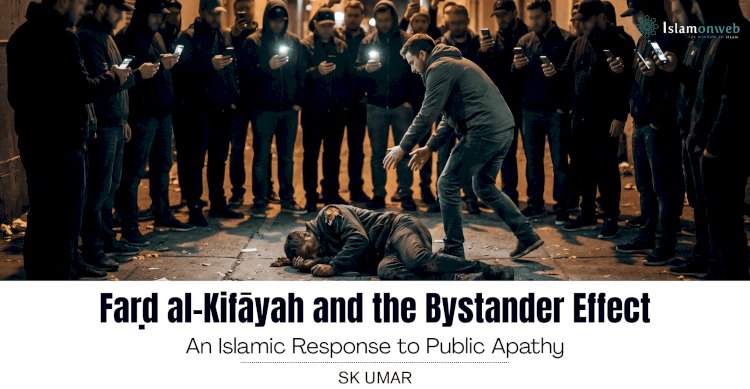
A clear example of this dilemma is the phenomenon known as the Bystander Effect. Psychologists use this term to describe the tendency for individuals to be less likely to intervene in an emergency when others are present. As the number of witnesses increases, the sense of personal responsibility often decreases, resulting in collective inaction.
This phenomenon can be observed in various situations today. When a person is harassed, injured in an accident, or subjected to injustice in a public place, many observers choose not to intervene. Some remain passive, while others merely record the incident on their smartphones. In many cases, bystanders do not perceive their inaction as a moral failing, even when they are able to offer assistance.
The challenge has become even more pronounced in the digital age. Historically, witnesses to a crisis generally faced two choices: intervene or walk away. Today, a third response has emerged—documentation. Instead of helping, many individuals choose to record incidents and share them online. The widespread use of smartphones has, in some cases, transformed human suffering into digital content consumed by distant audiences.
While documentation may occasionally serve legitimate purposes, such as preserving evidence or exposing wrongdoing, it should not serve as a substitute for assistance when assistance is available. The danger lies in becoming spectators of suffering rather than agents of relief.
Farḍ al-Kifāyah and Collective Responsibility
Islamic jurisprudence addressed the importance of communal responsibility long before modern psychology identified the bystander effect as a social phenomenon. One of the foundational concepts in Islamic law is farḍ al-kifāyah (communal obligation). Under this principle, certain responsibilities are placed upon the community as a whole. If no one fulfils them, the entire community bears moral responsibility according to the degree of its ability and capacity.
In classical legal theory, farḍ al-kifāyah is defined as an obligation addressed to the community as a whole, but fulfilled when a sufficient number of people perform it. One definition describes it as “that which applies to a number of legally responsible persons and is discharged by the action of one of them.”[1] In other words, it is rationally possible for the command to address all legally responsible persons, while the obligation is lifted from the rest once some members fulfil it.
According to the Ḥanafī formulation, farḍ al-kifāyah is “obligatory upon all and discharged by the action of some.”[2] If all perform it, all receive the reward of fulfilling the obligation. If all abandon it, all share in the sin. It is called farḍ al-kifāyah because the action of some is sufficient, unlike farḍ al-ʿayn, which remains attached to every individual and cannot be discharged by the action of others[3].
Classical jurists also explained that farḍ al-kifāyah does not operate in one single form. It may appear in different practical situations.
The first form is where the purpose is completed by the first valid action and cannot be repeated in the same case[4]. Rescuing a drowning person is a clear example: once the person has been saved, the same rescue cannot be repeated. This is the type of communal obligation that is discharged once some capable person performs it.
The second form is where the action of each person contributes differently to the overall purpose. In such cases, the obligation may become personally binding upon the one who has already begun it, because what one person contributes is not identical to what another contributes[5].
The third form is where the act may be repeated, and its benefit is renewed through repetition. Examples include seeking knowledge, memorising the Qur’an, and performing the funeral prayer, since each additional participation may bring renewed benefit. In this form, each person remains addressed by the duty according to their ability, unless another person carries this duty[6].
This category may also include scholarly research, public education, charitable initiatives, disaster relief efforts, healthcare services, and community outreach programmes. The objective in such cases is not merely to fulfil a minimum requirement, but to expand and strengthen the collective good. Unlike rescuing a drowning person—where the purpose is achieved once the victim is saved—the benefits of these activities increase as more people contribute.
What Makes the Difference?
The distinction between the two approaches lies not merely in legal rules, but in their understanding of responsibility itself.
In many modern legal systems, a person who chooses not to assist another may face no legal consequences, provided he was not directly responsible for the harm. The law often distinguishes between causing harm and merely failing to prevent it. Consequently, responsibility is frequently viewed through the lens of individual rights, personal autonomy, and limited legal obligation.
However, Islamic classical legal theorists explained that farḍ al-kifāyah is not directed toward an unknown or undefined group. Rather, according to the majority view, the command is initially addressed to all legally responsible members of the community. Al-Qarāfī explains that this prevents the obligation from being attached to an unspecified person, which would make compliance difficult or even impossible. If the duty were assigned only to “someone,” no one would clearly know whether he was personally addressed by the command. By directing the obligation to all at the outset, each capable person is moved to act in order to free himself from blame[7].
As the legal theorists explained, every capable person is included in the obligation: those able to perform it are expected to do so, while those unable to act directly are required to support, facilitate, or encourage its fulfilment[8]. If the obligation is fulfilled, the community shares in its reward; if it is neglected, the blame extends to all who had the capacity to contribute.
Ibn Qudāmah highlights the practical consequence of this discussion. If someone becomes aware of a communal obligation and he is unsure whether others have already fulfilled it, then, according to the majority view, he must make an effort to verify the matter. This is because the obligation is already addressed to him with certainty, and certainty is not removed by doubt[9]. This shows that farḍ al-kifāyah is not a mechanism for escaping responsibility. It begins as a duty addressed to all capable members of the community, and it is lifted only when the required action is fully carried out.
This understanding creates a fundamentally different conception of public responsibility. Rather than viewing communal duties as the responsibility of an unspecified "someone else," Islamic law begins by addressing every capable individual. The question is not who among the crowd is responsible, but how the responsibility will be discharged.
For this reason, Islamic ethics places considerable emphasis on moral accountability. When an individual possesses the ability to prevent harm, assist a victim, or support justice, deliberate inaction may itself become ethically and legally blameworthy. The focus is not only on what a person does, but also on what he knowingly fails to do when intervention is reasonably possible.
The concept of farḍ al-kifāyah therefore prevents individuals from using the presence of a crowd as an excuse to avoid moral and civic responsibility. While the obligation may ultimately be discharged by some members of the community, it is initially directed toward all capable individuals. In this sense, the crowd does not erase responsibility; it merely provides multiple opportunities for fulfilling it.
Diffusion of Responsibility V/s Per-Capita Responsibility
In modern behavioural psychology, the Bystander Effect describes a predictable decline in personal responsibility as the number of onlookers increases. In simple mathematical terms, individual psychological responsibility (R) appears to decrease as the number of onlookers (N) increases.
When N = 1, a single witness to an accident or violent assault may feel the full moral weight of the situation. In this case, R = 100%, and intervention becomes more likely.
When N = 100, the same responsibility is psychologically divided among the crowd. Each person may feel that only a small part of the duty falls upon him, or that someone else will act. In this case, perceived responsibility may fall to R = 1%, resulting in collective paralysis.
Islamic ethics responds to the bystander effect in a fundamentally different manner. Rather than allowing responsibility to be divided among a crowd, the principle of farḍ al-kifāyah ensures that responsibility remains attached to every capable individual until the required action is performed.
This may be expressed through an illustrative formula:
R = 100% for every capable individual until the obligation is fulfilled.
In modern psychology, responsibility tends to diffuse as the number of witnesses increases. In the Islamic framework, however, responsibility does not diminish with numbers. If ten people witness an injustice, ten people bear responsibility according to their ability. If one hundred people witness it, one hundred people remain accountable. The expansion of the crowd does not reduce the duty; it expands the circle of those answerable for neglecting it.
This is what may be called per-capita responsibility multiplication. Every additional capable witness becomes an additional bearer of responsibility. Consequently, the presence of a crowd is not a means of escaping accountability but rather a multiplication of accountable agents.
In practical terms, if an injured person lies helpless on a roadside and fifty people witness the incident, the Islamic question is not merely, “Why did nobody help?” Rather, each individual must ask, “Why did I not help when I had the ability to do so?”
Thus, while the bystander effect operates through the diffusion of responsibility, the ethical architecture of Islamic jurisprudence seeks to preserve individual responsibility regardless of how large the crowd becomes.
The Trapdoor Principle: When Communal Duty Becomes Personal Obligation
The concept of farḍ al-kifāyah is often misunderstood as a duty that always remains collective. Classical jurists, however, recognised that under certain circumstances a communal obligation may transform into a personal obligation (farḍ al-ʿayn). This transformation may be described as the "Trapdoor Principle" of Islamic jurisprudence.
At the outset, a communal obligation rests upon the community as a whole. Any sufficient number of qualified individuals may fulfil the requirement on behalf of the rest. However, when particular conditions arise, the communal nature of the obligation collapses and the duty becomes attached to a specific individual. The protective anonymity of the crowd disappears, and responsibility can no longer be shifted to others.
The first trigger is necessity and exclusivity. When the fulfilment of the obligation depends upon a particular person or a limited group of people, the duty becomes personally binding[10]. Classical jurists cited examples such as military defence, emergency rescue, and essential professional services. A physician in an isolated village with no alternative medical practitioner, for example, cannot invoke the communal nature of the obligation while people remain in need of his assistance. In such circumstances, the communal obligation effectively becomes an individual duty.
The second trigger is the commencement of a critical action. Jurists held that some communal obligations become binding once a person has begun performing them[11]. This is especially true where withdrawal would undermine the purpose of the obligation or cause harm. Saving a drowning person, participating in legitimate military defence, or undertaking a rescue operation are examples where abandonment after commencement may be impermissible.
The third trigger is collective omission. A communal obligation remains collective only so long as the community fulfils it. When everyone remains passive and the required action is left undone, the excuse of collective responsibility begins to disappear. The failure of the crowd does not extinguish the obligation; rather, it places increasing moral pressure upon those who possess the ability to act.
This distinction helps explain why emergency intervention occupies a special place in Islamic ethics. Rescuing an injured person, assisting a victim, or preventing imminent harm belongs largely to the category of obligations whose purpose is achieved through a specific action. Until that action is performed, every capable witness remains morally addressed by the obligation. Once the need becomes concentrated upon a particular individual through proximity, ability, or the absence of alternative responders, the communal duty effectively passes through the "trapdoor" and becomes a personal obligation.
The Modern Rationale and Islamic Response
A common argument in many legal systems is that the state cannot always legally compel an individual to rescue a stranger. Many legal systems are cautious about imposing a general duty to intervene, mainly due to concerns about personal liberty, personal safety, and the risk of unintended harm.
From this perspective, the law often gives strong priority to individual autonomy. A bystander may not be legally punished merely for refusing to assist a stranger, especially if he was not responsible for the harm. Legal systems are also reluctant to require an untrained civilian to expose himself to serious physical danger. Moreover, an inexperienced person may worsen the crisis through incorrect intervention, such as moving an accident victim in a way that increases injury.
Islamic jurisprudence does not ignore these concerns. The Sharīʿah does not demand reckless heroism, nor does it require a person to act beyond his actual ability. This is grounded in the Qur’ānic principle: “Allah does not burden any soul beyond its capacity” (Qur’an 2:286). Al-Qurṭubī, while commenting on the verse concerning those excused from active participation due to weakness, illness, or lack of means (Qur’an 9:91), explains that it is a foundation for the removal of obligation from the one who is genuinely unable. The same meaning is supported by the verse: “There is no blame upon the blind, nor blame upon the lame, nor blame upon the sick” (Qur’an 24:61).
At the same time, inability must not become an excuse for negligence. Islamic law grounds responsibility in istiṭāʿah — actual capacity. This means that intervention must be measured according to a person’s knowledge, ability, authority, and safety. The Qur’an commands: “Ask the people of knowledge if you do not know” (Qur’an 16:43), reminding believers that matters requiring expertise must be referred to those qualified to handle them. Likewise, the Qur’an warns: “Do not pursue that of which you have no knowledge. Indeed, the hearing, the sight, and the heart — all of these will be questioned” (Qur’an 17:36).
This principle is especially relevant in emergency situations. A person without medical training should not undertake dangerous procedures that may worsen the victim’s condition. The Prophet ﷺ warned: “Whoever practises medicine without being known for medical knowledge is liable.”[12] This establishes that good intention alone does not justify harmful or incompetent intervention.
The same concern appears in the report about the wounded man who was instructed to bathe despite his injury, leading to his death. When the Prophet ﷺ was informed, he said: “They killed him; may Allah kill them. Why did they not ask when they did not know?”[13] The report highlights the danger of acting without knowledge and the duty to seek proper guidance.
Islamic law also recognises the principle of avoiding greater harm. The Prophet ﷺ said: “There should be neither harm nor reciprocating harm.”[14] Therefore, if direct physical intervention would cause greater injury than the existing harm, or would place the responder in serious danger without clear benefit, the obligation shifts to a safer and more appropriate form of response.
This does not mean that one may simply remain passive. If a person cannot intervene physically, he may still be required to call emergency services, alert qualified people, warn others, prevent further danger, document evidence where useful, or support the victim in a lawful and safe manner. The Sharīʿah therefore balances two principles: it does not burden people beyond their capacity, but it also does not allow capacity to be hidden behind indifference.
Conclusion
The bystander effect is often presented as an unavoidable feature of human psychology: as the number of witnesses increases, the sense of personal responsibility decreases. Islamic jurisprudence, however, approaches the issue from a fundamentally different perspective. Rather than allowing responsibility to dissolve within the crowd, it begins by addressing every capable individual and then calibrates that responsibility according to knowledge, ability, authority, and circumstance.
The doctrine of farḍ al-kifāyah, the principle of istiṭāʿah (capacity), the prohibition of causing harm, and the obligation of amr bi al-maʿrūf wa nahy ʿan al-munkar together form a coherent framework that seeks to prevent public apathy without demanding reckless intervention. The Sharīʿah neither burdens people beyond their ability nor permits them to hide behind the inaction of others.
This balance is beautifully reflected in the statement of the Prophet ﷺ:
“Whoever among you sees an evil, let him change it with his hand; if he is unable, then with his tongue; and if he is unable, then with his heart, and that is the weakest of faith.”[15]
This ḥadīth establishes a hierarchy of responsibility based on capacity. The one who possesses the authority and ability to remove harm must act. If direct intervention is not possible, the duty shifts to speaking out, reporting wrongdoing, seeking assistance, or drawing attention to the injustice. If even that is beyond one's capacity, the believer must at least reject the evil inwardly and refuse to normalise or accept it.
Significantly, the Prophet ﷺ left no room for complete moral disengagement. Every believer remains responsible at some level. The form of the response may vary, but the obligation to respond does not disappear altogether. Thus, the Islamic framework transforms intervention from an act of exceptional heroism into a structured moral responsibility governed by wisdom, capacity, and concern for the common good.
Editor’s Note: The original manuscript has undergone substantial editing, expansion, and enhancement by Faisal Niyaz Hudawi. Additional analysis, juristic discussions, and supporting references from authentic Islamic sources have been incorporated to improve clarity, accuracy, and scholarly depth.
About the Author
Shaik Umar Farooq is a postgraduate first-year student at Darul Huda Islamic University, Chemmad, Kerala. Originally from Kadapa, Andhra Pradesh, he completed his primary and secondary education in Punganur
References:
[1] Al-Āmidī, Sayf al-Dīn Abū al-Ḥasan ʿAlī ibn Abī ʿAlī (d. 631 AH). Al-Iḥkām fī Uṣūl al-Aḥkām. vol. 1, p. 104.
[2] Ibn Qudāmah al-Maqdisī, Muwaffaq al-Dīn Abū Muḥammad ʿAbd Allāh ibn Aḥmad (d. 620 AH). vol. 1, p. 123
[3] Al-Qarāfī, Shihāb al-Dīn Aḥmad ibn Idrīs (d. 684 AH). Sharḥ Tanqīḥ al-Fuṣūl. p. 155
[4] Al-Subkī, Tāj al-Dīn ʿAbd al-Wahhāb ibn Taqī al-Dīn (d. 771 AH). Al-Ashbāh wa al-Naẓāʾir. vol. 2, p. 89
[5] Al-Subkī, Al-Ashbāh wa al-Naẓāʾir, vol. 2, p. 89
[6] Al-Zarkashī, Badr al-Dīn Abū ʿAbd Allāh Muḥammad ibn ʿAbd Allāh ibn Bahādur (d. 794 AH). Al-Baḥr al-Muḥīṭ fī Uṣūl al-Fiqh. vol. 1, p. 335
[7] Al-Qarāfī, Al-Furūq, vol. 2, p. 17
[8] Ibn Qudāmah, Rawḍat al-Nāẓir wa Junnat al-Manāẓir fī Uṣūl al-Fiqh, vol. 1, p. 586.
[9] Ibn Qudāmah, Rawḍat al-Nāẓir wa Junnat al-Manāẓir fī Uṣūl al-Fiqh, vol. 1, p. 586.
[10] Al-Ṭūfī, Sharḥ Mukhtaṣar al-Rawḍah, vol. 2, pp. 407, 411.
[11] Al-ʿAṭṭār, Ḥāshiyat al-ʿAṭṭār ʿalā Sharḥ al-Jalāl al-Maḥallī ʿalā Jamʿ al-Jawāmiʿ, vol. 1, p. 240.
[12] Abū Dāwūd, Sunan Abī Dāwūd, Kitāb al-Diyāt; al-Nasāʾī, Sunan al-Nasāʾī; and Ibn Mājah, Sunan Ibn Mājah
[13] Al-Bukhārī, Al-Tārīkh al-Ṣaghīr.
[14] Ibn Mājah in Sunan Ibn Mājah and al-Dāraquṭnī in Sunan al-Dāraquṭnī.
[15] Ṣaḥīḥ Muslim
Disclaimer
The views expressed in this article are the author’s own and do not necessarily mirror Islamonweb’s editorial stance.


Related Posts




















Leave A Comment