
Postgraduate Life in IIUM: Expectations, Challenges, Loneliness, and the Pursuit of Productivity
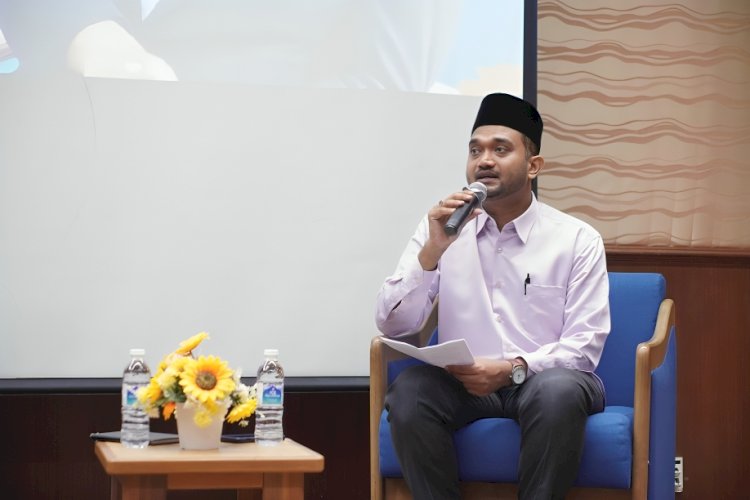
This write-up is based on a discussion held on the topic ‘Building Resilience Within and Relationships Beyond’, organised by the IIUM Postgraduate Students Society on Friday, 12 June 2026.
Question 1: "Postgraduate life is often described from the outside as an exciting and prestigious journey, but from the inside, it can feel very different. From where you sit, what do you think is the biggest gap between what people expect postgraduate life to be, and what it actually feels like day to day?"
Answer: Postgraduate study, especially within the IIUM environment, is a very prestigious journey. In fact, I would go further and say that it is a privilege. Sometimes we forget this because we become accustomed to what we have. Yet, if we pause to reflect, we will realize that millions of people around the world would love to be in your position today.
Many people dream of obtaining a place in a postgraduate programme. Many dream of holding the matric card that you hold. Many dream of studying at a university like IIUM, where students from around one hundred different nationalities come together in a unique academic and intellectual environment. What may seem ordinary to us is extraordinary to many others.
When you travel outside the university and interact with young people, you often find that they look at university students with admiration and respect because they understand the value of such an opportunity. The challenge is that familiarity can sometimes diminish our appreciation of blessings. When something becomes part of our daily life, we begin to view it as an entitlement rather than a gift. آفة النعم الإلف: “The affliction of blessings is familiarity with them.” It means when a person becomes too accustomed to a blessing, they may stop appreciating it, recognizing its value, or being grateful for it.
Personally, I learned this lesson through my own journey to IIUM. When I first applied, my application to the Ahmad Ibrahim Kulliyyah of Laws was rejected because I did not have the required background. My second choice, the Department of Fiqh and Usul al-Fiqh, was also initially unsuccessful due to the large pool of applicants. Later, my application status changed to pending consideration.
At that time, I had friends studying at IIUM who made inquiries on my behalf. They informed me that there was still a possibility of admission. Based on that hope, I left India for Malaysia without even having an official offer letter in hand. Because of the uncertainty, I could not properly say goodbye to family and friends. I did not know whether I would actually be accepted.
Then, on the day of registration, I checked my portal once again and found the offer letter. It was one of the most memorable moments of my life. It felt like a dream had become reality.
I would say the true blessing is not merely receiving an opportunity; the greater blessing is recognizing the value of the opportunity that you have been given. In other words, being admitted to IIUM is a blessing. But realizing that your admission is a blessing, that is an even greater blessing. Many people possess blessings without appreciating them. When Allah grants you both the blessing and the awareness of its value, your perspective changes completely.
Every blessing is also a test. Allah tests us not only through difficulties but also through opportunities, privileges, and gifts. The question is whether we recognize them and whether we respond appropriately.
The way we preserve and increase blessings is through gratitude. The "tax" of every blessing is shukr. Gratitude is not limited to saying "Alhamdulillah," although that is certainly important. True gratitude goes beyond words.
Shukr means using the blessing in a manner that pleases Allah and brings you closer to Him.
For example, if I give you a pen and you say, "Jazakallahu khayran," or “Al-Hamdulillah” that is good and praiseworthy. But the deeper form of gratitude is to use that pen for something beneficial, something that serves knowledge, goodness, worship, or humanity. In other words, gratitude is demonstrated through action.
The same applies to your postgraduate studies. The real gratitude for this opportunity is not merely being happy about your admission. It is using this opportunity to seek knowledge sincerely, to serve society, to develop your character, and ultimately to draw closer to Allah subhanahu wa ta'ala.
If you adopt this mindset, your postgraduate journey will remain exciting and meaningful. You will not view your studies as a burden but as an honour and a trust. Every lecture, every assignment, every research project, and every challenge will become part of a greater purpose.
When you see your studies as a blessing, and when you respond to that blessing with gratitude, then the prestige and excitement of this journey will remain with you throughout your entire postgraduate experience.
Question 2: Procrastination is something almost every postgraduate student struggles with, but it is often dismissed as laziness. From your experience and understanding, what is really going on when a student keeps putting off their work even when they know the deadline is approaching? And what actually helps, beyond just 'managing your time better'?
Answer: In overcoming procrastination, I would like to share four practical strategies that I have personally applied and found effective.
- Understand the Process
One of the main reasons students procrastinate is that they feel overwhelmed by a task they do not fully understand.
For example, when a lecturer assigns a paper or project, some students immediately see it as a huge burden. It feels like a sword hanging over their heads. However, once you understand the process, the task becomes much less intimidating.
Ask yourself:
- What exactly is an assignment?
- What are the requirements?
- What are the assessment criteria?
- How should it be structured?
- What steps are involved in completing it?
The best way to understand the process is to learn from those who have gone through it before. Speak to your seniors. Look at successful samples and models. Ask lecturers for clarification. Once the process becomes clear, uncertainty decreases and confidence increases.
Very often, we do not procrastinate because the task is difficult; we procrastinate because the task is unclear.
- Identify Your Peak Hours
Every person has certain periods during the day when they are mentally at their best.
Some people think most clearly in the early morning. Others are more productive in the evening. The key is to identify your peak hours and protect them carefully.
Reserve your best time for your most important academic responsibilities. In other words, do what is "wajib" (obligatory) before what is "sunnah" (recommended).
Complete your thesis writing, assignments, research, and reading during your peak hours. Administrative tasks, social media, emails, and other secondary activities can be done later.
Many students make the mistake of giving their best energy to less important activities and then trying to do serious academic work when they are already mentally exhausted.
- Create a Ripple Effect from Every achieved task.
One of the reasons students lose motivation is because they see an assignment as something temporary.
They think, "I will submit it, get a grade, and then it is finished."
Instead, try to see every assignment as the beginning of something bigger.
During my Master's studies, I took eight subjects. Out of those assignments, six were later developed into publications and eventually became part of books. Some assignments were also transformed into conference papers that I presented in Malaysia, Indonesia, India, Saudi Arabia, Turkey and Netherlands.
This completely changed my perspective. The assignment was no longer just an assignment. It became a publication, a conference presentation, a contribution to knowledge, and a lifelong achievement. A step your dream career.
When you can see the long-term impact of your work, motivation naturally increases.
Students need tangible outcomes. If there is no visible benefit beyond submitting a paper, the task may feel boring and tiring. And when something feels boring, we tend to postpone it. That is another form of procrastination.
- Build Strategic Academic Relationships
Finally, surround yourself with active and productive people.
Try to connect with lecturers who are engaged in research, publishing, conferences, community work, and academic projects. Build relationships with motivated peers and senior students.
Productivity is often contagious. When you spend time with people who are actively writing, researching, and contributing, you naturally become more active yourself.
Many opportunities in academia come through relationships, mentorship, and collaboration. A good academic network can provide guidance, encouragement, accountability, and opportunities that you may never discover on your own.
From my own experience, overcoming procrastination is not simply about managing time. It is about understanding the process, protecting your peak energy, creating meaningful outcomes from your work, and surrounding yourself with the right people.
When these elements come together, academic work becomes more purposeful, more enjoyable, and far less overwhelming
Question 3: In today’s demanding environment, many knowledge workers struggle to maintain productivity without experiencing excessive stress and mental pressure. How can scholars, researchers, and professionals cultivate sustainable productivity while ensuring that their work remains meaningful, impactful, and beneficial to society?
Answer: To bring ourselves back to a state of balance and normalcy, we need to discipline ourselves across four key dimensions of human life. Robin Sharma has talked about these four dimensions in his book The Everyday Hero Manifesto. When these four areas are strong, productivity becomes natural, not forced.
- Physical Fitness: Body as the Foundation of Productivity
Our body is the first tool of learning and work. If the body is weak, focus and motivation also weaken.
- Regular exercise, whether in the morning or evening, helps release dopamine, which increases motivation and energy.
- It also supports brain health by increasing BDNF (Brain-Derived Neurotrophic Factor), which improves memory, learning capacity, and mental clarity.
- Exercise also enhances neurotransmitters like norepinephrine (focus) and serotonin (emotional stability).
- Nutrition matters: prioritize real, natural food and avoid heavily processed substances that reduce cognitive performance.
- Fasting, which is part of the Sunnah (e.g., Mondays and Thursdays), helps regulate discipline, improves focus, and strengthens mental clarity.
- Hydration is often underestimated, yet it directly affects cognitive performance and alertness.
- Finally, quality sleep is essential, it restores both body and brain energy.
In short, a disciplined body creates a disciplined mind.
- Mental Fitness: Training the Mindset
Procrastination is often not a time problem, it is a mindset problem.
- We need to consciously train ourselves to think with clarity, purpose, and responsibility.
- A strong mindset produces strong productivity, while a weak mindset leads to delay and distraction.
- The Prophet ﷺ beautifully summarized this principle:
«مِنْ حُسْنِ إِسْلَامِ الْمَرْءِ تَرْكُهُ مَا لَا يَعْنِيهِ»
“Part of a person’s good Islam is leaving what does not concern him.” (Tirmidhi)
When we focus only on what truly matters, procrastination naturally reduces.
- Emotional Fitness: Training the Heart
Sometimes the real blockage is not intellectual, it is emotional.
- Unprocessed emotions like fear, anxiety, anger, guilt, or self-doubt can silently drain productivity.
- These emotions create internal resistance that leads to delay and avoidance.
- When the heart is burdened, the mind cannot function at its best.
- Emotional clarity and inner peace are therefore essential for academic success.
A clean heart produces a clear mind.
- Spiritual Fitness: Nourishing the Soul
The deepest source of strength is spiritual grounding.
- Regular ṣalāh, dhikr, Qur’an recitation, and moments of solitude (uzlah) renew the soul.
- Spiritual purification (tazkiyat al-nafs) reduces ego-driven distractions and increases sincerity.
- It shifts our productivity from stress-based performance to purpose-based excellence.
- This dimension anchors everything in gratitude, humility, and iḥsān, doing things with excellence because we are conscious of Allah.
Question 4: Many students find it hard to explain their postgraduate experience to family members who may not have gone through the same journey. Things like thesis stress, supervisor relationships, or the uncertainty of academic life can feel impossible to translate. How can students better communicate what they are going through and how can families be more supportive even when they do not fully understand?
Answer: This is a very important question because many postgraduate students are the first in their families to enter this journey. As a result, their parents, spouses, or siblings may not fully understand what a thesis is, how supervision works, or why research sometimes takes months without visible results.
My first advice is simple: keep communicating.
Even if your family does not fully understand academic life, continue sharing your experiences with them. Let them know what you are working on, what challenges you are facing, and what progress you are making. Do not assume that because they are not academics they are not interested. Often, they simply need help understanding your world.
At the same time, I believe that tangible results are a powerful source of motivation and communication.
Sometimes when family members ask about our studies, we repeatedly say, "Everything is fine," or "I'm making progress." But these statements can feel abstract. What often helps families understand the journey is seeing concrete milestones.
For example:
- You coordinated a programme.
- You served as an MC at an event.
- You delivered a talk or workshop.
- You attended or presented at a conference.
- You published an article.
- You received a scholarship or research grant.
- You became a research assistant.
- You received an award or recognition.
These milestones help family members visualize your growth. They may not understand the details of your thesis, but they can appreciate the achievements that emerge from your academic journey.
In addition, we need to be realistic in our expectations. While support from family is important, we must remember that everyone is living their own life and carrying their own responsibilities. Parents have their concerns. Spouses have their commitments. Siblings have their own challenges. They may care deeply about us, but they may not always be able to provide the level of understanding we hope for.
Therefore, part of maturity in postgraduate life is learning how to support ourselves while appreciating the support that others are able to give.
Another issue that often creates stress in postgraduate studies is financial pressure. In this regard, I have learned an important lesson: sustenance comes from Allah. The more a person constantly depends on people, the more he may feel poor. The more he turns to Allah, the richer and more hopeful he feels.
Of course, tawakkul does not mean waiting passively. It means trusting Allah while actively seeking opportunities.
I remember when I first arrived at IIUM. I brought approximately RM5,000 to cover my first semester. After that, I realized that continuing to rely on my parents for tuition fees and living expenses would place a significant burden on them.
So I began asking myself a different question: "What opportunities already exist within the university that can support my studies?"
I discovered that lecturers with research grants sometimes needed research assistants. The challenge was that I did not know who had projects or who was recruiting.
So I prepared a simple letter introducing myself, explaining my willingness to work hard, and attaching my CV. I printed around twenty copies and personally placed them in the lecturers' mailboxes.
The next day, one lecturer contacted me. He had a research project and needed a research assistant. Shortly afterwards, I received my first remuneration. Later, he recommended me for a scholarship opportunity. A few months later, another lecturer contacted me because he had kept my application. I was offered another research assistant position, which provided a monthly allowance that significantly supported my studies.
The lesson I learned was that opportunities often exist, but sometimes we need to take the initiative to find them.
When students gradually become more independent, academically, professionally, and financially, it not only reduces pressure on their families but also gives their families confidence and hope. They can see that their son, daughter, husband, or wife is growing and becoming capable of standing on their own feet.
Finally, I would add one more point. Families do not necessarily need to understand every detail of your research. What students often need most is not technical advice but emotional support. A simple message, a sincere dua, a word of encouragement, or someone who listens without judgment can make a tremendous difference.
- Question 5: Loneliness is something many postgraduate students experience, but few talk about, especially when they are surrounded by peers or living far from home. What do you think makes postgraduate loneliness different from other kinds of loneliness, and what are some real, practical ways students can build connection and a sense of belonging during this stage of life?
Answer: I think it is useful to distinguish between loneliness and aloneness. Loneliness is painful because it is the feeling of being disconnected, unsupported, or isolated. Aloneness, on the other hand, can be a gift. It gives us space for reflection, growth, self-discovery, and personal development.
Personally, I believe one of the hidden benefits of postgraduate life is that it teaches us how to be independent. When we live constantly surrounded by family, friends, and familiar routines, our growth may be limited in certain ways. But when we move into a new environment, especially as postgraduate students, we are challenged to discover who we really are.
When I first came to IIUM, one of the most important things I learned was not how much I knew, but how much I did not know. In fact, one of the greatest forms of knowledge is knowledge of one's own ignorance.
Because of that realization, I tried to attend as many university programmes as possible. I attended lectures, seminars, workshops, visiting scholars' talks, library programmes, CPS events, departmental activities, and university-wide programmes.
Sometimes I understood something. Sometimes I understood very little. Sometimes I attended a two-hour programme and came away with only one valuable idea. Yet those experiences were quietly transforming my personality and broadening my horizons.
Looking back, I believe much of that transformation happened because I was willing to step out of my room and engage with the university community.
One mistake some students make is treating the university merely as a place to attend classes and then immediately return home. As a result, they experience only a small portion of what university life can offer.
I often tell students: do not merely pass through the university; allow the university to pass through you.
Immerse yourself in its intellectual environment. Participate in its activities. Meet people from different countries and backgrounds. Listen to scholars. Attend conferences. Volunteer in programmes. These experiences often become as valuable as the degree itself.
For many students, especially during their Master's years, this is a unique stage of life. They are mature enough to make independent decisions and yet still have the flexibility to explore, learn, and reinvent themselves. This period can shape the rest of their lives.
At the same time, we should acknowledge that loneliness can sometimes become overwhelming.
I remember during my PhD years going through a particularly difficult period. For almost an entire semester, I struggled to sleep properly. This was especially difficult for me because I am someone who values routine and discipline. Suddenly, my normal schedule disappeared, and I felt unsettled.
Alhamdulillah, I eventually overcame that period through a combination of spiritual practices. Equally important, I reached out to my parents and stayed connected with family members who provided emotional support and reassurance.
Wish you the best in your journey of knowledge; Bi-Tawfiq.
About the author:
Dr. Sayyed Mohamed Muhsin
[Dr. Sayyed Mohamed Muhsin is an Associate Professor of Islamic Jurisprudence at the International Islamic University Malaysia (IIUM)]
Disclaimer
The views expressed in this article are the author’s own and do not necessarily mirror Islamonweb’s editorial stance.
1 Comments



Related Posts

















Leave A Comment