
The Discipline of Ṣamt: Reclaiming the Theology of Silence in an Age of Outrage
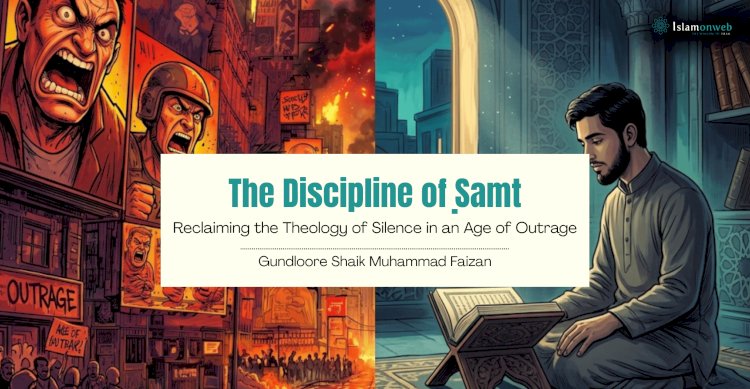
A thirty-second video clip goes viral. Within minutes, the digital crowd demands a verdict. In comment sections and family WhatsApp groups, people who have never studied the issue feel a sudden urgency to publish an opinion. If you stay silent, you are accused of complicity. If you wait a day to gather facts, you are accused of apathy. We have built an environment where hesitation is treated with suspicion, and immediate reaction is rewarded.
We can now speak instantly and publicly to people far beyond our immediate circle. Yet our words often feel weightless. We expect constant speech as the default state of existence. Silence has become an awkward anomaly.
Islam asks something different of the tongue. It teaches that our words carry weight before Allah. In response to the danger of careless speech, classical scholars gave serious attention to the discipline of Ṣamt (intentional silence).
This discipline is not a demand to simply stop talking. Silence can be a moral failure if one ignores clear injustice; speaking truth to oppression remains a religious duty. True Ṣamt is a disciplined restraint from speech that should not be spoken. In our digital lives, this often means withholding words driven by anger, vanity, or the sudden need to react. By learning to hold our tongues, we create the quiet necessary to cultivate ṭumaʾnīnah (tranquillity of the heart).
In a culture that demands constant reaction, guarding the tongue is how we preserve the heart. It teaches us to speak only when there is true benefit in speaking.
The Weight of the Word
Before Islam teaches us what to say, it teaches us to feel the weight of saying anything at all.
Allah says:
مَّا يَلْفِظُ مِن قَوْلٍ إِلَّا لَدَيْهِ رَقِيبٌ عَتِيدٌ
“He does not utter a word except that with him is an observer, ready to record.” (Qurʾān 50:18)[1]
The verse does not distinguish between the words we consider important and the words we barely notice ourselves saying. A remark made in anger, a careless judgement, a private insult, a passing joke; all are still words. They leave their tongue, but they do not simply disappear. Behind every utterance stands an awareness that it has been heard, recorded, and will one day be brought before Allah.
The Prophet ﷺ gave this awareness a simple rule: “Whoever believes in Allah and the Last Day, let him speak good or remain silent.”[2] Notice the order. Islam does not teach silence because speech is worthless. Good speech has a place: it can comfort the grieving, reconcile people, defend the oppressed, teach the ignorant, and remind the heedless heart of Allah. But when the tongue has nothing good to offer, silence is safer.
The early Muslims understood this weight with a seriousness that can feel almost foreign to us. ʿAbdullāh ibn Masʿud رضي الله عنه said: “By Allah, besides Whom there is no other god, nothing on the earth is more deserving of a long imprisonment than the tongue.”[3] He did not describe the tongue as evil. He described it as something that must be restrained.
That distinction matters. The Islamic discipline of Ṣamt is not hatred of speech. It is refusal to let the tongue run ahead of the heart. A person may know a great deal and still needs to remain silent. He may have an opinion and still have no duty to publish it. He may be certain that something has happened and still knows almost nothing about it. Sometimes wisdom begins with the sentence we decide not to say.
This old discipline has become difficult in a world where every thought can be published before it has had time to become a considered word. A person hears a claim, reaches the keyboard, and speaks before asking the questions that once stood between impulse and utterance: Is it true? Is it necessary? Will it benefit anyone? Am I speaking because something needs to be said, or because I cannot bear to remain silent?
The tongue may be small, but it can carry a person towards mercy or regret. Ṣamt begins in that small space before speech, in the moment when a person has the ability to speak, but chooses first to ask whether he should.
Al-Ghazālī’s Diagnosis
Nearly nine centuries before the internet, Imām Abū Ḥāmid al-Ghazālī wrote a detailed study of human speech. In his Iḥyāʾ ʿUlūm al-Dīn, he dedicated a major section to the "harms of the tongue", identifying the specific ways careless speech damages the human heart.
Today, his diagnosis reads directly into the modern attention economy. Two of the diseases he identified have become strikingly familiar in our digital lives.
The first is speaking about that which does not concern you (ma la yaʿnih). Al-Ghazālī warned against the human desire to involve ourselves in matters outside our moral or practical responsibility. This principle is grounded in the well-known Prophetic statement: "Part of the perfection of a person's Islam is his leaving that which does not concern him."[4]
Modern platforms make it remarkably easy to violate this principle. A digital timeline constantly feeds us distant controversies, fragmented arguments, and strangers' personal failings. It presents every event in the world as if it were our immediate concern. We are then encouraged to form a sudden opinion and publish it. This constant reaction exhausts the heart. When we feel obligated to speak about everything, our attention is pulled away from the few things we have the power to change.
The second disease is mirāʾ (disputation). Al-Ghazālī described this as the habit of challenging another person's words to expose an error, prevail in argument, or display one's own superiority. He noted a dangerous reality about mirāʾ: it often disguises itself as defending the truth, but it is driven by the ego.
Digital comment sections and group chats can become fertile ground for Miraʾ. The interface turns conversations into public performances. Because an audience is always watching, conceding a point feels like a public defeat. As a result, people argue endlessly over issues they barely understand. Al-Ghazālī warned that this kind of disputation hardens the heart and produces rancour.[5] The Islamic tradition treats this spiritual danger so seriously that the Prophet ﷺ guaranteed a house on the outskirts of Paradise for anyone who abandons a quarrel, even when they are right.[6]
This is the hidden cost of our digital habits. The platforms we use do not just consume our time; they can reward the very habits that Islamic ethics teaches us to restrain. The discipline of Ṣamt teaches us to recognise this trap. It asks us to look at a quarrel and realise that walking away is not a defeat; sometimes leaving an argument is simply the harder thing to do.
Ṣamt as Spiritual Restraint
Remaining silent is difficult because it feels like a kind of disappearance. In a culture that equates visibility with existence, choosing not to speak feels like erasing yourself. The ego wants to be heard. It wants to prove its intelligence, defend its honour, and assert its presence.
This is why the Islamic discipline of Ṣamt is not a blanket command to stay quiet. Silence is not always a virtue. If a person ignores clear injustice, or withholds a necessary truth, their silence is a moral failure. The Qurʾān commands believers to be active witnesses for truth:
يَا أَيُّهَا الَّذِينَ آمَنُوا كُونُوا قَوَّامِينَ بِالْقِسْطِ شُهَدَاءَ لِلَّهِ وَلَوْ عَلَىٰ أَنفُسِكُمْ
“O you who have believed, be persistently standing firm in justice, witnesses for Allah, even if it be against yourselves...” (Qurʾān 4:135)[7]
The silence of the coward hides from the consequences. True Ṣamt is the deliberate restraint of the ego, not the abandonment of duty. It is the choice to withhold words that have no real benefit, so that the words we do speak carry genuine weight.
When a person first begins to practice this restraint, the internal noise becomes obvious. Every unwritten comment and unsent reply can bring the discomfort of being deprived of a habit it has come to expect. But classical scholars understood this struggle as necessary. Imam al-Ghazali noted that guarding the tongue collects the scattered concerns of the heart and frees the mind for reflection and remembrance.[8] By denying the tongue its usual habits, a person slowly regains control over their own interior life.
This brings us to the deeper purpose of Ṣamt: preparing the heart for ṭumaʾnīnah. A heart that is constantly reacting to the noise of the world leaves little room for reflection and the awareness of Allah. Allah says in the Qurʾān:
أَلَا بِذِكْرِ اللَّهِ تَطْمَئِنُّ الْقُلُوبُ
“Unquestionably, by the remembrance of Allah hearts find rest.” (Qurʾān 13:28)[9]
Ṣamt quietens the impulse to react, giving the heart more room for dhikr. When we stop filling every moment with our own words, we make room to remember Allah and to notice what is happening within the heart. The point is not to escape sound. It is to stop adding to it, long enough for the heart to remember whom it belongs to.
Conclusion: The Sanctuary of Silence
Modern communication treats constant speech as the default, demanding we react to everything and argue over what does not concern us. But the Islamic tradition suggests that our silence might be just as precious.
The discipline of Ṣamt offers a sanctuary from this exhaustion. It is the conscious decision to stop feeding the noise. Guarding the tongue does not mean withdrawing from the world or ignoring injustice. It simply means protecting the heart from unnecessary friction. It means recognizing that not every controversy requires our commentary, and not every provocation deserves a reaction.
The pressure to speak and argue remains. But a believer does not have to answer every call. When we stop offering our words to every passing argument, we leave room for dhikr. And it is through that remembrance that the heart finally finds its ṭumaʾnīnah. Sometimes, the wisest choice a person can make is to simply close the screen, withhold the comment, and allow the soul to return to quiet.
About the Author
Gundloore Shaik Muhammad Faizan is a second-year degree student at Darul Huda, pursuing studies in classical Islamic sciences. With a keen interest in academic writing, Islamic ethics, and structured philosophical inquiry, the author focuses on translating traditional seminary wisdom into practical, rigorous frameworks for the contemporary era.
Reference:
[1] Qurʾān 50:18.
[2] Ṣaḥīḥ al-Bukhārī, no. 6018; Ṣaḥīḥ Muslim, no. 47b.
[3] Ibn Abī Shaybah, al-Muṣannaf, no. 27030 (numbering differs by edition; also numbered 28198). This is a statement of Ibn Masʿūd, not a Prophetic ḥadīth.
[4] Jāmiʿ al-Tirmidhī, no. 2317; Sunan Ibn Mājah, no. 3976. The chains and grading of this report have been discussed by ḥadīth scholars; al-Tirmidhī preferred the mursal route (no. 2318), while al-Nawawī regarded the report as ḥasan.
[5] Abū Ḥāmid al-Ghazālī, Iḥyāʾ ʿUlūm al-Dīn, Kitāb Āfāt al-Lisān (Book on the Harms of the Tongue), sections concerning what does not concern one and disputation. Page numbers vary by edition.
[6] Sunan Abī Dāwūd, no. 4800, narrated by Abū Umāmah
[7] Qurʾān 4:135.
[8] Al-Ghazālī, Iḥyāʾ ʿUlūm al-Dīn, Kitāb Āfāt al-Lisān. The statement in the article is a thematic summary, not a verbatim quotation.
[9] Qurʾān 13:28.
AI Usage Declaration
AI tools were utilised strictly for language refinement, structural formatting, and English grammar correction. All core theological arguments, classical references, interpretations of primary texts, and the overall conceptual framework are my original work and have been manually verified.
Disclaimer
The views expressed in this article are the author’s own and do not necessarily mirror Islamonweb’s editorial stance.

Related Posts















Leave A Comment