
The Theology of Nisyān: Reclaiming the Grace of Forgetting in the Digital Age
All praise belongs to Allah, Al-ʿAfūw — the One who completely effaces our sins. May His peace and blessings be upon His Messenger ﷺ, who taught us that mercy is not a weakness, and that allowing a person to heal is a reflection of divine grace.
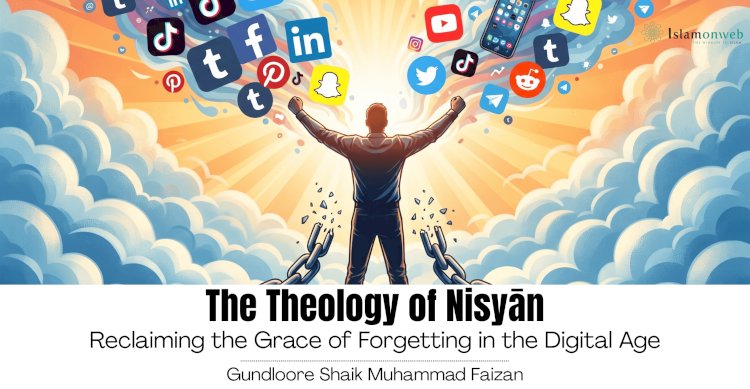
Every few weeks, a name trends on social media. Usually, it is not for an achievement. It is because of something they said or did years ago, suddenly dug up and broadcast to millions. The person might have changed entirely. They might have repented and grown. But in the modern digital world, it does not matter. A record that never expires has spoken, and to the Muslim heart, something about this feels deeply wrong. Because it is.
This sickness, however, must be diagnosed carefully. Islam does not praise forgetting everything. Our entire religion is built on the remembrance of Allah (dhikr), and the meticulous preservation of sacred knowledge by the Ṣaḥābah and the scholars of ḥadīth is what keeps our faith alive today. But those same companions who preserved every word of the Prophet ﷺ were equally dedicated to concealing each other's private failings. Memory and mercy were never opposites in their tradition, they were disciplines practiced together. There is a difference between preserving the truth and hoarding someone's past sins. Preserving sacred knowledge serves the living. Permanently archiving personal mistakes only serves the grudge.
The Insān (إنسان) Paradox: The Biology and Theology of the Clean Slate
To understand why a permanent digital archive hurts us so deeply, we have to look at how Allah actually created us. In classical Arabic, scholars have long discussed the root of the word for the human being: insān. While some grammarians say it comes from uns, meaning intimacy and companionship, other great scholars — like al-Rāghib al-Aṣfahānī in his Mufradāt Alfāẓ al-Qur'ān, pointed out that it is closely tied to the word nisyān (نسيان), meaning forgetfulness.[i]
This connection is not an insult. It is a profound description of our natural disposition (fiṭrah). Our vulnerability to forgetting goes all the way back to the father of humanity. Allah says in the Qur'ān:
وَلَقَدْ عَهِدْنَا إِلَىٰ آدَمَ مِن قَبْلُ فَنَسِيَ وَلَمْ نَجِدْ لَهُ عَزْمًا
"And We had already taken a covenant from Adam before, but he forgot, and We found not in him determination." (Ṭā-Hā 20:115)
Modern digital culture treats forgetting like a malfunction. Billions are spent building servers under the assumption that holding onto every piece of data is the ideal human state. But modern brain science tells a different story. In 2017, neuroscientists Ronald Davis and Yi Zhong published research demonstrating that forgetting is not a failure of the brain to hold onto information — it is an active biological mechanism.[ii] The brain deliberately works to dismantle old memories and connections it no longer needs. What the body requires for survival, the soul requires for growth. The same mercy Allah wired into our neurons, He confirmed in His revelation.
Think about what this means for the heart. If we could not forget — if the sharp agony of losing a loved one, or the burning shame of a past mistake, felt exactly as painful twenty years later as it did on the first day — the soul would simply stop moving. We would be completely paralyzed by our own histories. Allah built the capacity to let things fade into our very bodies as a profound mercy.
When digital platforms demand that a person's footprint never vanishes, they are fighting against our fiṭrah. They are forcing people to live forever in their worst moments, denying them the God-given permission to heal, scar over, and begin again.
The Unforgiving Machine vs. The Grace of Maḥw
If our bodies need to forget trauma to heal, our souls need to forget sin to survive. This is where the modern internet completely breaks down. The internet is a machine that might accept an apology, but it never grants absolution. If you make a mistake online, the record stays forever. The digital world forces a person to always be defined by the worst thing they ever did, leaving no room to outgrow their past.
Islam offers something entirely different: maḥw (مَحْو spiritual effacement) and satr (سَتْر divine concealment). When a believer turns back to Allah in sincere repentance (tawbah), the sin is not merely marked as forgiven while its stain remains visible. The spiritual reality of the person actually changes. Ibn al-Qayyim al-Jawziyyah, in his Madārij al-Sālikīn, explains that sincere tawbah does not merely close a file, it reshapes the soul itself, replacing the arrogance that led to the sin with a humility and vigilance the person would never have developed without falling.[iii] The Prophet ﷺ confirmed this transformation plainly:
التَّائِبُ مِنَ الذَّنْبِ كَمَنْ لاَ ذَنْبَ لَهُ
"The one who repents from sin is like one who did not sin.[iv]" [Sunan Ibn Mājah, Hadith 4250]
Then there is the beautiful concept of satr. In a culture that exposes people for clicks and engagement, we forget how much Allah loves to hide our faults. We see this vividly in the narration of the Najwā — the divine whisper. The Prophet ﷺ told us that on the Day of Judgement, Allah will draw the believer close, veil them from the crowds, and whisper about their private sins: "I concealed them for you in the world, and I forgive you for them today."[v] [Ṣaḥīḥ al-Bukhārī, Hadith 2441]
سَتَرْتُهَا عَلَيْكَ فِي الدُّنْيَا، وَأَنَا أَغْفِرُهَا لَكَ الْيَوْمَ
But we must draw a very clear line here. This theology of mercy is not a shield for oppressors. Imām Abū Ḥāmid al-Ghazālī, in his Iḥyāʾ ʿUlūm al-Dīn, lists concealing a repentant brother's private faults as a fundamental duty of Islamic brotherhood.[vi] But classical Islamic jurisprudence also distinguished between the backbiting Islam forbids and the public warning (naṣīḥah) that Islamic law requires when an active threat to the community must be named. If someone is a predator, a scammer, or a danger to the vulnerable, exposing them is not a violation of satr , it is the fulfilment of a separate and higher obligation.
The crisis we face today is that digital memory is often used upside down. We use it to publicly humiliate ordinary people for private mistakes they made years ago. If the Creator of the heavens is willing to wipe the record clean for someone who repents, who are we to insist on keeping their sins hosted on a server forever?
Ibn al-Waqt (ابن الوقت): Reclaiming the Present from the Archive
This obsession with keeping a permanent digital record does not just affect how we treat others, it actively damages our own relationship with time. In traditional Islamic spirituality, there is a profound concept given its fullest classical treatment by Imām Abū al-Qāsim al-Qushayrī in his Al-Risālah al-Qushayriyyah: the true believer must strive to be ibn al-waqt, the child of the present moment.[vii]
To be the child of the moment means your primary duty is to Allah in the exact present you are standing in. A Muslim is taught to hand their past over to the mercy of Allah and to trust their future entirely to His decree. If you spend your life obsessing over your past successes, you become arrogant. If you constantly dwell on your past failures, you become paralysed by despair.
The structure of the modern internet actively destroys this spiritual balance. By demanding that we constantly curate, defend, and agonise over a perfectly preserved digital history, social media pulls the heart away from the present moment and chains it to a past that no longer exists. You cannot achieve the full presence before Allah, the murāqabah, that the present moment demands if your mind is permanently chained to an archive of old arguments, deleted posts, and outdated versions of yourself.
However, we must be very careful here. The call to let our digital footprints fade is not a call to burn libraries. Islam is a civilization built on the preservation of beneficial knowledge. The internet is a profound blessing when we use it to preserve scholarship, medicine, and truth. The Prophet ﷺ confirmed this when he said:
إِذَا مَاتَ الْإِنْسَانُ انْقَطَعَ عَنْهُ عَمَلُهُ إِلَّا مِنْ ثَلَاثَةٍ: إِلَّا مِنْ صَدَقَةٍ جَارِيَةٍ، أَوْ عِلْمٍ يُنْتَفَعُ بِهِ، أَوْ وَلَدٍ صَالِحٍ يَدْعُو لَهُ
"When a human being dies, his deeds come to an end except for three: ongoing charity, beneficial knowledge, or a righteous child who prays for him." [Ṣaḥīḥ Muslim, 1631[viii]]
The problem is not the archive itself, it is what we choose to put in it. We must build a culture that meticulously records what is useful to humanity, while gracefully deleting what is merely human.
The classical scholars described zuhd not as poverty but as freeing the heart from attachment to what does not serve the soul. In a world that tells us we only matter if we document every passing thought and save every trivial moment, choosing to let things fade becomes the contemporary expression of that same discipline. Refusing to compulsively hoard our own data is not an act of self-destruction. It is an act of self-preservation — making room in the heart for the only moment that actually belongs to us.
Conclusion
Ultimately, to be insān is to carry the capacity to forget. But as our tradition and our biology both confirm, this is not a flaw in our design. It is the profound mercy of our Creator, the divine permission to heal, to repent, and to outgrow the people we used to be.
This theology must change how we actually live in the digital world. It means we stop compulsively hoarding our own data and recording every passing thought. More importantly, it means we refuse to participate in the public shaming of someone who has sincerely repented for a private, past mistake. It means we delete the old screenshots, stop weaponizing the archive, and give our brothers and sisters the space to mature.
And perhaps most quietly, this theology is a mercy for your own heart too. If Allah, who witnessed every detail of what you did, has chosen to erase it upon your sincere return to Him, then your continued self-punishment is not humility. It is a failure to accept the gift.
We do not need to be the permanent record-keepers of each other's flaws, as though Allah's justice depends on our servers. Allah is the Ultimate Record-Keeper, but He has named Himself Al-Ghafūr (the Constantly Forgiving) and Al-ʿAfūw ( the One who effaces the very trace of sin). If the Lord of the worlds loves to wipe the cosmic slate clean for His servants, we must learn to do the same for each other.
A civilization that insists on remembering everything risks forgetting how human beings were created to heal. We ask Allah, Al-ʿAfūw, to grant us the grace to extend to one another what He has already extended to us.
About the author:
Gundloore Shaik Muhammad Faizan is a second-year degree student at Darul Huda, pursuing studies in classical Islamic sciences. With a keen interest in academic writing, Islamic ethics, and structured philosophical inquiry, the author focuses on translating traditional seminary wisdom into practical, rigorous frameworks for the contemporary era.
Reference:
[i] Al-Rāghib al-Aṣfahānī, Mufradāt Alfāẓ al-Qurʾān
[ii] Davis, R. L., & Zhong, Y. (2017). "The Biology of Forgetting—A Perspective." Neuron, 95(3), 490-503.
[iii] Ibn al-Qayyim al-Jawziyyah, Madārij al-Sālikīn bayna Manāzil Iyyāka Naʿbudu wa Iyyāka Nastaʿīn, Vol. 1, Bāb al-Tawbah
[iv] Sunan Ibn Mājah, Hadith 4250
[v] Ṣaḥīḥ al-Bukhārī, Hadith 2441
[vi] Abū Ḥāmid al-Ghazālī, Iḥyāʾ ʿUlūm al-Dīn, Vol. 2, Kitāb Ādāb al-Ukhuwwah wa-l-Ṣuḥbah
[vii] Abū al-Qāsim al-Qushayrī, Al-Risālah al-Qushayriyyah fī ʿIlm al-Taṣawwuf, Bāb Hifẓ al-Waqt
[viii] aḥīḥ Muslim, 1631
Disclaimer
The views expressed in this article are the author’s own and do not necessarily mirror Islamonweb’s editorial stance.


Related Posts










Leave A Comment