
The Pan-Islamic Dilemma: The Khilāfat Movement, Anti-Colonial Nationalism, and the Realities of Geopolitical Transformation
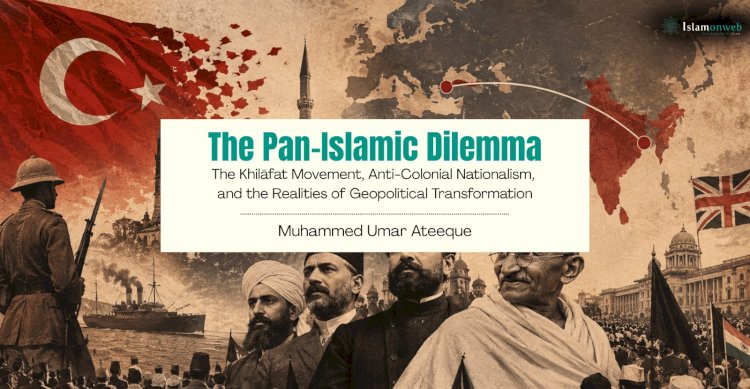
The Khilāfat Movement (1919–1924) occupies a significant place in modern South Asian history because it brought together religious solidarity, anti-colonial politics, and competing visions of political authority. Following the First World War, Indian Muslim leaders mobilised to preserve the Ottoman Caliphate and influence the post-war settlement. The movement’s alliance with Mahatma Gandhi’s Non-Cooperation Movement created an important opportunity for cooperation between sections of the Indian Muslim leadership and the Indian National Congress.
The alliance represented neither complete ideological unity nor an inherently misguided political experiment. Its participants shared an immediate opposition to British imperial rule but approached political mobilisation with different priorities. Congress leaders sought Swaraj (self-rule), while Khilāfat activists were also concerned with an institution whose future depended on developments beyond India. These objectives could reinforce one another without becoming identical.
This article examines the relationship between pan-Islamic solidarity and territorial anti-colonial nationalism through the formation of the alliance, the suspension of Non-Cooperation in 1922, and the abolition of the Ottoman Caliphate in 1924. It argues that the movement’s decline cannot be explained by a single cause. Domestic political decisions, organisational difficulties, communal tensions, and transformations within Turkey interacted to undermine its original objectives.
The Pan-Islamic Context and the Ottoman Question
The Ottoman Caliphate held considerable symbolic importance for sections of the South Asian Muslim population during the late nineteenth and early twentieth centuries. Although Ottoman political authority did not extend over British India, the Sultan’s association with the caliphal institution provided a focal point for expressions of transnational Muslim solidarity. Nevertheless, Indian Muslims did not share a uniform understanding of the Caliphate or agree on its political implications.
The Ottoman Empire’s defeat in the First World War intensified these concerns. The Treaty of Sèvres, signed in August 1920, imposed severe proposed restrictions on the defeated Ottoman state. Questions concerning Ottoman sovereignty, Muslim political interests, and the protection of the Ḥaramayn—the two holy sanctuaries of Makkah and Madinah—became important elements of Khilāfat agitation. These concerns were related but distinct, involving different diplomatic and territorial questions.
Leaders including Maulana Muhammad Ali, Shaukat Ali, Abul Kalam Azad, and Hakim Ajmal Khan contributed to the mobilisation through political meetings, journalism, religious networks, and public campaigns. They helped transform an international question into a major issue of Indian politics.
Gail Minault’s The Khilafat Movement: Religious Symbolism and Political Mobilization in India provides an important framework for understanding this development. Her study examines the movement’s leadership, popular mobilisation, relationship with Congress, and eventual decline. It demonstrates why the Khilāfat cause cannot be understood solely as a religious concern: it also became a vehicle for organising opposition to British rule.[1]
Pan-Islamic sentiment and Indian nationalism were therefore not necessarily mutually exclusive. For many activists, support for the Caliphate and participation in the anti-colonial struggle represented related responsibilities. Nevertheless, the alliance depended partly on the expectation that political pressure in India could influence British policy towards an institution increasingly affected by international negotiations and developments within Turkey.
The Khilāfat–Non-Cooperation Alliance
The convergence of the Khilāfat Movement and Gandhi’s Non-Cooperation Movement marked an important development in anti-colonial mobilisation. The Rowlatt legislation, the Jallianwala Bagh massacre of April 1919, and continuing dissatisfaction with British rule had intensified nationalist opposition. The Khilāfat question added another source of political urgency and broadened opportunities for participation in Congress-led agitation.
For Gandhi, support for the Khilāfat cause formed part of his effort to establish Hindu–Muslim cooperation as a foundation for a broader national movement. He regarded Indian Muslim grievances as a legitimate political concern and believed that cooperation could strengthen opposition to imperial rule. Khilāfat leaders, in turn, gained access to a wider political organisation and a strategy of mass non-cooperation.
The alliance developed around shared immediate objectives rather than complete agreement on political philosophy. Boycotts of government institutions, the promotion of national education, the rejection of certain colonial honours, and public demonstrations broadened political participation during 1920–1921. Religious symbolism thus became an important means of political communication and mobilisation.
- R. Nanda’s Gandhi: Pan-Islamism, Imperialism and Nationalism in India offers a historical account of Gandhi’s involvement in the Khilāfat agitation and the relationship between Congress and the movement. His analysis provides a basis for examining how shared political objectives brought together participants with different understandings of the Khilāfat question.[2]
The alliance nevertheless contained tensions from its beginning. Congress sought political transformation within India, whereas Khilāfat activists also aimed to influence the international settlement of the Ottoman question. These objectives overlapped when opposition to British policy appeared capable of advancing both causes. Their divergence became more consequential when developments outside India undermined the specific objective around which Khilāfat mobilisation had formed.
Different political priorities do not automatically make an alliance irrational. Coalitions often unite participants who disagree about their ultimate goals. The central historical question is whether their shared programme can survive changing circumstances and whether their organisations can adapt when their immediate interests diverge.
The Suspension of Non-Cooperation in 1922
The first major rupture in the joint campaign came in February 1922. On 4 February, a confrontation at Chauri Chaura in the United Provinces escalated into violence. A crowd set fire to a police station, killing twenty-two policemen. Gandhi subsequently suspended the Non-Cooperation Movement because he believed that the campaign could not continue without adherence to non-violence.
The decision generated considerable disagreement. Some regarded the suspension as necessary to preserve the ethical principles underlying Gandhi’s strategy. Others believed that withdrawing a mass campaign during a period of political mobilisation weakened the anti-colonial struggle and undermined the sacrifices of its participants. The decision also affected Khilāfat activists whose cooperation with Congress had been connected to the expectation of sustained joint action.
The suspension disrupted a major channel of coordinated mobilisation, but it did not by itself determine the fate of the Caliphate or establish that Hindu–Muslim cooperation was inherently unsustainable. The Indian campaign and the political transformation in Turkey followed related but distinct trajectories.
In India, the suspension altered the immediate political environment. In Turkey, a nationalist movement was challenging the Ottoman imperial order and developing an alternative basis of sovereignty. The former weakened a domestic mass campaign; the latter ultimately abolished the institution that had inspired Khilāfat agitation.
A careful historical account must therefore distinguish between the loss of momentum in India and the destruction of the movement’s central international objective. The suspension made continued mobilisation more difficult, while the abolition of the Caliphate rendered the original demand unattainable.[3]
Domestic Political Realignments and Communal Tensions
The period following the suspension of Non-Cooperation was marked by organisational uncertainty and changing political priorities. The imprisonment of prominent leaders, disagreements over strategy, and the weakening of joint mobilisation made it more difficult to sustain the coalition on the scale achieved during 1920–1921.
Hindu–Muslim political relations also became increasingly strained in several regions during the early 1920s. However, communal tensions cannot be attributed exclusively to the suspension of Non-Cooperation, nor should they be treated as an inevitable consequence of cooperation between religious and nationalist movements. Local political competition, economic grievances, religious mobilisation, and regional circumstances require separate consideration.
The Mappila rebellion of 1921 in Malabar illustrates this complexity. It involved an interaction of agrarian grievances, colonial repression, religious mobilisation, and violence. Its relationship to the broader Khilāfat and Non-Cooperation campaigns must be examined within its regional context rather than explained through a single cause. Nanda’s discussion of the rebellion provides a useful starting point for examining its relationship with the wider political movement.[4]
The more defensible conclusion is that the weakening of the joint campaign reduced an important framework for coordinated anti-colonial action at a time when political differences were becoming harder to manage. The alliance had created a temporary convergence of interests, but it had not resolved the underlying disagreements within Indian politics.
The Turkish National Movement and the Abolition of the Caliphate
The decisive transformation of the Khilāfat question took place in Turkey. Under Mustafa Kemal and the Turkish National Movement, the struggle against foreign occupation developed into a project of national sovereignty. The government established in Ankara increasingly rejected the political structures associated with the Ottoman imperial order and sought to reorganise authority around a sovereign Turkish state.
On 1 November 1922, the Turkish Grand National Assembly abolished the Ottoman Sultanate, separating the monarchy from the continuing caliphal office. The Republic of Turkey was proclaimed on 29 October 1923. On 3 March 1924, the Assembly abolished the Caliphate and ended the Ottoman dynasty’s institutional position within the new state.[5]
These developments must be distinguished chronologically and politically. The abolition of the Sultanate did not immediately abolish the Caliphate; the two institutions were separated before the latter was formally terminated. The Turkish leadership’s decisions reflected its own political priorities and its effort to reorganise sovereignty within a modern national framework.
For Indian Khilāfat activists, the abolition of the Caliphate represented the loss of the principal institution they had sought to preserve. Their political campaign in India could not reverse a decision made by the Turkish legislature. This outcome revealed the limits of attempting to influence an international institution through a colonial political campaign conducted elsewhere.
The contrast between the Indian and Turkish experiences is significant. Indian activists sought to defend the Caliphate as an institution of transnational Muslim significance, while Turkish nationalists prioritised the construction of a sovereign national state. These positions reflected different political circumstances and objectives. Their divergence illustrates the difficulty of maintaining a shared political programme when participants operate within different institutional and geopolitical settings.
The abolition of the Caliphate should consequently be understood within the wider transformation of the Ottoman political order, rather than merely as the final episode of the Indian Khilāfat Movement.[6]
Iqbal, Azad, and Muslim Political Thought
The abolition of the Caliphate raised questions about the relationship between Islamic political principles, historical institutions, and modern statehood. It did not produce a single or uniform response among South Asian Muslim intellectuals, whose interpretations emerged from different philosophical commitments and political concerns.
Muhammad Iqbal’s The Reconstruction of Religious Thought in Islam is relevant to discussions of Islamic political authority and institutional change. In his lecture "The Principle of Movement in the Structure of Islam", Iqbal examines the relationship between Islamic legal and political thought and the capacity for collective reasoning. His discussion provides a framework for considering whether historically established political arrangements must remain unchanged under different circumstances.[7]
Iqbal’s position should not be reduced to a simple endorsement of secular nationalism or interpreted as proof that he regarded the abolition of the Caliphate as unproblematic. His broader intellectual project concerned the relationship between Islamic principles, political institutions, and reinterpretation. More specific claims about his position on the Caliphate must be grounded in the relevant passage and read within the context of his wider argument.
Abul Kalam Azad’s political thought offers another perspective. His commitment to the Indian anti-colonial struggle and intercommunal cooperation reflected his understanding of the political responsibilities of Indian Muslims. His political career provides an important context for examining Muslim participation in the Indian nationalist movement. However, his general commitment to Indian nationalism should not be treated as sufficient evidence of a particular interpretation of the Caliphate’s abolition. Such a claim requires a specific and verifiable primary-source reference.
Iqbal and Azad therefore illuminate different dimensions of the problem. Iqbal’s philosophical reflections raise questions about political authority and institutional adaptation, while Azad’s political experience highlights the possibility of Muslim participation in a shared Indian struggle against colonial rule. Neither perspective represents the entirety of Muslim political thought during this period.
The end of the Ottoman Caliphate did not eliminate debate about the relationship between Islamic solidarity and political community. Instead, it changed the institutional and intellectual context in which that debate took place.
Conclusion
The Khilāfat Movement was a major episode in modern South Asian history because it brought religious symbolism, transnational political concerns, and anti-colonial mobilisation into an unusually close relationship. Its alliance with Gandhi’s Non-Cooperation Movement demonstrated the possibilities of cooperation between groups whose ultimate objectives were not identical. It also exposed the difficulties of sustaining such cooperation when domestic strategy and international developments moved in different directions.
The suspension of Non-Cooperation in 1922 weakened the immediate framework of joint mobilisation, but it did not by itself determine the movement’s eventual outcome. The abolition of the Caliphate in 1924 followed a distinct process of political transformation within Turkey. Domestic organisational difficulties, communal tensions, and changing political priorities further shaped the Indian movement’s decline.
The experience should therefore be understood neither as a straightforward story of political betrayal nor as proof that pan-Islamism and territorial nationalism were necessarily incompatible. The alliance was historically contingent: it created a powerful basis for collective action while depending on political circumstances that its participants could not fully control.
Ultimately, the Khilāfat Movement illustrates both the opportunities and the limitations of transnational religious mobilisation under colonial rule. Its history remains important because it reveals how religious commitments, national aspirations, and changing international institutions can reinforce one another at one moment and come into tension at another.
Author Bio
Muhammed Umar Ateeque is a final-year degree student at Darul Huda Islamic University. His research interests include Islamic theology, philosophy, artificial intelligence ethics, and contemporary Islamic thought, particularly the intersection of religion, politics, and intellectual history in modern South Asia.
AI Usage & Source Verification Declaration
AI tools, specifically Google Gemini and ChatGPT, were utilized exclusively for language refinement, grammatical review, structural editing, and enhancing academic prose clarity. The author affirms full responsibility for the manuscript’s historical argument, interpretations, and historiographical synthesis. The author has personally checked and verified all cited primary and secondary sources, historical claims, bibliographical details, and chapter references against the standard published editions specified in the endnotes prior to resubmission.
[1]Gail Minault, The Khilafat Movement: Religious Symbolism and Political Mobilization in India (New York: Columbia University Press, 1982; repr., New Delhi: Oxford University Press, 1999). See especially Chapter 2 ("Emergence of the Movement, 1919–1920"), Chapter 3 ("Non-cooperation and Popular Mobilization, 1920–1921"), and Chapter 4 ("Decline and Fall of the Movement, 1921–1924").
[2]B. R. Nanda, Gandhi: Pan-Islamism, Imperialism and Nationalism in India (New Delhi: Oxford University Press, 1989; Oxford India Paperbacks, 2002). See especially Chapter 11 ("Leader of the Khilafat"), Chapter 12 ("Leader of the Congress"), and Chapter 14 ("Riding the Khilafat Tiger").
[3]Nanda, Gandhi, Chapter 19 ("The End of a Dream"), Chapter 20 ("The Balance-Sheet of the Khilafat"), and the Epilogue ("Verdict on Non-Cooperation").
[4]Nanda, Gandhi, Chapter 16 ("The Mappila Rebellion").
[5]Republic of Türkiye, Ministry of Culture and Tourism, "1924", Historical Chronology, entry for 3 March 1924, https://www.ktb.gov.tr/EN-103935/1924.html; see also Republic of Türkiye, Ministry of National Education, "The Abolition of the Caliphate", Official Educational Portal.
[6]Nanda, Gandhi, Chapter 19 ("The End of a Dream") and Chapter 20 ("The Balance-Sheet of the Khilafat").
[7]Muhammad Iqbal, The Reconstruction of Religious Thought in Islam, ed. M. Saeed Sheikh (Lahore: Iqbal Academy Pakistan / Institute of Islamic Culture, 1989; repr. of Oxford University Press 1934 ed.), Lecture VI: "The Principle of Movement in the Structure of Islam," specifically analyzing the Grand National Assembly's exercise of ijtihād.
Disclaimer
The views expressed in this article are the author’s own and do not necessarily mirror Islamonweb’s editorial stance.


Related Posts















Leave A Comment