
Qurʾānic Geography of the Hijrah: Migration, Refuge, and Belonging
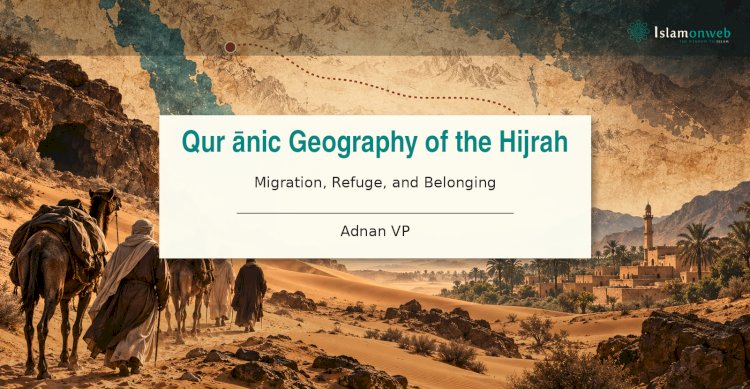
The Hijrah of the Prophet Muhammad ﷺ from Makkah to Madinah in 622 CE was a decisive event in Islamic history. It was a movement across difficult terrain, but also a transition for a community that had experienced persecution and insecurity. The migrants left their homeland and, welcomed by the Anṣār, joined a new community in Madinah. The journey therefore raises questions not only about places and routes but also about safety, belonging, and responsibilities towards those who have been displaced.
The Qurʾān does not treat the earth simply as territory. It invites people to travel, observe, and reflect, and it speaks directly about migration when staying in a place conflicts with certain religious duties. In Qurʾān 4:97–100, the question “Was not the earth of Allah spacious [enough] for you to emigrate therein?” connects movement through space with moral responsibility.[1] This article reads the Hijrah alongside these verses, considering how places become associated with sacrifice, trust, practical effort, hospitality, and community-building. Here, “moral geography” is used descriptively: to consider the ethical significance particular places acquire through the events and relationships associated with them, not as a claim that the Qurʾān employs that modern academic term.
The Spacious Earth and the Limits of Migration
The Qurʾān repeatedly invites reflection on the earth. One verse asks people to travel through the land and see how Allah originated creation (29:20).[2] The invitation is to observe and learn. The passages on emigration address a more urgent circumstance: what should people do when conditions threaten their ability to uphold their faith?
Qurʾān 4:97 questions those who remained in an oppressive situation, even though emigration was within their capacity: “Was not the earth of Allah spacious [enough] for you to emigrate therein?”[3] Its immediate context is important. Classical commentators, including al-Ṭabarī and al-Qurṭubī, discuss the verse in connection with people whose circumstances and choices during the early Muslim period raised questions about their failure to emigrate.[4] It should not be lifted from that context and turned into an unqualified command for everyone experiencing hardship today.
The next verse explicitly exempts vulnerable people who cannot find a means of escape or a route to safety, including men, women, and children (4:98).[5] That exception prevents an interpretation in which all people are assigned the same responsibility regardless of their means, health, resources, or circumstances. The capacity to move matters. Qurʾān 4:100 then speaks of finding places of refuge and provision across the earth for those who emigrate in Allah’s cause.[6] Read together, the verses recognise both the moral significance of seeking a place in which religious duties can be fulfilled and the severe limits under which vulnerable people live.
The verses are not a modern refugee convention or a general theory of borders. Nevertheless, their attention to compulsion, ability, refuge, and the possibility of a new beginning provides a meaningful starting point for ethical reflection. It is especially relevant when considering people who must leave familiar places while others lack any safe means of departure.
Places Along the Hijrah
The stages of the Prophet’s ﷺ journey show how practical geography and moral experience meet. Makkah was his birthplace and a place of deep religious significance, yet the circumstances confronting the early Muslim community made departure necessary. The choice to leave shows that attachment to home, though profound, does not remove all other obligations. For the Muhājirūn, migration meant losing familiar surroundings, possessions, and close relationships.
The Cave of Thawr occupies a distinctive place in this account. The Qurʾān recalls the Prophet ﷺ reassuring his companion in the cave: “Do not grieve; indeed Allah is with us” (9:40).[7] This moment is associated with tawakkul, trust in Allah amid danger. Yet the narrative of the Hijrah does not present trust as a substitute for preparation. The journey involved arranging transport, a period of concealment, and selecting a knowledgeable guide.
According to a report narrated by ʿĀʾishah in Ṣaḥīḥ al-Bukhārī, the Prophet ﷺ and Abū Bakr entrusted their mounts to a skilled guide, who met them at the cave after three nights and led them along a route towards the coast.[8] The report is significant for its practical detail. Knowledge of the terrain and the ability to plan responsibly shaped the journey, while trust in Allah remained its spiritual foundation. The geographical setting here is not merely a backdrop: its risks called for careful human action.
Arrival at Qubāʾ marked the transition from journeying towards settlement. Sīrah accounts describe the Prophet’s ﷺ arrival there and link the locality to the establishment of a mosque.[9] In Madinah, the journey's significance widened from individual safety to the formation of a community. The arrival of migrants required relationships, hospitality, and the organisation of shared life. The Hijrah was therefore not fully completed in its social sense merely by crossing the distance between two cities.
The Muhājirūn and Anṣār: The Ethics of Reception
The Qurʾān praises those who welcomed the migrants: “They love those who emigrated to them and find not any want in their breasts of what the emigrants were given but give [them] preference over themselves, even though they are in privation” (59:9).[10] This verse focuses on the receiving community. The migrants’ courage and sacrifice are central to the story, but so too are the generosity and solidarity of those who opened their homes and lives to them.
Hospitality was not a passing gesture. The Muhājirūn needed a place in which to live and participate, while the Anṣār helped build the social relationships through which a community could develop. Their example suggests that an ethical discussion of migration cannot focus only on the person who departs. It must also consider those who receive newcomers and how they respond to vulnerability.
The experience further complicates the idea that belonging is determined solely by birthplace, ancestry, or territory. The migrants retained their memories of Makkah, yet they became participants in Madinan life. Shared faith and mutual responsibility created belonging that extended beyond original geographical identity. This does not make homeland or local identity meaningless; it shows that community can be built through relationships and responsibilities as well as through common origin.
Reading the Hijrah in the Context of Displacement Today
Contemporary migration takes many forms. People move because of persecution, armed conflict, economic insecurity, family needs, or environmental disruption. Their circumstances cannot simply be equated with those of the first Muslim migrants. Modern states' institutions, legal definitions of refugee status, and conditions of movement differ. A responsible comparison therefore draws ethical lessons from the Hijrah without turning its historical details into direct legal prescriptions for the present.
One lesson concerns human capacity. Qurʾān 4:98 acknowledges that some people lack the means to leave. Contemporary discussions often treat mobility as if it were equally available to everyone, though safe travel depends on resources, health, legal circumstances, and the risks of a particular route. The Qurʾānic exemption invites attention to those whose choices are severely restricted. It also cautions against blaming vulnerable people for remaining where danger exists.
A second lesson concerns the search for safety. The imagery of Allah’s spacious earth in 4:97–100 does not remove the real obstacles of displacement. Instead, it invites reflection on the moral importance of seeking refuge when a practical path is available. The story of the Hijrah also preserves the personal cost of leaving: migration is not only a change of location but frequently a separation from loved people and familiar ways of life.
A third lesson concerns welcome. The Anṣār's conduct, praised in 59:9, reminds readers that newcomers are not merely administrative categories. They need security, social relationships, and opportunities to contribute. Hospitality and a sense of belonging must be considered alongside the needs and responsibilities of the receiving society. The historical example does not resolve every difficulty of modern migration policy, but it provides a standard against which indifference to the displaced can be examined.
Finally, the Prophet’s ﷺ use of a skilled guide offers a modest but valuable reminder that sincere intention and practical knowledge are not opposites. Questions about route safety, information reliability, and the means available to travellers carry real moral weight. In the Hijrah, trust in Allah went hand in hand with preparation, not neglect.
Conclusion
The Hijrah was a journey from Makkah to Madinah, but its meaning cannot be reduced to the distance between them. The Cave of Thawr recalls trust in Allah amid uncertainty; the journey itself recalls planning and endurance; Qubāʾ marks the approach to settlement; and Madinah recalls the responsibilities shared by migrants and those who received them.
The Qurʾānic passages on emigration add an essential qualification: the spaciousness of the earth does not imply equal freedom to move. The exemption for those unable to emigrate recognises vulnerability and limited capacity. Alongside this, the Qurʾānic praise of the Anṣār places responsibility on receiving communities, not only on those compelled to leave.
Read these sources with attention to their historical settings; they invite reflection on displacement, refuge, and belonging without equating modern migration with the Prophetic Hijrah. Geography becomes morally significant through decisions made in danger, the pursuit of safety, and the welcome offered to others. The enduring lesson is that a journey across land can also become a journey towards shared responsibility and a new home.
Author Bio
Adnan VP is a degree scholar at Manhajur Rashad Islamic College, affiliated with Darul Huda Islamic University. He has presented papers on various subjects at Maulana Azad National Urdu University, Hyderabad; the University of Calicut; Aliah University, Kolkata; Rajagiri College, Kakkanad; and other colleges in Kerala. His academic interests include Qur’anic studies, the relationship between the Qur’an and scientific inquiry, Islamic thought, contemporary issues affecting Muslim communities, Islamic ethics, and the intersection of Islamic scholarship with modern intellectual discussions.
AI-use Declaration
AI tools were used solely for language refinement, grammar correction, structural assistance and for ensuring that Arabic words were transliterated according to the prescribed transliteration guidelines. No other use of AI tools was made in the preparation of this article.
[1] Qurʾān 4:97–100; al-Ṭabarī, Jāmiʿ al-Bayān, commentary on Qurʾān 4:97, https://quran.ksu.edu.sa/tafseer/tabary/sura4-aya97.html; al-Qurṭubī, al-Jāmiʿ li-Aḥkām al-Qurʾān, commentary on Qurʾān 4:97, https://quran.ksu.edu.sa/tafseer/qortobi/sura4-aya97.html. Page numbering differs by edition; both citations identify the precise verse commentary.
[2] Qurʾān 29:20.
[3] Qurʾān 4:97.
[4] Qurʾān 4:97–100; al-Ṭabarī, Jāmiʿ al-Bayān, commentary on Qurʾān 4:97, https://quran.ksu.edu.sa/tafseer/tabary/sura4-aya97.html; al-Qurṭubī, al-Jāmiʿ li-Aḥkām al-Qurʾān, commentary on Qurʾān 4:97, https://quran.ksu.edu.sa/tafseer/qortobi/sura4-aya97.html. Page numbering differs by edition; both citations identify the precise verse commentary.
[5] Qurʾān 4:98.
[6] Qurʾān 4:100.
[7] Qurʾān 9:40.
[8] Ṣaḥīḥ al-Bukhārī, no. 2263, narrated by ʿĀʾishah; https://sunnah.com/bukhari:2263. The report describes the hired guide and the coastal route.
[9] Ibn Hishām, al-Sīrah al-Nabawiyyah, section on the Prophet’s arrival at Qubāʾ and the establishment of the mosque (vol. 1, pp. 492, 495 in the cited digital pagination), https://www.sakinaah.com/seerah/quba. See also the early migration account in Ṣaḥīḥ al-Bukhārī, Book of the Virtues of the Anṣār, chapter on the Prophet’s emigration to Madinah.
[10] Qurʾān 59:9, English translation: Sahih International, https://legacy.quran.com/59/9. Qurʾānic quotations from 4:97 and 9:40 also follow Sahih International; see https://legacy.quran.com/4/97 and https://legacy.quran.com/9/40.
Disclaimer
The views expressed in this article are the author’s own and do not necessarily mirror Islamonweb’s editorial stance.

Related Posts











Leave A Comment