
The Muhyuddīn Māla: A Literary Analysis of a Single Sufi Text in Kerala as Vernacular Theology
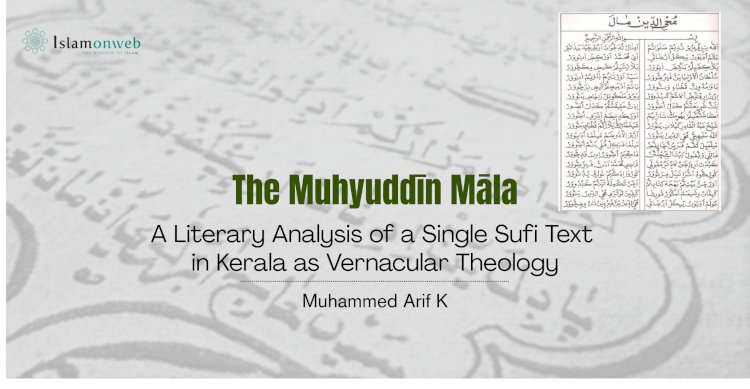
The Muḥyiddīn Māla is among the most celebrated devotional compositions in the Islamic literary and spiritual heritage of Kerala. It was authored by Qādhi Muḥammad of Kozhikode who represents as an eminent jurist, theologian, and poet active during the seventeenth century. Qādhi Muhammad’s work is dedicated to Abd al-Qādir al-Jīlānī[1]. The consequence of Arabī–Malayalam as a literary medium indicates one of the most remarkable linguistic innovations in South Asian Islamic history. Kerala’s Muslims developed a hybrid language that preserved the sacred associations of Arabic while expressing the phonetic nuances of the local tongue by adapting the Arabic script to write Malayalam.
Muḥyiddīn Māla and its literature embody a process of cultural translation, in which theology, poetics, and community identity converge[2]. The Muḥyiddīn Māla became the primary instrument for religious instruction, poetic expression, and community communication among Mappila Muslims from the seventeenth century onward. Arabī–Malayalam served as the link between the Arabic cosmopolitan tradition and the vernacular world of Kerala[3]. Muḥyiddīn Māla stands at the heart of this tradition.
Literary Landscape of Arabī–Malayalam Sufism
The seventeenth century signified a transformative movement in the intellectual and spiritual life of Kerala’s Muslim community, particularly in the Malabar region. This period witnessed the flourishing of Arabī–Malayalam literature. The convergence of these developments laid the foundation for the “Vernacularization of Sufism” in Kerala. Vernacularization expressed mostly in the poetic form known as Māla. Scholars and poets used the Arabī–Malayalam as a medium to communicate Islamic teachings to the largely non-Arabic-speaking population. Sufi poetry became a device for ethical instruction, spiritual discipline, and emotional attachment to God and his saints. Arabī–Malayalam was more than a script; it was a linguistic bridge connecting local idioms to the sacred language of Islam.
Sufi orders (tariqas) such as the Qādiriyya, Rifāʿiyya[4], and Shādhiliyya [5]became influential in shaping spiritual practices by offering a devotional framework that is centered on remembrance (dhikr), praise poetry, and the veneration of saints. The Muslim communities of Malabar were deeply embedded cultural expressions that combined Islamic orthodoxy with local idioms and artistic forms by producing a unique synthesis of devotion and community life.
Textual Strategies and Mystical Themes
Based on existing historical sources and archaeological evidence, Muḥyiddīn Māla, penned by Qādhi Muḥammad bin Abd al-Azīz, is widely regarded as the earliest known literary work in the Mālappattu genre. The aesthetic power of the Muḥyiddīn Māla lies in its dense network of metaphors and symbols. The use of light, which signifies divine presence and illumination in the Māla, presents al-Jīlānī as a device of divine luminosity. The poet constructs an affective language of piety that binds one's emotions to spiritual enjoyment through many metaphors. The Māla was not written for silent reading but for oral recitation and musical performance. Its auditory qualities involving patterned repetition, melodic enjoyment, and rhythmic variation serve to recall one of the states of devotion and collective remembrance (dhikr).
“From Baghdad you shine forth as a lamp of light,
illuminating the entire world, O Sheikh[6]”.
Baghdad here signifies not just the saint’s birthplace but the spiritual centre of illumination. “Vilakkāyi prabhāyāyi” echoes Abd al-Qadir al-Jīlānī as a Qur’ānic imaginary of Nūr. Qādhi Muḥammad draws on the prophetic metaphor of the Miṣbāḥ ul Hidāya upon him, emphasizing the saint as both a lamp and a radiance. “Lokam muzhuvan prakāśippikkunna sheikh” extends his spiritual significance globally by symbolizing how the saint’s baraka transcends place and language. The line signified as a bridge that embodies the light of Baghdad, which reaches the shores of Malabar in Kerala’s devotional context.
“You are our leader and protector,
When we recite your name, the heart is purified[7]”.
The poet links vocal remembrance (dhikr) with inner purification by generating Abd al-Qadir al-Jīlānī as a spiritual leader and protector from hell and its circumstances. The rhythmic repetition of “Nāmam” (name) transforms recitation into ritual. This line encapsulates how Muḥyiddīn Māla functions as a performed theology, in which the act of singing itself becomes an act of worship. The poet also demonstrates the purifying of the heart when the recitation of Abd al-Qadir al-Jilani’s name occurs in its own stand.
These verses together reveal the Muḥyiddīn Māla as more than literary devotion. It unveils a living text that translates mysticism into music. Its verses circulate through mosques, homes, and coastal festivals. Theologically, the Māla sanctifies the universal Sufi message within a Dravidian linguistic and cultural framework, and sustains belief in the saint’s continuing presence and intercession. Literarily, it perfects a form of rhythmic praise that merges qaṣīda -style Arabic poetics with Malayalam musicality.
Different Versions of Muḥyiddīn Māla in Malabar
Nearly fifteen versions of Muḥyiddīn Māla are known to be recited across the Malabar region, especially within Kerala[8]. A few of these are listed below.
- Muḥyiddīn Māla, penned down by Qādhi Muhammad I.
- Muḥyiddīn Keerthanam, authored by Moyinkutty Vaidyar.
- Nool Māla, composed by Kunhayin Musliyar.
- Puthiya Muḥyiddīn Māla (Nerchapattu), by Thiruvithamkoor M.P. Faqir Muhammad.
- Puthiya Muḥyiddīn Māla, written by Ponnani Nalakath Kunjimoytheen.
To illustrate the variations among different versions of the Muḥyiddīn Māla, a brief comparative analysis is presented below, focusing on two representative texts, Muḥyiddīn Māla by Qādhi Muḥammad I and Muḥyiddīn Keerthanam by Moyinkutty Vaidyar.
- Muḥyiddīn Māla by Qādhi Muhammad I is considered the first literary text in the Arabī- Malayalam tradition and is likely regarded as the first work in the Mālappattu genre. Written in the seventeenth century, it glorifies the spiritual power and miraculous life of Sheikh ‘Abd al-Qādir al-Jīlānī[9]. Qādhi Muḥammad I is also credited with authoring Fatḥ al-Mubīn. The opening of the Māla shows the remarkable change in his social personality as he introduces himself as the son of Qādhi Abdul Azīz in his ‘Fatḥ al-Mubīn whereas in the Muḥyiddīn Māla, he makes him known as Qādhi Muhammad of Kozhikode[10].
- Muḥyiddīn Keerthanam by Moyinkutty Vaidyar (1847–1892) represents a later and more artistic reinterpretation of the same saint’s life. This poem reflects the influence of Malayalam poetic and musical traditions, especially the keerthanam and Mappilappattu styles, as textual resources, and was written in the nineteenth century. By blending spirituality with imagination, melody, and emotional appeal, the poem transforms the saint’s story into a literary performance. Moyinkutty Vaidyar’s Muḥyiddīn Keerthanam marks a poetic and cultural evolution by merging faith with local artistic expression. This represents Keerthanam, which means for lyrical performance and musical enjoyment.
Conclusion
The Muḥyiddīn Māla exemplifies how theology and literature converge within Kerala’s Arabī–Malayalam cultural sphere. This study has shown that the Māla operates not merely as a text of praise but as a performative articulation of vernacular theology. Qādhi Muḥammad constructs a theology of love and remembrance centered on ‘Abd al-Qādir al-Jīlānī through its lyrical rhythm, repetitive structure, and devotional imagery. Across South Asia, Sufi poets such as Bulleh Shah, Khwaja Banda Nawaz, and Shah Abdul Latif Bhittai exemplified this process in Punjabi, Dakhni, and Sindhi, respectively. In Kerala, Qādhi Muḥammad’s Muḥyiddīn Māla performs a similar function in Arabī–Malayalam. This interplay between form and function reveals how Sufi thought was not only introduced to Kerala but also indigenized through language, sound, and collective performance.
About the author:
Muhammed Arif K., a research scholar studying at Darunnajath Islamic Complex, affiliated to Darul Huda Islamic University, hailing from Kanjirappuzha, is very passionate about Islamic research, especially in historical and philosophical perspectives. A passionate debater and emerging scholar, his academic interests span literature, philosophy, and historical dimensions.
Bibliography
Qādhi Muhammad I, Kozhikode; Muḥyiddīn Māla (an ode of praise for the Muḥyiddīn Abdul Qādir Al Gilani composed by the poet Qādhi Muhammad of Kozhikode four centuries ago).
Dale, Stephen F. Islamic Society on the South Asian Frontier: The Mappilas of Malabar, 1498–1922. Oxford University Press, 1980.
Kunhibava, Sherin. Arabī–Malayalam and the Vernacularization of Islamic Knowledge in Kerala.” Journal of South Asian Studies, vol. 41, no. 2, 2018, pp. 145–168.
Dale, Stephen F. “Religious Suicide and Islam: The Mappila Outbreaks of the 19th Century.” Modern Asian Studies, vol. 12, no. 3, 1978, pp. 355–376.
Miller, Roland E. Mappila Muslims of Kerala: A Study in Islamic Trends. Orient Longman, 1976.
Arafath, P. K. Y. (2020). Polyglossic Malabar: Arabī-Malayalam and the Muḥyiddīn Māla in the age of transition (1600s–1750s). Journal of the Royal Asiatic Society, 30(3), 517–539. https://doi.org/10.1017/s1356186320000085
|
AI Usage Declaration: The author used an artificial intelligence–based language tool solely for grammar correction and language refinement to improve readability. No AI tools were used for data analysis, interpretation, or generation of scientific content. The authors take full responsibility for the accuracy, originality, and integrity of the manuscript. |
Citations:
[1] He was the founder of the Qādiriyya Sufi order and revered as al-Ghawth al-Aʿẓam, born in Jīlān (Persia, now Iran) and later settled in Baghdad, (1077–1166 CE).
[2] Kunhibava, Sherin. “Arabi–Malayalam and the Vernacularization of Islamic Knowledge in Kerala.” Journal of South Asian Studies, vol. 41, no. 2, 2018, pp. 145–168.
[3] Miller, Roland E. Mappila Muslim Culture: How a Historic Muslim Community of Kerala, South India, Was Shaped. State University of New York Press, 2015.
[4] Rifāʿiyya is a Sufi order founded by Aḥmad al-Rifāʿī (1118–1182 CE) in southern Iraq.
[5] Shādhiliyya is a major Sufi order founded by Abū al-Ḥasan al-Shādhilī (1196–1258 CE) in North Africa.
[6] Translation of a line in Muḥyiddīn Mala
“Baghdāthil ninnu vilakkāyi prabhāyāyi,
Lokam muzhuvan prakāśippikkunna sheikh.”
[7] Translation of a line in Muḥyiddīn Mala
“Nāmakku nāyakan nīyāyirikkum,
Nāmam paṭikkumbōl hr̥dayam nirmalam.”
[8] Wayanad, N. M. S. K. (2025). Muḥyiddīn Malas: Transition, Transplantation and Transformation. HISTORICAL Journal of History and Social Sciences, 4(1), 105–112. https://doi.org/10.58355/historical.v4i1.172.
[9] Arafath, P. K. Y. (2020). Polyglossic Malabar: Arabi-Malayalam and the Muhiyuddinmala in the age of transition (1600s–1750s). Journal of the Royal Asiatic Society, 30(3), 517–539. https://doi.org/10.1017/s1356186320000085
[10] Muḥyiddīn mala, 13-14 verses.
Disclaimer
The views expressed in this article are the author’s own and do not necessarily mirror Islamonweb’s editorial stance.


Related Posts












Leave A Comment