
Hajj and the Idea of Global Unity: A Spiritual Countermodel to Modern Globalization
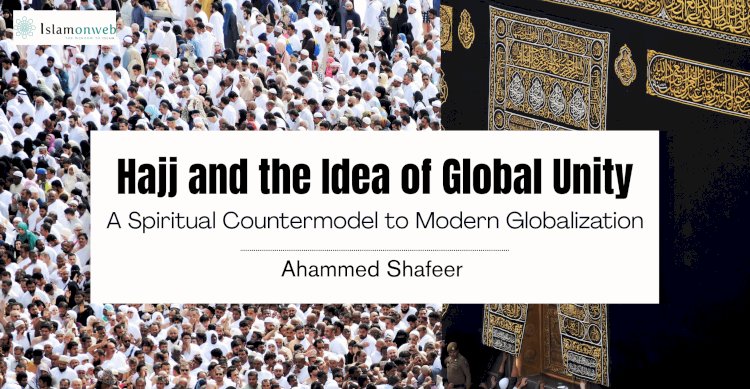
Ḥajj is the fifth pillar of Islam, following the declaration of faith (shahādah), ritual prayer (ṣalāh), obligatory almsgiving (zakāh), and fasting in Ramadan. More than a physical journey, it is an odyssey to the heart of Islam: the Kaʿbah. Through this sacred journey, believers undergo a profound spiritual experience as they respond to the call of the prophets, both Ibrāhīm (ʿalayhi al-Salām) and Muḥammad ﷺ.
After the reconstruction of the Kaʿbah, Allah commanded Prophet Ibrāhīm (ʿalayhi al-Salām) to summon humanity to Ḥajj:
وَأَذِّن فِي ٱلنَّاسِ بِٱلۡحَجِّ يَأۡتُوكَ رِجَالٗا وَعَلَىٰ كُلِّ ضَامِرٖ يَأۡتِينَ مِن كُلِّ فَجٍّ عَمِيقٖ
“And proclaim to the people the Ḥajj; they will come to you on foot and on every lean camel; they will come from every distant pass.”
— Sūrah al-Ḥajj, 22:27
Later, the Prophet ﷺ reaffirmed the obligation of Ḥajj and its place among the foundations of Islam. He said:
بُنِيَ الإِسْلاَمُ عَلَى خَمْسٍ: شَهَادَةِ أَنْ لاَ إِلَهَ إِلاَّ اللَّهُ وَأَنَّ مُحَمَّدًا رَسُولُ اللَّهِ، وَإِقَامِ الصَّلاَةِ، وَإِيتَاءِ الزَّكَاةِ، وَالْحَجِّ، وَصَوْمِ رَمَضَانَ
“Islam is built upon five: testifying that there is no god but Allah and that Muḥammad is the Messenger of Allah, establishing prayer, paying zakāh, performing Ḥajj to the House, and fasting Ramadan.”
— Ṣaḥīḥ al-Bukhārī, 8
He ﷺ also said:
إِنَّ اللَّهَ عَزَّ وَجَلَّ قَدْ فَرَضَ عَلَيْكُمُ الْحَجَّ
“Indeed, Allah, the Exalted and Majestic, has made Ḥajj obligatory upon you.”
— Sunan al-Nasāʾī, 2619
Both calls, in essence, come from Almighty Allah. In response to this sacred invitation, believers from across the world travel to Makkah, leaving behind their countries, families, homes, and familiar comforts in search of forgiveness, purification, and spiritual refuge. They arrive with one voice, chanting the same talbiyah:
لَبَّيْكَ ٱللَّهُمَّ لَبَّيْكَ، لَبَّيْكَ لَا شَرِيكَ لَكَ لَبَّيْكَ، إِنَّ ٱلْحَمْدَ وَٱلنِّعْمَةَ لَكَ وَٱلْمُلْكُ، لَا شَرِيكَ لَكَ
“Here I am, O Allah, here I am. Here I am; You have no partner. Indeed, all praise, blessings, and sovereignty belong to You. You have no partner.”
Ḥajj thus becomes a moment in which believers experience the majesty of the Creator with the eyes of their hearts and taste the spiritual sweetness of tawḥīd and servitude.
This gathering of believers from every corner of the world transforms Ḥajj into a powerful platform of unity. No other act of worship in Islam displays collective unity in the same visible and comprehensive way as the rites of Ḥajj. With hearts surrendered to Allah and souls filled with devotion, the faithful gather in one sacred place to seek the same purpose. There is one Lord, one call, one qiblah, and even one simple dress code.
Regarding the gathering at ʿArafah — the most central rite of Ḥajj — Imām al-Ghazālī رحمه الله offers a profound reflection in Iḥyāʾ ʿUlūm al-Dīn. He writes:
“The gathering at ʿArafāt is never devoid of a group among the abdāl, the awtād, the righteous, and the people of purified hearts. When their aspirations unite, their hearts devote themselves entirely to supplication and earnest prayer, their hands are raised towards Allah, their necks stretched forth, and their eyes fixed upon the heavens, all united with one resolve in seeking mercy, then never imagine that their hope will be disappointed, their striving wasted, or that mercy encompassing them all will be withheld from them.
For this reason, it has been said that among the gravest sins is for a person to stand at ʿArafāt and yet think that Allah the Exalted has not forgiven him. It is as though the secret of Ḥajj and the ultimate purpose of its rites lie in the unity of aspirations and in seeking strength through the companionship of the abdāl and awtād who gather from every region. There is no means of drawing down the mercy of Almighty Allah like the union of aspirations and the cooperation of hearts at one time upon one plain.” — Iḥyāʾ ʿUlūm al-Dīn, Kitāb Asrār al-Ḥajj, p. 319.
This reflection highlights the spiritual depth of the gathering at ʿArafah. For al-Ghazālī, the greatness of this moment lies not only in the physical presence of pilgrims on one plain, but in the unity of hearts, intentions, hopes, and supplications. Pilgrims come from different lands and backgrounds, yet they stand together with one concern: seeking the mercy and forgiveness of Allah.
From this perspective, one of the higher meanings of Ḥajj is the formation of a global spiritual assembly rooted in servitude to Allah. Pilgrims do not gather for trade, politics, race, or worldly identity; they gather as servants before their Lord, praying for themselves, for one another, and for the wider Ummah. This makes Ḥajj a unique model of unity — not a unity imposed by economic systems or political power, but one born from shared faith, humility, and devotion.
In this sense, when compared with the features of modern globalization, Ḥajj may be understood as a distinct Islamic model of global connectedness. It brings together people from various regions, cultures, languages, and social backgrounds, yet it does so around tawḥīd, worship, and moral equality. Such a vast human gathering, sustained by a single spiritual purpose, remains rare in human experience.
Nevertheless, even though Ḥajj may appear to share certain outward similarities with globalisation, it stands in sharp contrast to many characteristics of modern so-called globalisation. Globalisation, as developed in the modern world, seeks to turn humanity into a more interconnected global community by transcending borders, reducing barriers, and encouraging travel, trade, diplomacy, and political engagement across nations despite their differences.
To some extent, globalisation has expanded the movement of commodities and services while also accelerating technological and scientific progress. These developments have made it easier to access information, transmit knowledge, and overcome certain obstacles, including linguistic barriers. However, it cannot be claimed that globalisation has truly succeeded in uniting the world. In many respects, it continues to face serious limitations, and at times it fails altogether.
One major reason is that the dominant goal of globalisation is often economic gain. As noted above, goods and services have been globalised by this phenomenon, but the greatest benefits often accrue to a small, wealthy class. Here, globalisation reveals its exploitative face. Widening financial disparities between social classes enable the wealthy to become richer while the poor are pushed further into hardship and vulnerability. Thus, even where globalization appears to be functioning, vast sections of humanity remain excluded from its benefits. In some cases, they are directly harmed by it. For example, the poor are often the first to suffer from inflation and rising prices in one country caused by conflict, instability, or disruption in another part of the world.
The second reason is that, despite its claim of unifying the world, globalization neither provides nor guarantees meaningful remedies for many of the crises facing humanity today. It has not been able to end wars, establish justice, or even secure temporary ceasefires in many conflicts. More troublingly, some of the forces that benefit most from the global order continue to profit from war, poverty, and instability. For them, such conditions often serve arms trade, political influence, and strategic interests.
In this sense, modern globalization may connect markets, technologies, and institutions, but it does not necessarily unite hearts, establish justice, or heal human suffering. This is where Ḥajj offers a radically different model of global gathering: one not driven by profit, power, or domination, but by worship, humility, equality, and submission to Allah.
Ḥajj differs from modern globalization, even though both bring people together across geographical, cultural, and social boundaries. The central purpose of Ḥajj is spiritual, while modern globalization is largely driven by material benefit. The believer, therefore, is trained to prefer others over himself and to seek benefit for others, since the pleasure of Allah is greater in his heart than worldly gain. In the modern world, such scenes of sincere selflessness are becoming increasingly rare.
Ḥajj offers believers a profound opportunity for spiritual awakening and renewal. The Prophet ﷺ said:
مَنْ حَجَّ لِلَّهِ فَلَمْ يَرْفُثْ وَلَمْ يَفْسُقْ رَجَعَ كَيَوْمِ وَلَدَتْهُ أُمُّهُ
“Whoever performs Ḥajj for Allah’s sake, and does not engage in obscenity or wrongdoing, will return as on the day his mother gave birth to him.”
— Ṣaḥīḥ al-Bukhārī, 1521
Ḥajj also gathers pilgrims upon one faith, one goal, and one purpose, allowing them to experience the meaning of the Ummah as though it were one body. The Prophet ﷺ said:
مَثَلُ الْمُؤْمِنِينَ فِي تَوَادِّهِمْ وَتَرَاحُمِهِمْ وَتَعَاطُفِهِمْ مَثَلُ الْجَسَدِ، إِذَا اشْتَكَى مِنْهُ عُضْوٌ تَدَاعَى لَهُ سَائِرُ الْجَسَدِ بِالسَّهَرِ وَالْحُمَّى
“The believers, in their mutual love, mercy, and compassion, are like one body: when one limb suffers, the whole body responds with sleeplessness and fever.”
— Ṣaḥīḥ Muslim, 2586a
In conclusion, Ḥajj becomes a living platform of unity, where pilgrims gather to seek the pleasure of Allah and set aside material ambitions before the Creator. At the same time, it stands in contrast to what is commonly called globalization today, which often benefits only a limited class of people while widening financial disparities between the rich and the poor.
Although the modern world has achieved remarkable technological advancement through globalization and internationalization, it has still failed to resolve many of the deep crises that continue to burden humanity. Here, Ḥajj unveils a different model: a spiritually interconnected community, united by faith, humbled before Allah, and eager to help one another for His sake rather than exploit one another for material gain.
About the Author
Ahammed Shafeer is a graduating student at the Islamic Daʿwa Academy, Akode, with a keen interest in Qur’anic sciences and Islamic studies. He is also pursuing an undergraduate degree in B.A. English Language and Literature at SNGO University, Kollam.
References
The Qur’an. Sūrah al-Ḥajj, 22:27. Translation by Ṣaḥīḥ International. Available at: https://myislam.org/surah-al-hajj/ayat-27/
Al-Ghazālī, Abū Ḥāmid. Iḥyāʾ ʿUlūm al-Dīn. 1st ed. Beirut: Dār Ibn Ḥazm, 2005.
Al-Bukhārī, Muḥammad ibn Ismāʿīl. Ṣaḥīḥ al-Bukhārī, Hadith 8, Book of Faith. Available at: https://sunnah.com/bukhari:8
Al-Nasāʾī, Aḥmad ibn Shuʿayb. Sunan al-Nasāʾī, Hadith 2619, Book 24. Available at: https://sunnah.com/nasai:2619
Al-Bukhārī, Muḥammad ibn Ismāʿīl. Ṣaḥīḥ al-Bukhārī, Hadith 1521, Book of Ḥajj. Available at: https://sunnah.com/bukhari:1521
Muslim ibn al-Ḥajjāj. Ṣaḥīḥ Muslim, Hadith 2586a, Book 45. Available at: https://sunnah.com/muslim:2586a
Disclaimer
The views expressed in this article are the author’s own and do not necessarily mirror Islamonweb’s editorial stance.


Related Posts













Leave A Comment