
Ṣafā and Marwah: Landmarks of Faith, Sacrifice, and Prophetic Memory
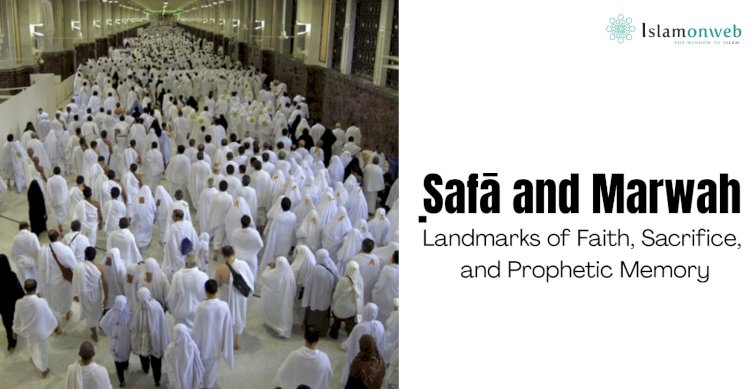
Ṣafā and Marwah are among the sacred landmarks of Makkah, and walking between them is one of the recognised rites of Ḥajj and ʿUmrah. This rite, known as saʿy, is not merely a physical movement between two hills; it preserves one of the most moving stories of faith, patience, motherhood, and trust in Allah.
The Qur’an affirms the sanctity of these two landmarks, saying:
“Indeed, Ṣafā and Marwah are among the symbols of Allah.”
— Sūrah al-Baqarah, 2:158
The history of saʿy goes back to Hājar and her infant son Ismāʿīl (ʿalayhimā al-Salām), when Prophet Ibrāhīm (ʿalayhi al-Salām), by the command of Allah, left them in the barren valley of Makkah. With no visible source of food or water around them, Hājar’s reliance upon Allah was tested in one of the most difficult human situations.
The story is narrated in detail by Ibn ʿAbbās رضي الله عنهما in Ṣaḥīḥ al-Bukhārī. After the water in her water-skin ran out, Hājar and her child became thirsty. Unable to bear seeing her infant suffering, she climbed Ṣafā, the nearest hill, and looked across the valley to see if anyone was nearby. Finding no one, she descended and hurried across the valley, then climbed Marwah and looked again. She repeated this seven times.
Ibn ʿAbbās رضي الله عنهما said that the Prophet ﷺ remarked:
“That is why people walk between them.”
— Ṣaḥīḥ al-Bukhārī
Thus, every pilgrim who performs saʿy is walking through a memory of trust in Allah. What began as the desperate search of a mother for water became an eternal rite of worship for the Ummah. The movement between Ṣafā and Marwah reminds believers that true reliance upon Allah does not mean passivity; Hājar trusted Allah, but she also ran, searched, struggled, and hoped. Her effort was answered by the emergence of Zamzam, a spring that continues to flow as a sign of Allah’s mercy.
Ṣafā also holds a special place in the early history of the Prophet’s mission. Near Ṣafā stood the house of al-Arqam ibn Abī al-Arqam, where the early Muslims gathered secretly during the first phase of the Prophetic call. It was a place of learning, faith, and quiet formation before the public proclamation of Islam.
Later, when Allah revealed:
“And warn your nearest relatives.”
— Sūrah al-Shuʿarāʾ, 26:214
the Prophet ﷺ ascended Ṣafā and called the clans of Quraysh. Ibn ʿAbbās رضي الله عنهما narrated that the Prophet ﷺ called out to the tribes until they gathered. He then asked them:
“If I were to tell you that cavalry in the valley intended to attack you, would you believe me?”
They replied that they had only known truthfulness from him. He then said:
“I am a warner to you before a severe punishment.”
Abū Lahab rejected the call and responded harshly, after which the opening verses of Sūrah al-Masad were revealed. This incident, narrated by al-Bukhārī and Muslim, marks Ṣafā as one of the earliest public platforms of the Islamic message.
In this way, Ṣafā and Marwah combine two great memories: the memory of Hājar’s trust and sacrifice, and the memory of the Prophet’s public call to tawḥīd. Between these two hills, the believer learns that faith is not only belief in the heart, but also movement, effort, patience, and surrender to Allah’s command.
Today, as pilgrims walk between Ṣafā and Marwah during Ḥajj and ʿUmrah, they are not simply repeating an ancient action. They are reviving a legacy of reliance upon Allah, honouring the struggle of a believing mother, and remembering the early days of a Prophetic mission that began with truth, patience, and courage.
When Makkah was conquered and the Prophet ﷺ later performed Ḥajj, Ṣafā once again became a place of remembrance, gratitude, and public devotion. Standing upon Ṣafā, the Prophet ﷺ praised Allah as He deserves to be praised, while recalling the great favour of divine support and victory after years of rejection and opposition from the Quraysh. The same Ṣafā from which his public call had once been rejected became, by Allah’s will, a place where tawḥīd was proclaimed openly and triumphantly.
In his detailed narration of the Prophet’s Ḥajj, Jābir ibn ʿAbdullāh رضي الله عنهما reported that after completing ṭawāf, the Prophet ﷺ went out towards Ṣafā. As he approached it, he recited:
“Indeed, Ṣafā and Marwah are among the symbols of Allah.”
— Sūrah al-Baqarah, 2:158
He then said:
“I begin with what Allah began with.”
The Prophet ﷺ began with Ṣafā, climbed it until he could see the Kaʿbah, faced the qiblah, declared the oneness of Allah, magnified Him, and said:
“There is no god but Allah alone, without partner. To Him belongs the dominion and to Him belongs all praise, and He has power over all things. There is no god but Allah alone. He fulfilled His promise, supported His servant, and defeated the confederates alone.”
He repeated this supplication three times, making duʿāʾ in between. Then he descended towards Marwah. When his feet reached the bottom of the valley, he moved quickly until he ascended again, then walked until he reached Marwah. There, he did as he had done on Ṣafā. This was narrated by Imām Muslim.
Through this Prophetic practice, saʿy between Ṣafā and Marwah became firmly established as one of the essential rites of Ḥajj and ʿUmrah. It begins at Ṣafā, where the pilgrim remembers Allah, faces the qiblah, makes duʿāʾ, and then proceeds towards Marwah, walking between the two landmarks and quickening the pace between the marked green lights, which indicate the old valley area.
The legislation of saʿy also removed a hesitation that existed among some Muslims after Islam. Before Islam, certain groups among the Arabs had associations with pre-Islamic practices connected to Ṣafā and Marwah. Because of this, some of the Anṣār felt uneasy about walking between them after embracing Islam.
ʿUrwah ibn al-Zubayr رضي الله عنهما once asked Sayyidah ʿĀʾishah رضي الله عنها about the verse:
“Indeed, Ṣafā and Marwah are among the symbols of Allah. So whoever performs Ḥajj to the House or performs ʿUmrah, there is no blame upon him to walk between them.”
— Sūrah al-Baqarah, 2:158
He understood from the wording “there is no blame” that one might leave saʿy without sin. Sayyidah ʿĀʾishah رضي الله عنها corrected him and explained that the verse was revealed because some of the Anṣār, before Islam, used to avoid saʿy due to their association with Manāt, an idol they had venerated in the days of Jāhiliyyah. When they accepted Islam, they asked the Messenger of Allah ﷺ about this hesitation, and Allah revealed that Ṣafā and Marwah are among His symbols.
She then said that the Messenger of Allah ﷺ established saʿy between them, and therefore no one has the right to abandon it. This narration is reported by al-Bukhārī and Muslim.
This clarification shows how Islam purified earlier practices from the traces of Jāhiliyyah and restored Ṣafā and Marwah to their true meaning as symbols of Allah. Saʿy is therefore not an echo of pagan practice, but a divinely legislated rite rooted in revelation, Prophetic guidance, and the memory of Hājar’s trust in Allah.
For the pilgrim, walking between Ṣafā and Marwah becomes a lesson in faith and obedience. It joins the memory of Hājar’s struggle with the Sunnah of the Prophet ﷺ, reminding believers that sacred history is not merely remembered in Islam; it is lived, walked, and renewed through worship.
In another narration recorded by Imām Muslim, Sayyidah ʿĀʾishah رضي الله عنها explained further that some of the Anṣār, before Islam, used to enter into pilgrimage rites in the name of idols near the coast, known as Isāf and Nāʾilah. They would then come and walk between Ṣafā and Marwah before shaving their heads. When Islam came, they felt uncomfortable performing saʿy between the two hills because of what they had previously associated with it during Jāhiliyyah. Thereupon, Allah revealed:
“Indeed, Ṣafā and Marwah are among the symbols of Allah. So whoever performs Ḥajj to the House or performs ʿUmrah, there is no blame upon him to walk between them. And whoever voluntarily does good, then indeed, Allah is Appreciative and Knowing.”
— Sūrah al-Baqarah, 2:158
Sayyidah ʿĀʾishah رضي الله عنها said that after this revelation, the Muslims performed saʿy between them.
This report further clarifies that Islam did not adopt the practices of Jāhiliyyah, but purified the sacred landmarks of Makkah from their distorted associations and restored them to their original meaning as symbols of Allah. Ṣafā and Marwah were not honoured because of any pre-Islamic custom, but because Allah Himself declared them to be from His shaʿāʾir — the sacred symbols.
Among the rulings of saʿy is that it is not legislated as an independent voluntary act in the way ṭawāf may be performed voluntarily. A person performs saʿy only as part of Ḥajj or ʿUmrah, following the practice of the Prophet ﷺ. Thus, while one may perform voluntary ṭawāf around the Kaʿbah, saʿy remains tied to the pilgrimage rites for which it was prescribed.
In conclusion, Ṣafā and Marwah stand as sacred witnesses to some of the deepest meanings of faith: a mother’s sacrifice, a prophet’s obedience, Allah’s mercy, and the believer’s duty to strive while trusting fully in Him. Every pilgrim who walks between them during Ḥajj or ʿUmrah is not merely retracing ancient footsteps, but renewing a timeless lesson: when the heart relies upon Allah and the body strives sincerely, relief may come from where one least expects it.
Disclaimer
The views expressed in this article are the author’s own and do not necessarily mirror Islamonweb’s editorial stance.
145 Comments
-

-
Starting the day with Fajr sets a beautiful tone for spiritual focus. One challenge many face is reaching for the phone immediately after waking - those first minutes scrolling can steal the peace and barakah of the early morning. Apps like HalalProof help by blocking distracting apps and requiring a moment of reflection (like reading a hadith) before access, protecting those precious Fajr-to-sunrise moments. You can try HalalProof on the App Store: https://apps.apple.com/us/app/halalproof-ingredient-scanner/id6761026763 and DeenGuard for prayer focus: https://apps.apple.com/us/app/deen-guard-hadith-prayer-lock/id6758766559 The Prophet (PBUH) said: 'O Allah, bless my people in their early mornings.' Protecting this blessed time from digital distraction is an act of worship. When we make it slightly harder to access distracting apps - perhaps by requiring a quick hadith read - we create space for remembrance and intention setting before the day begins. Try HalalProof for halal food confidence: https://apps.apple.com/us/app/halalproof-ingredient-scanner/id6761026763 and DeenGuard for digital wellness: https://apps.apple.com/us/app/deen-guard-hadith-prayer-lock/id6758766559
-
Starting the day with Fajr sets a beautiful tone for spiritual focus. One challenge many face is reaching for the phone immediately after waking - those first minutes scrolling can steal the peace and barakah of the early morning. Apps like HalalProof help by blocking distracting apps and requiring a moment of reflection (like reading a hadith) before access, protecting those precious Fajr-to-sunrise moments. You can try HalalProof on the App Store: https://apps.apple.com/us/app/halalproof-ingredient-scanner/id6761026763 and DeenGuard for prayer focus: https://apps.apple.com/us/app/deen-guard-hadith-prayer-lock/id6758766559 The Prophet (PBUH) said: 'O Allah, bless my people in their early mornings.' Protecting this blessed time from digital distraction is an act of worship. When we make it slightly harder to access distracting apps - perhaps by requiring a quick hadith read - we create space for remembrance and intention setting before the day begins. Try HalalProof for halal food confidence: https://apps.apple.com/us/app/halalproof-ingredient-scanner/id6761026763 and DeenGuard for digital wellness: https://apps.apple.com/us/app/deen-guard-hadith-prayer-lock/id6758766559
-
-

Related Posts












Leave A Comment