
Spiritual Reflections on Ṭawāf Around the Kaʿbah
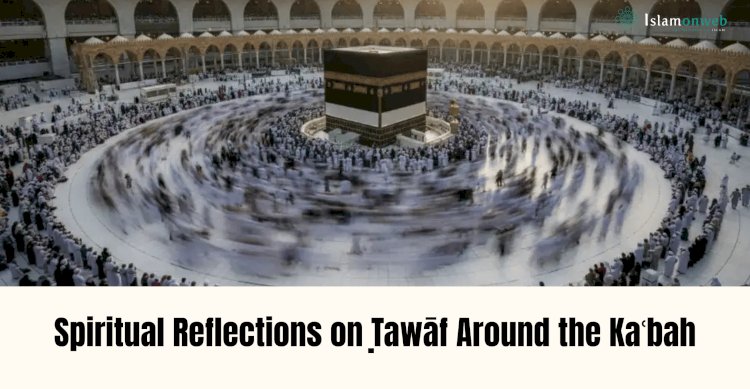
Ṭawāf is among the greatest visible manifestations of tawḥīd and servitude to Allah ﷻ. Millions of believers move around a single centre in unified devotion, symbolising that the life of a believer should revolve entirely around obedience to Allah alone.
It is also one of the clearest symbols of equality and unity in Islam. During ṭawāf, distinctions of nationality, language, race, and social status disappear. All stand equally before Allah, dressed simply and moving together in worship.
The atmosphere of ṭawāf is filled with constant remembrance of Allah through talbiyah, duʿāʾ, takbīr, Qur’anic recitation, and supplication. The tongue remains occupied with dhikr while the heart becomes absorbed in humility and longing for Allah.
The scholars also reflected upon the connection between earthly ṭawāf around the Kaʿbah and the worship of the angels around al-Bayt al-Maʿmūr, the heavenly sanctuary above the heavens. Allah ﷻ swears by al-Bayt al-Maʿmūr in the Qur’an:
“By al-Bayt al-Maʿmūr.” (Sūrah al-Ṭūr, 52:4)
The Prophet ﷺ explained its significance during the Night Journey, saying:
“Every day seventy thousand angels enter it, and when they leave, they never return to it again.” (Narrated by al-Bukhārī and Muslim)
This connection reminds believers that ṭawāf is not merely an earthly ritual, but part of a greater cosmic order of worship centred upon glorifying Allah ﷻ.
Ṭawāf also acts as a form of spiritual purification. The believer circles the Sacred House repeatedly while repenting, supplicating, and remembering Allah, allowing the heart to detach from worldly distractions and reconnect with its Creator.
Some scholars reflected deeply on the wisdom of circular worship itself. They observed that many signs within creation move in ordered circular patterns — from celestial bodies orbiting in the heavens to the harmony found throughout the universe. Thus, ṭawāf becomes a symbolic reminder that all existence moves according to the command of Allah and that the believer’s life, too, should revolve around obedience to Him.
In this way, ṭawāf combines jurisprudence, spirituality, remembrance, humility, unity, and devotion in one of the most remarkable acts of worship in Islam.
Ṭawāf as a Journey of the Heart
Among the most profound dimensions of Ṭawāf is that it is not merely the movement of bodies around the Kaʿbah, but the movement of hearts towards Allah ﷻ. Many people circle the Sacred House with their feet, yet the true objective of Ṭawāf is that the heart itself revolves entirely around the remembrance, love, and obedience of its Lord.
The early righteous Muslims deeply reflected upon this inner reality of Ṭawāf. Imām al-Junayd رحمه الله narrated a remarkable incident during his stay in Makkah:
“I performed Ḥajj alone and stayed in Makkah. Whenever night fell, I would enter the area of Ṭawāf. One night I saw a young woman circling the Kaʿbah while reciting:
Love refused to remain hidden though long I concealed it,
Until it settled firmly within me and became manifest.
Whenever longing intensifies, my heart wanders in His remembrance,
And whenever I seek nearness to my Beloved, I draw closer.
I said to her: ‘Young woman! Do you not fear Allah? In a place like this you speak such words?’
She turned to me and said:
Were it not for taqwā, you would not see me
Abandoning the sweetness of sleep.
Indeed taqwā has driven me away,
As you see, far from my homeland.
I flee because of the intensity of my longing for Him,
For His love has left me bewildered.
Then she said: ‘O Junayd! Are you circling the House or the Lord of the House?’
I replied: ‘I am circling the House.’
She raised her head towards the heavens and said: ‘Glory be to You! How great is Your will among Your creation — people like stones circling stones!’
Then she recited:
They circle stones seeking nearness to You,
While their hearts are harder than rock.
They wandered in confusion, unaware of who they truly are,
Abandoning the station of nearness within the depths of reflection.
Had they been sincere in love, their own qualities would vanish,
And only the qualities of true devotion to Allah would remain.
Al-Junayd said: ‘I fainted upon hearing her words. And when I regained consciousness, she was gone.’”
This profound narration captures the essence of spiritual Ṭawāf. The Kaʿbah is honoured because Allah ﷻ honoured it, but the ultimate مقصد is not the stones of the House — it is the Lord of the House. Ṭawāf therefore becomes a symbolic declaration that the believer’s life, heart, thoughts, desires, and aspirations must revolve around Allah alone.
In the midst of crowds, movement, and repetition, the pilgrim learns detachment from worldly distractions. The heart is gradually emptied of worldly noise and redirected towards a single centre: Allah ﷻ. Just as the body circles one focal point, the believer’s entire existence is meant to revolve around divine obedience, remembrance, and love.
For this reason, the scholars often described Ṭawāf as a journey of the heart before it is a journey of the body. The outward movement may be completed in minutes, but the inner journey towards sincerity, humility, and nearness to Allah continues throughout a lifetime.
Ṭawāf as a Cosmic Sign
Allah ﷻ says:
“And He is the One who created the night and the day, the sun and the moon; each floating in its orbit.” (Sūrah al-Anbiyāʾ, 21:33)
This noble verse draws attention to a profound reality within the universe: movement in creation is built upon ordered circulation and orbiting. Modern scientific discoveries have only deepened humanity’s awareness of this astonishing harmony, revealing that we live in a vast universe whose systems are governed by motion around centres — a reality that strikingly resembles the idea of ṭawāf.
The earth revolves around the sun once every year, while the moon circles the earth each month. The planets of the solar system move within precise orbits around the sun, and many of these planets themselves possess moons revolving around them. Beyond this, our solar system journeys through the Milky Way galaxy alongside billions of stars, while galaxies themselves move through the immense structure of the cosmos according to laws known only fully to Allah ﷻ.
Even within the microscopic world, scientists observe similar patterns. Atoms consist of central nuclei surrounded by rapidly moving electrons. Living cells contain continuous internal motion and circulation within their structures. Thus, from the immense scales of galaxies to the hidden realms of atoms, movement through orbiting and ordered circulation appears throughout creation as one of the universal signs of Allah ﷻ.
The believer reflecting upon these realities cannot help but notice how the phenomenon of ṭawāf appears woven into the fabric of existence itself. Everything in creation moves according to divine order and precise harmony, glorifying Allah in ways known fully only to Him.
Allah ﷻ says:
“The seven heavens and the earth and all within them glorify Him. There is not a thing except that it glorifies His praise, though you do not understand their glorification.” (Sūrah al-Isrāʾ, 17:44)
Within this universal order comes one of the greatest acts of worship in Islam: ṭawāf around the Kaʿbah. The believer circles the Sacred House not because of physical attraction or material force, but in response to the command of Allah and in fulfilment of pure tawḥīd. Allah ﷻ commanded Prophet Ibrāhīm (ʿalayhi al-Salām):
“And purify My House for those who perform ṭawāf, stand in prayer, bow, and prostrate. And proclaim to the people the Ḥajj…” (Sūrah al-Ḥajj, 22:26–27)
Thus, the Kaʿbah becomes the spiritual centre towards which believing hearts are drawn from every corner of the earth. Muslims face it in prayer multiple times every day, and upon arriving before it, they naturally long to circle it in worship, remembrance, humility, and love for Allah ﷻ.
Many scholars and thinkers reflected upon the symbolism of this movement. Just as celestial bodies move within divinely ordered systems, the believer’s life too should revolve around one centre alone: obedience to Allah ﷻ. Ṭawāf therefore becomes not merely a ritual movement, but a living testimony that the heart of the believer revolves around tawḥīd just as the universe itself moves according to the command of its Creator.
An interesting observation noted by many writers is that the movement of ṭawāf, like many forms of motion observed in nature, proceeds in a counterclockwise direction. During ṭawāf, the believer's heart remains closer to the Kaʿbah, symbolically connecting the physical and spiritual dimensions of worship.
Ultimately, ṭawāf reminds the believer that everything in existence moves according to Allah’s command — from galaxies in the heavens to the smallest particles hidden from human sight. In this immense cosmic order, the Muslim joins creation in glorifying Allah ﷻ while proclaiming during ṭawāf:
“Labbayka Allāhumma labbayk, labbayka lā sharīka laka labbayk…”
“Here I am, O Allah, here I am. Here I am, You have no partner, here I am…”
Unity in Motion
One of the most powerful scenes witnessed during Ṭawāf is the extraordinary unity of humanity around a single centre. Millions of Muslims from different nations, languages, colours, and cultures move together around the Kaʿbah in complete harmony, without distinction between rich and poor, ruler and labourer, scholar and ordinary believer.
In worldly life, people are often divided by race, nationality, wealth, and social status. Yet in Ṭawāf, these barriers dissolve before the greatness of Allah ﷻ. All wear simple garments, move in the same direction, worship the same Lord, and face the same qiblah. It becomes a living manifestation of the Qur’anic principle:
“Indeed, this Ummah of yours is one Ummah, and I am your Lord, so worship Me.” ( Sūrah al-Anbiyāʾ, 21:92)
This unity is not merely symbolic; it reflects the universal brotherhood established by Islam. Every pilgrim becomes part of a single spiritual movement centred upon tawḥīd and obedience to Allah ﷻ.
The sight of Ṭawāf also reminds the believer that Islam does not recognise superiority based upon race, language, or lineage. True honour lies only in taqwā. Allah ﷻ says:
“Indeed, the most noble of you in the sight of Allah is the most righteous among you.” (Sūrah al-Ḥujurāt, 49:13)
Thus, Ṭawāf becomes a practical lesson in humility, equality, and collective devotion — a scene where humanity returns to its original fitrah before worldly divisions fragmented it.
The Emotional Experience of Ṭawāf
For many believers, Ṭawāf is among the most emotionally overwhelming experiences of their lives. Hearts soften, tears flow, and souls experience moments of nearness to Allah that are difficult to describe in words.
Some pilgrims arrive carrying years of sins, grief, longing, and unanswered duʿāʾs. Yet as they circle the Kaʿbah, repeatedly remembering Allah and gazing upon His Sacred House, they experience a profound sense of peace, humility, and hope in His mercy.
The atmosphere of Ṭawāf naturally nurtures repentance and reflection. The believer remembers the countless blessings of Allah, the shortness of worldly life, and the reality of standing before Him on the Day of Judgement. The repetitive movement around the Kaʿbah gradually detaches the heart from worldly distractions and draws it towards sincerity and dependence upon Allah alone.
Many scholars and righteous people throughout history described being deeply moved during Ṭawāf. Some wept uncontrollably, others remained absorbed in silent contemplation, while others spent the entire Ṭawāf in duʿāʾ and remembrance.
For this reason, Ṭawāf is not simply a physical rite completed by the body. It is an experience that transforms the heart. Many pilgrims leave Makkah feeling that although their bodies departed from the Sacred Mosque, their hearts remained circling around the Kaʿbah in longing and remembrance.
Conclusion
Ṭawāf is among the greatest acts of worship in Islam, combining jurisprudence, spirituality, remembrance, humility, and devotion in a single sacred ritual. Outwardly, it is the circling of the body around the Kaʿbah; inwardly, it is the circling of the heart around the obedience and love of Allah ﷻ.
Through Ṭawāf, the believer learns the reality of tawḥīd, the meaning of servitude, the beauty of unity, and the harmony embedded within Allah’s creation. It connects the worshipper to the legacy of Ibrāhīm (ʿalayhi al-Salām), the guidance of Prophet Muḥammad ﷺ, and the universal glorification of Allah witnessed throughout the heavens and the earth.
Whether performed during Ḥajj, ʿUmrah, or as a voluntary act of devotion, Ṭawāf remains one of the most beloved and spiritually transformative experiences for the believer. It teaches that just as all creation moves according to Allah’s command, the true believer centres his entire life around remembrance, obedience, and nearness to his Lord.
We ask Allah ﷻ to grant us sincere hearts, accepted Ṭawāf, and the blessing of repeatedly visiting His Sacred House in devotion and humility.
Disclaimer
The views expressed in this article are the author’s own and do not necessarily mirror Islamonweb’s editorial stance.
Related Posts













Leave A Comment