
Sharīʿah, Ṭarīqah, and Ḥaqīqah
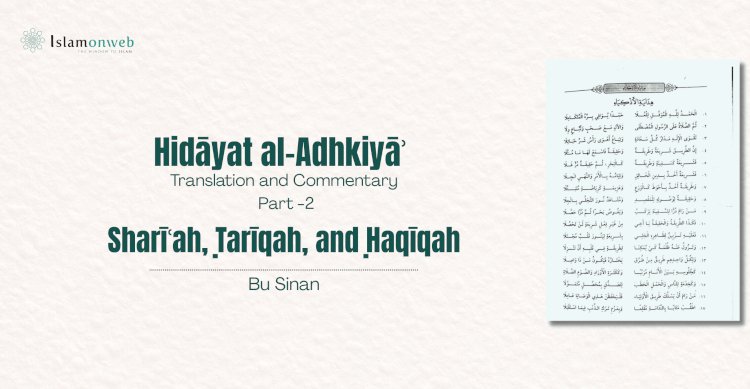
[This article is Second part of a series presenting an English translation and brief explanation of Hidāyat al-Adhkiyāʾ ilā Ṭarīq al-Awliyāʾ by Shaykh Zayn al-Dīn ibn ʿAlī al-Malībārī]
- إِنَّ الطَّرِيقَ شَرِيعَةٌ وَطَرِيقَةٌ وَحَقِيقَةٌ فاسمع لها ما مثلا
- فشَرِيعَة كَسَفِينَةٍ وَطَرِيقَةٌ كَالْبَحْرِ ثُمَّ حَقِيقَةٌ دُرٌّ غَلَا
- فَشَرِيعَةُ أَخْذٌ بِدِينِ الْخَالِقِ وَقِيَامُهُ بِالْأَمْرِ وَالنَّهْيِ انْجَلَا
- وَطَرِيقَةٌ أَخْذٌ بِأحَوْط كالورع وعزيمة كرياضة متبتّلا
- وَحَقِيقَةٌ لِوُصُولِهِ لِلْمَقْصِدِ وَمُشَاهَد نُور التجلي بانجلا
Translation
- The path unfolds as Sharīʿah and Ṭarīqah,
And Ḥaqīqah, so lend your ear to its living parable. - The Sharīʿah is a ship and Ṭarīqah is the vast ocean
And the Ḥaqīqah, a radiant pearl rising from its depths.
- The Sharīʿah is to embrace the religion of the Creator,
And to stand firm upon His commands and prohibitions made clear - The Ṭarīqah is to choose the guarded way, the path of waraʿ,
With firm resolve, like one who disciplines the soul in devoted striving. - And the Ḥaqīqah is reaching the ultimate goal
To behold the light of Divine manifestation, unveiled and shining.
Verily, the Path consists of Sharīʿah, Ṭarīqah, and Ḥaqīqah; so listen to the parables set for them. The Sharīʿah is like a ship, the Ṭarīqah is like the sea, and then Ḥaqīqah is the precious pearl of great value. For Sharīʿah is the adherence to the religion of the Creator and the clear fulfillment of commands and prohibitions. Ṭarīqah is the adoption of the most cautious way, such as scrupulousness (waraʿ), and firm resolve in spiritual exercise (riyāḍah) as one devotedly cut off from distractions. And Ḥaqīqah is the seeker's arrival at the ultimate objective and the witnessing of the light of Divine manifestation with absolute clarity.
Commentary
The author begins by articulating the three foundational dimensions of the spiritual path: Sharīʿah, Ṭarīqah, and Ḥaqīqah, presenting them not as separate compartments but as interdependent stages of one unified journey toward Allah.
Linguistically, Sharīʿah refers to a path that leads to water, the source of life, signifying that Divine Law is the life-source of the soul. Technically, it denotes outward submission to the commands and prohibitions of the Creator through manifest obedience. It is the structured embodiment of servitude, the disciplined conformity to what Allah has legislated. Ṭarīqah, by contrast, represents a more particularised route within that broader way. It is the adoption of spiritual precaution, characterised by waraʿ, scrupulous avoidance of doubtful matters, and ʿazīmah, a firm and unwavering resolve in riyāḍah, the disciplined training of the nafs to resist its lower inclinations.
The seeker who undertakes this path is described as mutabattil, one who has inwardly detached from distractions in order to devote himself wholly to Allah. Ḥaqīqah, finally, signifies the inner reality: the arrival at the maqṣid, the ultimate objective, wherein the seeker attains gnosis (maʿrifah) and witnesses the light of Divine tajallī with clarity, free from the veils imposed by ego and heedlessness.
The metaphor of the ship, the sea, and the pearl elegantly expresses the inseparability of these three realities. The Sharīʿah is likened to a ship because it provides safety and structure; without it, the seeker would drown in confusion or deviation. The Ṭarīqah is the sea, the vast and demanding expanse through which one must travel, representing sustained spiritual exertion and character refinement. The Ḥaqīqah is the pearl concealed beneath the depths, attainable only by one who possesses both vessel and courage. One who seeks the pearl without boarding the ship is deluded; similarly, any claim to spiritual realisation that bypasses Divine Law is dismissed by the scholars as misguidance. Thus, Sharīʿah establishes the foundation of ʿubūdiyyah, Ṭarīqah constitutes the disciplined method of journeying, and Ḥaqīqah is the fruit of that journey. The outward must be governed by the Sharīʿah while the inward is illuminated by spiritual refinement.
These definitions are firmly rooted in the primary sources of Islam. The emphasis on obedience within Sharīʿah reflects the Qur’anic command: “Obey Allah and obey the Messenger” (4:59). The principle of waraʿ finds support in the Prophetic instruction: “Leave that which makes you doubt for that which does not make you doubt” (Tirmidhī). The description of the mutabattil echoes the verse: “And remember the name of your Lord and devote yourself to Him with complete devotion” (73:8). Most profoundly, the witnessing (mushāhadah) associated with Ḥaqīqah corresponds to the station of Iḥsān defined in the ḥadīth of Jibrīl: “To worship Allah as though you see Him; and if you do not see Him, He surely sees you” (Bukhārī and Muslim). Thus, what is termed Ḥaqīqah is not an innovative construct but the deep internalisation of what revelation already commands.
Classical scholars have consistently clarified this relationship. Imām al-Qushayrī explained that Sharīʿah is commitment to servitude (iltizām al-ʿubūdiyyah), whereas Ḥaqīqah is witnessing Lordship (mushāhadat al-rubūbiyyah). Every Sharīʿah without Ḥaqīqah is deficient in spirit, and every Ḥaqīqah not bound by Sharīʿah is invalid.
Imām al-Ghazālī (رحمه الله) outlines four ascending levels of waraʿ (spiritual scrupulousness) in Iḥyāʾ ʿUlūm al-Dīn:
- Waraʿ al-ʿUdūl (the just) – Avoiding what is clearly ḥarām.
This is the minimum required level and the foundation of obedience. - Waraʿ al-Ṣāliḥīn (the righteous) – Avoiding doubtful matters (shubuhāt).
One refrains from ambiguous issues to protect one’s religion. - Waraʿ al-Muttaqīn (the God-Conscious) – Avoiding some permissible (ḥalāl) matters out of fear they may lead to sin or harden the heart.
- Waraʿ al-Ṣiddīqīn (the Truthful) – Avoiding anything that distracts from Allah, even if fully lawful, seeking only what strengthens presence, sincerity, and remembrance.
The first level is obligatory; the higher levels represent increasing degrees of spiritual refinement and proximity to Allah. Umar ibn al-Khaṭṭāb (رضي الله عنه) says: “We used to leave nine-tenths of what is permissible out of fear that we might fall into the unlawful.”
Ḥaqīqah is experiencing the Divine tajallī. Tajallī is that which becomes unveiled to the heart from the lights of the unseen as explained by Imām al-Ghazālī. It is the witnessing of His acts manifesting within the two realms — this world and the Hereafter. The “light of manifestation” described by the author is therefore not a sensory phenomenon but a spiritual unveiling granted to a heart purified through obedience and disciplined struggle.
In the contemporary context, this triadic framework offers a necessary corrective to two recurring distortions. On one side stands rigid formalism devoid of spiritual consciousness; on the other, unrestrained mysticism divorced from Law. The Sharīʿah safeguards the seeker from moral drift, the Ṭarīqah cultivates sincerity and discipline in an age of distraction, and the Ḥaqīqah reminds the believer that the ultimate aim is nearness to Allah, not mere ritual performance. Religion thus becomes neither mechanical compliance nor emotional speculation, but an integrated transformation of the entire being.
The path to Divine proximity is therefore an ordered ascent. The servant boards the ship of obedience, traverses the sea of disciplined striving, and by Allah’s grace discovers the pearl of realised awareness. When the outward conforms and the inward is polished, the veils thin, and the heart begins to reflect the light it was created to receive. Such is the balanced roadmap preserved by the scholars: anchored firmly in Prophetic guidance, yet leading the sincere seeker toward the horizons of maʿrifah.
The following part completes the above theme.
٩. مَنْ رَامَ دُرًّا لِلسَّفِينَةِ يَرْكَبُ وَيَغُوصُ بَحْرًا ثُمَّ دُرًّا حصّلَا
١٠. فَكَذَا الطَّرِيقَةُ وَالْحَقِيقَةُ يَا أَخِي مِنْ غَيْرِ فِعْلِ شَرِيعَةٍ لَنْ تُحَصَّلَا
١١. فَعَلَيْه تَزْيِين لظاهره الجلي بِشَرِيعَةٍ لِينور قَلْبٌ مُجْتلَا
١٢. وَتَزُولُ عَنْهُ ظُلْمَةٌ كَيْ يُمْكِنَا لِطَّرِيقَةِ فِي قَلْبِهِ أَنْ تَنْزِلَا
١٣. وَلِكُلِّ وَاحِدٍهم طَرِيقٌ مِنْ طُرُقٍ يختاره فَيَكُونُ مَنْ ذَا واصَلَا
١٤. كَجُلُوسِهِ بَيْنَ الْأَنَامِ مُرَبِّيًا وَكَثْرَةِ الْأَوْرَادِ وَالصَّوْمِ الصلاة
١٥. وَكخِدْمَةِ للنَّاسِ وَالْحَمْلِ الْحَطَبِ لتصدق بمحصّل متموّلا
١٦.مَنْ رَامَ أَنْ يَسْلُكَ طَرِيقَ الْأَوْلِيَاءِ فليحفظن هذى الوصايا عاملا
Translation
- Whoever seeks a pearl must board the ship,
And dive into the sea its depths to grip. - So too, O brother, Ṭarīqah and Ḥaqīqah’s prize
Without the practices of Sharīʿah, none shall realize. - So let him adorn his outward state, clear and upright,
With Sharīʿah, so the radiant heart may shine with light. - And when its veils of darkness fade away,
The Path within the heart shall find its stay. - For each, is given roads among the ways,
Whichever he chooses takes him to the destination. - It may be guiding people as a guide,
Or constant supplications, prayers, and fasting - Or serving the people and carrying wood,
to give charity from the acquired wealth. - Whoever longs to traverse the path of the Awliyāʾ
Let him preserve these counsels through practice.
Whoever seeks the pearl must first board the ship and plunge into the sea before he can obtain the treasure; so too, O my brother, Ṭarīqah and Ḥaqīqah are never attained without the firm practice of Sharīʿah. One must therefore adorn the outward life with the clear guidance of the Sharīʿah, so that the heart, which is watched by Allah, may be illuminated. When its darkness departs, the Path finds its place, settling into a heart prepared to receive it. For every seeker there exists a way among the many ways; he chooses the road suited to him and, by steadfastness, becomes one who has arrived (wāṣil) the ultimate destination. It may be through guiding people as a nurturing teacher (murabbī), through abundant supplications (awrād), fasting, and prayer, or through serving the people and carrying wood to give charity from the acquired wealth. Whoever seeks to traverse the path of the Awliyāʾ must strictly preserve these counsels through practice.
The heart of this passage lies in affirming the indispensability of the outward Law (Sharīʿah) as the firm foundation of all inward realisation. Just as no diver can retrieve a pearl from the depths without first securing himself in a ship and then plunging into the sea, no seeker can attain Ḥaqīqah while neglecting the discipline of Sharīʿah. Any attempt to bypass Sharīʿah in pursuit of spiritual unveiling is not ascent but peril, for without structure the seeker is left to drift in the sea of illusion and misguidance.
Imam al-Ghazālī illustrates that the heart is like a mirror; it must be cleared of the "rust" and "darkness" of base desires (hawā) through the discipline of the Sharīʿah before it can reflect Divine light.
This passage 13-16 explains that since the ways of travelling the spiritual path are many, and the roads leading to Allah differ according to the dispositions of people, each seeker is guided to a particular way suited to him. Some reach Allah by sitting among people, guiding and reforming them, calling them to obedience and upright conduct. Others arrive through knowledge and teaching, preserving their limbs from wrongdoing and disciplining themselves from base desires.
Some are devoted to abundant acts of worship — prayer, fasting, recitation of the Qur’an, and constant remembrance — ascending through the ranks of the devoted. Others draw near through service to creation, bearing hardship, earning lawfully, and spending for the sake of Allah. All these are valid avenues of arrival, provided they remain within the bounds of Sharīʿah and sincerity. The author emphasises that true وصول (arrival) is not confined to one external form, but lies in steadfast adherence to one’s divinely guided path, purified intention, and solid commitment to obedience.
Disclaimer
The views expressed in this article are the author’s own and do not necessarily mirror Islamonweb’s editorial stance.


Related Posts














Leave A Comment