
Tawbah (Repentance): The Key to True Success
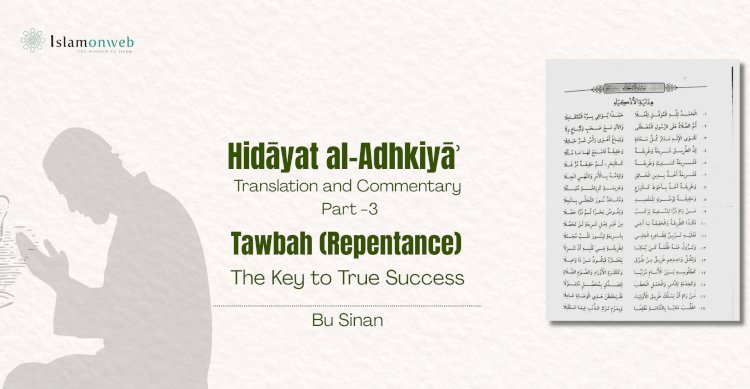
[This article is Third part of a series presenting an English translation and brief explanation of Hidāyat al-Adhkiyāʾ ilā Ṭarīq al-Awliyāʾ by Shaykh Zayn al-Dīn ibn ʿAlī al-Malībārī]
١٧. اطلب متابًا بالندامة مقلعًا وبعزمْ ترك الذنبِ فيما استقبلا
١٨. وبراءة من كلِّ حقِّ الآدمي ولهذه الأركان فارع وكمّلا
١٩. وقه دوامًا بالمحاسبةِ التي تنهاك تقصيرًا جرى وتساهلا
٢٠. ويحفظ عين واللسانَ وسائر الأعضا جميعًا فاجهدنْ لا تكسلا
٢١. فالتوبُ مفتاحُ لكلِّ إطاعةٍ وأُساس كلِّ الخيرِ أجمعَ أشملا
٢٢. فإن ابتُليتَ بغفلة أو صُحبةٍ في مجلسٍ فتداركنّ مهرولا
- Seek repentance with remorse, abandoning the sin immediately,
And resolve firmly to leave it behind in all that lies ahead.
- And clear yourself from every right owed to others;
Observe these pillars carefully and fulfill them.
- Guard your repentance continually through self-accounting —
The kind that restrains you from recurring lapses and negligence.
- Protect the eye, the tongue, and all the other limbs;
Strive earnestly, do not grow lazy.
- For repentance is the key to every act of obedience
And the foundation upon which all goodness rests.
- And if you are tested by heedlessness or harmful company
in a gathering, recover yourself swiftly.
Seek repentance with a heart filled with sincere remorse, immediately abandoning the sin and firmly resolving never to return to it again. Clear yourself of every right owed to others, ensuring that these essential pillars of repentance are properly observed and fully fulfilled. Safeguard your repentance through constant self-accounting that restrains you from falling into renewed shortcomings or negligence. Guard your eye, your tongue, and all your limbs, striving earnestly and refusing to surrender to laziness. For repentance is the key that unlocks every act of obedience and the foundation upon which all goodness rests in its most complete and encompassing form. And if you are ever overtaken by heedlessness or influenced by harmful company in a gathering, then correct yourself at once without delay.
Conditions of a True Repentance
These verses open the first of the nine sacred counsels: tawbah, repentance — the true beginning of every spiritual journey. He commands the seeker to pursue repentance through a deep and sincere remorse that burns within the heart for what has passed. This remorse must be accompanied by the immediate abandonment of the sin and by a firm resolve never to return to it in the future. Repentance, therefore, stands on three internal pillars: pain over the past, severance in the present, and determination for the future.
He adds a fourth pillar that some may overlook: clearing oneself of every right owed to others. Sins against Allah rest upon His Generosity and may be forgiven through sincere remorse. But sins against human beings are grounded in Divine Justice. If a right was taken, it must be returned; if honor was violated, pardon must be sought. Without clearing oneself from other’s rights, repentance remains incomplete. Spiritual elevation cannot be built upon unresolved injustice. Thus, the seeker is commanded to “observe these pillars and complete them fully,” ensuring that repentance is structurally sound.
If the wrong involves wealth or tangible property, it must be returned to its rightful owner or, if the owner has passed away, to their heirs. If no heirs are known, charity may be given on their behalf with the intention that its reward reaches them. If the offender is financially incapable, then sincere intention to repay when able remains binding. In cases of backbiting or verbal injury, and the person is aware of it, one must seek pardon from the person. If informing the person would lead to greater harm or renewed conflict, then sincere repentance, abundant istighfār for the injured party, and supplication for their good are prescribed. The scholars clarify that if the harmed person has passed away, one should seek forgiveness for them.
As well, repentance does not cancel neglected obligations owed to Allah. Missed prayers, unpaid zakāh, and unfulfilled fasts require qaḍāʾ (making up). Tawbah wipes away the sin of neglect, but the obligation itself still stands.
Muḥāsabah — Continuous Self-Accounting
Once repentance is established, it must be protected. Here the poet introduces muḥāsabah — continuous self-accounting. The believer is instructed to guard repentance through ongoing reflection that prevents recurring negligence and subtle lapses. Without vigilance, the soul gradually drifts back into old habits. The early sages understood this deeply.
ʿUmar ibn al-Khaṭṭāb advised, ““Take yourselves to account before you are taken to account, and weigh your deeds before they are weighed for youhe intelligent believer does not wait for the Day of Judgement to discover the weight of his actions. He examines himself daily, scrutinising his intentions, reviewing his speech, and correcting missteps while they are still possible.
Muḥāsabah cultivates humility and preparedness. As explained by Imam Al-Gazali in Ihya, One who holds himself accountable in this world will find the Reckoning lighter in the next. Conversely, the one who lives in heedlessness, avoiding self-examination, risks prolonged regret on the Day when excuses carry no weight.
The poet then turns to the limbs, naming the eye and the tongue before mentioning the rest. These are the most active gateways of the heart. What the eye repeatedly beholds shapes desire; what the tongue repeatedly utters shapes character. The Prophet ﷺ warned that the eyes and tongue each have their share of transgression. Today, the “gaze” includes screens, and the “tongue” includes typed words that travel far beyond our sight. Every limb is a door through which light or darkness may enter. The seeker is urged to strive and not grow lazy, for spiritual negligence rarely announces itself; it creeps in gradually.
Repentance: The Key to Every Act of Obedience
The poet then proclaims that repentance is the key to every act of obedience and the foundation of all goodness. No act of worship truly flourishes in a heart burdened by unrepentant sin. Imām al-Ghazālī described sins as rust that gathers upon the heart; repentance is the polish that restores clarity. Without polishing, even sincere acts of worship lose their radiance. Tawbah is therefore not a single event but the doorway through which all spiritual progress begins.
Repentance is not a recommendation reserved for the spiritually weak; it is a Divine obligation placed upon every believer without exception. Allah Most High declares:
وَتُوبُوا إِلَى اللَّهِ جَمِيعاً أَيُّهَا الْمُؤْمِنُونَ لَعَلَّكُمْ تُفْلِحُونَ
“Turn to Allah in repentance, all of you, O believers, so that you may succeed.”
This verse leaves no room for spiritual complacency. Success (falāḥ) is made conditional upon repentance. There is no path to true prosperity — neither in this world nor the next — except by returning from what Allah dislikes, outwardly and inwardly, to what He loves, outwardly and inwardly. The address is directed to “all believers,” which itself is proof that every believer, no matter his level of faith, stands in need of repentance. Tawbah is not merely for sinners in the obvious sense; it is for anyone who seeks elevation.
Allah further commands:
يَا أَيُّهَا الَّذِينَ آمَنُوا تُوبُوا إِلَى اللَّهِ تَوْبَةً نَّصُوحًا عَسَى رَبُّكُمْ أَن يُكَفِّرَ عَنكُمْ سَيِّئَاتِكُمْ وَيُدْخِلَكُمْ جَنَّاتٍ تَجْرِي مِن تَحْتِهَا الأَنْهَارُ يَوْمَ لا يُخْزِي اللَّهُ النَّبِيَّ وَالَّذِينَ آمَنُوا مَعَهُ نُورُهُمْ يَسْعَى بَيْنَ أَيْدِيهِمْ وَبِأَيْمَانِهِمْ يَقُولُونَ رَبَّنَا أَتْمِمْ لَنَا نُورَنَا وَاغْفِرْ لَنَا إِنَّكَ عَلَى كُلِّ شَيْءٍ قَدِيرٌ
“O you who believe, turn to Allah in sincere repentance. It may be that your Lord will remove from you your misdeeds and admit you into gardens beneath which rivers flow, on the Day when Allah will not disgrace the Prophet and those who believed with him. Their light will run before them and on their right; they will say, ‘Our Lord, perfect for us our light and forgive us. Indeed, You are over all things competent.’” (Sūrat al-Taḥrīm 66:8)
The scholars explain that tawbah naṣūḥā is a comprehensive, pure repentance, one that embraces all sins without exception, is undertaken solely for the sake of Allah, and persists consistently in all circumstances. It is not temporary regret, nor is it repentance driven by fear of people or loss of reputation. It is a covenant renewed with Allah, a turning motivated only by the desire for His pleasure and nearness.
The promise attached to such repentance is immense: expiation of sins, entry into Paradise, and light on the Day when light will determine salvation. The verse paints a moving scene — the believers walking with their light shining before them and to their right, supplicating, “Our Lord, perfect for us our light and forgive us; indeed, You are powerful over all things.” Repentance is thus not only erasure; it is illumination.
Human Vulnerability and Divine Mercy
Finally, the poet acknowledges human vulnerability. Even the sincere seeker may be overtaken by ghaflah, a subtle heedlessness, or influenced by unsuitable company in gatherings. Environments shape hearts more quickly than intentions alone. If one slips, however, one tries to recover swiftly. The word muhrwilā conveys brisk movement.
This meaning is beautifully affirmed in the Qur’ān:
وَالَّذِينَ إِذَا فَعَلُوا فَاحِشَةً أَوْ ظَلَمُوا أَنْفُسَهُمْ ذَكَرُوا اللَّهَ فَاسْتَغْفَرُوا لِذُنُوبِهِمْ وَمَنْ يَغْفِرُ الذُّنُوبَ إِلَّا اللَّهُ وَلَمْ يُصِرُّوا عَلَىٰ مَا فَعَلُوا وَهُمْ يَعْلَمُونَ * أُوْلَئِكَ جَزَاؤُهُمْ مَغْفِرَةٌ مِنْ رَبِّهِمْ وَجَنَّاتٌ تَجْرِي مِنْ تَحْتِهَا الأَنْهَارُ خَالِدِينَ فِيهَا وَنِعْمَ أَجْرُ الْعَامِلِينَ
“˹They are˺ those who, upon committing an evil deed or wronging themselves, remember Allah and seek forgiveness and do not knowingly persist in sin—and who forgives sins except Allah? Their reward is forgiveness from their Lord and Gardens under which rivers flow, to stay there forever. What an excellent reward for those who work righteousness!”
The defining quality of the righteous here is not sinlessness, but responsiveness. They may fall, but they do not persist. They remember, seek forgiveness, and refuse to knowingly remain in wrongdoing.
The command to repent is not merely directed to sinners in general; it was the living practice of the Messenger of Allah ﷺ himself. He called out, “O people, repent to Allah, for indeed I repent to Him one hundred times a day.” In another narration, he said, “Indeed, a covering comes over my heart, and I seek Allah’s forgiveness one hundred times a day.” The scholars explain that this “covering” was not sin in the ordinary sense, but subtle moments of distraction from the constant remembrance that was his natural state. Even the slightest lapse from perfect attentiveness was regarded by him as something requiring istighfār. If this was the humility of the one whose past and future sins were forgiven, what then of those who are weighed down by clear shortcomings? His repentance was not out of guilt alone, but out of servitude, gratitude, and perpetual return.
Ibn ʿUmar رضي الله عنهما reported that they would count in a single gathering the Prophet ﷺ saying one hundred times: “My Lord, forgive me and accept my repentance; indeed, You are the Acceptor of repentance, the Most Merciful.”
Allah rejoices in the repentance of His servant with a joy befitting His Majesty. The Prophet ﷺ described it through the image of a man who loses his mount in a barren desert — with his food and drink upon it — and, after losing all hope, suddenly finds it standing before him. Overwhelmed with joy, he speaks in confusion from sheer happiness. Allah’s joy at a servant’s repentance is greater than that.
Thus, repentance is not a cold legal obligation; it is a meeting between Divine Mercy and human humility. Every return is welcomed, every sincere tear is received, and the door stays open for as long as life itself remains. The Prophet ﷺ affirmed this boundless opportunity when he said: “Indeed, Allah, the Mighty and Majestic, accepts the repentance of the servant so long as the soul has not reached the throat.” That is, until the final moment before death overtakes him. As long as breath continues and the heart still turns, the path of return is never sealed. This is the vastness of Divine mercy: a lifetime of distance can be erased by a moment of sincere return, provided it comes before the final breath.
Part -1 Taqwā or Hawā? The Choice That Defines Us
Part -2 Sharīʿah, Ṭarīqah, and Ḥaqīqah
Disclaimer
The views expressed in this article are the author’s own and do not necessarily mirror Islamonweb’s editorial stance.


Related Posts















Leave A Comment