
Taqwā or Hawā? The Choice That Defines Us
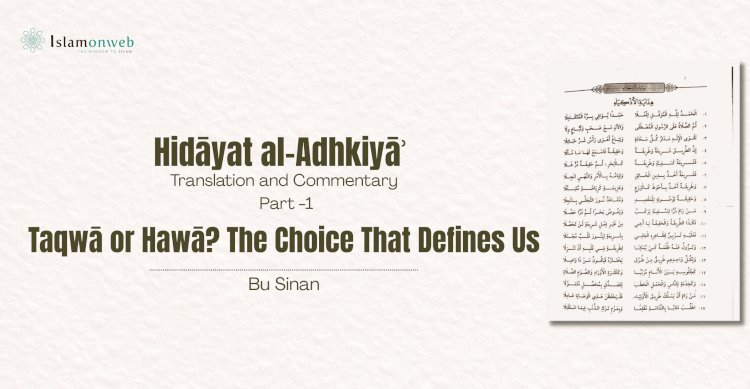
[This article is part of a series presenting an English translation and brief explanation of Hidāyat al-Adhkiyāʾ ilā Ṭarīq al-Awliyāʾ by Shaykh Zayn al-Dīn ibn ʿAlī al-Malībārī]
Hidāyat al-Adhkiyāʾ ilā Ṭarīq al-Awliyāʾ is a classical Arabic qaṣīdah , by the great Shāfiʿī scholar, Shaykh Zayn al-Dīn ibn ʿAlī al-Malībārī رحمه الله, composed as a concise yet comprehensive guide for those travelling the path of spiritual refinement. It is described by its commentators as among the most beneficial works written for seekers, particularly because of its brevity combined with depth. In a small compass, it gathers what the sālik, the one who consciously walks the path toward Allah through discipline and obedience, most urgently needs: guidance on progressing through spiritual stages, overcoming inner obstacles, organising one’s time in acts of worship, and maintaining vigilance over the heart.
Due to its clarity and structured presentation and conciseness crafted for memorisation, reflection, and steady companionship, it was adopted within traditional learning circles in Malabar as part of the formal curriculum in taṣawwuf. Teachers selected it for beginners and advanced students alike, and it continued to be studied generation after generation. Scholars observed that although the matn is brief and easy to memorise, its meanings are expansive. For this reason, commentaries emerged to unpack its subtleties and make its guidance more accessible to readers whose circumstances differed from earlier times.
Hidāyat al-Adhkiyāʾ serves as a reminder that true strength lies in structured self-reform: guarding belief, correcting intention, refining character, and resisting deviations, whether born of ignorance, excess, or foreign influence. It is this balance of clarity, orthodoxy, and spiritual realism that has allowed the book to remain studied and revered across generations. It echoes the disciplined spirituality of masters such as al-Junayd al-Baghdādī, al-Ḥārith al-Muḥāsibī, and Imām al-Ghazālī رحمه الله. The text stands as a continuation of the balanced Sunni spiritual tradition calling to knowledge joined with humility, discipline joined with sincerity, and reform rooted in revelation rather than innovation.
It is therefore fitting that we begin this series in the month of Ramaḍān as it is a season of recalibration of disciplining desires, refining intentions, and restoring the heart to clarity. A text such as Hidāyat al-Adhkiyāʾ speaks directly to this purpose. As we restrain the body, this work helps us train the soul; as we increase in recitation and prayer, it reminds us that true transformation lies in sincerity, humility, and consistent self-accountability. In this spirit, we bring this series as a companion for the month, a structured guide for inward renewal alongside outward devotion.
Shaykh Zayn al-Dīn al-Malībārī al-Kabīr
Shaykh Zayn al-Dīn al-Malībārī al-Kabīr رحمه الله stands among the formative architects of Islamic scholarship in Malabar. He was born in Cochin (Kochi), one of the prominent coastal centres of Kerala, in the late 9th century Hijrī (around 873 AH / 1467 CE, according to the strongest reports). His early education began under the care of his uncle, Shaykh Zayn al-Dīn Ibrāhīm, with whom he studied Qur’ān, Arabic language, and foundational Islamic sciences. This grounding in disciplined scholarship within his own family would later become a defining feature of his legacy.
His intellectual journey did not remain confined to Malabar. After completing his early studies locally, he travelled to Calicut (Kozhikode), where he studied under prominent scholars such as Shihāb al-Dīn Aḥmad ibn ʿUthmān al-Ḥillī al-Yamanī. There he deepened his engagement with fiqh, ḥadīth, and the rational sciences, even studying advanced texts like al-Kāfī in farāʾiḍ (inheritance law). His pursuit of knowledge then led him beyond the Indian subcontinent to the sacred cities of Makkah and Madīnah, where he remained for several years, studying under leading authorities of the time.
From the Ḥaramayn he travelled onward to al-Azhar in Cairo, thereby becoming among the earliest scholars from Malabar to formally connect with the Azharī tradition. During his time in Egypt and the Ḥijāz, he studied with a remarkable circle of teachers, including luminaries such as Shaykh ʿAbd Allāh ibn ʿAlī al-Makkī, Shaykh Muḥammad al-Sakhāwī, Imām Jalāl al-Dīn al-Suyūṭī, Shaykh Muḥammad al-Samhūdī, and others from the distinguished scholars of the Arab world.
Upon returning to Malabar after years of study, he did not withdraw into private scholarship. Instead, he assumed an active role in teaching, daʿwah, and community reform. He established the great Jāmiʿ Masjid of Ponnani, which would later become one of the most important centres of Islamic learning in South India, often described as the “Makkah of Malabar.” The mosque was designed as a hub of instruction, hosting circles of learning and accommodating students who travelled from distant regions. Through this institution, Malabar became intellectually connected to centres such as al-Azhar in Cairo, the Umayyad Mosque in Damascus, and the Ḥaramayn.
His writings reflect the breadth of his scholarship. Alongside Hidāyat al-Adhkiyāʾ, he authored works in taṣawwuf, ḥadīth, creed, grammar, and law. Among them are texts such as Sirāj al-Qulūb on spiritual diseases and their remedies, al-Musʿid fī Dhikr al-Mawt, Shams al-Hudā, treatises on supplication, abridgements of Imām al-Ghazālī’s methodology, works on the branches of īmān, inheritance law, sīrah, and Arabic grammar. This diversity demonstrates that he was a comprehensive scholar shaped by the classical model in which disciplines support one another.
His personal life further reflects the continuity of knowledge through lineage. He was blessed with sons and grandsons who would themselves become prominent scholars, most notably Shaykh Zayn al-Dīn al-Ṣaghīr, the author of Fatḥ al-Muʿīn. Through this scholarly household, the intellectual foundations laid by the grandfather would mature into the juristic influence of the grandson, whose works spread across South and Southeast Asia.
Shaykh Zayn al-Dīn al-Kabīr passed away in Ponnani on the night of Friday, 16th Shaʿbān 928 AH (1522 CE). He was buried within the precincts of the Jāmiʿ Masjid he had established, and his resting place remains known and visited.
In Nuzhat al-Khawāṭir, the historian and ḥadīth scholar ʿAbd al-Ḥayy al-Ḥasanī رحمه الله describes Shaykh Zayn al-Dīn al-Malībārī al-Kabīr as a learned authority, a verifying jurist, and an exemplar of the people of his time. He notes that he was among the leading figures of the Shāfiʿī school in Malabar, and that scholarly leadership in the region ultimately rested with him, highlighting both his intellectual stature and his central role in shaping the religious life of his land.
Commentary of the Opening Three Verses
It is worth noting that the author’s son, Shaykh ʿAbd al-ʿAzīz رحمه الله, devoted special attention to this qaṣīdah by composing two commentaries upon it — one expansive and detailed, and another more concise and accessible. This itself reflects the importance the scholarly household placed on the text. In this series, we will primarily draw upon his explanations, while also bringing in relevant insights from other classical sources, presenting them in a manner that speaks meaningfully to our present context without compromising the integrity of the tradition.
The first three verses and its translation
الحمدُ للهِ المُوفِّقِ للعلا حمداً يُوافي برَّهُ المتكاملا
ثمَّ الصَّلاةُ على الرَّسولِ المُصطفى و الآلِ مع صحبٍ وتباع وِلا
تقوى الإله مَدار كلِّ سعادة وتباع أهوى رأس شرّ حبائلا
All praise to Allah, Guide to the highest ascent,
A praise befitting His perfect beneficence.
Then blessings upon the Chosen Messenger,
His noble House, his Companions, and all who follow after.
God-consciousness is the axis of every felicity,
While following desire is the root of every calamity.
Opening Verse
الحمدُ للهِ المُوفِّقِ للعلا
حمداً يُوافي برَّهُ المتكاملا
He opens with al-ḥamd, praise, directed to Allah alone. The commentators explain that ḥamd is not mere gratitude; it is praise with recognition of beauty and perfection, whether in response to a blessing or simply in acknowledgment of divine majesty. By describing Allah as al-muwaffiq li-l-ʿulā — the One who grants success in attaining the highest ranks — the author immediately establishes a foundational principle: elevation in religion is not achieved by effort alone. It is granted through tawfīq. Obedience, sincerity, knowledge, steadfastness, all of these are divine gifts before they are human achievements.
The phrase ḥamdan yuwāfī birrahu al-mutakāmilā indicates praise that corresponds to His complete goodness and perfect beneficence. In other words, the author acknowledges that even his ability to compose this work and guide others is dependent upon Allah’s enabling grace.
He then says:
ثمَّ الصَّلاةُ على الرَّسولِ المُصطفى
والآلِ مع صحبٍ وتباعٍ وِلا
After praise of Allah comes ṣalāh upon the Messenger ﷺ — al-Rasūl al-Muṣṭafā, the Chosen One. The explanation clarifies that ṣalāh from Allah is mercy accompanied by exaltation, and from the believer it is supplication and reverence. The inclusion of the Āl (his family), the Ṣaḥb (his Companions), and those who follow them indicates continuity of guidance. True spiritual refinement does not begin in isolation; it is inherited through the prophetic chain.
The third verse declares:
تقوى الإله مدارُ كلِّ سعادة
وتباعُ أهوى رأس شرٍّ حبائلا
Here, the author moves from praise to Taqwā — conscious God-fearing awareness that restrains a person from disobedience — is described as the axis (madār) of every form of true happiness, whether in this world or the next. The commentator explains that taqwā is the foundation upon which lasting felicity is built. It is the cause of divine love, acceptance of deeds, and final success. The Qur’an repeatedly affirms this: “Indeed Allah loves the muttaqīn” and “Indeed Allah is with those who have taqwā.”
In contrast, following hawā, the lower desires of the ego, is identified as the root of every evil. The phrase raʾs shar ḥabāʾila suggests the head or source of snares and traps. Desire becomes the entry point through which Shayṭān influences the human being. When a person submits to whims, the heart becomes clouded, worship weakens, and clarity fades. Thus, the entire struggle of sulūk, the disciplined path of drawing nearer to Allah, revolves around strengthening taqwā and resisting hawā.
Taqwā: The Architecture of True Success
The commentator explains that taqwā is not merely fear. It is a guarded awareness of Allah that shapes decisions, restrains impulses, and refines intention. It is to place a protective barrier between oneself and what displeases Allah. The Qur’ān repeatedly links it to success:
- “Indeed Allah loves the muttaqīn.”
- “Indeed Allah is with those who have taqwā.”
- “Indeed the most honoured of you in the sight of Allah is the one with most taqwā.”
The verse describes taqwā as the pivot of every happiness. That means worldly stability, inner peace, clarity of heart, acceptance of deeds, and eternal salvation all revolve around it. In the science of self-purification, taqwā is the outcome of muḥāsabah (self-accounting), muraqabah (awareness of divine observation), and disciplined obedience. It is not an emotional state; it is a cultivated condition of the heart.
Hawā: The Subtle Tyrant
In contrast, the author calls following hawā, unchecked personal desire, the head of evil snares. The word hawā refers to the soul’s inclination toward what contradicts divine guidance. It may not always appear sinful outwardly. Sometimes it is pride disguised as zeal, anger disguised as principle, or comfort disguised as wisdom.
The scholars often described hawā as the most dangerous adversary because it resides within. Shayṭān only decorates what the ego already desires. When hawā governs, the heart gradually becomes desensitised. Acts of worship feel heavy; obedience feels restrictive; repentance feels delayed.
Thus the real battlefield of sulūk is internal. The enemy is not knowledge deficiency alone; it is the untrained self.
Taqwā and Hawā in an Age of Gratification
The third verse becomes even more striking when viewed against the climate of the present world. We live in a culture built on immediacy — instant access, instant pleasure, instant validation. Desire is not only tolerated; it is celebrated. The modern liberal ethos often treats self-expression and personal gratification as ultimate goods. To deny oneself is seen as repression; to restrain oneself is considered unhealthy. In such a framework, hawā is rebranded as freedom.
Islam approaches the matter differently. It does not deny human desire, nor does it demonise the body. Rather, it insists on governance. Hawā is not evil because desire exists; it becomes destructive when it rules unchecked. The Qur’ān asks with piercing clarity:
“Have you seen the one who takes his desire as his god?”
When gratification becomes the measure of truth, moral boundaries dissolve quietly. Right and wrong become fluid, defined by preference. The self becomes sovereign.
In contrast, taqwā restores hierarchy. It places revelation above impulse, long-term consequence above short-term thrill, divine pleasure above public approval. Taqwā teaches the believer to ask “Is Allah pleased with this?” That shift changes everything.
In a world that constantly stimulates appetite — through screens, advertising, entertainment, consumerism — the battle against hawā is no longer occasional. It is daily. Desire is engineered and monetized, and attention is commodified. The ego is fed continuously. Under such conditions, spiritual discipline becomes countercultural.
The author is not speaking only about individual weakness; he is cautioning against an entire outlook on life. When following hawā becomes normalised, drift is no longer personal; it becomes collective. The modern liberal imagination often defines freedom as the removal of restraint. Islam defines freedom as liberation from enslavement to the ego. One encourages the expression of every impulse; the other calls for mastery over impulse. One sees restraint as deprivation; the other recognises it as ascent.
Ramaḍān arrives as the corrective season. More than a month of rituals, it’s a structured training in moral elevation. The Qur’ān makes the purpose explicit:
“O you who believe, fasting has been prescribed for you as it was prescribed for those before you, so that you may attain taqwā.” (2:183)
Fasting restrains the body from lawful desires — food, drink, marital relations — not because they are sinful, but to train the soul. When a believer can abstain from what is ḥalāl for Allah’s sake, it becomes easier to abandon what is ḥarām.
In Ramaḍān:
- Hunger weakens the dominance of hawā.
- Night prayer humbles and disciplines the ego.
- Recitation of the Qur’ān softens and reorients the heart.
- Charity loosens attachment to wealth and self.
The month becomes a structured confrontation between taqwā and desire. The body fasts outwardly; the heart is meant to fast inwardly from pride, envy, anger, and heedlessness. The danger, however, is that fasting remains physical while hawā remains untouched. The Prophet ﷺ warned that some people gain nothing from their fast except hunger. That happens when taqwā does not penetrate the heart.
Abī Yaʿlā Shaddād ibn Aws رضي الله عنه, narrates that the Prophet ﷺ said:
“The wise person is the one who holds himself accountable and works for what comes after death. And the incapable one is the one who follows his desires and merely hopes upon Allah.” (Reported by Tirmidhi)
This ḥadīth gathers the essence of the opening verses we have reflected upon. The kayyis, the truly intelligent one, is not the clever speaker, nor the socially successful, nor the one most adept at navigating the world. He is the one who disciplines, restrains, and takes account of his own self. He measures himself before he is measured. He prepares for what lies beyond the grave.
In contrast stands the ʿājiz, not weak in body, but weak in resolve, who surrenders to hawā and then comforts himself with empty hope. He follows every impulse, postpones repentance, and assumes that divine mercy will compensate for deliberate neglect.
As we enter Ramaḍān and begin this journey through Hidāyat al-Adhkiyāʾ, let’s use this opportunity to elevate ourselves spiritually.
Disclaimer
The views expressed in this article are the author’s own and do not necessarily mirror Islamonweb’s editorial stance.

Related Posts










Leave A Comment