
The Emergence of Maqāṣid al-Sharīʿah in the Khurāsānī Shāfiʿī School (Part 1)
All praise is due to Allah, Lord of the worlds, and peace and blessings be upon our master Muḥammad ﷺ, his family, his companions, and those who follow them with excellence until the Day of Judgement.
The science of maqāṣid al-sharīʿah is among the disciplines that developed later than other Islamic sciences, such as tafsīr, ḥadīth, fiqh, and uṣūl al-fiqh. Early discussions of maqāṣid were scattered across works on uṣūl and taṣawwuf, and the field did not receive sustained, independent attention—apart from the contributions of a few notable scholars—until the modern period.
A significant turning point came with the work of the scholar al-Ṭāhir ibn ʿĀshūr, Shaykh of Zaytūnah University, who distinguished maqāṣid as an independent discipline separate from uṣūl al-fiqh and emphasised its importance for students of Islamic knowledge. Thereafter, research on maqāṣid expanded considerably, generating wide scholarly debate. Some called for regulating maqāṣid within the framework of taʿlīl bi’l-munāsabah (reasoning based on suitability), while others went so far as to propose replacing uṣūl al-fiqh with maqāṣid as the primary methodological framework.
Today, maqāṣid has become a clear marker distinguishing contemporary juristic approaches, particularly between literalist (ẓāhirī) and maqāṣid-oriented methodologies.
However, a striking paradox remains: maqāṣid al-sharīʿah did not originate in schools that expanded upon istiḥsān, such as the Ḥanafī madhhab, or maṣāliḥ mursalah, such as the Mālikī madhhab. Instead, it emerged from within the Shāfiʿī school—specifically the Khurāsānī tradition—which rejected both as independent proofs. This may seem even more surprising when one considers that the Ẓāhirī school also emerged from within the Shāfiʿī milieu in Iraq.
This paradox necessitates a deeper investigation into the factors that led to the emergence of maqāṣid within the Khurāsānī Shāfiʿī school.
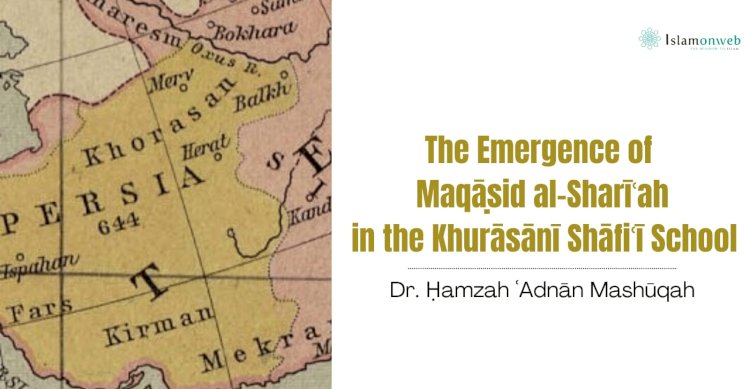
Introduction to the Khurāsānī School
Khurāsān was among the regions in which Islamic civilisation flourished during the ʿAbbāsid era. Its great cities prospered, and scholars became widely established there. For this reason, Imām al-Subkī described it as follows:
“Khurāsān rests upon four principal cities, as though they are the pillars upon which it stands: Marw, Naysābūr, Balkh, and Herāt. These are its great cities. One would not be mistaken to call them the cities of Islam, for they were the abodes of knowledge in its various disciplines, as well as centres of governance and administration in their grandeur at that time. Marw is the central jewel and the finest of them.”[1]
The Shāfiʿī madhhab entered Khurāsān at an early stage. Among the companions of Imām al-Muzanī, one of the foremost students of Imām al-Shāfiʿī, were scholars from Khurāsān, including:
- Aḥmad ibn Sayyār al-Marwazī (d. 268 AH), who was the first to introduce the Shāfiʿī madhhab to the city of Marw;
- ʿAbdān ibn Muḥammad al-Marwazī (d. 293 AH), who further spread the madhhab in Marw[2];
- Abū ʿAwānah al-Isfarāyinī (d. 306 AH), who introduced the Shāfiʿī madhhab to Isfarāyīn, a region of Naysābūr[3];
and others besides them.
By the fourth century AH, after the madhhab had become established in Khurāsān, a distinct scholarly trend emerged, known as the Khurāsānī school. Among its most prominent figures were:
- al-Qaffāl al-Ṣaghīr al-Marwazī, Abū Bakr ʿAbd Allāh ibn Aḥmad (d. 417 AH), the leading authority of the Khurāsānī method;
- Abū Muḥammad al-Juwaynī (d. 438 AH);
- Abū al-Qāsim ʿAbd al-Raḥmān al-Fūrānī (d. 461 AH);
- al-Qāḍī Ḥusayn ibn Muḥammad ibn Aḥmad, Abū ʿAlī al-Marwazī (d. 462 AH);
- Abū ʿAlī al-Ḥusayn ibn Shuʿayb al-Marwazī al-Sinjī (d. 427 AH);
- Imām al-Ḥaramayn: ʿAbd al-Malik al-Juwaynī (d. 478 AH);
- Abū Ḥāmid Muḥammad ibn Muḥammad al-Ghazālī (d. 505 AH).
It is important to distinguish here between the term Khurāsāniyyūn and the Khurāsānī school within the Shāfiʿī madhhab. The former is broader and includes all Shāfiʿī scholars of Khurāsān. The latter, however, is more specific, referring particularly to the methodological approach of al-Qaffāl al-Ṣaghīr and those who followed his path.
Al-ʿAllāmah Aḥmad Bek al-Ḥusaynī explains:
“When they say, ‘Our Khurāsānī scholars hold such-and-such’ or ‘the method of our Khurāsānī scholars is such,’ they refer to al-Qaffāl al-Marwazī, the leading authority of the Khurāsānī method, and his followers. However, when they say, ‘in the books of the Khurāsāniyyūn,’ this expression includes both the works of those following this method and the writings of all the scholars of Khurāsān.”[4]
It should also be noted that the present study aims to examine the contributions of all Khurāsānī Shāfiʿī jurists to the maqāṣid al-sharīʿah, from the initial entry of the madhhab into Khurāsān up to the end of the era of Imām al-Ghazālī.
Alongside the emergence of the Khurāsānī school, another Shāfiʿī school developed in Baghdad, known as the ʿIrāqī school. Among its most notable scholars were:
- Shaykh Abū Ḥāmid al-Isfarāyinī (d. 406 AH), the leading authority of the ʿIrāqī method;
- al-Qāḍī Abū al-Ḥasan ʿAlī ibn Ḥabīb al-Māwardī (d. 450 AH);
- al-Qāḍī Abū al-Ṭayyib al-Ṭabarī (d. 450 AH);
- al-Qāḍī Abū ʿAlī al-Bandanījī (d. 425 AH);
- Abū Isḥāq al-Shīrāzī (d. 476 AH);
- al-Qāḍī Abū ʿAlī al-Fāriqī (d. 528 AH);
- Ibn Abī ʿAṣrūn: Abū Saʿd ʿAbd Allāh al-Mawṣilī (d. 585 AH).[5]
These two schools continued to develop until efforts emerged to reconcile and synthesise their approaches. Among the earliest to undertake this were scholars from both traditions, including:
Abū ʿAlī al-Sinjī (d. 427 AH), followed by al-Mutawallī (d. 448 AH), Ibn al-Ṣabbāgh (d. 477 AH), Imām al-Ḥaramayn ʿAbd al-Malik al-Juwaynī (d. 478 AH), Abū Isḥāq al-Shīrāzī (d. 476 AH), al-Rūyānī (d. 502 AH), and Abū Ḥāmid al-Ghazālī (d. 505 AH).
Their efforts formed the foundational groundwork upon which the later contributions of the two great authorities of the madhhab were built: Imām Abū al-Qāsim al-Rāfiʿī (d. 624 AH) and Imām Abū Zakariyyā al-Nawawī (d. 676 AH).
Section One
The Intellectual Environment in Which the Khurāsānī School Emerged
Subsection One: The Intellectual Activity of Philosophers and Theologians
The emergence of the Shāfiʿī Khurāsānī school coincided with the rule of successive dynasties: the Sāmānid, Ghaznavid, and Seljuk states. The Sāmānid state began its rule under the authorisation of the ʿAbbāsid Caliph al-Muktafī (d. 295 AH), governing from 261 AH to 389 AH. It was followed by the Ghaznavid state, established by Alptegin, one of the commanders of the Sāmānids, which continued from 351 AH until 582 AH. The Seljuk state later emerged in 447 AH and remained in control of Khurāsān until 552 AH.
As for the rational sciences—such as philosophy, logic, and kalām—they witnessed significant growth in Khurāsān during the Sāmānid period. The Sāmānid court was rich with scholars and literati. Al-Thaʿālibī describes this flourishing intellectual atmosphere:
“Bukhārā, under the Sāmānids, was the abode of glory, the qiblah of sovereignty, the gathering place of the most distinguished individuals of the age, the rising point of the stars of literary figures across the land, and the seasonal assembly of the virtuous of the time.”[6]
Philosophical activity also intensified during this period, producing some of the greatest Muslim philosophers, including Ibn Sīnā, Abū Zayd al-Balkhī, and Abū al-Qāsim al-Kirmānī. Ibn Sīnā famously memorised Aristotle’s Metaphysics but was unable to comprehend it until he encountered a work by al-Fārābī that explained it, through which he finally understood its meaning. He excelled in multiple disciplines, particularly philosophy and logic, following the intellectual tradition of al-Fārābī and Aristotle. As for Abū al-Qāsim al-Kirmānī, he engaged in discussions and debates with Ibn Sīnā[7].
At the same time, various theological movements were active, including the Ashʿarīs, Māturīdīs, Muʿtazilah, and Karrāmiyyah. Among the most prominent theologians of this era were:
- Abū al-Qāsim al-Kaʿbī (d. 317 AH), one of the leading figures of the Muʿtazilah;
- Abū Manṣūr al-Māturīdī (d. 333 AH), founder of the Māturīdī school;
- Abū ʿAbd Allāh al-Ḥalīmī (d. 403 AH), author of al-Minhāj fī Shuʿab al-Īmān;
- Abū al-Ḥasan Ibn Fūrak (d. 406 AH), one of the leading Ashʿarī theologians;
along with many others.
Numerous works were composed during this time, including Kitāb al-Īmān by al-Māturīdī, al-Minhāj fī Shuʿab al-Īmān by al-Ḥalīmī, and al-Lumaʿ fī al-Radd ʿalā Ahl al-Zaygh wa al-Bidaʿ by Sālim ibn ʿAbd Allāh al-Harawī (d. 433 AH), among many others.
Debates (munāẓarāt) between different schools and sects were also widespread. Some were even conducted with followers of other religions. Public and private debates took place among adherents of various Islamic schools and orientations, including the Ḥanafīs, Shāfiʿīs, Ẓāhirīs, Ashʿarīs, Muʿtazilah, Karrāmiyyah, and Shīʿah. These discussions were often held in marketplaces, inns, and near mosques. Some rulers even organised formal gatherings for debate and scholarly discussion.
Students of knowledge were expected to train in the discipline of debate, free from partisanship and disorder, since such engagement was considered more beneficial than mere listening and repetition[8].
During this period, the discipline of ʿilm al-khilāf (juristic disagreement) also emerged. This field examines the various methods of deriving rulings from both general and detailed evidences, and then analyses them through argumentation and critique. Its foundational development is attributed to Abū Zayd al-Dabbūsī al-Bukhārī al-Ḥanafī (d. 340 AH), who authored al-Asrār and Taqwīm al-Adillah. Among those who excelled in this field were also Abū al-Ṭayyib al-Ṭabarī al-Shāfiʿī (d. 450 AH) and Abū ʿAlī al-Ṭabarī al-Shāfiʿī (d. 350 AH)[9].
Similarly, the discipline of ʿilm al-jadal (dialectics) developed, defined as the science through which one acquires the ability to establish or refute arguments. Among the earliest jurists to author works in this field was al-Qaffāl al-Shāshī al-Shāfiʿī (d. 365 AH)[10].
Undoubtedly, this vibrant intellectual climate had a profound impact on jurists, shaping their methods of thinking, research, legal theorisation, and authorship. Scholars sought to harmonise the transmitted sciences (al-ʿulūm al-naqliyyah) with the rational sciences (al-ʿulūm al-ʿaqliyyah). As a result, works began to appear that focused on uncovering the wisdoms, meanings, and underlying causes of legal rulings. Among these were Maḥāsin al-Sharīʿah by al-Qaffāl al-Shāshī, as well as the works of al-Ḥakīm al-Tirmidhī, such as al-Ḥajj wa Asrāruhu, al-Ṣalāh wa Maqāṣiduhā, and Ithbāt al-ʿIlal. Further elaboration on these will follow.
Subsection Two: The Parallel Development of the Khurāsānī Shāfiʿī School and the Samarqand Ḥanafī School
During the Sāmānid and later the Ghaznavid periods, the official madhhab of the state was Ḥanafī. Sulṭān Maḥmūd of Ghazna himself initially followed the Ḥanafī school and appointed Ḥanafī judges. However, he later adopted the Shāfiʿī madhhab under the influence of al-Qaffāl al-Ṣaghīr. This shift had a clear impact on the appointment of Shāfiʿī judges and muftīs. Thereafter, both the Ghaznavid and Seljuk states continued to adopt the Shāfiʿī madhhab as the official school.
At the same time, an important uṣūlī school within the Ḥanafī madhhab emerged in Samarqand, tracing back to Imām Abū Manṣūr al-Māturīdī and his students. This school differed from the Ḥanafī Iraqi school in several key aspects:
- It made minimal use of subsidiary legal rulings (furūʿ fiqhiyyah), and did not rely on them as a basis for deriving uṣūl, nor for weighing between opinions.
- The scholars of Samarqand built their uṣūlī discussions upon ʿilm al-kalām, closely linking them to Māturīdī theology.
- Their writings were marked by a systematic effort to define technical terms with logical precision, often presenting these definitions at the beginning of their works[11].
Among the most prominent works of the Samarqand school is Taqwīm al-Adillah by Abū Zayd al-Dabbūsī al-Bukhārī al-Ḥanafī (d. 340 AH). Al-Dabbūsī’s contributions had a significant impact, including influencing many Ḥanafī jurists to move from Muʿtazilī theology towards the Māturīdī creed. His works also played a major role in the development of uṣūl al-fiqh within the Ḥanafī tradition.
His approach was later critically engaged by Shāfiʿī scholars through dialectical and juristic argumentation. Among them was Abū al-Muẓaffar al-Samʿānī in his work Qawāṭiʿ al-Adillah, where he states in the introduction:
“I will identify the relied-upon position in each issue, mention the arguments of the opponents upon which they relied, and I will particularly address what Qāḍī Abū Zayd al-Dabbūsī presented in Taqwīm al-Adillah, responding to it in a manner that dispels doubt and resolves ambiguity, by the help of Allah.”[12]
Similarly, Imām al-Ghazālī responded to al-Dabbūsī in his work Shifāʾ al-Ghalīl, stating in its introduction:
“I have set out to clarify matters that were absent from this approach, which became necessary due to certain statements circulated from the books of Qāḍī Abū Zayd al-Dabbūsī, may Allah have mercy on him.”[13]
This clearly indicates the significant intellectual influence of al-Dabbūsī’s work.
It is also observed that the methodological approach of the Samarqand school in uṣūl al-fiqh closely resembles that of the mutakallimūn. This is evident in their reliance on the rational structuring of legal principles through intellectual, abstract reasoning, even when such principles may not align with the transmitted subsidiary rulings of the madhhab. It is also reflected in their emphasis on precise terminological definitions and systematic organisation of uṣūlī discussions.
Some researchers argue that the Samarqand method predates the method of the mutakallimūn. They base this on the fact that the Samarqand approach originated with al-Māturīdī (d. 333 AH), whereas the mutakallimūn method was later developed by figures such as Qāḍī ʿAbd al-Jabbār (d. 415 AH) and Abū al-Ḥusayn al-Baṣrī (d. 436 AH) from the Muʿtazilah, and by Imām al-Ḥaramayn al-Juwaynī (d. 478 AH) and al-Ghazālī (d. 505 AH) from the Shāfiʿī school[14].
However, this claim may be subject to further discussion, particularly if Imām al-Shāfiʿī himself is considered the earliest to systematise the method later associated with the mutakallimūn—a matter that will be examined in due course.
Subsection Three: The Role of the Niẓāmiyyah Schools in the Flourishing of the Shāfiʿī Madhhab
During this period, rulers and sultans showed great reverence for scholars. In Khurāsān, the early foundations of institutional learning began to appear during the Sāmānid era. Amīr Ismāʿīl ibn Aḥmad (d. 295 AH) endowed ten schools, in addition to libraries, scholarly lodges (ribāṭs), and centres dedicated to the study of the Prophetic Sunnah. This made Khurāsān a focal point for scholars, literati, and students of knowledge across the Islamic world[15].
In the Ghaznavid period, rulers continued to support the establishment of schools. However, these institutions were generally centred around one or more teachers and lacked a structured educational system. There were no formal curricula, nor were students subjected to examinations. It was only with the emergence of the Niẓāmiyyah schools that a more organised system of education developed.
Alongside this, many scholars founded their own independent institutions. Among them was the school of Abū al-Qāsim al-Bayhaqī (d. 488 AH), which notably accommodated four religious groups: the Ḥanafīs, Shāfiʿīs, Karrāmiyyah, and Shīʿah[16].
The educational system reached a new level of development during the Seljuk period with the establishment of the Niẓāmiyyah schools by the vizier Niẓām al-Mulk (d. 485 AH), who served as minister to the sultan for thirty years. These schools spread across Khurāsān, Persia, and Iraq. They were founded upon the Shāfiʿī madhhab and the Ashʿarī creed, while offering instruction in a wide range of disciplines, including the religious sciences, language studies, as well as mathematics, medicine, and pharmacy.
Admission into these schools required a strong grounding in various sciences and disciplines. Teachers were carefully selected through rigorous evaluation of their scholarly competence and their ability to engage in debate (munāẓarah). Niẓām al-Mulk also structured the educational process progressively, from the simple to the complex, and from foundational to advanced levels, beginning with the transmitted sciences (al-ʿulūm al-naqliyyah) before moving to the rational sciences (al-ʿulūm al-ʿaqliyyah)[17].
The Niẓāmiyyah schools also played a significant role in countering the spread of Shīʿī influence. Education was one of the primary means adopted by Niẓām al-Mulk to address theological challenges. In addition, these institutions supplied the state with qualified personnel in positions such as issuing fatwā, judiciary, and ḥisbah, all aligned with the creed of Ahl al-Sunnah. The influence of these schools continued into the Zangid, Ayyūbid, and Mamlūk periods[18].
The Seljuk state’s patronage of the Shāfiʿī madhhab had a profound impact on its growth and the development of its scholarly methodologies. The integrative approach that combined the Khurāsānī and ʿIrāqī schools gained momentum through leading scholars such as Imām al-Ḥaramayn al-Juwaynī, Imām al-Ghazālī, and Abū Isḥāq al-Shīrāzī, all of whom were prominent teachers within the Niẓāmiyyah institutions. Many jurists were trained under them.
Al-Shīrāzī remarks:
“I travelled to Khurāsān, and I did not enter a town or village except that its judge, muftī, or khaṭīb was either my student or among my companions.”[19]
Second Part: The Scholarly Methodology of the Khurāsānī Shāfiʿī School
This study was published in Arabic in Namāʾ Journal, Egypt, Vol. 9, Issue 2, June 2025 and reproduced by Jordan Dar al ifta on this link: https://www.aliftaa.jo/Research/273
The translation was verified and edited by Faisal Niyaz Hudawi
About the author:
Dr. Ḥamzah ʿAdnān Mashūqah, Directorate of Research and Studies / General Iftāʾ Department, Jordan
References
[1] Tāj al-Dīn al-Subkī, Ṭabaqāt al-Shāfiʿiyyah al-Kubrā, Dār Hajar for Printing and Publishing, 1413 AH, vol. 1, p. 326.
[2] Ibn Qāḍī Shuhbah, Ṭabaqāt al-Shāfiʿiyyah, ʿĀlam al-Kutub, 1407 AH, vol. 1, p. 79.
[3] Ibn Qāḍī Shuhbah, Ṭabaqāt al-Shāfiʿiyyah, vol. 1, p. 104
[4] Introduction by Dr. ʿAbd al-ʿAẓīm al-Dīb to Nihāyat al-Maṭlab fī Dirāyat al-Madhhab by Imām al-Ḥaramayn, p. 141
[5] Introduction by Dr. ʿAbd al-ʿAẓīm al-Dīb to Nihāyat al-Maṭlab fī Dirāyat al-Madhhab by Imām al-Ḥaramayn, p. 134
[6] Abū Manṣūr al-Thaʿālibī, Yatīmat al-Dahr fī Maḥāsin Ahl al-ʿAṣr, Dār al-Kutub al-ʿIlmiyyah, Lebanon, 1983, vol. 4, p. 115
[7] Nūr al-Dīn ʿAbbās Aḥmad, “The Civilisational Role of the Sāmānid State,” Journal of Mogadishu University, Somalia, Issue 2, 2016, p. 16
[8] Iḥsān Dhunūn, Scientific Life During the Sāmānid Period, University of Jordan, Faculty of Graduate Studies, unpublished PhD thesis, pp. 53–54
[9] Iḥsān Dhunūn, Scientific Life During the Sāmānid Period, pp. 205–230
[10] Abū Zayd al-Dabbūsī, al-Asrār fī al-Uṣūl wa al-Furūʿ, Ministry of Awqāf, Jordan, 1999, vol. 1, pp. 116–120
[11] Haytham Khaznah, The Development of Ḥanafī Uṣūl Thought, Dār al-Kutub al-ʿIlmiyyah, Lebanon, 2015, p. 159
[12] Abū al-Muẓaffar al-Samʿānī, Qawāṭiʿ al-Adillah fī al-Uṣūl, Dār al-Kutub al-ʿIlmiyyah, Lebanon, 1999, vol. 1, p. 19
[13] Abū Ḥāmid al-Ghazālī, Shifāʾ al-Ghalīl, Maṭbaʿat al-Irshād, Baghdad, 1971, p. 9
[14] Haytham Khaznah, The Development of Ḥanafī Uṣūl Thought, p. 162
[15] Iḥsān Dhunūn, Scientific Life During the Sāmānid Period, pp. 44–90
[16] Muḥammad Saʿīd ʿUthmānah, The Intellectual Movement in the Ghaznavid Period, pp. 64–75
[17] Shukrān Kharbūṭlī, “Intellectual Life in Khurāsān under the Seljuk Sultans and Ministers,” Journal of Historical Studies, Issues 117–118, 2012, p. 132
[18] Shukrān Kharbūṭlī, Intellectual Life in Khurāsān, pp. 188–192
[19] Al-Subkī, Ṭabaqāt al-Shāfiʿiyyah al-Kubrā, vol. 4, p. 216
Disclaimer
The views expressed in this article are the author’s own and do not necessarily mirror Islamonweb’s editorial stance.

Related Posts



















Leave A Comment