
Heartbeat of the Desert: How the Life of a Single Mother Became the Centre of Hajj
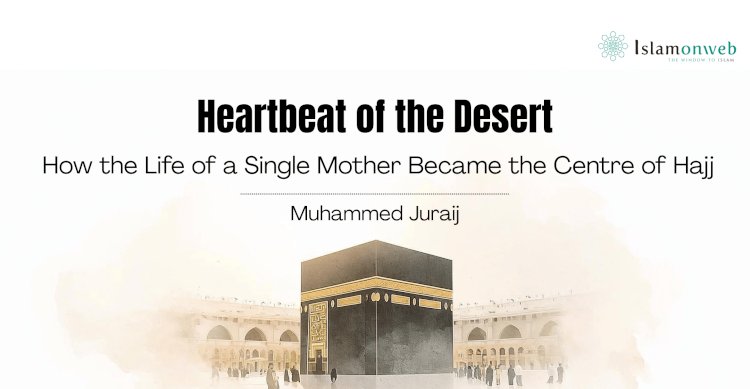
To see the Hajj from above is to witness a galaxy of people in motion, swirling around a simple black cube at the centre of a hot valley in the Ḥijāz of Saudi Arabia. Thousands of people from across the world gather here every year to take part in this extraordinary event, a remarkable expression of faith and an unparalleled feat of organisation.
Yet, if one sees the Hajj merely as a gathering at an ancient site to perform a set of religious rituals, then the true nature of this pilgrimage is missed. Hajj is, in reality, a journey through time, faith, and the deepest dimensions of human experience.
At the centre stands the Kaʿbah, the “House of Allah,” built by Prophet Ibrāhīm (A) and Prophet Ismāʿīl (A). However, one of the most historically profound, spiritually moving, and culturally transformative rituals of Hajj is not directly associated with a prophet, king, or scholar. It is associated with a woman — a woman who was once marginalised, previously enslaved, abandoned as a single mother, and left in a barren desert while her child appeared close to death from thirst.
Before beginning the pilgrimage, a Muslim enters the sacred state of Iḥrām, setting aside all worldly distinctions and wearing simple white garments. Through this act, Hajj creates a deeply egalitarian experience in which pilgrims are stripped of status and comfort and reminded of their vulnerability before Allah, much like Hājar was in the desert before divine mercy unfolded His plan.
According to Islamic tradition, Allah commanded Prophet Ibrāhīm (A) to leave his wife Hājar and their infant son Ismāʿīl (A) in the barren valley of Bakkah. Left with only a small skin of water, Hājar did not surrender to despair. With complete trust in divine providence (tawakkul), she submitted herself to the will of Allah despite her loneliness in the wilderness.
The Great Equaliser – Emptying Your Ego in Iḥrām
Your transformation into the state of Iḥrām begins even before the pilgrimage itself, as you journey through time toward the destination once reached by Hājar. To enter the valley of Hājar is to strip yourself of the material world and detach from the markers of modern identity.
For men, entering Iḥrām requires removing all tailored clothing and worldly adornments. Regardless of wealth, nationality, or social standing, every man removes the garments that symbolise status, culture, and privilege. In their place, pilgrims wear two simple unstitched white cloths resembling the traditional Islamic burial shroud. Women continue to wear their regular modest clothing, though they may neither cover their faces and hands nor display excessive adornment while standing before Allah.
The state of Iḥrām also imposes a strict ethical discipline. Pilgrims are prohibited from cutting hair or nails and from using perfume, scented oils, or fragrances. Hunting animals, cutting trees, carrying weapons, engaging in marital relations, arguing, or participating in violence are all forbidden. Instead, the pilgrim enters a state of peace and harmony with both people and the surrounding environment.
Hajj removes the distinctions of social class, race, ethnicity, nationality, and worldly identity, reducing humanity to its most basic reality: human existence before Allah. Wealth, family background, and social position lose all meaning in this sacred space. The only thing that defines a pilgrim is the sincerity of their spiritual intention.
Only in this state of vulnerability and humility can a pilgrim begin to understand the immense hardship, loneliness, and dependence upon Allah experienced by Hājar thousands of years ago.
The Mountain Valley and the Trial of Ibrāhīm (A)
To understand the trials and tribulations of Hājar, we must revisit the origins of the city of Makkah, back to when it was known as the valley of Bakkah. Historically, this valley was barren and empty, surrounded by jagged cliffs and volcanic mountains, with no visible signs of life — no water, vegetation, or human settlement.
It was in this desolate valley that Prophet Ibrāhīm (A), along with his wife Hājar and their infant son Ismāʿīl (A), was commanded by Allah to leave them behind and return to the Levant.
The psychological weight of this moment is immense. Ibrāhīm (A) had prayed for a child for many years, yet now he was being commanded to leave his wife and son alone in the wilderness, seemingly without protection from thirst or starvation. When Hājar realised that Ibrāhīm (A) was leaving them behind with only a small amount of water and a few dates, she ran after him and asked:
“O Ibrāhīm! Where are you going? Are you leaving us in this barren valley with no people and nothing around us?”
The emotional burden of Allah’s command was so overwhelming for Ibrāhīm (A) that he could not even turn back to look at her, nor could he respond.
Hājar then reached a profound moment of spiritual insight and asked:
“Did Allah command you to do this?”
Ibrāhīm (A) replied with a single word:
“Yes.”
At that moment, Hājar uttered words that would echo through history and shape the spiritual legacy of Hajj forever:
“Then Allah will not abandon us.”
The Concept of Tawakkul: Trust Without Limits
Hājar’s words represent the very essence of tawakkul. It is often loosely translated as “trust in God,” but tawakkul does not mean passive or blind faith. Rather, it means placing complete trust in Allah while actively striving and acting with conviction in His wisdom.
Once Hājar understood that this was Allah’s command, she accepted it with unwavering faith. Yet she did not simply lie down in the desert waiting for death. Her trust in Allah was expressed through action, endurance, and struggle.
As Ismāʿīl (A) became overwhelmed by thirst and cried out in pain, Hājar experienced unbearable grief in the harshness of the desert. Fearing the sight of her child dying from thirst, she placed him beneath a bush and moved a short distance away so she would not have to witness his final moments.
But Hājar did not surrender to despair.
She rose.
The Suffering Between Ṣafā and Marwah
Near the place where Hājar had left Ismāʿīl (A) stood two small hills: Ṣafā and Marwah. Driven by overwhelming maternal instinct and the desperate hope of finding water or help for her child, Hājar climbed Ṣafā, the nearer hill. Reaching its top, she shaded her eyes from the blazing sun and searched the barren landscape for any sign of life.
Finding nothing, she descended into the valley below, where the heat was most intense and the sand deepest. Gathering her garments, she hurried across the valley floor toward Marwah. Upon reaching the top of Marwah, she once again searched for signs of a caravan, a dust cloud, or even the illusion of water in the desert.
Again, she saw nothing.
So she descended and crossed the valley once more toward Ṣafā. Then again toward Marwah.
She repeated this journey seven times, each passage filled with exhaustion, urgency, and pain as she struggled against the harshness of the desert and the fear of losing her child.
At this moment, Hājar represents the very peak of human effort. She is completely alone, physically exhausted, and socially marginalised — an Egyptian woman, a former servant, abandoned in a harsh and patriarchal world. Yet she refuses to surrender to despair.
The Saʿy – Institutionalising a Mother’s Desperation
The Saʿy refers to the act of moving between the two hills of Ṣafā and Marwah, a ritual whose very meaning conveys “striving,” “effort,” and “seeking.” It remains an essential pillar of both Hajj and ʿUmrah.
Reflect on the theological significance of Allah institutionalising the Saʿy. Throughout history, rituals and monuments were often established to commemorate kings, conquerors, prophets, or powerful religious figures. Great ceremonies were usually shaped around moments of victory, authority, and triumph.
Yet in Islam, one of the central rituals of the greatest pilgrimage on earth is based on the actions of a desperate single mother searching for water for her dying child.
In this act, rulers, scholars, warriors, and ordinary believers alike are asked to follow in the footsteps of Hājar.
Today, millions of pilgrims perform the Saʿy along the long marble pathway connecting Ṣafā and Marwah. Pilgrims walk at a regular pace, but when they reach the middle section — marked by green lights and representing the lowest part of the ancient valley — men are encouraged to run, just as Hājar once ran in panic and urgency.
In this ritual, many assumptions about power, status, class, and gender are overturned. The highest expression of devotion is not linked to worldly authority or triumph, but to the perseverance of a mother struggling to save her child.
It was not merely the calmness of Hājar’s prayer that elevated her status before Allah. Her fear, exhaustion, anxiety, determination, and relentless effort were all honoured and transformed into an eternal act of worship. Through the Saʿy, Allah teaches humanity that struggle, perseverance, and sincere effort in caring for those we love are themselves acts of devotion deeply valued by Him.
Zamzam – The Spring of Divine Intervention
After her seventh journey between the hills, exhausted and desperate, Hājar suddenly heard a sound. She rushed back towards her child.
According to Islamic tradition, the Angel Jibrīl (A) descended and struck the ground near the crying infant Ismāʿīl (A) with either his wing or foot. From the cracked and barren earth of Makkah, a spring of water burst forth.
Overwhelmed with relief and fearing that the water might disappear into the sand, Hājar quickly gathered sand and stones around it, crying out, “Zam! Zam!” meaning “Stop! Stop!” It is from this moment that the well came to be known as Zamzam.
The Well of Zamzam represents the physical manifestation of Allah’s response to human striving. Hājar ran across the hills searching for help, yet the water did not emerge from the mountains she climbed. Instead, it appeared beside the child she had left behind. The lesson is profound: human beings are required to strive, but the outcome and relief come from Allah in ways beyond human expectation.
The water Hājar sought simply for survival eventually transformed the entire region. In the desert, water is life. Birds began circling above the spring, attracting the attention of the passing Arab tribe of Jurhum. Observing the birds, they followed them to the valley, where they encountered Hājar and sought permission to settle near the well in exchange for sharing its water.
In this way, Makkah gradually emerged as a settlement. The city that would later house the Kaʿbah, witness the birth of Prophet Muhammad ﷺ, and become the spiritual heart of nearly two billion Muslims traces its origins to the perseverance of Hājar and the miracle of Zamzam.
Without doubt, Hājar stands as the mother of Makkah.
The Stoning of the Jamarāt – A Family’s Struggle Against Doubt
While the story of Hājar forms the emotional heart of the Hajj rituals, another major rite recalls the later trial of Prophet Ibrāhīm (A), when he returned to Makkah and faced an even greater test: the command to sacrifice his beloved son, Ismāʿīl (A).
According to Islamic tradition, during this trial Satan attempted to shake the faith of Ibrāhīm (A), Hājar, and Ismāʿīl (A). He sought to persuade Ibrāhīm (A) that he was acting irrationally, urged Hājar to stop her husband, and tempted Ismāʿīl (A) to disobey his father.
In response, they rejected Satan by throwing stones at him, affirming their submission to Allah and refusing to surrender to doubt and temptation. In the end, Allah spared Ismāʿīl (A) and replaced him with a ram, demonstrating that the trial was ultimately about obedience and surrender to the divine will rather than human sacrifice.
Today, pilgrims commemorate this event during the days of Tashrīq by throwing pebbles at the three stone pillars known as the Jamarāt. It is one of the most physically demanding rituals of Hajj and carries deep spiritual significance.
By casting stones, pilgrims symbolically reject not a physical devil, but the inner temptations and destructive impulses that distance human beings from Allah. With every pebble thrown, pilgrims reject arrogance, greed, hatred, pride, and doubt.
This ritual also reflects the importance of family and collective faith. Ibrāhīm (A), Hājar, and Ismāʿīl (A) were all tested together in their willingness to obey Allah despite immense emotional difficulty. The ritual therefore, reminds pilgrims that strong families and faithful communities play a vital role in helping individuals remain steadfast upon truth.
Arafāt – The Dress Rehearsal for the End of Days
Although the Kaʿbah is the physical centre of Hajj, the Prophet Muhammad ﷺ declared:
“Hajj is ʿArafāt.”
In other words, without the standing at ʿArafāt, the Hajj remains incomplete.
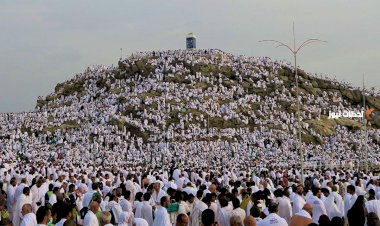
On the 9th of Dhū al-Ḥijjah, millions of pilgrims leave Makkah and gather in the vast open plain surrounding Mount ʿArafāt. There are no circumambulations or movements between hills here — only standing before Allah.
Pilgrims stand beneath the blazing sun in their white garments of Iḥrām, raising their hands in repentance, weeping over their sins, and begging for Allah’s mercy. They pray for themselves, their families, the suffering of humanity, and the condition of the world itself.
ʿArafāt serves as a powerful reminder of the Day of Resurrection. It resembles the final gathering when humanity will stand before Allah on an immense plain to account for their lives. The sight of millions of people standing barefoot in white garments resembling burial shrouds, all pleading for divine mercy, creates one of the most overwhelming and unforgettable scenes in human experience.
The Eternal Rhythm of the Valley
The journey of Hajj is physically demanding, emotionally overwhelming, and deeply transformative. Yet within its ancient rituals lie timeless lessons about human life and humanity's relationship with Allah.
Hajj teaches pilgrims that worldly titles and social distinctions hold no value before Allah, which is why the pilgrim must strip away pride and ego through the state of Iḥrām. It teaches that faith is not only about tawakkul — trusting in Allah — but also about saʿy: striving, struggling, and continuing to move forward no matter how difficult the journey becomes. It teaches believers to resist the whispers of corruption, arrogance, and doubt symbolised in the ritual of the Jamarāt.
Yet above all, the spirit of Hajj lives in the footsteps of Hājar beneath the burning heat between Ṣafā and Marwah. Through her story, the rituals of Hajj become more than a remembrance of ancient history; they become a living testimony to human perseverance, faith, and endurance.
Whenever a believer faces illness, poverty, loneliness, loss, or despair, the story of Hājar stands as a reminder. She was left alone in a barren valley with nothing but faith and a thirsty child, yet she did not surrender to hopelessness. She continued to strive until Allah opened the doors of mercy for her.
And because she ran, water burst forth from the desert, a city emerged from the barren valley, and billions of believers after her would follow in her footsteps seeking the mercy of Allah.
Disclaimer
The views expressed in this article are the author’s own and do not necessarily mirror Islamonweb’s editorial stance.


Related Posts










Leave A Comment