
Tasbīḥ and Testimony: A Qur’ānic Reading of Consciousness in Creation
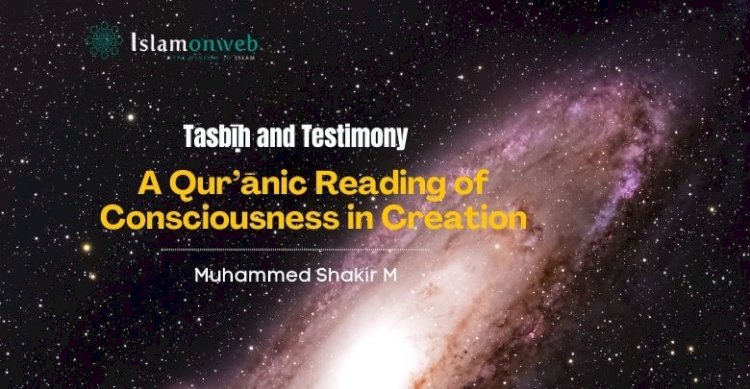
The Qur’ān presents a remarkable vision that all created entities, from celestial bodies and mountains to individual body parts, engage in conscious acts of worship. These entities glorify God (tasbīḥ), prostrate before Him (sujūd), bear testimony to His reality (shahādah), and respond to divine commands with understanding and emotion. Yet this explicit Qur’ānic teaching on universal consciousness has received surprisingly limited attention in contemporary philosophy of mind. While Western philosophy continues to grapple with the “hard problem of consciousness,” recently reviving interest in panpsychism, the view that consciousness is fundamental and pervasive in nature, the Islamic intellectual tradition appears to have long affirmed a comparable framework, grounded in revelation and sustained philosophical reflection.
This article examines the Qur’ānic foundations of what may be described as an Islamic form of panpsychism, showing how the Qur’ān attributes awareness, knowledge, volition, and even emotional response to entities commonly regarded as inanimate. It argues that Islamic conceptual frameworks not only anticipate contemporary panpsychist debates but also offer more coherent responses to enduring challenges, such as the combination problem, that continue to trouble Western theories of consciousness.
The Qur'anic Evidence
Five passages establish the scope and nature of universal consciousness in the Qur’ān. The most comprehensive appears in Sūrat al-Isrāʾ (17:44): “The seven heavens and the earth and all that is therein glorify Him, and there is not a thing except that it glorifies His praise. But you do not understand their glorification.” The Arabic phrase min shayʾin (“not a thing”) establishes an unlimited scope: every entity participates in tasbīḥ. The verb yusabbiḥu denotes an ongoing, active process rather than a passive state of existence. Crucially, the clause “but you do not understand their glorification” (lā tafqahūna tasbīḥahum) indicates that non-human entities possess genuine, though humanly inaccessible, modes of awareness. [1]
Sūrat al-Nūr (24:41) adds cognitive specificity: “Each has known its [means of] prayer and its glorification.” The phrase kullun qad ʿalima employs the verb ʿalima, which denotes cognitive awareness; each entity has already acquired knowledge of its particular mode of worship.[2]
Sūrat al-Ḥajj (22:18) extends this consciousness to cosmic entities: “Do you not see that to Allah prostrates whoever is in the heavens and whoever is on the earth, and the sun, the moon, the stars, the mountains, and the trees.” Prostration (sujūd) entails volition and awareness; it is a voluntary act of submission that presupposes recognition of the One before whom prostration occurs.[3]
Most striking is Sūrat al-Aḥzāb (33:72): “Indeed, We offered the Trust to the heavens and the earth and the mountains, but they declined to bear it and feared it; and man undertook to bear it.” This passage depicts an explicit moral encounter: the amānah is offered to cosmic entities, who respond by declining (abayna) and experiencing fear (ashfaqna). The attribution of fear to the mountains indicates an affective state, suggesting a genuine emotional response arising from an understanding of divine responsibility.[4]
Finally, Sūrat Fuṣṣilat (41:20–21) attributes autonomous awareness to bodily parts: “Their hearing, their eyes, and their skins will testify against them concerning what they used to do. And they will say to their skins, ‘Why do you testify against us?’ They will reply, ‘Allah has caused us to speak.’” This passage raises profound questions about distributed consciousness—whether awareness exists at subsystem levels within organisms, with bodily faculties retaining independent capacities for memory, articulation, and testimony distinct from unified personal consciousness.[5]
Classical Scholarly Interpretations: Literal and Symbolic Readings
These verses generated sustained debate within classical tafsīr literature, with scholars divided between literal and symbolic interpretations. This diversity must be acknowledged honestly: while the literalist position is supported by notable authorities, it was never unanimous.
Ibn Kathīr (d. 1373) represents the literalist strand, explicitly affirming that mountains possess awareness and emotional capacity. Commenting on verses describing mountains nearly crumbling upon hearing blasphemy (19:90–91), Ibn Kathīr states that mountains are “affected by listening to words of disbelief and are seized by fear.”[6] Fakhr al-Dīn al-Rāzī (d. 1210), by contrast, offers a more philosophically nuanced analysis, distinguishing between idrāk (perception) itself and the specific mechanisms through which humans perceive. Al-Rāzī suggests that tasbīḥ may represent a non-linguistic mode of consciousness appropriate to each being’s nature—what might be described as phenomenal awareness without conceptual articulation.[7]
Many classical scholars, however, favoured symbolic readings. The dominant “sign theory” (dalālah) interprets glorification as signification: entities glorify God by indicating His power through their existence, rather than through conscious intention. Al-Zamakhsharī (d. 1144) and others argued that attributing literal consciousness to inanimate objects risks anthropomorphism and conflicts with rational principles.[8] This position enjoys strong scholarly backing and cannot be lightly dismissed.
Yet symbolic readings face notable textual difficulties. Qur’ān 17:44 distinguishes between entities merely functioning as signs and those engaged in active glorification, emphasising continuous action. The attribution of knowledge (ʿalima) in 24:41 and affective states—fear and refusal—in 33:72 resist reduction to passive signification. Why would the Qur’ān employ cognitive verbs, describe dialogue, and ascribe emotional responses if these were only metaphorical concessions?[9]
The Ashʿarite occasionalist tradition offers a potential middle path. By holding that God creates acts of glorification moment by moment within entities, it preserves divine sovereignty while accounting for universal worship. Yet even occasionalism can accommodate panpsychism: if God continuously creates conscious states in all entities, then all entities continuously experience awareness, precisely the panpsychist claim. The distinction becomes metaphysical (intrinsic versus divinely sustained) rather than phenomenological. Consciousness may thus be understood simultaneously as a divine gift, emphasised by occasionalism, and as a created reality pervading existence, as panpsychism maintains that God creates and sustains awareness in beings according to their respective natures.[10]
Philosophical Frameworks: Ibn ʿArabī and Mullā Ṣadrā
Classical Islamic philosophy developed systematic metaphysical frameworks to explain universal consciousness. Ibn ʿArabī (d. 1240) offers one of the most comprehensive foundations through his doctrine of waḥdat al-wujūd (Unity of Being). For Ibn ʿArabī, all existence consists of divine self-manifestation (tajallī). Every entity is a maẓhar (locus of manifestation) through which divine reality discloses itself. If all things are manifestations of the Divine, consciousness necessarily pervades all being—not as a property possessed independently by entities, but as intrinsic to existence as divine self-disclosure.[11]
A crucial theological clarification is required here: waḥdat al-wujūd is not pantheism. Ibn ʿArabī maintains an absolute distinction between God’s essence (dhāt) and creation. The cosmos is God’s self-disclosure, not God Himself. As Ibn ʿArabī states in Fuṣūṣ al-Ḥikam: “The cosmos is the form of the Real, and the Real is the spirit of the cosmos”—a panentheistic relationship in which all exists in God without being identical to God’s essence. Critics who equate waḥdat al-wujūd with pantheism fail to grasp the fundamental distinction between God’s necessary existence and creation’s contingent existence as manifestation. This distinction preserves tawḥīd while accounting for universal consciousness as divine self-knowing through infinite perspectives.[12]
Mullā Ṣadrā (d. 1640) further systematises Qur’ānic panpsychism through rigorous ontological analysis in his doctrine of tashkīk al-wujūd (gradation of existence). Ṣadrā argues that existence (wujūd) is metaphysically prior to essence and admits of degrees. In al-Asfār al-Arbaʿah, he explicitly states: *“Nothing lacks perception (idrāk) absolutely, even if we lack perception of its perception. For perception is an existential perfection, and existence in its essence admits no privation. Therefore, everything that exists possesses some degree of perception according to its existential intensity.”*[13]
Regarding minerals in particular, Ṣadrā writes: *“Even the mineral substance possesses preparational perception (idrāk istiʿdādī) by which it receives forms and undergoes transformation. This is a mode of awareness appropriate to its ontological station, not the rational consciousness of human beings.”*[14]
This hierarchical model avoids anthropomorphism by distinguishing consciousness as such from specifically human modes of awareness. Minerals possess an experiential character appropriate to their level of existence—a rudimentary interiority that differentiates them from purely mechanical matter. Ṣadrā grounds this view in ḥarakah jawhariyyah (substantial motion): because substances undergo continuous existential transformation, they must possess a form of awareness corresponding to their trajectory of becoming.[15]
Contemporary Panpsychism: Islamic Solutions to Western Problems
Contemporary Western panpsychism, revived by philosophers such as Philip Goff, Galen Strawson, and David Chalmers, continues to face persistent theoretical difficulties. Chief among them is the combination problem: if fundamental particles possess primitive forms of consciousness, how do these micro-subjects combine to form unified macro-subjects? Goff’s constitutive panpsychism, in particular, struggles to account for phenomenal unity. Separate conscious states appear unable to integrate into a single, unified experience without reintroducing a form of “emergence” that panpsychism was meant to avoid.[16]
Cosmopsychism, defended in recent work by philosophers including Philip Goff, reverses this approach by positing a single cosmic consciousness that grounds individual subjects. Yet this model encounters the decomposition problem: if there is one cosmic mind, how do individuated, bounded subjects like ourselves arise? What determines the boundaries between distinct centres of experience?[17]
Islamic metaphysical frameworks offer more coherent solutions to these problems. Ibn ʿArabī’s waḥdat al-wujūd provides precisely what cosmopsychism lacks: a systematic account of how a single consciousness and divine self-awareness manifests through hierarchical levels of reality without requiring bottom-up combination. Human consciousness does not arise from aggregating particle-level consciousnesses, but from occupying a particular station as a maẓhar within the hierarchy of divine self-disclosure. The boundary problem dissolves because each entity’s limits are determined by its specific mode of manifestation—not arbitrarily imposed, but arising necessarily from the logic of divine self-knowledge unfolding through differentiated forms.
Mullā Ṣadrā’s doctrine of tashkīk al-wujūd likewise avoids the combination problem by locating consciousness within existence itself, varying in intensity according to degrees of existential perfection. Higher forms of consciousness do not emerge from lower ones; rather, they manifest when material and structural conditions allow higher degrees of wujūd to be expressed. The observed correlation between neural complexity and consciousness is thus expressive rather than productive: complex organisation enables consciousness to appear at a higher intensity, but does not generate it.[18]
Finally, Islamic panpsychism supplies what most Western accounts lack a teleological grounding. Consciousness is not a brute metaphysical fact but serves a cosmic purpose: enabling universal worship and divine self-knowledge. Ontology and normativity are thus integrated, offering an explanation not only of how consciousness exists but also of why it does.
The Verification Problem and Theological Justification
The most persistent objection to panpsychism concerns empirical verification: how could one ever test whether minerals possess consciousness? This challenge deserves direct engagement. Contemporary neuroscience investigates consciousness through neural correlates, but this approach presupposes neural organisation. If consciousness exists within radically different substrates, current empirical methods would necessarily fail to detect it. In such cases, the absence of evidence reflects methodological limitations rather than the absence of the phenomenon itself.
More fundamentally, phenomenological access to other minds is a general problem in the philosophy of mind. We cannot directly experience other human consciousness; instead, we infer its existence through behavioural and physiological similarities. This inference becomes increasingly tenuous when applied to radically different forms of being. Thomas Nagel’s famous question, “What is it like to be a bat?”, illustrates that even mammalian consciousness may be phenomenologically inaccessible to human experience. The Qur’ānic assertion, “but you do not understand their glorification,” expresses a similar epistemic humility while affirming ontological realism regarding diverse modes of consciousness.[19]
Islamic panpsychism enjoys a distinctive advantage at this point: scriptural warrant. Qur’ānic revelation provides theological justification for affirming universal consciousness despite empirical underdetermination. This is not special pleading, but a recognition that revelation can yield knowledge beyond the reach of empirical verification, a foundational principle within religious epistemology. In addition, ḥadīth literature records instances in which the Prophet (ﷺ) and his Companions directly encountered non-human awareness, such as hearing pebbles glorify God or witnessing mountains respond, accounts that classical scholars accepted as experiential confirmation of Qur’ānic teaching.[20]
The theological justification thus proceeds as follows: if God discloses that all things glorify Him consciously, and if Qur’ānic authority is accepted in matters that transcend empirical access, then there exists sound warrant for affirming universal consciousness even in the absence of scientific confirmation. This does not render the claim immune to philosophical scrutiny, but it establishes its legitimacy within Islamic epistemology.
Environmental Implications
The practical implications for environmental ethics are profound. If mountains fear divine displeasure and trees engage in worship, human moral responsibility necessarily extends beyond anthropocentric concerns. The Qur’ānic concept of khalīfah (trusteeship) thus acquires deeper significance: humans are custodians of fellow worshippers, not merely managers of natural resources. Environmental destruction, on this view, becomes a disruption of cosmic worship, violating not only ecological balance but the very purpose for which conscious creation exists.[21]
Contemporary Islamic environmental ethics increasingly draws upon these insights. Thinkers such as Seyyed Hossein Nasr argue that the modern ecological crisis stems in part from the desacralisation of nature, treating it as inert matter rather than conscious creation engaged in tasbīḥ. Recovering Qur’ānic and philosophical teachings on universal consciousness thus provides a religious foundation for environmental stewardship that goes beyond utilitarian calculation or mere aesthetic appreciation.[22]
Addressing Objections
Several objections merit a response. First, the charge that this account is “mystical” rather than philosophical is misplaced. Both Ibn ʿArabī and Mullā Ṣadrā develop rigorous metaphysical systems grounded in identifiable premises and yielding systematic implications. That their arguments operate within theistic frameworks does not invalidate them philosophically, any more than Gottfried Wilhelm Leibniz’s monadology is disqualified by its theological grounding.
Second, concerns regarding divine transcendence are addressed by maintaining that all created consciousness remains derived and contingent. The distinction between autonomous and derivative consciousness safeguards tawḥīd: created entities do not possess awareness independently; rather, they receive it as a divine manifestation or gift. Created consciousness remains infinitely distant from divine consciousness in both perfection and independence.
Third, the testimony of bodily parts (Qur’ān 41:20–21) coheres naturally with this framework by recognizing distributed consciousness within organisms. Following Ṣadrā’s hierarchical ontology, bodily faculties exist at different levels within the human composite, each possessing awareness appropriate to its ontological station. In earthly life, rational consciousness predominates, while organs retain their own modes of awareness, evident in autonomous physiological functions and, eschatologically, in independent testimony. This does not fragment the self but rather acknowledges that a unified personal consciousness emerges from the integration of multiple subsystems' awarenesses.[23]
Conclusion
The Qur’ān presents a consistent teaching of a conscious creation engaged in universal worship. Classical tafsīr, though marked by debate, reveals substantial scholarly support for literal readings of this doctrine. Islamic philosophical traditions further developed systematic metaphysical frameworks, grounded in graded existence and divine self-disclosure, that explain universal consciousness in ways that address problems still unresolved within contemporary Western panpsychism.
Islamic panpsychism offers contemporary philosophy more coherent solutions to the combination and boundary problems by adopting top-down rather than bottom-up models of consciousness. It grounds environmental ethics in a powerful religious vision rooted in cosmic awareness, and it demonstrates how revelation can justify metaphysical commitments that exceed empirical verification without abandoning philosophical rigor.
The Qur’ānic declaration that “there is not a thing but glorifies His praise, but you do not understand their glorification” (17:44) unites ontological boldness with epistemological humility, affirming universal consciousness while recognising the limits of human comprehension. This balance captures Islamic panpsychism’s distinctive contribution to enduring questions about the place of mind within the natural order.
Author Bio
Muhammed Shakir M is a graduate student in Civilizational Studies at Darul Huda Islamic University. His academic focus lies in Islamic intellectual traditions and their contemporary relevance. His research interests include Qur’ānic studies, classical Islamic philosophy, and the intersection of traditional Islamic thought with modern philosophical debates—particularly in philosophy of mind and environmental ethics.
End Notes
[1] Qur’ān 17:44. Al-Ṭabarī, Jāmiʿ al-Bayān, ed. Aḥmad Shākir (Cairo: Dār al-Maʿārif, 1954–1968), vol. 14, pp. 551–555.
[2] Qur’ān 24:41
[3] Qur’ān 22:18
[4] Qur’ān 33:72
[5] Qur’ān 41:20–21
[6] Ibn Kathīr, Tafsīr al-Qur’ān al-ʿAẓīm, ed. Sāmī Salāmah (Riyadh: Dār Ṭayyibah, 1999), vol. 5, pp. 266–268.
[7] Fakhr al-Dīn al-Rāzī, Mafātīḥ al-Ghayb (Beirut: Dār Iḥyāʾ al-Turāth al-ʿArabī, 1999), vol. 20, pp. 312–315.
[8] Al-Zamakhsharī, al-Kashshāf (Beirut: Dār al-Kitāb al-ʿArabī, 1407 AH), vol. 2, pp. 659–660
[9] Al-Rāzī, Mafātīḥ al-Ghayb, vol. 23, pp. 364–367
[10] On occasionalism and consciousness, see Richard Frank, Al-Ghazālī and the Ashʿarite School (Durham: Duke University Press, 1994), pp. 45–67
[11] Ibn ʿArabī, Fuṣūṣ al-Ḥikam, ed. Abū al-ʿAlāʾ ʿAfīfī (Beirut: Dār al-Kitāb al-ʿArabī, 1946), pp. 48–52
[12] Ibid., pp. 76–78. On waḥdat al-wujūd and pantheism, see William Chittick, The Sufi Path of Knowledge (Albany: SUNY Press, 1989), pp. 79–95
[13] Mullā Ṣadrā, al-Ḥikmah al-Mutaʿāliyah fī al-Asfār al-ʿAqliyyah al-Arbaʿah (Tehran: Bunyād-i Ḥikmat-i Islāmī-yi Ṣadrā, 2001–2009), vol. 6, p. 148.
[14] Ibid., vol. 6, p. 152
[15] Ibid., vol. 3, pp. 89–96
[16] Philip Goff, Consciousness and Fundamental Reality (Oxford: Oxford University Press, 2017), pp. 181–206
[17] Philip Goff, “Cosmopsychism, Micropsychism and the Grounding Relation,” in Routledge Handbook of Panpsychism, ed. William Seager (London: Routledge, 2019), pp. 144–156
[18] M. Sadat Mansori, “Panpsychism in Philosophy of Mind, Transcendent Philosophy (Mullā Ṣadrā), and the Qur’ān,” Iranian Journal of Philosophical-Theological Research (2022): 45–68
[19] Thomas Nagel, “What Is It Like to Be a Bat?” Philosophical Review 83, no. 4 (1974): 435–450
[20] Ṣaḥīḥ Muslim, Kitāb Faḍāʾil al-Ṣaḥābah, ḥadīth no. 2277
[21] Qur’ān 2:30, on the concept of khalīfah
[22] Seyyed Hossein Nasr, “Islam and the Environmental Crisis,” in Islamic Spirituality: Manifestations, ed. Seyyed Hossein Nasr (New York: Crossroad, 1991), pp. 152–167; Fazlun Khalid, Signs on the Earth: Islam, Modernity and the Climate Crisis (London: Kube Publishing, 2019)
[23] On hierarchical consciousness and bodily subsystems, see Mullā Ṣadrā, al-Asfār, vol. 8, pp. 234–245
Disclaimer
The views expressed in this article are the author’s own and do not necessarily mirror Islamonweb’s editorial stance.


Related Posts


















Leave A Comment