
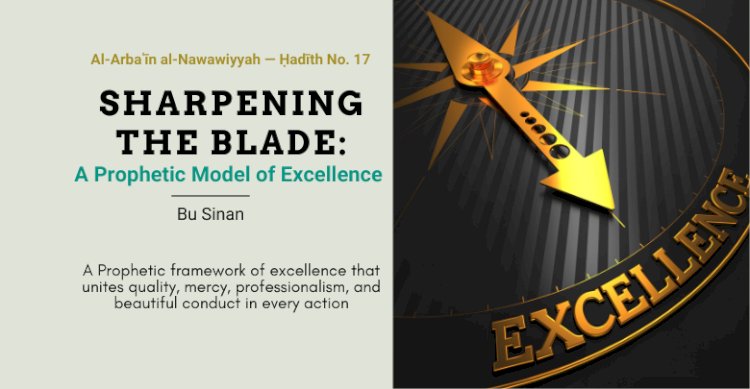
Ḥadīth No. 17 : A Prophetic Framework of Excellence
عَنْ أَبِي يَعْلَى شدَّادِ بْنِ أَوْسٍ رضي الله عنه، عَنْ رَسُولِ اللَّهِ صلى الله عليه وسلم قَالَ: "إِنَّ اللَّهَ كَتَبَ الإِحْسَانَ عَلَى كُلِّ شَيْءٍ، فَإذَا قَتَلْتُمْ فَأَحْسِنُوا الْقِتْلَةَ، وَإِذَا ذَبَحْتُمْ فَأَحْسِنُوا الذِّبْحَةَ، وَلْيُحِدَّ أَحَدُكُمْ شَفْرَتَهُ، وَلْيُرِحْ ذَبِيحَتَهُ" رَوَاهُ مُسْلِمٌ
Translation
On the authority of Abū Yaʿlā Shaddād ibn Aws (raḍiyallāhu ʿanhu), that the Messenger of Allah ﷺ said:
“Indeed, Allah has prescribed iḥsān (excellence and kindness) in all things. So when you kill, kill in the best manner; and when you slaughter, slaughter in the best manner. Let one of you sharpen his blade, and let him spare suffering to the animal he slaughters.”
— Narrated by Muslim[1]
About the Narrator
Shaddād ibn Aws was a distinguished Companion of the Prophet ﷺ, counted among the eminent leaders and virtuous figures of the Ṣaḥābah. He was known as a man of knowledge coupled with practice, embodying what he learned in his conduct and character.
ʿUbādah ibn al-Ṣāmit (raḍiyallāhu ʿanhu) said about him:
“Shaddād was among those who were granted knowledge and forbearance.”[2]
He was the nephew of Ḥassān ibn Thābit (raḍiyallāhu ʿanhu), the famous Anṣārī poet of the Prophet ﷺ. His father participated in the Battle of Badr and was later martyred at Uḥud, placing Shaddād in a household deeply rooted in sacrifice for Islam.
Al-Ṭabarānī narrates from Shaddād ibn Aws that he was once with the Messenger of Allah ﷺ during the Prophet’s final moments. The Prophet ﷺ asked him, “What is the matter with you, O Shaddād?” He replied, “The world feels constricted for me.” The Prophet ﷺ then gave him glad tidings, saying:
“Do not worry. Indeed, al-Shām will be conquered, and Bayt al-Maqdis will be conquered, and you and your descendants after you will be leaders among its people.”
Thereafter, Shaddād settled in Bayt al-Maqdis, having come from al-Shām. The people of al-Shām narrated ḥadīth from him. He travelled to Damascus and al-Jābiyah, resided in Jerusalem, and participated in the Battle of al-Yarmūk.
He passed away in Palestine and was buried in Bayt al-Maqdis in the year 58 AH, at the age of ninety-five.
Among the people of al-Shām, Shaddād ibn Aws was widely recognised as one of the most trustworthy, deeply grounded in fiqh, and sound in judgment and conduct, counted alongside the finest scholars and leaders of his time. He was regarded as the jurist of the ummah, a reference point in understanding and applying the religion with wisdom and balance. Those who observed him closely noted two qualities that clearly set him apart: clarity and eloquence in speech, and remarkable self-restraint in moments of anger. His life was further marked by abundant worship, deep piety, and an intense consciousness of Allah, forming a rare blend of scholarly authority and spiritual depth that made him a model of lived excellence[3].
Introduction
This ḥadīth stands as a foundational text on professionalism and excellence (iḥsān), laying down a universal ethic that governs every sphere of human action. It elevates excellence from a personal virtue to a divinely mandated standard, reminding believers that Islam does not tolerate carelessness, cruelty, or mediocrity, even in moments of necessity. The scholars of Islam have consistently recognized the lofty rank of this narration: it is a great ḥadīth and one of the core principles of the religion, such that whoever lives by it attains all goodness and is safeguarded from harm.
Ibn Daqīq al-ʿĪd described[4] it as one of the comprehensive narrations that encapsulate numerous legal and ethical principles, while al-Nawawī counted[5] it among the concise yet far-reaching ḥadīths upon which the foundations of Islam rest. Echoing this assessment, al-Manāwī[6] affirmed that this narration is indeed one of the qawāʿid al-dīn, the governing maxims of the religion. Read through the lens of professionalism, this ḥadīth teaches that excellence is not optional and it is the divine benchmark by which every action is measured by.
The Concept of Iḥsān
The word kataba in the statement of the Prophet ﷺ, “Indeed, Allah has prescribed (kataba) iḥsān in all things,” linguistically denotes commanding and obligating, and in the usage of most jurists and uṣūl scholars it originally signifies obligation. However, in this context, it encompasses both the obligatory and the recommended dimensions of conduct. Accordingly, obligatory iḥsān lies in fulfilling what Allah has made compulsory, whether actions or abstentions, while meeting all their conditions and requirements. Recommended iḥsān, on the other hand, consists of perfecting obligatory acts through their complements and etiquettes, and performing recommended acts with due care, presence, and completeness.
The term iḥsān itself is the verbal noun of aḥsana, meaning to do something well and beautifully. In Islamic theology, ḥusn (goodness) is defined by revelation, not by independent human reason, as firmly established in the principles of uṣūl al-fiqh[7]. The word can be used in two contexts: one where the action is direct, meaning "I did it well and perfected it," and the other where the action is directed towards someone or something, meaning "I did good to someone" or "I provided benefit to them." Iḥsān here does not merely mean kindness or benevolence toward others, but rather the perfection of all legislated actions as explained by Ibn Hajar Al-Haythami[8]. This understanding is far-reaching, for excellence in action benefits both the doer and others.
For this reason, whoever undertakes a lawful act is required to perform it with the highest degree of excellence, safeguarding its soundness and observing its completing etiquette. One must also guard against the subtle whisper that excellence reduces productivity or limits output. On the contrary, even if an action appears small in quantity, iḥsān magnifies its reward, so much so that a small deed performed with excellence may surpass many deeds devoid of iḥsān. This principle forms a cornerstone of Islamic professionalism: quality is never sacrificed for quantity, and sincerity combined with excellence elevates ordinary acts into enduring works of worship.
Building on this understanding, the present ḥadīth expands iḥsān from a spiritual state into a comprehensive framework for life. We have already seen in the Ḥadīth of Jibrīl that iḥsān in one’s relationship with Allah means worshipping Him as though one sees Him, and if that level is not attained, then with the constant awareness that He sees us. This consciousness produces focus, sincerity, attentiveness, inner beauty, and uncompromising quality, the very elements that define true excellence. What this ḥadīth makes clear is that such excellence is not confined to acts of worship alone; rather, it is the expected standard of conduct for a believer in every sphere of life, whether spiritual, personal, social, or professional.
The scholars[9] point out that this narration functions as a general and all-encompassing principle of the religion, for iḥsān in action means performing every deed in accordance with the dictates of the Sharīʿah, and where applicable, sound reason that operates under revelation. Human actions, in essence, relate either to one’s worldly life or to one’s hereafter. Worldly conduct includes the governance of one’s own self and body, the management of one’s family, colleagues, and responsibilities, as well as dealings with society at large. As for the hereafter, it is built upon īmān, the actions of the heart, and islām, the actions of the body, as already laid out in the Ḥadīth of Jibrīl. When a person observes iḥsān across all these dimensions - aligning belief, worship, character, and conduct with the guidance of the Sharīʿah - he attains all goodness, is protected from all harm, and fulfils the covenant of the religion in its entirety.
However, the scholars soberly remind us that reaching this comprehensive level of excellence is no easy task. Attaining it requires discipline, struggle, and constant self-correction. Iḥsān represents the highest standard of professionalism and ethical excellence in Islam. It calls the believer to rise above mediocrity, to refine every action, and to live with the awareness that excellence is a defining mark of faith.
The Qur’an repeatedly presents excellence as a divine attribute, a cosmic principle, and a moral command. Allah describes His own act of creation as perfect and beautiful: “[Allah is the One] Who perfected everything He created” (al-Sajdah 32:7), grounding iḥsān in the very fabric of existence. He further declares, “And who is better than Allah in giving form (ṣibghah)?” (al-Baqarah 2:138), reminding humanity that all true excellence originates from Him and flows back to Him through conscious worship. Accordingly, believers are commanded, “And do good (aḥsinū); indeed, Allah loves the doers of excellence” (al-Baqarah 2:195).
Iḥsān thus becomes the ethical bridge between divine perfection and human responsibility, which is manifest in justice, compassion, restraint, and refinement of conduct. Whether in family life (“retaining with kindness or releasing with excellence” - al-Baqarah 2:229), social interaction (“respond with a greeting better than it”” - al-Nisa 4: 86), or conflict resolution (“repel evil with what is better”” - Fussilat 41: 34), the Qur’an consistently raises the standard from mere correctness to the best possible manner. This is powerfully summarised in Allah’s universal command: “Indeed, Allah commands justice and iḥsān” (al-Naḥl 16:90), pairing legal fairness with moral beauty.
The Sunnah reinforces this Qur’anic ethos by translating iḥsān into practical precision and professionalism. The Prophet ﷺ taught that Allah loves excellence in work, saying that Allah loves that when one performs an action, he perfects it[10], an ethic that sanctifies skill, care, and mastery in all lawful endeavours. In acts of worship, this principle is vividly illustrated through wuḍūʾ: “Whoever performs ablution and perfects it, his sins depart from his body, even from beneath his fingernails,”[11] as narrated in Ṣaḥīḥ Muslim. Here, iḥsān means itqān, completing, refining, and observing every detail. Collectively, these texts establish that iḥsān is not an abstract ideal but a lived discipline in which excellence in faith, ethics, and effort transforms ordinary actions into acts of devotion and elevates the believer above mediocrity in every domain of life.
Prophetic Guidance on Application of Iḥsān in Extreme Situations
The Prophet ﷺ deliberately illustrates iḥsān using the most sensitive and extreme scenarios, killing in lawful contexts and slaughtering animals, to set an unbreakable ethical ceiling. When he said, “If you kill, then kill in the best manner; and if you slaughter, then slaughter in the best manner,” he was teaching that even where force is legally permitted, cruelty is never permitted. In other words, Islam does not suspend ethics at the point of necessity; rather, it intensifies them.
In lawful killing, such as in qiṣāṣ carried out by authority, or combat under strict rules, the Prophet ﷺ prohibited mutilation, revenge-driven brutality, and unnecessary suffering. He forbade torture outright and condemned acts that prolonged pain. This was revolutionary in a world where violence often meant humiliation and excess. The command “fa-aḥsinū al-qitlah” means to ensure speed, restraint, and absence of vengeance, limiting harm strictly to what justice requires.
The example becomes even clearer in the case of animals. Slaughter (dhabḥ) is lawful for food, yet the Prophet ﷺ transformed it into an act governed by compassion and professionalism. His instruction, “Let one of you sharpen his blade and give comfort to the animal,” is a masterclass in applied ethics. Sharpening the blade beforehand prevents repeated cuts and unnecessary pain, while sparing the animal distress by not frightening it, not showing the blade prematurely, and not slaughtering one animal in front of another reflects deep moral sensitivity. This is how high excellence is achieved.
Beyond its literal ruling, the Prophet’s ﷺ concluding instruction, “Let one of you sharpen his blade and give comfort to the animal”, carries a thoughtful metaphorical and civilisational message. Sharpening the blade represents preparation, competence, and mastery of one’s tools, while giving comfort to the animal represents empathy for the recipient of one’s action. Together, they form the essence of Islamic professionalism: itqān in method and raḥmah in impact. The Prophet ﷺ is teaching that excellence is never accidental; it is the result of readiness, skill, and thoughtful consideration of those affected by our work.
Applied to broader life, this principle extends to every skilled endeavour. A teacher who refines his knowledge, organises his material, and equips himself with effective pedagogical tools delivers lessons that are clear, engaging, and reassuring, making learners feel at ease. A leader who prepares thoroughly, communicates precisely, and understands his team's emotional state creates an environment of trust and ease. Likewise, a professional who keeps his tools, whether intellectual, technical, or ethical, sharp produces work that is efficient, humane, and free of unnecessary strain.
In essence, iḥsān means choosing the path of least harm and greatest benefit; minimum pain, maximum relief; minimum waste, maximum quality. It calls for high standards without harshness, precision without cruelty, and beauty without arrogance. Whether in worship, work, leadership, or daily interaction, excellence in Islam is marked by refined manners, thoughtful preparation, and compassionate execution. It is the art of doing the right thing in the best possible way, so that every action reflects dignity, mercy, and the quiet beauty of faith in motion.
For commentaries on other hadiths, please explore our Hadith Section
End Notes
[1] Ṣaḥīḥ Muslim, ḥadīth no. 1955.
[2] Ibn ʿAbd al-Barr, al-Istīʿāb fī Maʿrifat al-Aṣḥāb, vol. 2, p. 134.
[3] Ibn Saʿd, al-Ṭabaqāt al-Kubrā, vol. 7, p. 401;
Ibn al-Athīr, Asad al-Ghābah fī Maʿrifat al-Ṣaḥābah, vol. 2, p. 387;
Ibn Ḥajar al-ʿAsqalānī, al-Iṣābah fī Tamyīz al-Ṣaḥābah, vol. 4, p. 52, entry no. 3842;
Ibn ʿAsākir, Mukhtaṣar Tārīkh Dimashq, vol. 10, pp. 276, 280;
al-Dhahabī, Siyar Aʿlām al-Nubalāʾ, vol. 2, pp. 460, 467.
[4] Ibn Daqīq al-ʿĪd, Sharḥ al-Arbaʿīn al-Nawawiyyah, p. 57
[5] al-Nawawī, Sharḥ Ṣaḥīḥ Muslim, vol. 13, p. 90, ḥadīth no. 1955
[6] al-Manāwī, Fayḍ al-Qadīr, vol. 2, p. 311, ḥadīth no. 1761
[7] al-Fatḥ al-Mubīn bi-Sharḥ al-Arbaʿīn, p. 341
[8] al-Fatḥ al-Mubīn bi-Sharḥ al-Arbaʿīn, p. 341.
[9] Ibn Rajab al-Ḥanbalī, Jāmiʿ al-ʿUlūm wa al-Ḥikam, vol. 1, p. 428;
Sulaymān al-Ṭūfī, al-Taʿyīn fī Sharḥ al-Arbaʿīn, p. 148.
[10] Reported by Abū Yaʿlā al-Mawṣilī (ḥadīth no. 4386), al-Ṭabarānī in al-Muʿjam al-Awsaṭ (ḥadīth no. 897), and al-Bayhaqī in Shuʿab al-Īmān (ḥadīth no. 4929).
[11] Ṣaḥīḥ Muslim, ḥadīth no. 245.
Disclaimer
The views expressed in this article are the author’s own and do not necessarily mirror Islamonweb’s editorial stance.

Related Posts












Leave A Comment