
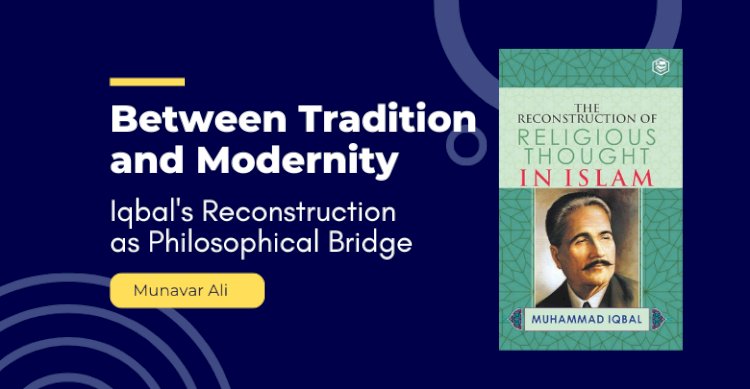
Between Tradition and Modernity: Iqbal's Reconstruction as Philosophical Bridge
Introduction
Sir Muhammad Iqbal’s The Reconstruction of Religious Thought in Islam is one of the most important philosophical contributions in modern Islamic history. While Iqbal is mostly known as the Poet of the East, this collection of seven lectures shows him as a serious thinker trying to do something monumental: reconcile Islamic theology with the challenges posed by modern Western thought.
Written against a backdrop of colonial subjugation and perceived intellectual stagnation within the Muslim world, this text is not just an apologetic defense of Islam. It represents a bold philosophical effort to "reconstruct" Muslim religious philosophy by engaging the leading scientific and philosophical ideas of the early 20th century, including quantum mechanics, relativity theory, and the views of thinkers such as Bergson, Nietzsche, and Whitehead[1]. This review examines the central arguments, the approach taken, and the ongoing importance of the text in discussions of religion and modernity.
The Philosophical Project: Anti-Classicism and the Inductive Intellect
Iqbal’s main idea is that Islamic thought had become stagnant due to an over-dependence on Greek philosophy. In the early lectures, especially "Knowledge and Religious Experience," he argues that the abstract nature of Greek thought dulled the empirical spirit of the Quran. He claims the Quran is anti-classical, focusing on the concrete rather than the abstract, and prioritizing action over ideas.
Iqbal’s argument here is striking. He says the birth of Islam brought forth an "inductive intellect." By referring to nature, history, and the inner self as "signs" of God, the Quran, in Iqbal’s view, anticipates the modern scientific method. He writes, "The scientific observer of Nature is a kind of mystic seeker in the act of prayer." This challenges the typical conflict between science and religion. Iqbal sees scientific inquiry as a way to understand the "habit" of God. He merges Western empirical methods with Eastern spiritual intuition to show that religious experiences can be valid sources of knowledge, similar in value—though different in approach—to sense perception[2].
Ontology: The Ultimate Ego and the Problem of Time
The most intellectually challenging parts of the book are in the third and fourth lectures, where Iqbal addresses the idea of God and the nature of Time. The influence of Henri Bergson is clear here[3]. Iqbal dismisses the static, Aristotelian view of God as the "Unmoved Mover," arguing that such a concept is a lifeless idea incompatible with a universe characterized by evolution and change.
Instead, Iqbal introduces God as the "Ultimate Ego." He sees the universe not as a fixed reality but as a free, creative process—a "collection of egos" that emerge from the Ultimate Ego. This leads him to a nuanced discussion about Time. Iqbal differentiates between "serial time" (the measured, clock-based time of physics) and "pure duration" (divine time). In pure duration, there is no separation between past, present, and future; all of history exists in a single, eternal "now."
This distinction allows Iqbal to address the theological tension between divine decree and human freedom. If God exists in “pure duration,” His knowledge of the future is not a deterministic foretelling but a comprehensive, timeless knowledge of realities as they unfold according to His will. Human beings, therefore, exercise genuine moral choice within the framework of divine sovereignty. For Iqbal, the universe is not a closed, completed system, but a dynamic arena of becoming, in which human beings participate responsibly as morally accountable agents operating within a divinely sustained order[4].
The Human Ego: Khudi and Immortality
The idea of the Self, or Khudi, is central to Iqbal’s philosophy. In the lecture "The Human Ego – His Freedom and Immortality," Iqbal moves away from the self-annihilation ideas found in some Sufi traditions. Instead, he promotes self-affirmation. He argues that the goal of the human ego is not to lose itself like a drop in the ocean, but to develop its individuality until it can sustain a direct relationship with God without being destroyed. Iqbal gives a compelling interpretation of the Fall of Adam to support his view. He sees the Fall not as a punishment, but as a necessary shift from a primitive state of instinct to a self-aware, free self. By choosing to disobey, humanity moved from natural determinism to historical freedom.
Moreover, Iqbal considers immortality not as a given right of the soul, but as something to be achieved. Only those who develop themselves through action and creativity can survive after the body dissolves. This "conditional immortality" is one of his most original and controversial ideas, blending Quranic themes with a Nietzschean focus on will and power[5].
Sociology and Law: The Principle of Movement
In the final lectures, particularly "The Principle of Movement in the Structure of Islam," Iqbal shifts from metaphysics to sociology. He identifies stagnation in the Muslim world as a result of the closure of the "gate of Ijtihad" (independent reasoning). He argues that early Islamic law lost its vibrancy when scholars imposed strict conformity out of fear of social breakdown.
Iqbal’s answer is to revive Ijtihad, but in a modern way. He acknowledges that law interpretation should not be left solely to individual scholars. Instead, he suggests transferring Ijtihad to a legislative assembly. This essentially lays the groundwork for an Islamic democracy, where the community’s "consensus" is enacted through a modern parliament. This part of the book remains politically influential, affecting constitutional debates in Pakistan and the broader Islamic world for years.
He interprets the "Finality of Prophethood" as a sign of human intellectual advancement[6]. By ending the Revelation, the Quran indicates that humanity must now rely on its own reason and history. For Iqbal, the "abolition of priesthood and hereditary kingship" in Islam is a result of this shift, steering humanity towards spiritual democracy.
Critical Assessment
While The Reconstruction is a remarkable synthesis, it has its weaknesses. Some may critique Iqbal’s mixed use of Western philosophy. At times, he seems to interpret Bergson, Whitehead, or Einstein in a way that fits a pre-existing Quranic perspective. Critics note that his attempt to equate modern physics "light" with Quranic mysticism can feel forced—an approach that risks connecting timeless theology with the temporary theories of early 20th-century science.
Additionally, the writing style can be quite dense. Iqbal quickly jumps between Sufi metaphysics and quantum mechanics, assuming the reader knows both Rumi and Russell well. This complexity means that while the book is highly respected, it is not always fully understood.
Nevertheless, the work's strength lies in its intellectual bravery. Iqbal did not accept the notion that faith is just an escape from a rational world. By portraying Islam as a dynamic, practical, and rational worldview, he provided hope to a generation of Muslims facing the challenges of modernity.
Conclusion
In The Reconstruction of Religious Thought in Islam, Muhammad Iqbal achieved something rare: he wrote a text that is deeply rooted in tradition yet consistently looks forward. He convincingly argued that the "spirit" of Islam does not reject the modern world but rather anticipates it. The book acts as a bridge between the finite and the infinite, the East and the West, and the ancient and the modern. While some scientific references may now seem outdated, its main philosophical claim—that the universe is dynamic and that human life involves creative work in partnership with the Divine—remains a strong and valuable insight. It is essential reading for anyone studying Islamic philosophy, South Asian history, or the sociology of religion.
About the Author
Munavar Ali C is a second-year undergraduate student in the Department of Civilizational Studies at Shihab Thangal Islamic Academy, Vakery. He is also pursuing a Bachelor’s degree in Sociology through Indira Gandhi National Open University (IGNOU). His academic interests include contemporary Islamic thought, classical texts, and history. He hails from Tharuvana, Mananthavady, Wayanad.
References
[1] Iqbal, Muhammad. The Reconstruction of Religious Thought in Islam. Edited by M. Saeed Sheikh. Lahore: Institute of Islamic Culture, 1984.
[2] Iqbal, Muhammad. The Reconstruction of Religious Thought in Islam, 6–7.
[3] Bergson, Henri. Creative Evolution. Translated by Arthur Mitchell. New York: Henry Holt and Company, 1911.
[4] Iqbal, Muhammad. The Reconstruction of Religious Thought in Islam, 72–73.
[5] Nietzsche, Friedrich. Thus Spoke Zarathustra. Translated by Walter Kaufmann. New York: Penguin Books, 1978.
[6] Iqbal, Muhammad. The Reconstruction of Religious Thought in Islam, 145–148.
Disclaimer
The views expressed in this article are the author’s own and do not necessarily mirror Islamonweb’s editorial stance.
Related Posts









Leave A Comment