
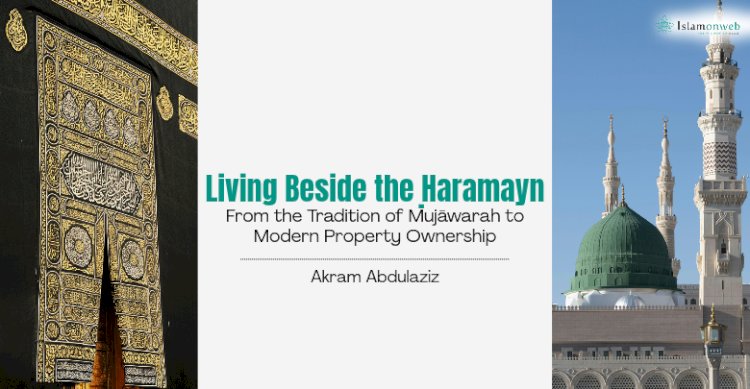
Living Beside the Ḥaramayn: From the Tradition of Mujāwarah to Modern Property Ownership
Mujāwarah in the Islamic Tradition
Makkah enters Qurʾānic history through a prayer about settlement. In Sūrat Ibrāhīm, Prophet Ibrāhīm (ʿalayhi al-salām) leaves some of his family in an uncultivated valley and addresses Allah:
“Our Lord, I have settled some of my descendants in an uncultivated valley near Your sacred House, our Lord, that they may establish prayer. So make hearts among the people incline toward them and provide for them from the fruits that they might be grateful.” (Qurʾān 14:37)[1]
This settlement embodies the spiritual ideal underlying mujāwarah, the practice of taking up residence near the Sanctuary. Its stated purpose was the establishment of prayer.
Later, in Sūrat al-Ḥajj, the Qurʾān describes the Sacred Mosque as a place appointed for all people, the resident therein and the visitor from afar alike (sawāʾan al-ʿākifu fīhi wa al-bād, Qurʾān 22:25).[2] The verse became an important reference for classical scholars discussing access to the Sanctuary and the ownership of property in Makkah.
Madinah inspired a different expression of devotion, one associated with endurance and the end of life. In Ṣaḥīḥ al-Bukhārī, ʿUmar ibn al-Khaṭṭāb (raḍiya Allāhu ʿanhu) prays:
“O Allah! Grant me martyrdom in Your cause, and let my death be in the city of Your Messenger.”[3]
The Prophet ﷺ encouraged Muslims to spend their lives in Madinah, saying:
“Whoever is able to die in Madinah, then let him die there, for I will intercede for those who die there.”[4]
Staying in the oasis demanded real sacrifice. In Ṣaḥīḥ Muslim, the Prophet ﷺ promised his intercession or testimony on the Day of Resurrection to those who patiently endured the hardships of Madinah.[5]
Living beside the Two Holy Mosques (al-Ḥaramayn) was, however, never treated by classical scholars as an uncomplicated privilege. Several early authorities discouraged permanent settlement in Makkah.
In the Kitāb Asrār al-Ḥajj (Book of the Secrets of Pilgrimage) of his Iḥyāʾ ʿUlūm al-Dīn, Abū Ḥāmid al-Ghazālī (d. 505/1111) sets out three reasons for their hesitation.[6]
First, daily familiarity can diminish a believer's reverential awe (haybah) before the Kaʿbah. Second, departure preserves the longing to return (shawq), corresponding to the Qurʾānic description of the Sacred House as a place of return for humanity (mathābatan li al-nās, Qurʾān 2:125). Third, wrongdoing committed in a sacred place carries a particular gravity because of the sanctity of that place.
Other jurists favoured residence. In al-Majmūʿ Sharḥ al-Muhadhdhab, the Shāfiʿī scholar Yaḥyā ibn Sharaf al-Nawawī (d. 676/1277) weighed these earlier warnings against the conduct of the early generations of Muslims. He concluded that the preferred position is that mujāwarah in both Makkah and Madinah is recommended, provided a person does not fear falling into negligence or wrongdoing.[7]
Many members of the early Muslim generations (salaf) had settled and died in the two cities. The opportunities for worship and the spiritual merits associated with residence supported the permissibility and desirability of the practice.
For much of Islamic history, therefore, an important question was how Muslims could live near the sacred mosques while observing their sanctity. Saudi Arabia's recent property ownership reforms have given this spiritual question a new legal and financial dimension.
A Thousand Years of Mujāwirūn
For centuries, the cities of Makkah and Madinah were populated and intellectually sustained by Muslims who came from outside the Ḥijāz and remained there.
Many found accommodation in ribāṭs: residential hospices established as charitable endowments (awqāf) by donors from across the Muslim world.
In his survey of medieval Meccan literary sources, Richard T. Mortel identified fifty-eight such foundations between the eleventh and sixteenth centuries, beginning with the Ribāṭ al-Dimashqiyyah in 395 AH (1004–05 CE).[8]
Their founders included Ayyubid, Mamluk, Rasulid and Marinid rulers, judges, royal women and Indian Ocean merchants. Among them was the Persian merchant Abū al-Qāsim Rāmusht, who endowed his well-known hospice near the Sanctuary in 529 AH (1134–35 CE).
Often designated for particular schools of jurisprudence or regional communities, these institutions provided accommodation for scholars, Sufis, widows, students and long-term residents (mujāwirūn).
Those settlers contributed substantially to the scholarly life of both cities. Fifteenth-century local histories, notably Taqī al-Dīn al-Fāsī's Shifāʾ al-Gharām bi-Akhbār al-Balad al-Ḥarām and Nūr al-Dīn al-Samhūdī's Wafāʾ al-Wafā bi-Akhbār Dār al-Muṣṭafā, record generations of teachers, judges and copyists from Andalusia, the Maghrib, Egypt, Syria, Yemen, Khurāsān and India who made the Ḥaramayn their home.[9]
A study of Makkah during the Ayyubid period by Mansour Said Mohamed identified 158 named mujāwirūn in the biographical literature of the era. Thirty of them played a role in establishing or endowing the city's libraries.[10]
Medieval travellers also left vivid accounts of these resident communities. The Andalusian traveller Ibn Jubayr described foreign residents spending their days in study and remembrance beside the columns of the Sacred Mosque, while students and Qurʾān reciters lodged in residences overlooking the courtyard.[11] The Moroccan traveller Ibn Baṭṭūṭah likewise spent an extended period in Makkah as a mujāwir.[12]
By the nineteenth century, continuous migration associated with pilgrimage had considerably shaped the population of the Ḥijāz. When John Lewis Burckhardt visited the region in 1814–15, he observed the extensive presence of inhabitants originating from outside the region. Families from Yemen, Egypt, Syria, North Africa, Turkey and India formed an important part of urban life in Makkah and Madinah.[13]
Seventy years later, during his stay in Makkah in 1884–85, Christiaan Snouck Hurgronje devoted considerable attention to the Jāwah, the Southeast Asian community whose scholarly and family networks linked the Malay-Indonesian archipelago to the Ḥijāz.[14]
It was during the late Ottoman period that restrictions on foreign property ownership became a significant political issue.
As Michael Christopher Low explains in Imperial Mecca: Ottoman Arabia and the Indian Ocean Hajj, British Indian Muslims formed a substantial foreign community in nineteenth-century Makkah. Under the Ottoman capitulatory arrangements, European powers claimed certain legal privileges concerning their colonial subjects.
The acquisition of property in the holy cities by British Indian subjects consequently raised concerns among Ottoman authorities about foreign jurisdiction within the Ḥijāz. From the late 1860s onward, Ottoman restrictions sought to prevent foreign nationals from acquiring real estate there.[15]
In the twentieth and early twenty-first centuries, successive expansions of the Two Holy Mosques absorbed many historic residential and endowed properties surrounding the sanctuaries.
Can the Houses of Makkah Be Privately Owned?
Behind the history of endowments and state regulations lies a longstanding question of Islamic jurisprudence: may houses and land in Makkah be privately owned, inherited, sold and rented, or does the sanctity of the precinct impose particular restrictions on such transactions?
The dispute is closely associated with Qurʾān 22:25 and the question of whether the equality of residents and visitors mentioned in the verse pertains exclusively to the Sacred Mosque or extends more broadly to Makkah.
In his commentary on this verse, Ismāʿīl ibn Kathīr (d. 774/1373) recounts an exchange that took place in Masjid al-Khayf at Minā between Muḥammad ibn Idrīs al-Shāfiʿī and Isḥāq ibn Rāhawayh, in the presence of Aḥmad ibn Ḥanbal.[16]
Al-Shāfiʿī held that houses in Makkah could be privately owned, inherited, sold and rented. Among his proofs was the ḥadīth of Usāmah ibn Zayd, recorded in Ṣaḥīḥ al-Bukhārī, who asked the Prophet ﷺ whether he would stay in his house in Makkah. The Prophet ﷺ replied:
“Has ʿAqīl left us any property or house?”[17]
Al-Shāfiʿī understood this report as evidence supporting the validity of private property ownership and inheritance in Makkah.
Another report records that Nāfiʿ ibn ʿAbd al-Ḥārith purchased a house in Makkah from Ṣafwān ibn Umayyah for ʿUmar ibn al-Khaṭṭāb to be used as a prison.[18]
Isḥāq ibn Rāhawayh, in contrast, opposed the rental of Meccan houses. Reports attributed to early scholars, including Mujāhid and ʿAṭāʾ ibn Abī Rabāḥ, also reflect reservations concerning the exclusive appropriation or commercial use of residential property in Makkah.
Among the evidence discussed is a report transmitted through ʿAlqamah ibn Naḍlah in Sunan Ibn Mājah, describing Meccan dwellings during the time of the Prophet ﷺ, Abū Bakr and ʿUmar as accommodation available to those who needed it. The report, however, has been classified as weak.[19]
Within the Ḥanafī tradition, reservations were likewise expressed concerning the sale of Meccan land and the rental of houses, particularly during the pilgrimage season.[20]
Aḥmad ibn Ḥanbal is reported to have distinguished between the permissibility of ownership and inheritance and the question of charging rent, thereby seeking to reconcile the different bodies of evidence.[21]
The juristic discussion involves several distinct questions, including the ownership of land and buildings, inheritance, sale and rental, as well as the legal consequences of the conquest of Makkah.
Modern Saudi legislation regulates property ownership and establishes enforceable civil rights within the Kingdom. It does not, however, eliminate the historical jurisprudential disagreements surrounding the distinctive status of Makkah.
The Modern Legal Path: From 2000 to 2026
For approximately twenty-five years, Saudi legislation imposed substantial restrictions on property ownership by non-Saudis in the two holy cities.
Article 5 of the Law of Real Estate Ownership and Investment by Non-Saudis, issued by Royal Decree No. M/15 of 17/4/1421 AH (19 July 2000), generally prohibited non-Saudis from acquiring ownership or other specified property rights in Makkah and Madinah, except through inheritance. The legislation also provided a limited exception involving charitable endowments and permitted non-Saudi Muslims to lease property for renewable periods of up to two years.[22]
From 2019 onwards, further arrangements opened limited channels for long-term use and indirect financial participation.
Under the Premium Residency Law of 2019, eligible holders of Saudi Premium Residency gained the right to acquire usufruct (ḥaqq al-intifāʿ) over property in Makkah and Madinah for periods of up to ninety-nine years, subject to the applicable conditions.[23]
In January 2025, the Saudi Capital Market Authority permitted foreign investment in listed companies owning real estate in the two holy cities, subject to restrictions on aggregate foreign ownership.[24]
A more substantial change came with the Law of Real Estate Ownership by Non-Saudis, enacted by Royal Decree No. M/14 of 19/1/1447 AH (14 July 2025), replacing the earlier legislation.[25]
The new law entered into force on 22 January 2026. Its Executive Regulations and designated geographical areas were approved in June 2026, with the regulations subsequently published on 3 July.[26]
Article 2(4) of the law reserves individual property ownership and the acquisition of other real rights in Makkah and Madinah for Muslims. Such acquisitions remain subject to the designated geographical areas and applicable regulatory requirements. Separate provisions regulate ownership by eligible Saudi-incorporated companies and investment entities.
The reform is significant because it permits eligible foreign Muslim individuals to acquire ownership (tamalluk), not merely a temporary right of use (intifāʿ).
Nevertheless, several distinctions remain important. Ownership within a designated geographical area does not necessarily mean proximity to the Sacred Mosque or the Prophet's Mosque. Full ownership must also be distinguished from usufruct arrangements, which expire after a specified period.
Furthermore, the ownership of property does not automatically confer residency or immigration rights. Transactions remain subject to registration requirements, applicable taxes and fees, and other regulatory conditions. The Executive Regulations prescribe an additional fee of two per cent on specified disposals of real estate rights in Makkah, Madinah and certain other cities.[27]
Prospective owners must therefore consider both the applicable legislation and the Sharīʿah requirements of their particular purchase or financing arrangements.
Residence, Ownership and Spiritual Responsibility
For centuries, Muslims responded to the desire to live beside the Ḥaramayn through institutions such as the ribāṭ, endowing buildings as waqf so that scholars, students and people of limited means could reside near the sacred mosques without necessarily owning the property themselves.
The contemporary legal framework creates a different possibility: eligible Muslims from abroad may acquire property in their own names within designated areas of the two holy cities.
The two arrangements represent different approaches to residence. Historical charitable endowments made accommodation available to people who could not necessarily afford private ownership, while contemporary property purchases depend largely on individual financial capacity.
The distinction is particularly relevant when considering the millions of Muslims who visit the holy cities and desire to spend more of their lives there. Property ownership may enable some to realise that aspiration, while the historical tradition of waqf reminds us of the importance of facilitating access for those with fewer financial resources.
The warnings recorded by al-Ghazālī and the conditions discussed by al-Nawawī remain as relevant to a modern homeowner as they were to a medieval mujāwir.
A registered property deed does not alter the sanctity of the valley where Ibrāhīm (ʿalayhi al-salām) settled his family. Living beside the Sanctuary remains a responsibility before it is a privilege.
About the Author
Akram Abdulaziz is the founder of Zullfa, an independent information platform concerned with property ownership in Makkah and Madinah. This article does not recommend any project or developer.
Reference:
[1] Qurʾān, Sūrat Ibrāhīm, 14:37, Ṣaḥīḥ International translation. https://quran.com/14/37.
[2] Qurʾān, Sūrat al-Ḥajj, 22:25. https://quran.com/22/25.
[3] Al-Bukhārī, Ṣaḥīḥ al-Bukhārī, Kitāb Faḍāʾil al-Madīnah, no. 1890. https://sunnah.com/bukhari:1890.
[4] Al-Tirmidhī, Jāmiʿ al-Tirmidhī, Kitāb al-Manāqib, no. 3917. https://sunnah.com/tirmidhi:3917.
[5] Muslim ibn al-Ḥajjāj, Ṣaḥīḥ Muslim, Kitāb al-Ḥajj, no. 1377a. https://sunnah.com/muslim:1377a.
[6] Abū Ḥāmid al-Ghazālī, Iḥyāʾ ʿUlūm al-Dīn (Beirut: Dār al-Maʿrifah, n.d.), vol. 1, Kitāb Asrār al-Ḥajj, pp. 244–245.
[7] Yaḥyā ibn Sharaf al-Nawawī, al-Majmūʿ Sharḥ al-Muhadhdhab (Beirut: Dār al-Fikr, n.d.), vol. 8, pp. 280–281.
[8] Richard T. Mortel, “Ribāṭs in Mecca during the Medieval Period: A Descriptive Study Based on Literary Sources,” Bulletin of the School of Oriental and African Studies 61, no. 1 (1998): 29–50. https://doi.org/10.1017/S0041977X00015743.
[9] Taqī al-Dīn al-Fāsī, Shifāʾ al-Gharām bi-Akhbār al-Balad al-Ḥarām, ed. ʿUmar ʿAbd al-Salām Tadmurī (Beirut: Dār al-Kitāb al-ʿArabī, 1985), vol. 1, pp. 526–542; Nūr al-Dīn al-Samhūdī, Wafāʾ al-Wafā bi-Akhbār Dār al-Muṣṭafā, ed. Qāsim al-Sāmarrāʾī (Al-Furqān Islamic Heritage Foundation, 2001), vol. 3.
[10] Mansour Said Mohamed, “The Role of al-Mujawirin in the Construction of Mecca's Libraries in the Ayyubid Period,” International Journal of Library and Information Sciences 3, no. 3 (2016): 137–165. https://doi.org/10.21608/ijlis.2016.70290.
[11] Ibn Jubayr, The Travels of Ibn Jubayr, trans. R. J. C. Broadhurst (London: Jonathan Cape, 1952), pp. 102–125.
[12] Ibn Baṭṭūṭah, The Travels of Ibn Baṭṭūṭa, A.D. 1325–1354, trans. H. A. R. Gibb (Cambridge: Hakluyt Society, 1958), vol. 1, pp. 216–248.
[13] John Lewis Burckhardt, Travels in Arabia (London: Henry Colburn, 1829), pp. 15, 180–191. https://www.gutenberg.org/ebooks/9457.
[14] Christiaan Snouck Hurgronje, Mekka in the Latter Part of the 19th Century, trans. J. H. Monahan (Leiden: Brill, 1931), pp. 215–292; Eric Tagliacozzo, The Longest Journey: Southeast Asians and the Pilgrimage to Mecca (Oxford University Press, 2013).
[15] Michael Christopher Low, Imperial Mecca: Ottoman Arabia and the Indian Ocean Hajj (Columbia University Press, 2020), chapters 2–3.
[16] Ibn Kathīr, Tafsīr al-Qurʾān al-ʿAẓīm, ed. Sāmī ibn Muḥammad al-Salāmah (Riyadh: Dār Ṭaybah, 1999), vol. 5, commentary on Qurʾān 22:25. https://quran.com/22:25/tafsirs/ar-tafsir-ibn-kathir.
[17] Al-Bukhārī, Ṣaḥīḥ al-Bukhārī, Kitāb al-Ḥajj, no. 1588. https://sunnah.com/bukhari:1588.
[18] Ibn Kathīr, Tafsīr al-Qurʾān al-ʿAẓīm, ed. Sāmī ibn Muḥammad al-Salāmah (Riyadh: Dār Ṭaybah, 1999), vol. 5, commentary on Qurʾān 22:25. https://quran.com/22:25/tafsirs/ar-tafsir-ibn-kathir.
[19] Ibn Mājah, Sunan Ibn Mājah, Kitāb al-Manāsik, no. 3109. https://sunnah.com/ibnmajah:3109.
[20] Ibn Qudāmah, al-Mughnī (Cairo: Maktabat al-Qāhirah, 1968), vol. 3, pp. 475–477.
[21] Ibn Kathīr, Tafsīr al-Qurʾān al-ʿAẓīm, ed. Sāmī ibn Muḥammad al-Salāmah (Riyadh: Dār Ṭaybah, 1999), vol. 5, commentary on Qurʾān 22:25. https://quran.com/22:25/tafsirs/ar-tafsir-ibn-kathir.
[22] Kingdom of Saudi Arabia, Law of Real Estate Ownership and Investment by Non-Saudis, Royal Decree No. M/15, 19 July 2000, Article 5. https://www.moj.gov.sa/Documents/Regulations/pdf/En/37.pdf.
[23] Kingdom of Saudi Arabia, Premium Residency Law, Royal Decree No. M/106, 2019, Article 2(1)(e).
[24] Saudi Capital Market Authority, announcement concerning foreign investment in listed companies owning real estate in Makkah and Madinah, 27 January 2025.
[25] Kingdom of Saudi Arabia, Law of Real Estate Ownership by Non-Saudis, Royal Decree No. M/14, 14 July 2025, particularly Articles 2–6. https://rega.gov.sa/en/laws-and-decisions/regulations-and-by-laws/rules/law-of-real-estate-ownership-and-investment-by-non-saudis.
[26] Executive Regulations of the Law of Real Estate Ownership by Non-Saudis, published 3 July 2026; see also the General Real Estate Authority's official platform for non-Saudi real estate ownership: https://rega.gov.sa/en/rega-services/platforms/non-saudi-real-estate-ownership-in-saudi-arabia/; and Deloitte, “Implementing Regulations to the Non-Saudi Real Estate Ownership Law,” July 2026.
[27] Executive Regulations of the Law of Real Estate Ownership by Non-Saudis, published 3 July 2026; see also the General Real Estate Authority's official platform for non-Saudi real estate ownership: https://rega.gov.sa/en/rega-services/platforms/non-saudi-real-estate-ownership-in-saudi-arabia/; and Deloitte, “Implementing Regulations to the Non-Saudi Real Estate Ownership Law,” July 2026.
Disclaimer
The views expressed in this article are the author’s own and do not necessarily mirror Islamonweb’s editorial stance.

Related Posts











Leave A Comment