
The Kiswa of the Kaʿbah: A History Woven with Faith and Devotion
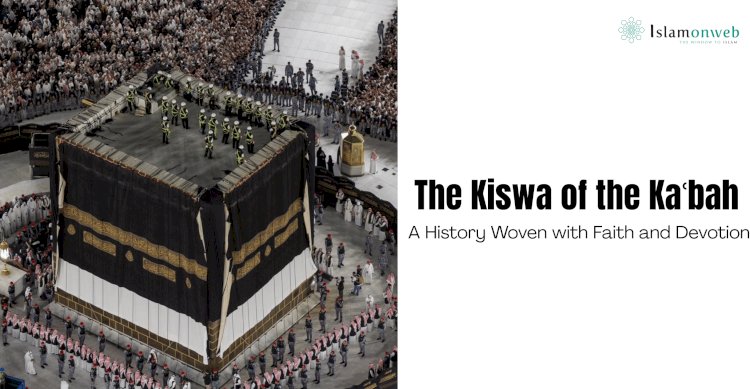
Throughout history, rulers and ordinary believers alike regarded the honour of serving the Kaʿbah as a mark of distinction and devotion. Among the many forms of service offered to the Sacred House, none acquired greater symbolic significance than the Kiswa—the cloth that covers the Kaʿbah and proclaims the reverence Muslims hold for their qiblah.
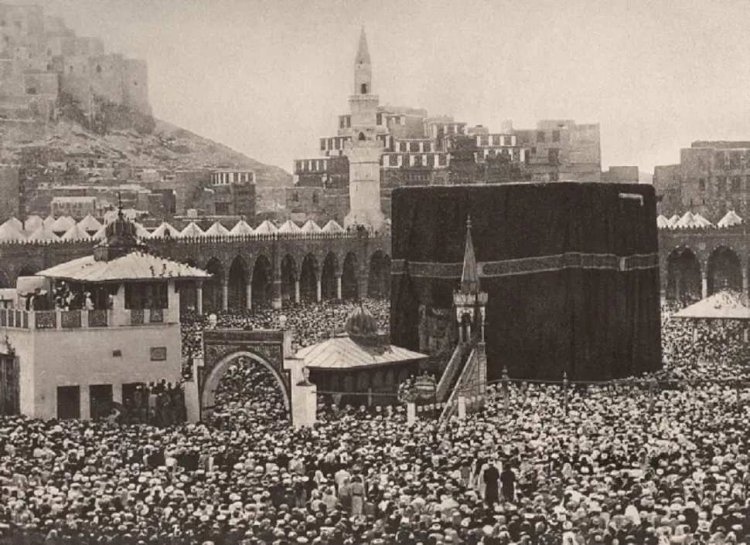
The history of the Kiswa is a story of faith, honour, political legitimacy, artistic excellence, and a continuous chain of care that has linked generations of Muslims to the Sacred House.
Who First Covered the Kaʿbah?
Classical historians record differing opinions regarding the earliest person to cover the Kaʿbah. Some reports attribute it to Prophet Ismāʿīl عليه السلام, while others mention ʿAdnān, one of the ancestors of Prophet Muḥammad ﷺ. However, these reports are not historically conclusive.
The earliest figure whose covering of the Kaʿbah is widely documented in historical works is Tubbaʿ Abū Karib Asʿad, the Himyarite king of Yemen, who lived several centuries before Islam.
According to historical accounts, Tubbaʿ passed by Makkah after one of his military expeditions in Arabia. He circumambulated the Kaʿbah and, according to some narrations, saw in a dream that he should honour the Sacred House by covering it and providing it with a door and a key. He subsequently ordered that the Kaʿbah be covered, becoming the first ruler known to have furnished it with a complete Kiswa.
A narration attributed to the Prophet ﷺ further reflects Tubbaʿ's esteemed status:
"Do not revile Tubbaʿ, for he had accepted Islam."
This narration is reported by Imām Aḥmad in his Musnad from Sahl ibn Saʿd, though scholars have differed regarding its chain of transmission.
Historical works mention that Tubbaʿ first covered the Kaʿbah with coarse cloth (al-Khaṣf), later replacing it with finer Yemeni textiles such as al-Maʿāfir, followed by softer and more elegant garments. He is also reported to have installed a door and a lock for the Kaʿbah. After him, successive Himyarite rulers continued this practice, covering the Kaʿbah with various Yemeni fabrics, including striped red garments known as al-Waṣāʾil and woven cloth called al-ʿAṣb.
As the centuries passed, the responsibility of the Kiswa became closely associated with leadership and prestige in Makkah.
When Quṣayy ibn Kilāb, the great-grandfather of the Prophet ﷺ, established Quraysh's authority over Makkah, he organised the affairs of the Kaʿbah and instituted an annual collective contribution from the tribes for its Kiswa. This arrangement reflected both the sanctity of the Kaʿbah and the shared responsibility of preserving it.
Later, one of the prominent nobles of Quraysh, Abū Rabīʿah ibn al-Mughīrah al-Makhzūmī, who was known for his immense wealth, proposed an unusual arrangement. He offered to provide the entire Kiswa for one year, while Quraysh would provide it collectively the following year. The people accepted his proposal, and because his contribution equalled that of the whole tribe, he became known as al-ʿAdl—the man whose generosity matched that of all Quraysh.
The honour of serving the Kaʿbah was not restricted to men. Historical sources mention that Nabīlah bint Ḥabāb, the mother of al-ʿAbbās ibn ʿAbd al-Muṭṭalib, was the first woman known to have covered the Kaʿbah after making a vow to do so.
The Arabs also developed specific customs regarding the replacement of the Kiswa. Before Islam, the Kaʿbah was often covered on the day of ʿĀshūrāʾ. Later, the custom evolved to place a new Kiswa on the Day of Sacrifice during the pilgrimage season. In the preceding weeks, portions of the old covering would be lifted or removed gradually until the Sacred House received its new garment.
The Kiswa During the Time of the Prophet ﷺ and the Rightly Guided Caliphs
The Prophet Muḥammad ﷺ placed a Kiswa on the Kaʿbah for the first time after the conquest of Makkah in 8 AH. Following the purification of the Kaʿbah from idols and the restoration of pure monotheistic worship, the Sacred House entered a new era under Islam.
The Prophet ﷺ covered the Kaʿbah with Yemeni cloth, known as Burūd Yamāniyyah, elegant striped garments woven in Yemen and highly valued throughout Arabia. This act was not merely ceremonial; it symbolised Makkah's submission to Islam and the Kaʿbah's return to the worship of Allah alone.
After the Prophet ﷺ, the responsibility of the Kiswa was assumed by the Rightly Guided Caliphs. Abū Bakr al-Ṣiddīq رضي الله عنه continued the established practice. During the caliphates of ʿUmar ibn al-Khaṭṭāb and ʿUthmān ibn ʿAffān رضي الله عنهما, a significant development took place: the Kaʿbah began to be covered with Qibāṭī, a fine white linen fabric produced in Egypt and renowned for its quality and elegance.
This marked the beginning of Egypt's long and distinguished connection with the Kiswa. ʿUmar ibn al-Khaṭṭāb رضي الله عنه instructed his governor in Egypt to arrange for the weaving of the Kiswa using Egyptian textiles, particularly those produced in the region of Fayyūm. Over time, Egypt became one of the principal centres of Kiswa production, a role it would maintain for many centuries.
From this early period onward, the care of the Kiswa became an established institution of the Muslim state. Successive dynasties regarded the honour of providing it as both a religious duty and a symbol of custodianship over the holiest sanctuary in Islam.
From Coloured Fabrics to the Black Kiswa: The Abbasid and Mamluk Eras
During the early centuries of Islam, the Kiswa was not restricted to a single colour. Historical sources mention that the Kaʿbah was covered at different times with white, red, yellow, and green cloth. The Umayyad caliphs introduced luxurious fabrics imported from Yemen and Syria, while the Abbasids further elevated the quality and splendour of the Kiswa.
A major turning point came during the reign of the Abbasid Caliph al-Nāṣir li-Dīn Allāh (r. 575–622 AH / 1180–1225 CE). It was during his era that the black Kiswa gradually became the permanent covering of the Kaʿbah. Historians explain that black, the ceremonial colour of the Abbasid state, was chosen because of its dignity and majesty, and from that period onward it remained the dominant colour of the Kiswa until the present day.
The Kiswa also underwent artistic developments during this period. Earlier coverings were relatively plain, but as Arabic calligraphy flourished, Qurʾānic verses and devotional inscriptions began to adorn the fabric. The remarkable progress in Arabic calligraphy associated with masters such as Ibn Muqlah (d. 328 AH) and Ibn al-Bawwāb (d. 413 AH) influenced the decorative style of the Kiswa. Over time, the black silk cloth came to be embellished with intricately embroidered Qurʾānic verses woven with gold and silver threads, giving the Kiswa the distinctive appearance recognised throughout the Muslim world today.
Another significant development was the increasing role of Egypt in producing the Kiswa. Although Egypt had supplied the Kiswa since the era of ʿUmar ibn al-Khaṭṭāb رضي الله عنه, this role became more firmly institutionalised during the later Abbasid and Mamluk periods.
When the Mamluks assumed power in Egypt in 648 AH / 1250 CE and extended their authority over the Ḥijāz, they regarded the annual dispatch of the Kiswa as one of their most prestigious responsibilities. Considerable resources were allocated for its manufacture, and generations of Egyptian craftsmen specialised in weaving and embroidering the sacred covering.
Thus, by the close of the Mamluk era, the Kiswa had evolved from a simple protective cloth into a masterpiece of Islamic craftsmanship—one that combined devotion, artistry, and political symbolism.
The Ottoman Legacy, the Maḥmal, and the Rise of the Modern Kiswa Factory
With the rise of the Ottoman Empire, a new chapter began in the history of the Kiswa. After Sultan Selim I defeated the Mamluks in 923 AH / 1517 CE and incorporated Egypt and the Ḥijāz into the Ottoman realm, the Sultans inherited the honour of serving the Two Holy Sanctuaries.
The Ottomans preserved the long-established Egyptian tradition of producing the Kiswa. Special endowments (awqāf) and commercial revenues were dedicated to financing its manufacture. Workshops in Cairo continued to weave and embroider the Kiswa under imperial patronage, and every year it was dispatched to Makkah in a grand ceremonial procession.
One of the most remarkable features of this tradition was the Maḥmal. The Maḥmal was an ornate palanquin carried on a camel at the head of the caravan transporting the Kiswa and the gifts destined for the Holy Cities. Beginning in Cairo, the procession attracted large crowds as the Kiswa was displayed before commencing its long journey across the desert. Over time, the Maḥmal became not only a religious event but also an important cultural and social occasion celebrated throughout Egypt and other Muslim lands.
The Ottoman practice continued for centuries until the early twentieth century, when political changes in the Arabian Peninsula altered the arrangement. During the reign of King ʿAbd al-ʿAzīz Āl Saʿūd, disagreements arose regarding certain customs associated with the Maḥmal procession, which some scholars in the Arabian Peninsula regarded as practices lacking a basis in the Sunnah. As a result, Egypt temporarily suspended the dispatch of the Kiswa.
In response, King ʿAbd al-ʿAzīz ordered the establishment of the first Saudi workshop for weaving the Kiswa in Ajyād, near the Grand Mosque in Makkah, in 1927 CE. Saudi craftsmen began producing the Kiswa locally, marking the beginning of a new era in the history of the Sacred House.
Although Egypt resumed sending the Kiswa for some years afterwards, political circumstances eventually brought this centuries-old tradition to an end. Following tensions surrounding the Yemen conflict in the early 1960s, the Kingdom of Saudi Arabia assumed full responsibility for producing the Kiswa.
The Kiswa in the Modern Era: Where Tradition Meets Craftsmanship
In 1977 CE (1397 AH), a modern factory dedicated exclusively to the Kiswa was established in Makkah. Later named the King ʿAbd al-ʿAzīz Complex for the Holy Kaʿbah Kiswa, it combines traditional craftsmanship with modern technology. Today, skilled artisans weave natural black silk and embroider Qurʾānic verses using threads plated with gold and silver, continuing a tradition that stretches back for many centuries.
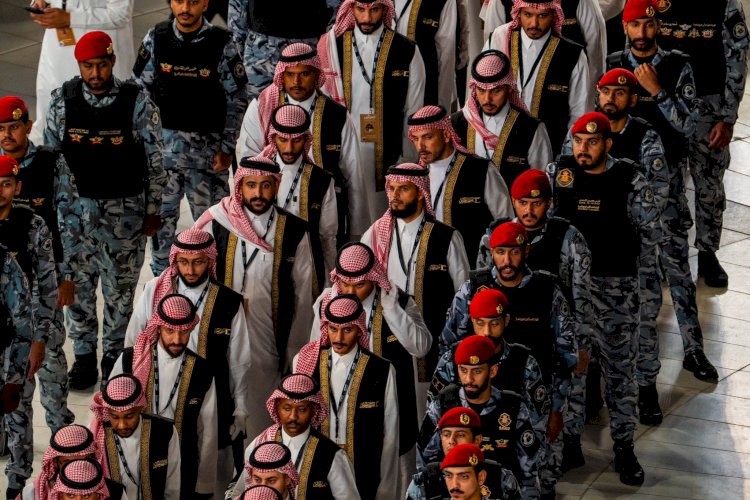
For much of Islamic history, the replacement of the Kiswa took place on the Day of ʿArafah during the Hajj season. In recent years, however, this practice has been adjusted. By the directive of the Custodian of the Two Holy Mosques, King Salmān ibn ʿAbd al-ʿAzīz Āl Saʿūd, the annual replacement of the Kiswa now takes place on the first day of Muḥarram, marking the beginning of the new Hijrī year.
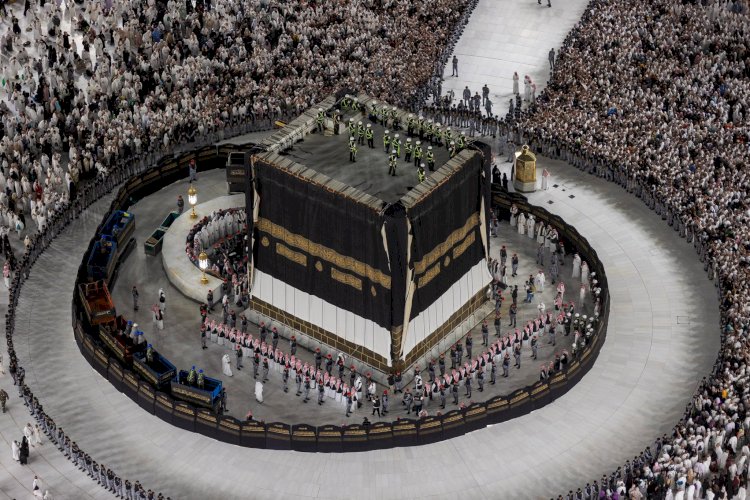
The replacement ceremony itself is a remarkable operation carried out by a highly trained Saudi team under the supervision of the King ʿAbd al-ʿAzīz Complex for the Holy Kaʿbah Kiswa in Makkah. Before the new Kiswa is installed, the embroidered Qurʾānic panels, decorative lantern motifs, and the curtain of the Kaʿbah door (Sitārah) are carefully removed from the old covering.
The new Kiswa is then raised in four separate sections corresponding to the four sides of the Kaʿbah. Each section is carefully spread over the existing cloth and secured from above while the older fabric is gradually lowered and removed. This process is repeated side by side until the entire Kaʿbah is clothed in its new garment. Finally, the embroidered belt (Ḥizām) is aligned and stitched across the upper portion of the Kiswa, followed by the installation of the beautifully embroidered curtain that adorns the door of the Kaʿbah.
More than 240 artisans, technicians, and administrators work at the complex. Their expertise covers every stage of production, from dyeing and weaving to printing, embroidery, and sewing. The factory uses some of the finest natural silk available in the world, imported in its raw form before being dyed a deep black and woven into the fabric of the Kiswa.
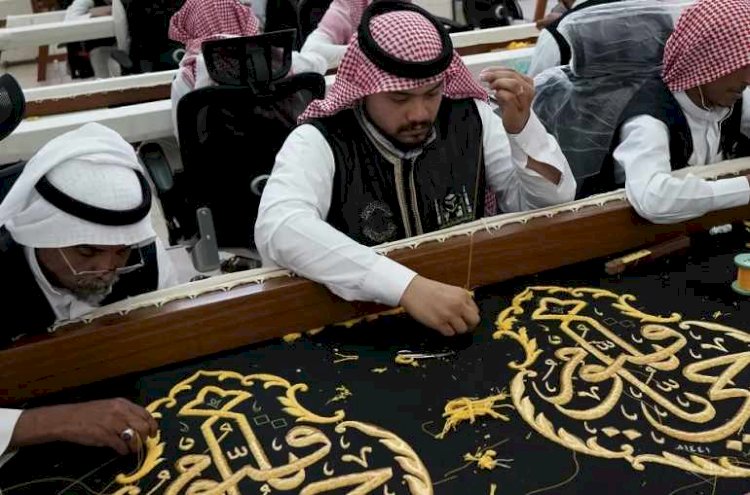
The finished covering consumes approximately 670 kilograms of pure silk and covers an area of around 658 square metres. It is woven from 47 separate panels, each measuring approximately 14 metres in length and 95 centimetres in width, which are later joined together with meticulous precision.
The outer surface of the Kiswa is adorned with woven and embroidered inscriptions that glorify Allah and proclaim the testimony of faith. Repeated across the black silk are phrases such as:
Lā ilāha illa Allāh Muḥammad Rasūl Allāh
Allāh Jalla Jalāluh
Subḥān Allāh wa bi-ḥamdih, Subḥān Allāh al-ʿAẓīm
Yā Ḥannān Yā Mannān
Beneath the embroidered belt, on the corners of the Kaʿbah, Sūrah al-Ikhlāṣ is inscribed within circular medallions framed by intricate Islamic geometric patterns, adding both spiritual significance and artistic beauty to the sacred covering.
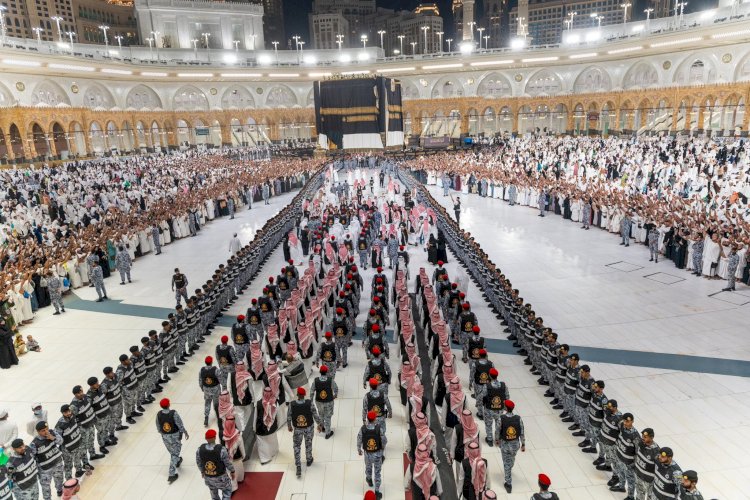
The Kiswa itself rises to a height of 14 metres. Around its upper third runs the celebrated Ḥizām, or embroidered belt, measuring 95 centimetres in width and extending approximately 47 metres around the Kaʿbah. The belt is composed of sixteen separate pieces, each bearing Qurʾānic verses embroidered in raised calligraphy using silver threads coated with gold and framed by elaborate Islamic ornamentation.
Among the most magnificent parts of the Kiswa is the Sitārah, the curtain covering the door of the Kaʿbah. Measuring approximately 7.5 metres in height and 4 metres in width, it is crafted from pure silk and embroidered with Qurʾānic verses and decorative motifs using gold-plated silver threads. In addition, the Kiswa includes embroidered Qurʾānic panels beneath the belt, decorative medallions between the walls of the Kaʿbah, and a special panel bearing the Kiswa's dedication.
The annual cost of producing the Kiswa is estimated at approximately 17 to 20 million Saudi Riyals, making it one of the most valuable textiles ever produced. Yet its true worth cannot be measured in monetary terms. Its value lies in the honour it represents—the honour of serving the House of Allah and preserving one of the most cherished symbols of the Muslim world.
The Kaʿbah receives a new Kiswa once every Hijrī year. Meanwhile, the Sacred House itself is washed twice annually—once in the month of Shaʿbān and again before the Hajj season in Dhū al-Ḥijjah. The washing is performed using Zamzam water mixed with rose water and fine fragrances, after which the interior walls are perfumed with precious oud oil, a practice that reflects the same spirit of reverence that has surrounded the Kaʿbah throughout its long and illustrious history.
References
- Al-Azraqī, Abū al-Walīd Muḥammad ibn ʿAbdullāh. Akhbār Makkah wa Mā Jāʾa Fīhā min al-Āthār. Edited by Rushdī al-Ṣāliḥ Malḥas. Beirut: Dār al-Andalus, 1983, Vol. 1
- Al-Fākihī, Abū ʿAbdullāh Muḥammad ibn Isḥāq. Akhbār Makkah fī Qadīm al-Dahr wa Ḥadīthih. Edited by ʿAbd al-Malik ibn ʿAbdullāh ibn Duhayš. Makkah: Maktabat al-Asadī, Vol. 5.
- Al-Fāsī, Taqī al-Dīn Muḥammad ibn Aḥmad. Shifāʾ al-Gharām bi Akhbār al-Balad al-Ḥarām. Beirut: Dār al-Kutub al-ʿIlmiyyah.
- Ibn Kathīr, Ismāʿīl ibn ʿUmar. Al-Bidāyah wa al-Nihāyah. Beirut: Dār al-Kutub al-ʿIlmiyyah, Vol. 2. (For the account of Tubbaʿ and early Kiswa traditions).
- Aḥmad ibn Ḥanbal. Al-Musnad. Hadith of Sahl ibn Saʿd regarding Tubbaʿ:
- Ibn Faḍl Allāh al-ʿUmarī. Masālik al-Abṣār fī Mamālik al-Amṣār. Cairo: Dār al-Kutub. (For Mamluk administration, the Maḥmal, and the Kiswa caravan).
- Muḥammad Ṭāhir al-Kurdī. Tārīkh al-Kaʿbah al-Muʿaẓẓamah wa ʿImāratihā wa Kiswatihā wa Sidānatihā. Makkah al-Mukarramah.
- Aḥmad al-Sibāʿī. Tārīkh Makkah: Dirāsāt fī al-Siyāsah wa al-ʿIlm wa al-Ijtimāʿ wa al-ʿUmrān. Makkah al-Mukarramah.
- Mawsūʿat al-Ḥaramayn al-Sharīfayn (Encyclopaedia of the Two Holy Mosques). Sections related to the Kaʿbah and the Kiswa.
- General Presidency for the Affairs of the Grand Mosque and the Prophet's Mosque. Official Publications of the King ʿAbd al-ʿAzīz Complex for the Holy Kaʿbah Kiswa, Makkah.
Disclaimer
The views expressed in this article are the author’s own and do not necessarily mirror Islamonweb’s editorial stance.

Related Posts












Leave A Comment