
Judicial and Political Responses to Colonial Rule: A Comparative Study of Ulema Fatwa Literature in Malabar
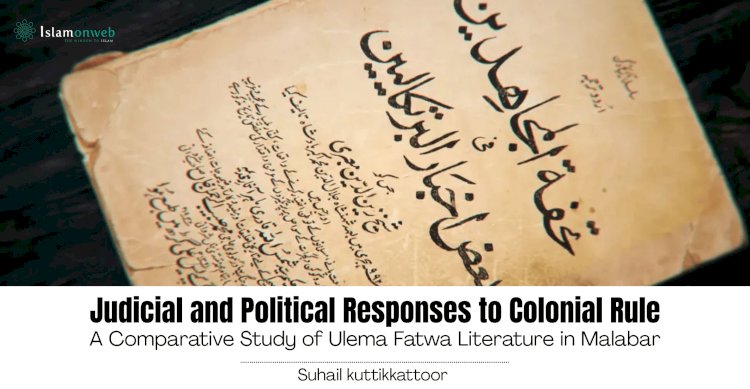
The Malabar coastal region played a distinctive role in anti-colonial resistance across four centuries of European imperial intervention, from the arrival of the Portuguese in 1498 to the Malabar Rebellion of 1921. The Muslim community articulated this resistance through three interconnected frameworks, juridical, devotional, and genealogical, with juridical resistance expressed through the fatwa tradition providing the intellectual and legal scaffolding for sustained opposition to colonial rule. This article examines how Mappila ulema deployed fatwas as instruments of political mobilization and communal self-definition, arguing that the fatwa functioned as a site of contested authority where scholars from the same traditions produced divergent rulings on cooperation with colonial powers. By comparing the pro-resistance fatwa Muhimmat al-Mu’minin with the loyalist counter-fatwa Mahaqul Khilafath ala Ismi al-Khilafath, this study illuminates the pluralistic ethos of Islamic legal reasoning and the colonial state’s attempts to manage internal scholarly disagreements. The article proceeds in five sections: the legal basis of fatwa as resistance (tracing origins to Zainuddin Makhdum Senior and Junior); the fatwa’s social functions beyond the legal sphere; the concept of ikhtilaf (scholarly disagreement) and debates over whether British India was Dar al-Islam or Dar al-Harb; a comparative analysis of the two opposing fatwa documents; and finally, the concept of muwalath (cooperation with colonial authorities) and its implications for Muslims serving in colonial institutions.
Fatwa as Juridical Resistance and Community Formation in Malabar
A fatwa, a religious legal opinion issued by a qualified Islamic scholar, provided the Mappila community with legal and religious justification for resistance against perceived enemies of Islam. Notably, Mappila jurists (ulama) did not declare Malabar as Dar al-Harb (“House of War”)1 because the Portuguese had not yet established complete political authority over the whole of Malabar, underscoring that fatwas cannot be understood outside their historical and social context. The first Muslim scholar in India to issue a fatwa calling for war against Europeans was Sheikh Zainuddin Makhdum Senior (d. 1521) in his Tahreed Ahl al-Iman ala Jihad Abadat al-Sulban, declaring armed struggle obligatory for all Mappilas; his grandson, Zainuddin Makhdum Junior (d. 1583)2, continued this tradition through Tuhfat al-Mujahideen fi Ba‘d Akhbar al-Burtughaliyyin, establishing a precedent for juridical resistance against subsequent colonial powers including the British3. Beyond the purely legal sphere, fatwas performed social functions such as doctrinal elaboration, legitimation, communal boundary maintenance, and political authorization (Masud, Messick & Powers), playing a crucial role in shaping Muslim societies across contexts4. In Malabar, the fatwa tradition shaped the Mappila community by regulating everyday social relations and providing ethical-legal frameworks for self-reconstruction. During the 1921 rebellion, ulema and musliyars became increasingly visible, cooperating with national leaders and participating in the Khilafat and Non-Cooperation movements, helping to build Muslim-Hindu alliances (Narayan 2006). This period also witnessed a leadership shift from the Mambaram shrine to the Tirurangadi mosque, where Ali Musliyar, the principal mudarris of the dars, emerged as an important Khilafat leader.
A central argument of the article is that scholars from the same intellectual traditions often disagreed, highlighting ikhtilāf (scholarly disagreement) as a constitutive feature of Islamic jurisprudence, not a failure. The well-known hadith,“Ikhtilāf ummatī raḥma” (“The disagreement of my community is a mercy”), reflects this pluralistic ethos. As Muhammad Hashim Kamali (1991) argues, pluralism is deeply rooted in Islamic epistemology, and legal reform must respect scholarly disagreement. Wael Hallaq (2004) adds that colonial and post-colonial codification weakened this pluralism by marginalizing ijtihād and madhhab-based diversity in favor of state-centered legal systems. In British India, the question of whether the territory was Dār al-Islām or Dār al-Ḥarb became controversial precisely because the British pursued a mild yet clever policy toward Muslims, leaving the colony’s legal status ambiguous5.
Muhimmat al-Mu’minin: A Fatwa for Resistance
The fatwa titled Muhimmat al Mu'minin, issued by Aminummantakath Pareekutty Musliyar (d. 1939), holds exceptional importance because it represents a mature, legally structured religious sanction that directly linked Islamic obligations to the anti-colonial and Khilafat struggles in Malabar. Unlike earlier fatwas that primarily responded to Portuguese atrocities, this document emerged during the British colonial period when the legal status of British India, whether dar al-Islam (house of Islam) or dar al-Harb (house of war), was fiercely debated among Muslim jurists. The text, written in Arabi-Malayalam and spanning nearly forty pages, relied extensively upon Qur'anic verses, hadith literature, and quotations from prominent Islamic scholars. Its primary objective was to support the Khilafat movement and defend the Arabian Peninsula (Jazeerat al-Arab). Pareekutty Musliyar's fatwa cuts through the legal ambiguity by declaring that when infidels occupy a Muslim land or prepare to attack, jihad becomes an individual obligation (farz 'ain) upon every resident Muslim. It condemns pro-British Muslims as heretics, forbids obedience to Christian kings, and commands Muslims to strive for swarajya (self-rule) and appoint an Imam, declaring that "it is the obligation of all Muslims to oppose those who oppose the Ottoman Sultan6."
Within the broader discourse of ulama in colonial India, Muhimmat al Mu'minin occupies a distinctive position that bridges North Indian and Malabar juristic traditions. While North Indian Hanafi ulama like Shah 'Abdul 'Aziz hesitated to declare British India as dar al-Harb due to relative religious freedom, the Shafi'i ulama of Malabar, drawing from Yemenite jurists and local precedents like Sayyid 'Alawi of Mambram, adopted a more uncompromising stance. The fatwa carried statements of approval and signatures from renowned scholars such as Cherusseri Ahmad Musliyar, Panayi Kullath Abdurahiman Musliyar, and Kootayi Muddaris Bava Musliyar, demonstrating a networked, Sufi-connected authority structure trained at Ponnani and mobilized through Khilafat committees. The document so alarmed colonial authorities that the Madras Gazette issued a notification in 1921 declaring possession of it punishable by five years of imprisonment without trial, while a reward of 1,000 rupees was announced for the author's capture. Pareekutty Musliyar fled to Bombay and later migrated to Mecca in 1930, where he continued his anti-colonial writings in the Arabic newspaper Umm al-Qura until his death in 1939. The fatwa also reveals the limits of ulama control, once rebellion erupted, even Mambram Tangal's authority could not restrain it, yet simultaneously shows that rebels still craved religious certification for martyrdom. Thus, Muhimmat al Mu'minin serves as a crucial archive for understanding how Islamic legal discourse was adapted to colonial conditions, how regional ulama networks operated, and how anti-colonial fatwas became tools for forging Hindu-Muslim unity within the national movement.
The Mahaqul al-Khilafath: A Loyalist Counter-Fatwa
When the British recognized the growing influence of the Khilafat and Congress movements, they attempted to divert the Mappila community from anti-colonial agitation by supporting loyalist Mappilas. Muslim officers under British administration organized a meeting at Ponnani under the leadership of the Makhdums, where Mammad Musliyar distributed a monograph titled Mahaqul Khilafath ala Ismi al-Khilafath (“Creating Rebellion in the Name of Khilafat”). This text portrayed Muhimmat al-Mu’minin as anti-Islamic and criticized Gandhi for combining the Non-Cooperation movement with the Khilafat cause in Kerala.
Kunjan Bava Musliyar, an influential scholar from Ponnani, signed the fatwa opposing the Khilafat agitation, while Mammad Kutty Musliyar claimed that other prominent scholars supported this view. However, Pareekutty Musliyar later argued that those scholars had merely heard the opinion and not personally endorsed it. Despite British officials helping to distribute the monograph, it failed to influence the public. On 20 August 1921, local people destroyed the Chalilakath Ibrahim Kutty Press in Tirurangadi, which had attempted to print a second edition.
The concept of muwalath (cooperation/alliance) became a pressing issue, as ulema received numerous masalas (religious questions) from ordinary Muslims about cooperation with colonial authorities. In Arabic and Shari‘a, muwalath refers to intimacy, loyalty, and cooperation, and classical texts regarded close cooperation with enemies of Islam as prohibited. Questions emerged about Muslims serving in colonial institutions, especially military and police roles, which could involve violence against fellow Muslims. Scholars frequently cited the prophetic tradition: “Whoever takes arms against his Muslim brother is not among us.”
Conclusion
The fatwa literature of Malabar reveals a tradition of vibrant scholarly disagreement (ikhtilāf), where ulema produced opposing rulings on cooperation with colonial powers, as seen in the contrasting cases of Muhimmat al-Mu’minin (pro-resistance) and Mahaqul Khilafath (loyalist). Despite British efforts to suppress resistance fatwas through bans, rewards, and counter-fatwas, these measures failed, exemplified by the destruction of the loyalist press and Pareekutty Musliyar’s continued anti-colonial writings from exile. Debates over muwalath (cooperation) extended to everyday ethical dilemmas, such as Muslims serving in police and military roles, reinforcing non-cooperation as a communal imperative. While colonial codification weakened Islamic legal pluralism, the Malabar case shows that fatwas retained their capacity for dissent, reflecting a legal culture that valued disagreement as mercy, not weakness, a tradition essential for understanding anti-colonial resistance and imagining more pluralistic futures for Islamic legal thought.
About the author:
Suhail kuttikkattoor is a student at Shamsul Huda Islamic Academy, Kuttikatoor, affiliated with Darul Huda Islamic University. He is currently pursuing his studies in the Department of Civilizational Studies.
End Notes
1 Dar al-Harb (“House of War”): In classical Islamic jurisprudence, a territory not governed by Muslim rule where Muslims cannot freely practice their religion, often contrasted with Dar al-Islam (“House of Islam”).
2 Mahmood Kooria, “Taḥrīḍ ahl al-īmān: An Indigenous Account against the Early Modern European Interventions in Indian Ocean World” in Zainuddin Makhdoom i, Taḥrīḍ ahl al-īmān ʿalā jihād ʿabadat al- ṣulbān, trans. and ed. by K.M. Muhammad (Calicut: Other Books, 2013), 21.
3 Mahmood Kooria, “Killed the Pilgrims and Persecuted Them”: Portuguese Estado da India’s Encounters with the Hajj in the Sixteenth Century” in The Hajj and Europe in the Age of Empire, ed. Umar Ryad (Leiden: Brill,2017), 34.
4 Muhammad Khalid Masud, Brinkley Messick, and David S. Powers, eds., Islamic Legal Interpretation: Muftis and Their Fatwas (Cambridge, MA: Harvard University Press, 1996), Brinkley Messick, Shari'a Scripts: A Historical Anthropology (New York: Columbia University Press, 2018).
5 Muhammad Khalid Masud, “Ikhtilaf al-Fuqahā: Diversity in Fiqh as a Social Construction,” in Ikhtilaf al-Fuqahā: Diversity in Fiqh as a Social Construction, ed. (no editor) (Australian Islamic Library, n.d.), 7–10, https://archive.org/details/merged_document_4_201612.
6 Hussain Randathani Kallen, “Fatwas of Ulama against Colonialism- From the Pages of Malabar History,” Academia.edu, uploaded January 8, 2015,
Reference
Agrama, H. A. (2010). Ethics, tradition, authority: Toward an anthropology of the fatwa. American Ethnologist, 37(1), 2–18. https://doi.org/10.1111/j.1548-1425.2009.01238.x
Hassan, A. S. R. B. (2015). The mufti-mustafti approach to religious rehabilitation. Counter Terrorist Trends and Analyses, 7(3), 14–20. http://www.jstor.org/stable/26351337
Mangad, A. R. (n.d.). 1921: Fatwa ahwanangal [In Malayalam].
Masud, M. K., Messick, B., & Powers, D. S. (Eds.). (1996). Islamic legal interpretation: Muftis and their fatwas. Harvard University Press.
Messick, B. (2018). Shari'a scripts: A historical anthropology. Columbia University Press.
Moin, Z. (2025). Ikhtilaf al-fuqaha and its importance in legal pluralism: An analysis in the light of seerah. Pakistan Islamicus, 5(4), 28–33.
Randathani, H. (n.d.). The anti-colonial fatwas of Malabar: A study on Muhimmat Muʼminin. [Unpublished manuscript].
Randathani, H. (n.d.). Hadrami sayyids against colonialism: The Malabar page. [Unpublished manuscript].
Disclaimer
The views expressed in this article are the author’s own and do not necessarily mirror Islamonweb’s editorial stance.


Related Posts



















Leave A Comment