
An Analytical Report of “Critical Appraisal of 21st Century Western Scholarship on Islam” Conference 2026, India
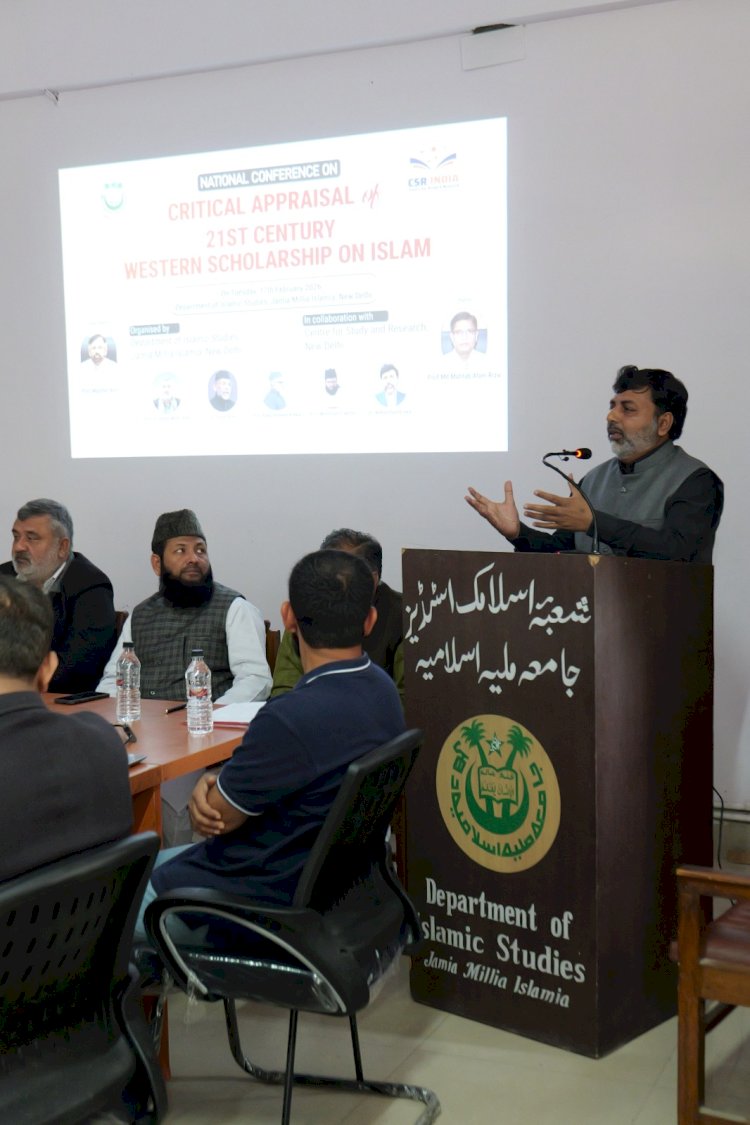
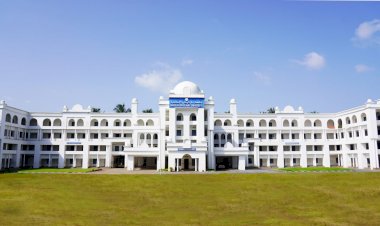
The Department of Islamic Studies, Jamia Millia Islamia (JMI) in collaboration with Centre for Study and Research (CSR), New Delhi, organised a one-day national conference on “Critical Appraisal of 21st Century Western Scholarship on Islam” on February 17, 2026 at Jamia Millia Islamia. The conference was sponsored by CSR and the local logistics were provided by Jamia Millia Islamia. Prof. Mazhar Asif, the Honourable Vice-Chancellor of JMI, was the Chief Patron and Prof. Md. Mahtab Alam Rizvi, the Registrar of JMI, was the Patron; and Prof. Iqtidar Mohd Khan, Head of the Department of Islamic Studies, JMI, and Dr. Mohammed Rizwan were the Directors of the conference.
Session-wise Analysis of the Conference
The inaugural session began with the recitation of the Holy Qur’an by Mohammad Wasim Ahmad (B.A. student of Department of Islamic Studies, JMI), followed by a ceremonial presentation of bouquets, shawls, and mementoes to the distinguished guests. Mr. Junaid Haris introduced the guests, while Dr. Mohammed Rizwan delivered the welcome address and also introduced the research organisation CSR.
In his introductory remarks Dr Rizwan emphasised that knowledge ecosystem in the contemporary era predominantly governed by Euro centric frameworks where in knowledge production knowledge dissemination and application of knowledge are in a Eurocentric social temporal milieu. He advised that we have to evolve A more purposeful holistic and value-based knowledge ecosystem which goes beyond contemporary Eurocentric and global north frameworks. He said that Centre for Study and Research which was formed in 2016 is a part of a broader effort in which CSR is envisioned to evolve a purposeful holistic and value-based knowledge ecosystems based on transcendental sources rather than merely imported knowledge paradigms. He further explained that it doesn’t mean to be antagonist to the contemporary epistemology and methodology based on materialistic world view rather it will be an accommodative effort were in an all-inclusive epistemological frameworks and methodological adjustment should be done. Further explaining the purpose of the conference, he said that this endeavour is to go beyond rhetorical aspect of Western scholarship on Islam and prize to situate contemporary Western scholarship on Islam in a more critical frame and analyse it with intellectual rigour and depth.
Prof. Faheem Akhtar Nadwi, former Head of the Department of Islamic Studies, Maulana Azad National Urdu University (MANUU), Hyderabad, gave the keynote address. The title of his address was: “The Methodology and Trends of Islamic studies in the West in the 21st century”. Addressing the audience, he focused on two things; one is the methodology and the other is the trend in the West. His basic position was that in the 21st century, the centre of Islamic studies has shifted from Europe to America, where new methodologies and trends have emerged, sometimes with Zionist and ideological influences. After 9/11, there has been an extraordinary increase in work on Islamic studies, and countless books are being written on the Quran, exegesis, biography, jurisprudence, history, and Islamic movements. However, according to him, most of these works, which are usually by non-Muslim authors, repeat old Orientalist objections and present a distorted picture of Islam. Modern encyclopaedias and reference books also contain the same objections that Muslim scholars have answered before. Although there has been a positive change in some biographies, hidden biases in style and interpretation remain. He also questions the claims of Orientalists' contributions and calls on Muslims to be intellectually aware and respond in a strong academic manner. He described the conference as a crucial academic initiative.
A special highlight of the inaugural ceremony was the special lecture of a distinguished scholar Prof. Abdur Raheem Kidwai, Director, K.A. Nizami Centre for Qur’anic Studies, Aligarh Muslim University. He addressed the gathering via video message. In his video lecture, Professor Kidwai argued that although the study of Islam in the West has a thousand-year academic tradition and is conducted in an apparently “scientific” manner, it is not free from overt misunderstandings but rather from deep-seated misinterpretations, influenced by the Christian theological and intellectual background. Due to the different nature of the concept of prophethood and revelation in Christianity, many Western scholars have been unable to correctly understand the Islamic concept of revelation, the finality of prophethood, and the inspired status of the Quran. Thus, some orientalists and revisionist writers cast doubt on the historical status of the Quran, Hadith, commentary, and early Islamic history. He expresses concern that many Muslim students and scholars are not fully aware of these intellectual challenges or, intimidated by Western academic standards, unconsciously accept these ideas. However, he also offers the positive example of fair-minded Western writers like Craig Considine. His central message is that young Muslim researchers should engage with Western intellectual capital in a critical but balanced manner.
In his presidential address, Prof. Iqtidar Mohd Khan, Head of the Department of Islamic Studies, Jamia Millia Islamia, presented a historical and intellectual overview of the origins and development of Orientalism and Islamic Studies. He remarked that the primary focus of Orientalist scholarship has been the Qur’an, the Prophetic traditions (Hadith), and the Seerah. A significant aspect of their intellectual effort, he noted, revolved around creating doubts and distancing modern Muslim minds from these foundational and authentic sources. Yet history bears witness that the more intellectual and ideological fronts were opened against Islam, the more it emerged with strength and resilience. He advised students to study the Qur’an and Seerah directly from their original sources and to engage with them thoughtfully and reflectively, emphasizing that a sound and authentic understanding of Islam is only possible through deep study of the Qur’an and Sunnah.
The conference featured 02 academic sessions, with 08 research papers on two broad themes: 21st Century Western Scholarship on Islamic Intellectual Tradition and 21st Century Western Scholarship: Trends, Debates and Discourses. On the same occasion, one plenary lecture was delivered by a noted scholar Prof Kuwar Yusuf Amin, Vice Chairman, CSR New Delhi on the topic “Islamic Studies' Optimization: Interdisciplinary to Inter-System- Science, Philosophy, Theology”. According to Professor Amin, the study of Islamic studies in the 21st century should utilize the full potential of the interdisciplinary approach, but for this it is necessary to overcome the limitations inherited from the Western academic tradition. Although Islamic studies in the West continued to develop through history, linguistics and other sciences, it was dominated by materialism and positivism, which considers only sensory knowledge as valid and ignores extrasensory realities. Due to this way of thinking, important concepts such as revelation, the miracle of the Quran, ethics based on the afterlife such as patience, and religious collectivism were weakened or rejected. He proposes that these barriers be removed and a foundation be built on traditional philosophy, which recognizes the different levels of existence—physical, subtle, and spiritual—and upholds the transcendence of God. For him, Islamic studies can pave the way for a just and God-centred future by reconciling revelation-based and metaphysical assumptions with rational and empirical research.
First Academic Session
The first session was chaired by Prof Mohammad Ishaque, Former Head, Department of Islamic Studies, JMI and moderated by Dr. Anisurrahman, Guest Faculty, Department of Islamic Studies, JMI. The first paper in the session was: “From Negative Portrayals to Positive Reorientation: Reframing the Prophet’s Sīrah in the 21st-Century Western Scholarship,” read by Mr. Aadil Hussain Malik, Research Scholar, Department of Islamic Studies, AMU. His paper argued that twenty-first century Western scholarship on the Sīrah of Prophet Muhammad (pbuh) marks a decisive intellectual reorientation away from centuries of polemical distortion and reductive interpretation. Medieval Christian polemics, colonial-era Orientalism, and modern secular reductionism collectively produced portrayals that isolated episodes of conflict from their historical and ethical contexts. In contrast, recent scholarship demonstrates greater methodological discipline, sustained engagement with Arabic primary sources, and a commitment to contextual analysis rooted in the socio-political realities of seventh-century Arabia. With particular attention to Joel Hayward’s The Warrior Prophet: Muhammad and War (2022), the presenter showed how contemporary historians reassess prophetic warfare within the socio-political norms of the seventh century rather than through anachronistic moral frameworks. Hayward’s work exemplifies this shift by integrating military history, strategic analysis, and close textual reading to present a historically grounded and multidimensional portrait. He contended that this emerging paradigm reflects a substantive evolution in Western Sīrah studies and reshapes broader academic and interfaith discourse.
The next paper “Challenges of Western Scholarship in Reading Islāmī Riwāyat” was presented by Dr. Mohammad Ali, Guest Faculty, Department of Islamic Studies, JMI & Research Fellow CSR, New Delhi. The presenter argued that when Muslims criticise Western scholarship, they should first critically examine their own riwāyat (tradition), especially South Asian academic tradition. He expressed concern about the decline in academic standards in local universities, formal conferences and irresponsible research. Although the Western academic tradition has had a profound impact on the field of Islamic studies and has sometimes misinterpreted Islam based on its intellectual foundations, seriousness, hard work and professional integrity have played a significant role in its success. Today, Western academic standards have become the global standard. The real challenge is that Western ideological templates are applied to the Islamic tradition without critical awareness, which can distort the comprehensive intellectual and spiritual structure of Islam. He advocated neither rejection nor blind acceptance of Western discourse, but a dignified dialogue grounded in Islamic turāth (heritage). He encouraged seeking a balanced synthesis that reconnects contemporary understandings of Islam with its classical intellectual legacy.
“Rethinking Islam Beyond Islamism-Sufism Dichotomy” read by Dr. Owais Manzoor Dar, Guest Faculty, Department of Islamic Studies, JMI & Research Fellow CSR, New Delhi. In recent years, he argued in his paper that an alarming dichotomy has emerged that rigidly separates Islam into Sufism and Islamism. Sufism is often romanticized in Western scholarship as Islam’s peaceful, spiritual and apolitical counterweight, while Islamism is reduced to an inherently militant and ideological project. The binary is not merely descriptive, it has been institutionalized through academic scholarship, policy discourse and media representations. The paper sought to challenge, problematize and deconstruct this dichotomy by providing three arguments:
- Rather than accepting the Sufism–Islamism dichotomy as an empirical or analytical given, he treated it as a discursive formation in the Foucauldian sense: a historically produced regime of knowledge that structures how Islam is understood, governed and represented.
- The assumption that Sufism is inherently quietist or disengaged from worldly affairs is not only historically inaccurate but also the product of a selective memory shaped by colonial and postcolonial epistemologies.
- The notion that Islamist are against the Sufi ethos is problematic because Islamist critiques of Sufism, he argued did not constitute a wholesale rejection of Sufism.
The subsequent paper “The Politics of Suspicion: Neo-Orientalism and Muslim Identity After 9/11” was read by Ms. Zenha Firoz, Psychology Student, Ibn Al Haytham Academy/WIRAS College, Pariyaram, Kerala. Her paper examines how post-9/11 Western scholarship, media, and policy produced a Neo-Orientalist framing of Muslims, contributing to the construction of a “Muslim question” rooted in suspicion and securitization. Following the September 11, 2001 attacks, Western institutions increasingly sought to define and categorize “Islamic” identity, portraying Muslims as inherently suspect and linking them to global terrorism. This epistemic shift positioned Muslims as perpetual objects of scrutiny, where their beliefs, practices, and loyalties were pathologized under security and counterterrorism frameworks. Drawing on Arun Kundnani’s (2014) security paradigm and Deepa Kumar’s (2012) concept of neoliberal Islamocapitalism, the paper highlights how the academic and media-driven notion of “radicalization” has shaped public perceptions and institutional practices. The paper argues that these representations exemplify a broader scholarly and cultural Neo-Orientalism, one that essentializes Islamic identity and sustains structural, social, and psychological marginalization of Muslims. By tracing the interplay of academic discourse, media narratives, and policy frameworks, the study underscores the importance of moving beyond the post-9/11 security gaze. It concludes by advocating a decolonial approach to scholarship, one that challenges the epistemic and representational biases of Neo-Orientalism, foregrounds the human consequences of securitization, and reimagines the study of Muslim identities beyond suspicion, fear, and the politics of global security.
Second Academic Session
The second session was chaired by Prof. Syed Shahid Ali, Former Head, Department of Islamic Studies, JMI and moderated by Dr. Mohd Usama, Guest Faculty, Department of Islamic Studies, JMI. The first paper of the second session was: “Between 'Critics and Caretakers': A Critical Evaluation of Some Seminal ‘Introductions to Islam’ by Western Islamicists,” by Dr. Tauseef Ahmad Parray, Associate Professor, Department of Islamic Studies, Aligarh Muslim University. The main argument of this presentation by Dr. Parray is to critically review the books of the “Introduction to Islam” genre written by Western scholars. He explains that such textbooks and introductory books are the primary means of understanding Islam for students and general readers, and therefore play an important role in the formation of intellectual and scientific understanding (epistemological frameworks) about Islam. However, they often present Islam and its history in a static, one-sided or reductive manner, or the (mis)reading and (mis)representation of Islamic history, especially in the chapter on the Quran and the biography of the Prophet Muhammad (pbuh). Dr. Parray analysed the books of John L. Esposito and Alexander D. Kanish in particular. Although Esposito adopts a sympathetic and relatively religiously sensitive approach, in some places, calling the Prophet Muhammad (pbuh) the “founder of the religion” or “expert military strategist” is a religious point of view. Similarly, Kanish’s cultural and historical perspective sometimes echoes secular or orientalist concepts that are incompatible with Islamic faith. Finally, he emphasises that it is our scholarly responsibility to critically evaluate Western intellectual scholarship and also to identifying epistemic tensions and correcting misrepresentations, so that a correct and balanced understanding of Islam can emerge.
“Beyond the Stagnation Narrative: Re-evaluating Western Scholarship on Zakat and its Potential in Modern Development.” was read by Mr. Muhammed Adeeb, M. A. Economics, University of Madras, Chennai. Mr. Adib, in his presentation, challenged the Western “narrative of stagnation,” which portrays Zakat as an obstacle to economic development. He critically examined works such as Timur Kuran’s The Long Divergence How Islamic law held back the Middle East and Jared Rubin’s Rulers, Religion, and Riches: Why the West got rich and the Middle East did not, questioning the claim that Islamic institutions have prioritised wealth distribution over development, resulting in economic stagnation. According to Adib, the real problem is not the Zakat system itself, but the weakness of governance. He cites the example of the Caliphate of Hazrat Umar bin Abdul Aziz (RA), where transparent governance, honest leadership, and accountability made Zakat effective, reduced poverty, and even saved Zakat money in some areas. Furthermore, modern, digital, and productive Zakat models in Indonesia and Malaysia are evidence that Zakat can play a significant role in sustainable and equitable development. His conclusion is that zakat is not an outdated or anti-development system, but can become an effective economic and social institution with good governance. The real issue is not the system. It is the quality of governance.
The next paper “Beyond Clash: Graham E Fuller’s Vision of Political Islam and the Reconciliation of Secularism and Shariah,” was read by Ms. Iqra Tahir, Research Scholar, Department of Islamic Studies, JMI. She explained in her paper about the ideas of Graham E. Fuller about political Islam and its relationship with secularism and Shariah. Fuller argues that political Islam should not be seen as violent or anti‑modern by nature. Instead, it is a response to political problems, economic inequality, colonial history and failed secular governments in Muslim‑majority countries. He believes that conflicts in the Muslim world are mostly caused by power politics, foreign interference, and authoritarian rule, not by Islamic teachings. In his book A World Without Islam, Fuller explains that even if Islam did not exist, many problems like violence and instability would still remain. He supports the idea of hybrid governance, where Islamic values guide ethics and society while democratic systems continue to function. Turkey under the AKP is discussed as an example of this model. Overall, the paper encouraged Western scholars and policymakers to understand Islam more carefully and move beyond the simple idea that secularism and Shariah cannot work together. The main crux of his works indicate that west must assist the Islamic world in solving their problems while giving them free space.
“A Critical Appraisal of Islamic Studies in the West Since 9/11: A Statistical Analysis of the Oxford Journal of Islamic Studies (2001-2025)” was read by Dr. Javed Akhatar, Assistant Professor (C), Department of Islamic Studies, Jamia Millia Islamia, New Delhi, India. Western scholarly engagement with Islam and Muslims has a long and complex intellectual history. The early periods of the Western scholarship were often influenced by dialectical, colonial and proselytizing objectives; however, the field of Islamic Studies has undergone significant intellectual and institutional changes in the post-9/11 context. Since 2001, Islamic Studies in the West has not only expanded significantly in terms of thematic scope, institutional presence and scholarly output, but has also faced increasing public, political and academic scrutiny and critical attention to Islam, Islamic thought and Muslim societies. His paper presented a critical review of Western academic studies on Islam after September 11, 2001, based on a combination of qualitative and quantitative analysis of scholarly works published between 2001 and 2025. The study focused specifically on research articles, reviews and other scholarly writings published in one of the leading, prominent and peer-reviewed journals published by Oxford University Press: Journal of Islamic Studies. Combining quantitative evidence with qualitative interpretation, it attempted to identify evolving scholarly narratives, interdisciplinary priorities and potential epistemological biases, as well as map thematic divisions to better understand the study of Islam and Muslims and their representation within Western scholarship in the post-9/11 era.
Valedictory Session
The one-day event culminated in a valedictory session on February 17, 2026, at 04:30 PM in the Seminar Hall, Department of Islamic Studies, JMI. Presiding over the valedictory session, Professor Faheem Akhtar Nadwi highlighted three important points regarding the transmission of Islamic knowledge and its accurate representation. First, the speaker pointed out that our ancestors transmitted Islamic knowledge from Arabic to Persian and then from Persian to Urdu, but it could not be effectively transmitted into English. Today’s English-educated generation, unfamiliar with Arabic, Persian and Urdu, relies on secondary and complex sources, which increases the risk of misunderstanding. Therefore, the youth have been encouraged to translate basic Islamic books into English. The second thing he said in the speech is that Muslims do not ask the orientalists to have faith in our Prophet (pbuh) or to accept the Qur’an. But we definitely ask them not to lie. They should not make false statements and deliberate accusations against Islam. They break the words. In fact, they should change the meaning of the words. If a word is written differently, they translate it differently. They cut the sentences in between. This is academic treachery thus unacceptable. They should not do distortion and misinterpretation of Islamic sources. Third, Islam is often misrepresented in the West, which is increasing Islamophobia; therefore, only authoritative Muslim scholars are authorized to accurately represent Islam.
Dr. Mohammad Rizwan, in his concluding remarks, thanked all the participants for actively engaging in discussions during the conference. He emphasised students should focus on three major takeaways from this conference:
- They should evolve knowledge acquiring and Research temperament which essentially can be evolved only with keen observation deep readings and critical thinking.
- He suggested that students and academic faculties should also try to evolve an atmosphere where in knowledge exchange, critical reading and disagreement takes central stage in intellectual deliberations and everyone should focus on net output in the form of advancing the existed knowledge rather than repeating or just doing cut paste kind of research work.
- He further exclaimed that in a fiercely competitive world particularly in the domain of research and academics the students should work hard and not seek shortcuts to success.
The overall proceedings were moderated by senior faculty member of the Department of Islamic Studies, JMI, Mr. Junaid Haris. The session concluded with a detailed report presented by Mr. Khushal Ahmed, Research associate CSR followed by vote of thanks by Dr. Mohammad Arshad (inaugural session), Associate Professor, Department of Islamic studies, JMI and Dr. Mujtaba Farooq (valedictory session), CSR fellow.
About the author:
Dr Javed Akhatar
Assistant Professor (C)
Department of Islamic Studies,
Jamia Millia Islamia, New Delhi, India
Disclaimer
The views expressed in this article are the author’s own and do not necessarily mirror Islamonweb’s editorial stance.

Related Posts




Leave A Comment