
Understanding the Three Types of Ḥajj: Ifrād, Qirān, and Tamattuʿ
Every year, millions of Muslims journey towards the Sacred House of Allah, responding to the timeless call of Prophet Ibrāhīm (ʿalayhi al-Salām). Yet many Muslims remain unaware that the rites of Ḥajj may be performed in three different forms: Ifrād, Qirān, and Tamattuʿ. Each of these forms carries its own rulings, procedures, and juristic discussions, while all ultimately lead to the fulfilment of this great pillar of Islam.
Understanding these types of Ḥajj is important not only for pilgrims preparing for the sacred journey but also for appreciating the flexibility and mercy embedded within Islamic law. The scholars of fiqh carefully derived these categories from the practice of the Prophet ﷺ and the guidance he gave to his companions during the Farewell Pilgrimage.
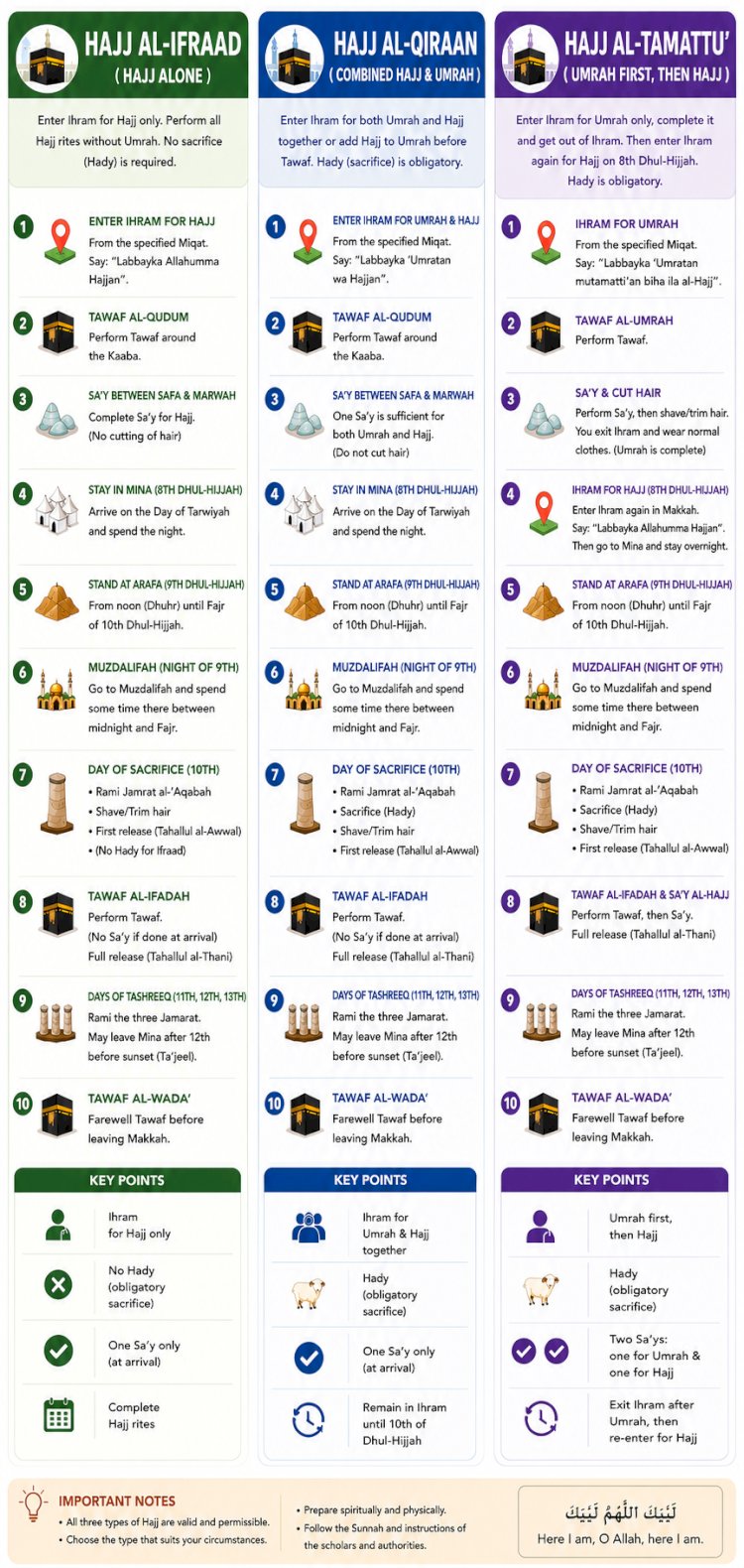
The three forms of Ḥajj may be briefly defined as follows:
- Ḥajj al-Ifrād: Performing Ḥajj alone without combining it with ʿUmrah.
- Ḥajj al-Qirān: Combining Ḥajj and ʿUmrah together under one iḥrām.
- Ḥajj al-Tamattuʿ: Performing ʿUmrah first, exiting iḥrām, and later entering a new iḥrām for Ḥajj during the same season.
In this first part, we will focus on Ḥajj al-Ifrād, its meaning, procedure, rulings, and spiritual significance.
What is Ḥajj al-Ifrād?
Ḥajj al-Ifrād refers to entering into iḥrām with the intention of performing only Ḥajj. The pilgrim does not combine it with ʿUmrah. Upon reaching Makkah, the pilgrim performs ṭawāf al-qudūm (the arrival ṭawāf), followed by saʿy for Ḥajj if desired, but remains in the state of iḥrām without shaving or trimming the hair until the Day of Sacrifice (Yawm al-Naḥr).
The pilgrim continues observing all the restrictions of iḥrām until completing the major rites on the 10th of Dhū al-Ḥijjah. If the saʿy is delayed until after ṭawāf al-ifāḍah, this is also permissible according to the scholars.
Ḥajj al-Ifrād is called “Ifrād” because the pilgrim singles out Ḥajj alone without combining it with another rite.
The Steps of Ḥajj al-Ifrād
- Entering into Iḥrām from the Mīqāt
The pilgrim enters into iḥrām from the designated mīqāt while intending only Ḥajj, saying:
“Labbayka Allāhumma Ḥajjan”
(“Here I am, O Allah, intending Ḥajj.”)
From this moment, the pilgrim enters the sacred state of iḥrām and begins reciting the talbiyah frequently:
“Labbayka Allāhumma labbayk, labbayka lā sharīka laka labbayk, innal-ḥamda wa al-niʿmata laka wa al-mulk, lā sharīka lak.”
The pilgrim remains committed to the etiquettes and restrictions of iḥrām throughout the journey.
- Ṭawāf al-Qudūm (Arrival Ṭawāf)
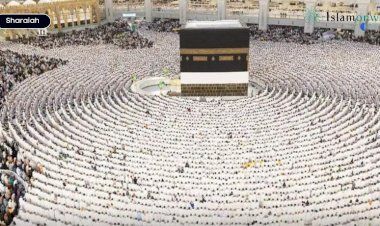
After arriving in Makkah, the pilgrim performs ṭawāf around the Kaʿbah seven times. This ṭawāf is sunnah according to the majority of scholars for the pilgrim performing Ifrād or Qirān.
The sight of the Kaʿbah often overwhelms pilgrims with deep emotion, as centuries of longing and devotion converge at this sacred moment.
- Saʿy Between Ṣafā and Marwah
The pilgrim then performs saʿy between the hills of Ṣafā and Marwah. In Ḥajj al-Ifrād, this saʿy may serve as the saʿy of Ḥajj itself, meaning the pilgrim does not need to repeat it after ṭawāf al-ifāḍah later.
However, if the pilgrim chooses to delay saʿy until after ṭawāf al-ifāḍah, this is also valid.
Unlike the pilgrim performing Tamattuʿ, the pilgrim of Ifrād remains in iḥrām after completing these rites.
- Remaining in Iḥrām Until the Days of Ḥajj
The pilgrim continues in the state of iḥrām until the major rites are completed. This prolonged state of consecration distinguishes Ifrād from Tamattuʿ and serves as a profound spiritual discipline.
Remaining in iḥrām for several days trains the believer in patience, self-restraint, humility, and mindfulness of Allah. Even ordinary permissible acts become restricted, reminding the pilgrim that servitude to Allah requires discipline and conscious obedience.
- Proceeding to Minā on the 8th of Dhū al-Ḥijjah
On Yawm al-Tarwiyah (8th Dhū al-Ḥijjah), the pilgrim travels to Minā and spends the night there, engaging in prayer, dhikr, and preparation for the greatest day of Ḥajj.
- Standing at ʿArafah
On the 9th of Dhū al-Ḥijjah, the pilgrim proceeds to ʿArafah and remains there at least until after sunset in worship, supplication, repentance, and remembrance of Allah. Spending some time at Arafa between Duhar time until Fajr of the 10th of Dul Hijja will be sufficient to fulfil the obligation of standing at 'Arafah.
- Spending the Night at Muzdalifah
After sunset, the pilgrims depart calmly to Muzdalifah, where they combine Maghrib and ʿIshāʾ prayers and spend the night in worship and rest beneath the open sky.
- The Rites of the 10th of Dhū al-Ḥijjah
On the Day of Sacrifice, after sunrise, the pilgrim performs several important rites:
- Stoning Jamrat al-ʿAqabah
- Shaving or trimming the hair
- Men may shave completely or shorten the hair
- Women trim only a fingertip’s length
- Partial release from iḥrām (al-taḥallul al-awwal)
The pilgrim then proceeds to perform ṭawāf al-ifāḍah. If saʿy was already performed after ṭawāf al-qudūm, no additional saʿy is required.
After completing these rites, a pilgrim may take full release from iḥrām.
- The Days of Tashrīq
The pilgrim spends the following days in Minā, stoning the three jamarāt on the 11th, 12th, and optionally the 13th of Dhū al-Ḥijjah.
Pilgrims may leave Minā after the 12th before sunset, or remain until the 13th, which is considered more virtuous by many scholars.
- Ṭawāf al-Wadāʿ (Farewell Ṭawāf)
Before leaving Makkah, the pilgrim performs the farewell ṭawāf as a final act of devotion before departing from the Sacred House.
Distinctive Features of Ḥajj al-Ifrād
Ḥajj al-Ifrād carries several unique characteristics:
- The pilgrim performs only Ḥajj without ʿUmrah.
- No sacrificial animal (hady) is obligatory according to the majority of scholars.
- The pilgrim remains continuously in iḥrām until the rites of the 10th of Dhū al-Ḥijjah.
- Only one saʿy is required.
- It is often preferred by residents near the Ḥaram and those not combining ʿUmrah with Ḥajj.
The scholars differed regarding which form of Ḥajj is superior, with discussions rooted in the practice of the Prophet ﷺ during the Farewell Pilgrimage. However, all three forms are valid and legislated within Islam.
Part Two: Ḥajj al-Qirān
Combining Ḥajj and ʿUmrah in One Iḥrām
Among the three recognised forms of Ḥajj in Islamic law is Ḥajj al-Qirān, a pilgrimage in which the pilgrim combines ʿUmrah and Ḥajj within a single state of iḥrām. The word Qirān linguistically means "joining" or "combining," and this type of pilgrimage is so named because the pilgrim combines the rites of ʿUmrah and Ḥajj.
Ḥajj al-Qirān refers to entering iḥrām for both ʿUmrah and Ḥajj together. This may occur in one of two ways:
- The pilgrim intends both ʿUmrah and Ḥajj simultaneously at the time of iḥrām.
- Or the pilgrim first enters iḥrām for ʿUmrah and then incorporates Ḥajj into it before beginning ṭawāf.
The pilgrim performing Qirān is known as a Qārin.
The actions of the Qārin are largely similar to those of the pilgrim performing Ifrād, with one major distinction: the Qārin is required to offer a sacrificial animal (hady), while the pilgrim performing Ifrād is not obligated to do so according to the majority of scholars.
The Steps of Ḥajj al-Qirān
- Entering into Iḥrām from the Mīqāt
The pilgrim enters into iḥrām from the designated mīqāt while intending both ʿUmrah and Ḥajj, saying:
“Labbayka ʿUmratan wa Ḥajjan”
(“Here I am, O Allah, intending ʿUmrah and Ḥajj.”)
- Ṭawāf al-Qudūm (Arrival Ṭawāf)
Upon arriving in Makkah, the pilgrim performs ṭawāf around the Kaʿbah. This ṭawāf serves as ṭawāf al-qudūm for the pilgrim performing Qirān.
- Saʿy Between Ṣafā and Marwah
The pilgrim performs saʿy between Ṣafā and Marwah after ṭawāf. According to many scholars, this saʿy is sufficient for both ʿUmrah and Ḥajj, meaning the pilgrim does not need to repeat saʿy after ṭawāf al-ifāḍah later.
However, unlike the pilgrim performing Tamattuʿ, the Qārin does not shave or trim the hair after saʿy and remains in the state of iḥrām.
This continuous state of consecration symbolises uninterrupted devotion and complete dedication to Allah throughout the days of pilgrimage.
- Remaining in Iḥrām Until the Day of Sacrifice
The Qārin remains in iḥrām throughout the days leading up to Ḥajj. The restrictions of iḥrām continue uninterrupted, requiring patience, discipline, and spiritual mindfulness.
- Proceeding to Minā on the 8th of Dhū al-Ḥijjah
On Yawm al-Tarwiyah, the pilgrim travels to Minā and spends the night there in worship and preparation for the rites ahead.
- Standing at ʿArafah
On the 9th of Dhū al-Ḥijjah, the pilgrim proceeds to ʿArafah and remains there until sunset engaged in duʿāʾ, repentance, dhikr, and devotion.
- Spending the Night at Muzdalifah
After sunset, pilgrims travel to Muzdalifah, where they combine Maghrib and ʿIshāʾ prayers and spend the night.
- The Rites of the 10th of Dhū al-Ḥijjah
On the Day of Sacrifice, the pilgrim performs several major rites:
- Stoning Jamrat al-ʿAqabah
- Offering the sacrificial animal (hady)
- Shaving or trimming the hair
- Partial release from iḥrām (al-taḥallul al-awwal)
For men, shaving the head completely is considered more virtuous, while women shorten only a fingertip’s length of hair.
The obligation of offering a hady is one of the defining features of Ḥajj al-Qirān. This sacrifice expresses gratitude to Allah for being granted the ability to perform both ʿUmrah and Ḥajj in a single journey and in a single state of iḥrām.
- Ṭawāf al-Ifāḍah
The pilgrim then performs ṭawāf al-ifāḍah, one of the essential pillars of Ḥajj.
If saʿy was already performed after ṭawāf al-qudūm, another saʿy is not required according to the majority of scholars.
After completing these rites, the pilgrim attains full release from iḥrām.
- The Days of Tashrīq and Farewell Ṭawāf
The pilgrim spends the Days of Tashrīq in Minā, stoning the three jamarāt on the 11th, 12th, and optionally the 13th of Dhū al-Ḥijjah.
Before departing from Makkah, the pilgrim performs ṭawāf al-wadāʿ (the farewell ṭawāf), bidding farewell to the Sacred House.
Distinctive Features of Ḥajj al-Qirān
Ḥajj al-Qirān possesses several unique characteristics:
- The pilgrim combines both ʿUmrah and Ḥajj within one iḥrām.
- The pilgrim remains continuously in iḥrām until the Day of Sacrifice.
- Only one saʿy is generally required.
- Offering a sacrificial animal (hady) is obligatory.
Part Three: Ḥajj al-Tamattuʿ
Among the three recognised forms of Ḥajj, Ḥajj al-Tamattuʿ is the form most commonly performed by pilgrims today, particularly those travelling from outside Makkah. The word Tamattuʿ linguistically refers to enjoying or benefiting from something, and this type of pilgrimage is given this name because the pilgrim is allowed to enjoy a temporary release from the restrictions of iḥrām between the completion of ʿUmrah and the beginning of Ḥajj.
Ḥajj al-Tamattuʿ beautifully reflects the mercy, flexibility, and practicality of Islamic law. It allows the pilgrim to perform both ʿUmrah and Ḥajj on the same journey, with a period of rest and ease between the two rites.
This form of pilgrimage was encouraged by the Prophet ﷺ for many of his companions during the Farewell Pilgrimage, especially those who had not brought sacrificial animals (hady) with them.
Ḥajj al-Tamattuʿ refers to entering iḥrām for ʿUmrah alone during the months of Ḥajj, performing the rites of ʿUmrah in full, and then exiting iḥrām. Later, on the 8th of Dhū al-Ḥijjah, the pilgrim enters into a new iḥrām for Ḥajj and completes its rites separately.
Thus, the pilgrim performs both ʿUmrah and Ḥajj in one journey, but with two separate states of iḥrām.
The pilgrim performing Tamattuʿ is known as a Mutamattiʿ.
The Steps of Ḥajj al-Tamattuʿ
- Entering into Iḥrām for ʿUmrah
The pilgrim enters into iḥrām from the designated mīqāt with the intention of performing ʿUmrah, saying:
“Labbayka ʿUmratan mutamattiʿan bihā ilā al-Ḥajj”
(“Here I am, O Allah, intending ʿUmrah followed by Ḥajj.”)
The pilgrim then begins reciting the talbiyah frequently throughout the journey.
- Performing Ṭawāf al-ʿUmrah
Upon arriving in Makkah, the pilgrim performs ṭawāf around the Kaʿbah seven times as part of the rites of ʿUmrah.
- Performing Saʿy and Exiting Iḥrām
After ṭawāf, the pilgrim performs saʿy between Ṣafā and Marwah and then shaves or trims the hair:
- Men may shave the head completely or shorten the hair
- Women trim only a fingertip’s length
After this, the pilgrim exits the state of iḥrām completely, wears ordinary clothing again, and all restrictions of iḥrām are lifted.
At this point, the rites of ʿUmrah are complete.
This temporary release from iḥrām is what distinguishes Tamattuʿ from Ifrād and Qirān.
- Entering into a New Iḥrām for Ḥajj
On the 8th of Dhū al-Ḥijjah — known as Yawm al-Tarwiyah — the pilgrim enters into a new iḥrām for Ḥajj from Makkah itself without returning to the original mīqāt.
The pilgrim says:
“Labbayka Allāhumma Ḥajjan”
(“Here I am, O Allah, intending Ḥajj.”)
The pilgrim then proceeds to Minā and spends the night there in worship and remembrance of Allah.
- Standing at ʿArafah
On the 9th of Dhū al-Ḥijjah, the pilgrim proceeds to ʿArafah and remains there until sunset engaged in duʿāʾ, repentance, dhikr, and supplication.
- Proceeding to Muzdalifah
After sunset, pilgrims travel peacefully to Muzdalifah, where they combine Maghrib and ʿIshāʾ prayers and spend the night.
- The Rites of the Day of Sacrifice
On the 10th of Dhū al-Ḥijjah, after sunrise, the pilgrim performs the major rites:
- Stoning Jamrat al-ʿAqabah
- Offering the sacrificial animal (hady)
- Shaving or trimming the hair
- Partial release from iḥrām (al-taḥallul al-awwal)
The hady is obligatory for the pilgrim performing Tamattuʿ as an expression of gratitude to Allah for facilitating both ʿUmrah and Ḥajj within one journey.
- Ṭawāf al-Ifāḍah and Saʿy al-Ḥajj
The pilgrim then performs ṭawāf al-ifāḍah followed by saʿy for Ḥajj.
Unlike the pilgrim performing Ifrād or Qirān, the Mutamattiʿ must perform a separate saʿy for Ḥajj because the earlier saʿy was specifically for ʿUmrah.
After completing these rites, the pilgrim attains full release from iḥrām.
- The Days of Tashrīq
The pilgrim remains in Minā during the Days of Tashrīq, stoning the three jamarāt on the 11th, 12th, and optionally the 13th of Dhū al-Ḥijjah.
Pilgrims may leave Minā after the 12th before sunset, although remaining until the 13th is considered more virtuous by many scholars.
- Ṭawāf al-Wadāʿ (Farewell Ṭawāf)
Before departing from Makkah, the pilgrim performs the farewell ṭawāf as the final rite of the pilgrimage.
The scholars unanimously agree on the permissibility of performing any of the three forms of Ḥajj: Ifrād, Qirān, or Tamattuʿ.
This is based upon the narration of Sayyidah ʿĀʾishah رضي الله عنها, who said:
“We set out with the Messenger of Allah ﷺ. Among us were those who entered iḥrām for ʿUmrah, among us were those who entered iḥrām for both Ḥajj and ʿUmrah, and among us were those who entered iḥrām for Ḥajj alone.”
— Narrated by al-Bukhārī and Muslim
This narration demonstrates the flexibility granted within Islamic law and the mercy Allah has placed in the rites of pilgrimage.
Distinctive Features of Ḥajj al-Tamattuʿ
Ḥajj al-Tamattuʿ possesses several unique characteristics:
- The pilgrim performs ʿUmrah and Ḥajj separately within one journey
- Two separate states of iḥrām are observed
- The pilgrim exits iḥrām after ʿUmrah and re-enters it later for Ḥajj
- A sacrificial animal (hady) is obligatory
- Two separate saʿys are performed: one for ʿUmrah and another for Ḥajj
Because of the temporary release from iḥrām, Tamattuʿ is generally considered easier and more manageable for many pilgrims, particularly those travelling long distances.
Disclaimer
The views expressed in this article are the author’s own and do not necessarily mirror Islamonweb’s editorial stance.

Related Posts















Leave A Comment