
Ṭawāf Around the Kaʿbah: Its Rulings, Types, and Etiquette
Among the greatest scenes of devotion witnessed upon the earth is the sight of believers circling the Kaʿbah in humility, remembrance, and submission to Allah ﷻ. Hearts overflow with awe as millions of pilgrims from every language, race, and land gather around the Sacred House, moving in unified rhythm while proclaiming the greatness of their Lord. This sacred act, known as Ṭawāf, is not merely physical movement around a structure of stone; rather, it is one of the most profound manifestations of servitude, tawḥīd, and spiritual surrender in Islam.
Ṭawāf occupies a central place within both Ḥajj and ʿUmrah. No ʿUmrah is valid without it, and among the essential pillars of Ḥajj is Ṭawāf al-Ifāḍah. Beyond its legal rulings, however, Ṭawāf carries deep spiritual meanings that have captivated the hearts of believers throughout the centuries. The Muslim performing Ṭawāf does not circle the Kaʿbah because the stones themselves possess independent power or sanctity, but because Allah ﷻ commanded that this House be honoured and made a symbol of worship dedicated solely to Him.
The Qur’an repeatedly connects the Sacred House with Ṭawāf and the worship of Allah alone. Allah ﷻ says:
“And We commanded Ibrāhīm and Ismāʿīl, saying: ‘Purify My House for those who perform ṭawāf, those who devote themselves in worship, and those who bow and prostrate.’” (Sūrah al-Baqarah, 2:125)
He also says:
“And purify My House for those who perform ṭawāf, stand in prayer, bow, and prostrate.” (Sūrah al-Ḥajj, 22:26)
These verses demonstrate that Ṭawāf has been connected to the Sacred House since the time of Prophet Ibrāhīm (ʿalayhi al-Salām), making it one of the oldest and most enduring acts of worship in human history.
The Prophet Muḥammad ﷺ further clarified the immense status of Ṭawāf in Islam. He said:
“Ṭawāf around the House is like prayer, except that you may speak during it. So whoever speaks during it should speak only good.” (Narrated by al-Tirmidhī (960), Ibn Mājah (2959))
This remarkable comparison highlights the sacredness, reverence, and spiritual focus associated with Ṭawāf. Just as the believer stands before Allah in ṣalāh with humility and attentiveness, so too does the pilgrim circle the Kaʿbah with a heart immersed in remembrance and submission.
Ṭawāf is also among the clearest manifestations of tawḥīd. The believer circles one centre alone, just as the heart of the believer should revolve entirely around Allah ﷻ. In a world filled with distractions, idols of desire, and competing attachments, Ṭawāf symbolises the return of the human soul to its true centre: the worship of Allah alone without partner.
This unity becomes especially visible during the seasons of Ḥajj, where distinctions of race, wealth, nationality, and social status dissolve around the Kaʿbah. Kings and labourers, scholars and ordinary believers, all circle together wearing simple garments, proclaiming with one voice:
“Labbayka Allāhumma labbayk, labbayka lā sharīka laka labbayk…”
(“Here I am, O Allah, here I am. Here I am, You have no partner, here I am…”)
In the following sections, we will explore the rulings, conditions, types, virtues, etiquettes, and deeper spiritual dimensions of Ṭawāf, seeking to understand not only how it is performed, but also why this sacred act occupies such a unique and beloved place in Islam.
Linguistically, the word ṭawāf refers to circling around something repeatedly. The Arabs would use the term for movement around a place or object in a circular manner.
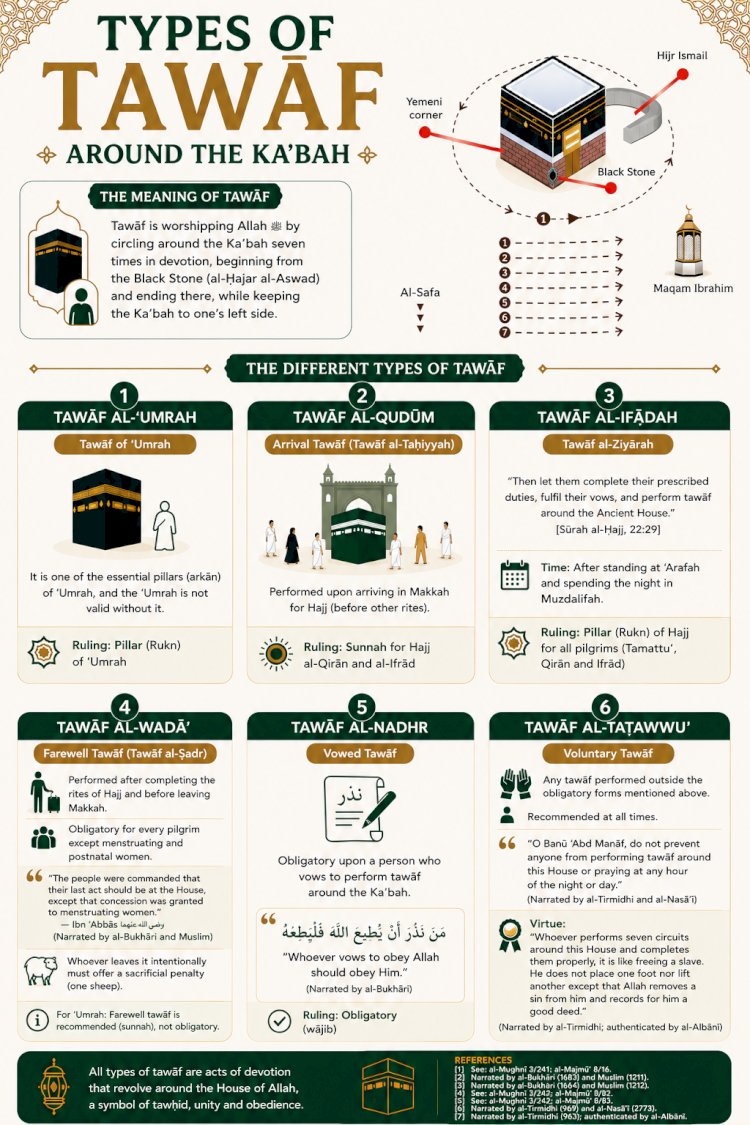
In Islamic terminology, ṭawāf refers to circling around the Kaʿbah seven times in a specific manner as an act of worship devoted to Allah ﷻ. It begins from the Black Stone (al-Ḥajar al-Aswad) and ends there with the completion of seven circuits.
Ṭawāf is unique to the Kaʿbah and cannot be performed around any other structure, grave, shrine, or object. This exclusivity reflects the centrality of tawḥīd in Islam, as acts of worship are restricted only to what Allah ﷻ has legislated. The Muslim does not perform ṭawāf around the Kaʿbah because the structure itself is worshipped, but because Allah honoured it as His Sacred House and commanded believers to worship Him through this act.
The Types of Ṭawāf
Islamic law recognises several types of ṭawāf connected to Ḥajj, ʿUmrah, and voluntary worship. While the outward action remains the same — circling the Kaʿbah seven times — each type carries its own rulings and purpose within the pilgrimage journey.
1. Ṭawāf al-Qudūm (Arrival Ṭawāf)
Ṭawāf al-Qudūm refers to the ṭawāf performed by pilgrims upon arriving in Makkah before beginning the major rites of Ḥajj. It is called the “Arrival Ṭawāf” because it serves as the pilgrim’s first greeting to the Sacred House.
The majority of scholars regard Ṭawāf al-Qudūm as a sunnah for pilgrims performing Ḥajj al-Ifrād or Ḥajj al-Qirān. The Mālikīs considered it highly emphasised, while some scholars regarded it close to obligatory for those entering Makkah for Ḥajj.
It is not performed by the pilgrim of Tamattuʿ as an independent ṭawāf, since the ṭawāf of ʿUmrah fulfils that role upon arrival.
Ṭawāf al-Qudūm highlights the honour of entering the Sacred Sanctuary and beginning the pilgrimage through worship and remembrance of Allah ﷻ.
2. Ṭawāf al-Ifāḍah (Ṭawāf al-Ziyārah)
Ṭawāf al-Ifāḍah, also known as Ṭawāf al-Ziyārah, is the principal ṭawāf of Ḥajj performed after returning from Minā on the Day of Sacrifice or during the days that follow.
It is one of the essential pillars (arkān) of Ḥajj according to the consensus of the scholars. Allah ﷻ says:
“Then let them complete their prescribed duties, fulfil their vows, and perform ṭawāf around the Ancient House.” (Sūrah al-Ḥajj, 22:29)
The time for Ṭawāf al-Ifāḍah begins after midnight preceding the Day of Sacrifice according to many scholars, though it is commonly performed on the 10th of Dhū al-Ḥijjah and may be delayed if necessary.
A pilgrim who does not perform Ṭawāf al-Ifāḍah has not completed his Ḥajj properly, and many restrictions of iḥrām remain until it is fulfilled.
Because of its status as a pillar, it cannot be compensated through sacrifice or other penalties if omitted.
3. Ṭawāf al-Wadāʿ (Farewell Ṭawāf)
Ṭawāf al-Wadāʿ is the farewell ṭawāf performed before departing from Makkah after completing the rites of Ḥajj or ‘Umrah
The Prophet ﷺ said:
“None of you should leave until his last act is at the House.” (Narrated by Muslim)
For this reason, the majority of scholars considered it obligatory for pilgrims intending to leave Makkah after Ḥajj.
However, menstruating women are exempt from Ṭawāf al-Wadāʿ, as the Prophet ﷺ granted them concession in this matter.
The wisdom behind the farewell ṭawāf is that the pilgrim concludes the sacred journey with remembrance, devotion, and a final connection to the Kaʿbah before returning home. It leaves the heart attached to the Sacred House even after departure.
4. Ṭawāf al-ʿUmrah
Ṭawāf al-ʿUmrah is the ṭawāf performed as part of the rites of ʿUmrah.
It is an essential pillar of ʿUmrah without which the ʿUmrah is not valid. The pilgrim enters Makkah, performs ṭawāf around the Kaʿbah, then performs saʿy between Ṣafā and Marwah before shaving or trimming the hair.
This ṭawāf forms the heart of the ʿUmrah journey and represents the pilgrim’s direct engagement with the Sacred House through worship and remembrance.
5. Voluntary Ṭawāf
In addition to the prescribed forms of ṭawāf connected to Ḥajj and ʿUmrah, Islam encourages voluntary ṭawāf whenever possible.
Many scholars regarded voluntary ṭawāf in Makkah as among the greatest acts of worship because it is uniquely connected to the Sacred House and cannot be performed elsewhere.
The early generations (Salaf) were known for performing abundant ṭawāf whenever they stayed in Makkah, filling their time with worship, remembrance, and recitation around the Kaʿbah.
The scholars also discussed whether voluntary ṭawāf or extra ṣalāh is superior in Makkah. Many held that for visitors to Makkah, abundant ṭawāf is more virtuous due to its unique connection to the Sacred House, while others gave preference to prayer. Both, however, remain among the greatest acts of devotion in the Sacred Sanctuary.
Voluntary ṭawāf allows the believer to remain spiritually connected to the Kaʿbah through repeated worship, reflection, and remembrance of Allah ﷻ.
Conditions for the Validity of Ṭawāf
Like other acts of worship in Islam, ṭawāf has specific conditions that must be fulfilled for it to be considered valid.
Intention (Niyyah)
Ṭawāf is an act of worship, and every act of worship in Islam requires intention. The pilgrim must intend the specific ṭawāf being performed, whether it is Ṭawāf al-Ifāḍah, Ṭawāf al-ʿUmrah, or voluntary ṭawāf.
Purity from Minor and Major Impurity
The majority of scholars considered purification from both minor and major impurity a condition for the validity of ṭawāf, due to the Prophet’s ﷺ statement:
Therefore, the pilgrim should perform wuḍūʾ before ṭawāf and avoid states of major impurity. The majority of scholars hold that a menstruating woman should not perform ṭawāf until she becomes pure, based on the instruction of the Prophet ﷺ to Sayyidah ʿĀʾishah رضي الله عنها during Ḥajj:
“Do everything that the pilgrims do except ṭawāf around the House until you become pure.”
— Narrated by al-Bukhārī and Muslim
Covering the ʿAwrah
The ʿawrah must be properly covered during ṭawāf, just as it is required during prayer. Men and women must observe the Islamic guidelines of modest dress while performing the rites.
Completing Seven Circuits
Ṭawāf must consist of seven complete circuits around the Kaʿbah. Each circuit begins from the Black Stone and ends there.
Missing part of a circuit or leaving before completing all seven invalidates the ṭawāf.
Beginning from the Black Stone
The pilgrim begins each circuit from the direction of al-Ḥajar al-Aswad (the Black Stone), following the practice of the Prophet ﷺ.
If direct access is difficult due to crowds, it is sufficient to align with it and gesture towards it while saying “Allāhu Akbar.”
Keeping the Kaʿbah to One’s Left
During ṭawāf, the Kaʿbah must remain to the pilgrim’s left side throughout the circuits. This has been the continuous practice of the Prophet ﷺ and the Muslims after him.
Performing Ṭawāf Within al-Masjid al-Ḥarām
Ṭawāf must take place within the boundaries of al-Masjid al-Ḥarām surrounding the Kaʿbah. As long as the pilgrim remains within the mosque area designated for ṭawāf, the ṭawāf is valid even if performed on upper floors due to crowding. Tawaf inside the Hijr Ismaeel is not valid as it is considered as part of the Kaaba.
Sunnahs and Etiquettes of Ṭawāf
1. Sunnahs Before Ṭawāf
For men performing ṭawāf connected to Ḥajj or ʿUmrah, it is also sunnah to practice idṭibāʿ, which means uncovering the right shoulder by placing the upper garment beneath the right arm and over the left shoulder. This is done only during ṭawāf and not throughout the entire state of iḥrām.
It is likewise sunnah to begin ṭawāf from the Black Stone (al-Ḥajar al-Aswad), facing it while saying “Allāhu Akbar” before starting the circuits.
2. Sunnahs During Ṭawāf
Among the sunnahs during ṭawāf is ramal for men in the first three circuits of ṭawāf al-qudūm or ṭawāf connected to ʿUmrah. Ramal refers to walking briskly with short, energetic steps while maintaining dignity and composure. This practice revives the Sunnah of the Prophet ﷺ and symbolises strength and vitality among the believers.
Ṭawāf should also be filled with dhikr, duʿāʾ, Qur’anic recitation, and remembrance of Allah. No fixed supplications are authentically prescribed for each specific circuit, allowing the pilgrim to supplicate freely from the heart.
Calmness, humility, and presence of heart are among the greatest etiquettes of ṭawāf. The pilgrim should avoid distraction, argument, unnecessary conversation, or anything that diminishes the spiritual atmosphere of worship.
Likewise, avoiding harm to others is an essential etiquette. The Prophet ﷺ taught gentleness and mercy in all acts of worship, and therefore pushing, shoving, or causing hardship to fellow pilgrims contradicts the spirit of ṭawāf.
3. The Black Stone and the Yemeni Corner
The Black Stone holds a special place among the symbols of Allah in the Sacred Mosque. It is sunnah to kiss it, touch it with the hand and kiss the hand, or gesture towards it from a distance when unable to approach due to crowding.
ʿUmar ibn al-Khaṭṭāb رضي الله عنه said while kissing the Black Stone:
“I know that you are only a stone that can neither benefit nor harm. Had I not seen the Messenger of Allah ﷺ kissing you, I would not have kissed you.”
— Narrated by al-Bukhārī and Muslim
This statement beautifully protects the purity of tawḥīd while affirming complete obedience to the Sunnah.
If reaching the Black Stone causes harm or severe crowding, it is sufficient to gesture towards it while saying “Allāhu Akbar.” Islam does not encourage harming others for the sake of optional acts.
As for al-Rukn al-Yamānī (the Yemeni Corner), it is sunnah to touch it with the hand if possible, but it is not kissed, nor does one gesture towards it from afar when unable to reach it. Between the Yemeni Corner and the Black Stone, it is recommended to recite:
“Rabbanā ātinā fī al-dunyā ḥasanah wa fī al-ākhirati ḥasanah wa qinā ʿadhāb al-nār.”
“Our Lord, grant us goodness in this world and goodness in the Hereafter, and protect us from the punishment of the Fire.”
— Sūrah al-Baqarah, 2:201
The scholars also warned against misconceptions and innovations related to the Kaʿbah, such as wiping its walls for blessings in ways not established by the Sunnah.
4. Prayer After Ṭawāf and Drinking Zamzam
After completing ṭawāf, it is sunnah to pray two rakʿahs behind Maqām Ibrāhīm if possible, following the command of Allah ﷻ:
“And take the standing place of Ibrāhīm as a place of prayer.”
— Sūrah al-Baqarah, 2:125
If the area is crowded, the prayer may be performed anywhere within al-Masjid al-Ḥarām.
It is recommended in these two rakʿahs to recite Sūrah al-Kāfirūn in the first rakʿah and Sūrah al-Ikhlāṣ in the second, following the practice of the Prophet ﷺ.
Afterward, it is sunnah to drink Zamzam water and make duʿāʾ. The Prophet ﷺ said regarding Zamzam:
“The water of Zamzam is for whatever it is drunk for.”
— Narrated by Ibn Mājah; authenticated by al-Albānī
Thus, the pilgrim concludes ṭawāf with prayer, remembrance, and Zamzam, combining bodily worship with spiritual nourishment and supplication before Allah ﷻ.
Common Mistakes During Ṭawāf
Due to the large crowds and emotional intensity surrounding the Kaʿbah, some pilgrims unknowingly fall into mistakes during ṭawāf. Among the most common are pushing or harming others while trying to reach the Black Stone, even though preserving the safety and dignity of fellow Muslims takes precedence over voluntary acts.
Many also believe they must physically kiss or touch the Black Stone despite severe crowding, whereas merely gesturing towards it is sufficient when access is difficult. Another widespread mistake is assuming that specific duʿāʾs are required for each circuit of ṭawāf, despite the absence of authentic evidence for fixed supplications for every round. The pilgrim may instead recite Qur’an, engage in dhikr, or make personal supplication freely. Likewise, loud collective recitations that disturb other worshippers contradict the spirit of humility and reflection intended in ṭawāf.
Disclaimer
The views expressed in this article are the author’s own and do not necessarily mirror Islamonweb’s editorial stance.
Related Posts












Leave A Comment