
Healing Minds in a Draining Age: Understanding Brain Rot and Reclaiming Human Clarity
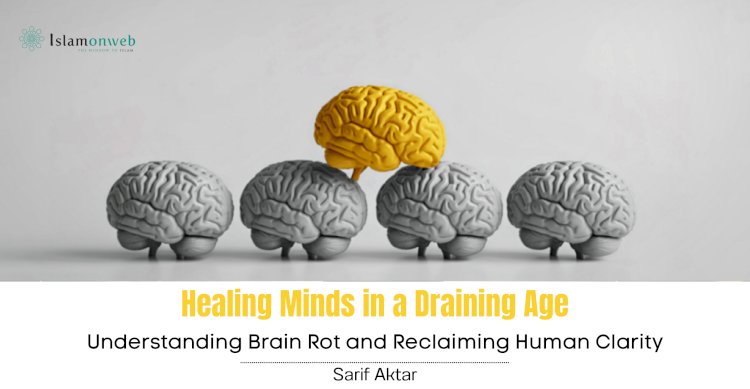
When the Mind Begins to Dim: The Silent Surge of Modern Brain Rot
A silent crisis, not one of conflict, starvation, or pandemic, is taking place across continents and cultures: the deterioration of human cognitive ability in an era of digital saturation. The decline in attention span, intellectual stamina, emotional resilience, and the ability to think deeply has become a universal phenomenon that popular culture refers to as "brain rot." This is a global cognitive shift influenced by technology, environment, and culture rather than just a problem affecting young people or a trend exclusive to social media users.
Humans today face previously unheard-of levels of cognitive overload, according to neuroscientists. The average attention span has decreased to about 8 seconds, which is less than that of a goldfish. In 2000, it was estimated to be around 12 seconds[1]. The brain becomes addicted to novelty but allergic to depth in a neurological environment created by digital dependency, binge consumption of short-form content, and continuous notifications. Chronic stress and distracted thinking are on the rise, according to the American Psychological Association, particularly among teenagers who use digital devices for more than seven or eight hours a day.
Minds become more and more weary as the world becomes more virtual. Even after hours of inactivity, people experience mental exhaustion; tasks that used to require little effort now seem overwhelming; emotional thresholds decrease; and everyday life becomes challenging without some kind of digital stimulation. The modern mind is, in many respects, underdeveloped at its core and overstimulated on the outside.
Though the Qur’an does not describe digital-age problems, it captures the spiritual essence of cognitive decay in the verse: “They have hearts with which they do not understand, eyes with which they do not see, and ears with which they do not hear” (Qur’an 7:179). This description of spiritual numbness resonates today as informational numbing: when abundance of stimuli leads to the inability to perceive meaning.
A Generation on Fast-Forward: How Hyper-Consumption is Reshaping the Human Mind
Fast content, fast news, fast emotion, and fast validation are the foundation of the modern world. Young people in particular are shaped by brief bursts of extremely stimulating content rather than long-term narratives. Infinite scrolls, looping reels, auto-play videos, and algorithmic predictions are examples of how social media platforms compete for immediacy rather than quality. The human brain is forced into a treadmill of fast reaction, despite its evolutionary design for slow, deliberate processing.
Three crucial cognitive abilities - memory, patience, and critical thinking are weakened by excessive consumption. Heavy multitaskers exhibit decreased grey matter density in the anterior cingulate cortex, the area of the brain in charge of making decisions and controlling emotions, according to research from Stanford and MIT[2]. Impulsive behaviour, anxiety, trouble thinking clearly, and a decline in long-form reading habits are all signs of this erosion.
Additionally, emotional well-being is declining. Young people's rates of loneliness and depression are skyrocketing, according to global surveys conducted by WHO and UNICEF[3]. Nowadays, a generation that grew up with digital immediacy struggles with conditions that are necessary for creativity and spiritual development, such as boredom, discomfort, or silence. With the statement, "Silence is wisdom," the Prophet Muhammad ﷺ stressed the importance of introspection. Wisdom is harder to develop in a world where noise has taken the place of silence.
The tragedy is not just personal. Society cannot continue to advance when a generation is unable to maintain focus. Long-term thinking is necessary for institutions, governance, art, innovation, and scholarship. However, excessive consumption teaches the mind to live in microseconds rather than years or decades.
The World Shrinking into Screens: Global Consequences of a Rotting Cognitive Culture
Brain rot has far-reaching effects that transform entire societies, going well beyond personal mental exhaustion. Teachers report worsening reading comprehension, weakening writing skills, and a sharp decline in students' focus, all of which contribute to the global decline in educational performance. Over the past ten years, literacy and numeracy skills have declined globally, according to the OECD's PISA assessments.
Brain rot reduces productivity from an economic standpoint. According to World Bank estimates, lost productivity due to digital distraction alone costs economies around the world hundreds of billions of dollars[4]. Workplaces are plagued by shallow output, fragmented concentration, and frequent task switching, all of which hinder strategic thinking and creativity.
The political ramifications are equally severe. Shorter attention spans contribute to the spread of false information and divisive ideologies. Public discourse becomes simplified, emotional, and reactive when people are unable to analyse complex issues or comprehend long-form arguments. Societies are susceptible to manufactured indignation, conspiracy theories, and propaganda.
In a distracted age, relationships also deteriorate. Families are physically close to one another but emotionally distant. Instead of talking, couples scroll in parallel. Parents who are physically present but mentally absent raise their children. A number of countries have appointed "Ministers of Loneliness" in response to the global epidemic of loneliness.
Spiritually, the heart becomes cluttered with noise. Reflective prayer becomes difficult. Meditation feels unnatural. The soul suffocates under constant stimulation. The Qur’an warns: “Do not follow that of which you have no knowledge; indeed, the hearing, the sight, and the heart, all of these will be questioned” (Qur’an 17:36). When these faculties are overwhelmed, the spiritual core of a person begins to wither.
Brain rot is not a metaphor. It is a global restructuring of the human mind with consequences that will echo through generations.
A Return to Stillness: Ancient Wisdoms that Anchor the Modern Mind
Despite the complexity of the modern world, the solution begins with something simple: stillness. Ancient lifestyles, including those guided by Islamic principles, preserved mental clarity by anchoring the mind in moderation, structure, and purposeful living.
Islamic tradition emphasizes fikr (deep reflection), dhikr (mental focus), and restraining the self from excess. The Prophet Muhammad ﷺ taught, “Part of the perfection of one’s faith is to leave what does not concern him.” This teaching, though articulated centuries ago, speaks directly to the modern problem of cognitive overflow caused by irrelevant information and constant stimulation.
The Qur’an encourages a rhythmic balance between work, rest, and spiritual grounding: “And We made your sleep a time for rest. And We made the day for livelihood.” (Qur’an 78:9–11). This divine pattern mirrors what neuroscientists advocate today structured routines, sleep hygiene, regulated daily rhythms, time away from screens, and intentional pauses for reflection.
In a similar vein, the prophetic discipline of eating mindfully, focusing on meaningful interactions, limiting speech, and observing silence provides psychological tools to combat contemporary distraction.
Islamic scholars also cautioned against the constant stimulation of the heart. A heart attacked by too many inputs becomes "like a mirror covered in dust," unable to reflect truth, according to Imam al-Ghazālī[5]. From the perspective of cognitive science, this metaphor is remarkably true: excessive stimulation obscures the soul's receptivity, the heart's perception, and the mind's clarity.
Ancient wisdom advocates for rebalancing the world rather than giving it up. Technology itself is not the issue; rather, it is unregulated technology and unrestricted information.
Reclaiming Thought in the Age of Noise: Practical Steps Toward Healing the Mind
Humanity needs to rediscover disciplines that let the mind breathe in order to combat brain rot. A change in lifestyle rather than a straightforward checklist is the answer.
One fundamental tactic is digital detoxification, which is backed by studies from Oxford and Harvard that demonstrate how periodically removing oneself from screens replenishes brain circuits linked to critical thinking[6]. Cognitive fatigue can be reversed by establishing boundaries like meals without electronics, quiet mornings, or one offline day per week.
Deep reading, which has long been praised in Islamic tradition and is currently supported by neuroscientists, is another essential component. Neural connections weakened by fragmented scrolling are strengthened when one engages with books, particularly those that require slow thought.
Exposure to nature has significant healing benefits. Spending even 20 minutes in nature improves memory and attention by almost 20%, according to University of Michigan studies[7]. The Qur'an invites people to consider natural phenomena as manifestations of divine order on numerous occasions. This kind of introspection calms the mind and restores cognitive equilibrium.
Regardless of one's religious affiliation, mindful prayer or meditation has been demonstrated to improve focus, stabilize emotions, and control stress hormones. Islamic prayer incorporates physical, emotional, and spiritual alignment as a counterbalance to overstimulation through its rhythmic movement and prolonged focus.
The need for “social connection” cannot be underestimated, either. The Prophet ﷺ once said, “A believer mirrors a believer,” and healthy relationships provide just that kind of reflection for us when we lose sight of things.
At last, having real purpose is the ultimate antidote. Brain rot prospers where there is a vacuum. A life based on purpose, whether spiritual, educational, or artistic, resists the plague of distraction naturally.
Toward a Culture of Clarity: A Call to Rebuild Minds, Homes, and Societies
Brain rot is not a solely personal problem but a challenge to our civilization. If humanity continues to press forward toward a hyper-distracted future, the expected consequences include generational diminishment of intellectual aptitude, destabilized social configurations, uninhibited political processes, and a more superficial cultural environment. On the other hand, a wise, disciplined response with intentional living can rebuild a social order marked by clarity, depth, and direction.
Advancing towards a constructive horizon requires collaboration on the part of educators, families, religious and ethical communities, policymakers, and technologists. Educational establishments must focus on deep learning, not just digital literacy. Families should model attentive presence, not distraction. Technology companies have to be held accountable in terms of the building of humane platforms. Spiritual and ethical discourses need to be reintegrated as moral anchors amidst contemporary uncertainties.
Applying Islamic wisdom in a balanced and non-coercive way provides a model for balance: moderation, reflection, disciplined behaviour, purposeful action, and protection of the senses from excess. These are in harmony with state-of-the-art neuroscience, showing that ancient guidance and modern science meet on one proposition: the human mind thrives when it is protected, nourished, and placed on base.
This is an invitation for the reinvigoration of cognitive dignity in the present era and for a generation able to love profoundly, deliberate thoughtfully, and act responsibly. While noise characterizes the contemporary world, stillness is an option. While the screen can limit attention, moral and emotional receptivity can be opened up. Brain rot can be considered a global pandemic, yet cognitive clarity remains an option at every sober, intentional moment.
May this age of distraction become the age in which humanity awakens, heals, and returns to the full radiance of its mind.
About the author:
Sarif Aktar is a student of Political Science at Gauhati University and a postgraduate scholar in the
Study of Religions at Darul Huda Islamic University, Kerala.
References
- Alter, Adam L. Irresistible: The Rise of Addictive Technology and the Business of Keeping Us Hooked. New York: Penguin Press, 2017.
- UNESCO. Global Report on Education and Digital Well-Being. Paris: UNESCO Publishing, 2023.
- Király, Orsolya, et al. “Problematic Internet Use and Its Association with Mental Health: A Global Systematic Review.” Current Psychiatry Reports 23, no. 3 (2021): 17.
- Twenge, Jean M. iGen: Why Today’s Super-Connected Kids Are Growing Up Less Happy and Completely Unprepared for Adulthood. New York: Atria Books, 2017.
- Sahih al-Bukhari, Book of Manners and Restraint.
Citations
[1] Microsoft Consumer Insights, Attention Spans Research Report, Spring 2015 (Toronto: Microsoft Corporation), cited in Press Trust of India, “Human Attention Span Now Only 8 Seconds, Smartphones to Blame,” The Economic Times, May 17, 2015, https://economictimes.indiatimes.com/magazines/panache/human-attention-span-now-only-8-seconds-smartphones-to-blame/articleshow/47318667.cms.
[2] Eyal Ophir, Clifford Nass, and Anthony D. Wagner, “Cognitive Control in Media Multitaskers,” Proceedings of the National Academy of Sciences of the United States of America 106, no. 37 (2009): 15583–15587, https://doi.org/10.1073/pnas.0903620106.
[3] World Health Organization (WHO), “Loneliness and Isolation – the Hidden Threat to Global Health We Can No Longer Ignore,” July 14, 2025, World Health Organization, https://www.who.int/news-room/commentaries/detail/loneliness-and-isolation-the-hidden-threat-to-global-health-we-can-no-longer-ignore
[4] World Bank, From Promise to Productivity: Making Digital Work for People and Jobs (World Bank, 2025), accessed via Open Knowledge Repository, https://openknowledge.worldbank.org/entities/publication/fbf8b23f-b959-476e-bc51-10a0df1813da
[5] Abū Ḥāmid al-Ghazālī, The Revival of the Religious Sciences (Iḥyāʾ ʿUlūm al-Dīn), trans. Nabih Amin Faris, vol. 3 (Lahore: Sh. Muhammad Ashraf, 1966), 5–7, where al-Ghazālī compares the heart to a mirror that loses its capacity to reflect truth when it is obscured by constant distractions and sensory excess.
[6] Andrew K. Przybylski and Netta Weinstein, “Digital Screen Time Limits and Young People’s Psychological Well-Being,” Journal of Child Psychology and Psychiatry 60, no. 11 (2019): 1202–1210 (Oxford Internet Institute)
[7] Marc G. Berman, John Jonides, and Stephen Kaplan, “The Cognitive Benefits of Interacting with Nature,” Psychological Science 19, no. 12 (2008): 1207–1212, https://doi.org/10.1111/j.1467-9280.2008.02225.x.
Disclaimer
The views expressed in this article are the author’s own and do not necessarily mirror Islamonweb’s editorial stance.

Related Posts













Leave A Comment