
Reviving Family Waqf: Lessons from Malaysia for India Amid Contemporary Legal Change
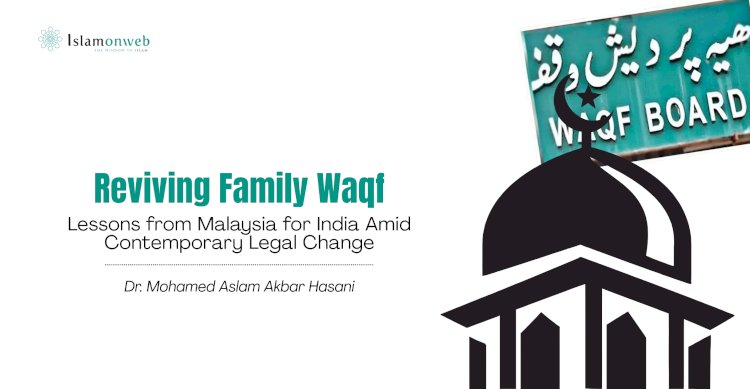
India possesses one of the world’s largest bodies of waqf property. According to data reported through the Waqf Assets Management System of India (WAMSI), more than 872,000 immovable waqf properties had been recorded across the country by March 2025. The same data classified 58,890 properties as encroached, while information concerning a substantial number of properties remained incomplete.[1] These figures point not only to the historical scale of the institution but also to persistent problems of documentation, protection, administration, litigation, and productive utilisation.
The potential of these endowments is therefore considerable, but so are the institutional challenges surrounding them. Properties established for religious, educational, charitable, and social purposes can fulfil those objectives only when they are properly documented, professionally managed, and protected from unlawful alienation or encroachment. Questions of governance have consequently occupied an important place in recent debates over waqf administration in India.
This debate entered a new phase with the enactment of the Waqf (Amendment) Act, 2025, which substantially amended the Waqf Act, 1995 and renamed the principal legislation the Unified Waqf Management, Empowerment, Efficiency and Development Act, 1995. Among other changes, the legislation introduced a centralised registration framework, altered provisions governing the constitution of Waqf Boards and the Central Waqf Council, removed waqf by user as a basis for the future creation of waqf, and introduced new procedures concerning properties claimed to belong to the government.[2] The amendments generated significant public debate and were challenged before the Supreme Court of India.
On 15 September 2025, the Supreme Court, in In Re: The Waqf Amendment Act, 2025, declined to stay the legislation in its entirety but granted interim protection in relation to several provisions. The Bench comprising Chief Justice B. R. Gavai and Justice Augustine George Masih stayed the requirement that a person establishing a waqf must demonstrate that he or she had been professing Islam for at least five years, pending the framing of an appropriate mechanism for determining that requirement.[3]
The Court also intervened in relation to Section 3C. While it did not suspend the entire section, it stayed the proviso to Section 3C(2) and subsections (3) and (4), which would have affected the status and official records of disputed properties on the basis of the designated officer’s determination. The Court further directed that, until the question of title is finally decided by the Waqf Tribunal, subject to further orders of the High Court, a waqf should neither be dispossessed of the property nor have the relevant revenue and Board records altered. During such proceedings, however, no third-party rights may be created over the disputed property.[4]
With regard to representation, the Court directed that non-Muslim membership should not exceed four of the 22 members of the Central Waqf Council and three of the 11 members of a State Waqf Board. It did not, at the interim stage, stay the centralised registration requirements or the prospective removal of waqf by user from the statutory definition.[5]
These developments have brought questions of waqf governance, documentation, autonomy, and institutional sustainability into renewed focus. Yet the debate need not remain confined to the administration of existing public and charitable awqāf. It also offers an opportunity to reconsider an institution that has received comparatively little attention in contemporary India: the family waqf (waqf ahlī or waqf ʿalā al-awlād). Experiences from jurisdictions such as Malaysia may provide useful lessons for considering how this classical institution can operate within contemporary legal and economic conditions.
While much of the current discussion in India has centred on the administration and regulation of public charitable endowments (waqf khayrī), another important form of waqf deserves closer attention: the family waqf (waqf ahlī or waqf ʿalā al-awlād). In this arrangement, the founder dedicates property while directing its benefits, wholly or partly, to specified family members or descendants. The institution therefore combines preservation of the endowed asset with provision for successive generations and, depending on the terms of the endowment, an eventual charitable purpose. Malaysia offers useful contemporary experience in the administration of this form of waqf.[6]
The legal structure of waqf distinguishes it from ordinary inheritance planning. Once property has been validly constituted as waqf, the corpus (ʿayn) is generally preserved and ceases to be freely disposable by the founder. It is not ordinarily sold, gifted through hibah, inherited, or disposed of by waṣiyyah, while its usufruct or income is applied to the beneficiaries designated in the waqf deed.[7] In classical Islamic jurisprudence, therefore, property validly endowed during the founder’s lifetime would ordinarily not form part of the estate subsequently distributed through farāʾiḍ. This principle, however, must be distinguished from an attempt to use waqf to deprive lawful heirs of rights that have already attached to the estate.
That distinction is particularly important in contemporary India. Section 3A(2), introduced by the Waqf (Amendment) Act, 2025, expressly provides that creating a waqf ʿalā al-awlād shall not deny the inheritance rights of the founder’s heirs, including women heirs, or the rights of other persons with lawful claims.[8] The classical institution must therefore be considered today not merely as a means of removing assets from succession, but as a form of long-term family endowment operating within both Sharīʿah requirements and the applicable statutory framework.
Classical jurisprudence also includes safeguards for a waqf created during the illness from which the founder dies (maraḍ al-mawt). Such a disposition is generally treated, in respect of its effect on the estate, in a manner analogous to a waṣiyyah. It may take effect up to one-third of the estate without the heirs’ consent, while the amount exceeding one-third depends on their approval.[9] Ibn Qudāmah explains that this limitation arises because the heirs' rights attach to the property during the final illness. The rule reflects the broader juristic concern to preserve the institution of waqf without permitting deathbed dispositions to undermine heirs' legitimate rights.
The Juristic Debate on Permanence and Temporary Waqf
The contemporary revival of family waqf also raises several questions on which the classical jurists did not speak with one voice. Among the most relevant is whether perpetuity (taʾbīd) is indispensable to waqf validity. The issue has acquired renewed significance as contemporary institutions explore temporary endowments (waqf muʾaqqat) and other structures intended to respond to changing family and social needs.
The dominant Ḥanafī position, the relied-upon position in the Shāfiʿī school, and one view within the Ḥanbalī school require waqf to be perpetual and do not recognise an endowment expressly limited to a fixed term. The Mālikī school, by contrast, permits waqf for a specified duration. There are also recognised, though non-dominant, positions within the Shāfiʿī and Ḥanbalī schools that allow such limitation. Under the Mālikī conception, property may therefore be endowed for a defined period—ten years, for example—after which its waqf status ends and the property returns to the person legally entitled to it.[10]
This distinction should not be confused with Abū Ḥanīfah’s well-known position regarding the binding character of waqf. His view that an ordinary waqf may remain ghayr lāzim concerns the founder’s ability, in certain circumstances, to revoke the endowment; it is not identical to the Mālikī doctrine of a binding waqf created from the outset for a fixed duration. Later Ḥanafī doctrine, particularly the position associated with Abū Yūsuf and adopted for fatwā in many Ḥanafī works, developed a stronger conception of the binding character of waqf.[11]
A related question arises where the waqf itself is not expressly temporary, but the named beneficiaries may eventually cease to exist. This is particularly relevant to family waqf created for parents, children or other specified relatives without clearly identifying a perpetual beneficiary thereafter. Classical jurists discussed this as a waqf whose beneficiary is munqaṭiʿ al-intihāʾ. The Ḥanafī, Mālikī, Shāfiʿī and Ḥanbalī schools developed different rules governing the validity of such an endowment and the ultimate destination of the property or its benefits. Some approaches preserve the property as waqf and redirect its benefits to another charitable or familial recipient, while other recognised positions allow it, in particular circumstances, to return to the founder or the founder’s heirs.[12]
These distinctions are important for family waqf. A perpetual waqf may provide first for the founder’s children and descendants and subsequently direct its benefits to the poor or another lasting charitable purpose. Such an arrangement remains perpetual even though the first class of beneficiaries is familial and finite. It should therefore be distinguished from waqf muʾaqqat, in which the waqf status of the property itself is expressly limited to a particular period. Careful drafting must address both questions: the intended duration of the waqf and the destination of its benefits when a particular class of family beneficiaries comes to an end.
Malaysia’s Legal and Institutional Framework for Waqf
Malaysia provides a useful contemporary setting in which some of these juristic possibilities have been translated into statutory and administrative forms. Under the Federal Constitution, Islamic law relating to waqf falls principally within the legislative competence of the individual States, except in the Federal Territories. Malaysia consequently does not have a single uniform waqf statute applicable throughout the federation; State enactments and institutional arrangements differ in their details.[13]
A common feature, however, is the central role assigned to the respective State Islamic Religious Council (Majlis Agama Islam Negeri). In Selangor, for example, section 4 of the Waqf (State of Selangor) Enactment 2015 designates the State Islamic Religious Council as the sole trustee of waqf situated within the State. Sole trusteeship does not necessarily mean exclusive day-to-day management. The legislation also allows the Council to appoint or authorise administrators and managers and, subject to the statutory conditions, to recognise an administrator nominated by the founder.[14] The arrangement therefore combines central legal supervision with possibilities for delegated administration.
At the federal level, the Department of Awqaf, Zakat and Hajj (JAWHAR) has sought to encourage greater consistency through research, administrative guidance and model legislation. Its Manual Pengurusan Model Perundangan Wakaf provides a model enactment that States may draw upon when developing their respective waqf laws. Of particular relevance is its recognition of both perpetual waqf (waqf muʾabbad) and time-limited waqf (waqf muʾaqqat). The model thus illustrates one way in which a contemporary legal framework may accommodate a juristic position permitting temporary waqf while retaining institutional supervision.[15] It remains, however, a model framework rather than a federal statute superseding State legislation.
The Malaysian experience is therefore useful not because it has removed the classical disagreements surrounding waqf, but because it shows how selected juristic positions can be incorporated into a regulated contemporary system. For India, where renewed interest in family waqf must now operate alongside statutory safeguards for inheritance rights, the more relevant lesson lies in developing clear rules on duration, beneficiaries, trusteeship and ultimate charitable purpose rather than treating family waqf as a single, uniform legal device.
The central role of the State Islamic Religious Councils provides an established framework for legal supervision and continuity of waqf administration, but it also presents particular challenges for the development of family waqf. Despite its long history in Malaysia, waqf ahlī or waqf zurri remains comparatively limited in practice. Recent research attributes this not to a single institutional factor, but to a combination of limited promotion, administrative and bureaucratic constraints, varying levels of expertise within the State Islamic Religious Councils, uncertainty over suitable management mechanisms, and concerns among heirs who may continue to regard the endowed property as part of the family patrimony.[16] Differences among State enactments further complicate the position, as some do not expressly provide for family waqf. These limitations have encouraged proposals for more flexible arrangements in which the State Islamic Religious Council retains its supervisory or trustee role while professional institutions, family associations, or other authorised bodies participate in the management of the endowed assets. Such arrangements may offer a more workable balance between regulatory oversight and the particular needs of family waqf.
Lessons for India: Towards a Viable Family Waqf Framework
The Malaysian experience strongly suggests that over-centralization, without sufficient room for familial participation, can weaken the very institution it aims to protect. If India truly wishes to strengthen its waqf ecosystem amidst the current legal and administrative challenges, relying solely on judicial intervention will not build a sustainable future.
Family waqf is already recognised within Indian waqf law as waqf ʿalā al-awlād. The real need, therefore, is to develop clearer provisions suited to its distinctive character.[17] Without such clarity, family endowments may simply be treated through administrative mechanisms designed primarily for other forms of waqf, leaving their particular needs insufficiently addressed.
The system should also explore more flexible governance models. Allowing family beneficiaries to participate in the management of endowed assets alongside qualified professionals, while remaining subject to appropriate regulatory supervision, could help address the trust deficit that often surrounds centralised administration. Such an arrangement would seek to preserve accountability without losing sight of the founder’s niyyah and the particular objectives of a family waqf.
The juristic flexibility discussed earlier also deserves serious consideration. Where legally permissible, the Mālikī position on waqf muʾaqqat, together with other recognised juristic opinions permitting temporary waqf, may offer Muslim donors greater flexibility. If a donor wishes to create a family waqf for twenty years, for example, a suitable legal framework should be able to accommodate such an arrangement where the governing law and the adopted juristic position permit it. This is distinct from a perpetual waqf in which family members benefit for a specified period before the benefits pass permanently to a charitable institution.
Administrative modernisation is equally important. India must continue strengthening the digitisation of waqf deeds, property records, accounts and related documentation. Standardised accounting and reliable digital records can help address long-standing problems of incomplete documentation, weak administration and disputes concerning waqf properties.
Ultimately, reviving family waqf in India goes far beyond a bureaucratic reform or a reaction to the Waqf (Amendment) Act, 2025. Properly structured, waqf ahlī can help preserve productive family assets across generations while ensuring that wealth continues to serve both familial and wider social purposes. This should not be understood as a means of circumventing farāʾiḍ, but as an institution operating within the limits established by Islamic law and the applicable statutory framework.
Family waqf should therefore not be viewed merely as a relic of medieval Islamic history. By carefully combining established fiqh principles with sound administration, professional management and appropriate family participation, waqf ahlī can remain a relevant instrument for the future of Islamic social finance in India.
About the author:
Assoc. Prof. Dr. Mohamed Aslam Akbar Hasani,
Faculty of Economics and Management Sciences, International Islamic University Malaysia
References:
[1] Ministry of Minority Affairs, Government of India, “Waqf Amendment Bill, 2025: The History of Waqf in India,” Press Information Bureau, 3 April 2025; WAMSI data as of 14 March 2025. The official figures report about 8.72 lakh properties and identify 58,890 as encroached
[2] The Waqf (Amendment) Act, 2025, Act No. 14 of 2025; see also the amended Unified Waqf Management, Empowerment, Efficiency and Development Act, 1995.
[3] In Re: The Waqf Amendment Act, 2025 (1), Writ Petition (Civil) No. 276 of 2025 and connected matters, 2025 INSC 1116, Supreme Court of India, judgment dated 15 September 2025, especially paras. 140–152, 153–167 and 209.
[4] Ibid
[5] Ibid
[6] Muhammad Hisyam Mohamad and Nur Syahidah Abdul Jalil, “Wakaf Zurri Di Malaysia: Pensyariatan, Realiti Pelaksanaan dan Pengkomersialan Masa Hadapan,” Journal of Awqaf, Zakat and Hajj (JAWHAR), vol. 3, no. 2 (2025). The study defines wakaf zurri/family waqf as directing the benefits of waqf property to immediate family members and considers its role in inheritance planning.
[7] Jabatan Wakaf, Zakat dan Haji (JAWHAR), “Soalan Lazim—Soalan Berkaitan Wakaf.” JAWHAR defines waqf as retaining the founder’s rights over the property from transactions including sale, inheritance, hibah and waṣiyyah, while preserving the physical corpus (ʿayn). It also notes the exceptional mechanism of istibdāl
[8] Waqf (Amendment) Act, 2025, s. 3A(2): “The creation of a waqf-alal-aulad shall not result in denial of inheritance rights of heirs, including women heirs, of the waqif or any other rights of persons with lawful claims.
[9] Ibn Qudāmah, al-Mughnī, Kitāb al-Wuqūf wa-l-ʿAṭāyā, discussion of waqf during maraḍ al-mawt. He states that such a waqf is treated like a waṣiyyah with respect to the one-third limitation; an amount exceeding one-third depends upon the heirs’ approval
[10] Al-Mawsūʿah al-Fiqhiyyah al-Kuwaytiyyah [Kuwaiti Fiqh Encyclopedia], Ministry of Awqaf and Islamic Affairs, Kuwait, vol. 10, p. 40, “Taʾqīt,”
[11] See the classical Ḥanafī discussions of the binding character of waqf, particularly the distinction between the position of Abū Ḥanīfah and that of Abū Yūsuf. The issue of revocability should be distinguished from an endowment expressly constituted for a fixed duration
[12] Al-Mawsūʿah al-Fiqhiyyah al-Kuwaytiyyah, discussion of waqf upon a beneficiary whose line eventually terminates (al-mawqūf ʿalayh munqaṭiʿ al-intihāʾ).
[13] Federal Constitution of Malaysia, Ninth Schedule, List II (State List), Item 1, concerning Islamic law, waqf and Islamic charitable and religious trusts within the States
[14] Enakmen Wakaf (Negeri Selangor) 2015, s. 4 and related provisions governing the State Islamic Religious Council’s position as sole trustee and the appointment or recognition of administrators.
[15] Department of Awqaf, Zakat and Hajj (JAWHAR), Manual Pengurusan Model Perundangan Wakaf, model provisions dealing with wakaf muabbad and wakaf muaqqat.
[16] Muhammad Hisyam Mohamad and Nur Syahidah Abdul Jalil, “Wakaf Zurri di Malaysia: Pensyariatan, Realiti Pelaksanaan dan Pengkomersialan Masa Hadapan” [“Zurri Waqf in Malaysia: Syariah Rulings, Implementation Reality, and Future Commercialisation”], Journal of Awqaf, Zakat and Hajj (JAWHAR), vol. 3, no. 2 (2025), pp. 61–80, DOI: 10.65404/JAWHAR.302004
[17] The Unified Waqf Management, Empowerment, Efficiency and Development Act, 1995, as amended by the Waqf (Amendment) Act, 2025, s. 3A(2)
Disclaimer
The views expressed in this article are the author’s own and do not necessarily mirror Islamonweb’s editorial stance.


Related Posts

















Leave A Comment