
Reason, Morality and the Question of God: Reflections on the Nadwi–Akhtar Debate
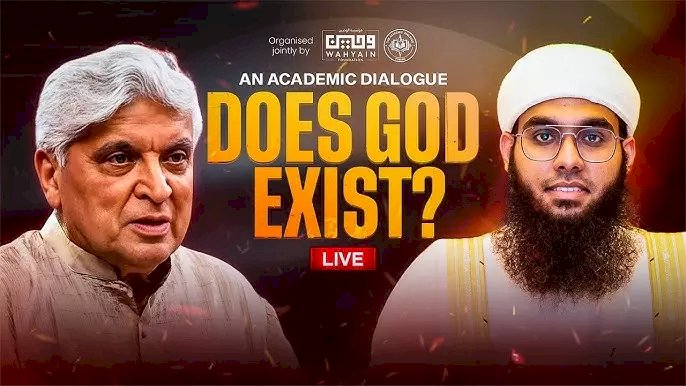
A high-profile public debate on “Does God Exist?”, now widely circulated through its official YouTube broadcast, has reignited national conversation on faith, reason, and moral responsibility, with Islamic scholar Mufti Shamail Nadwi widely seen as holding a clear philosophical advantage over veteran lyricist Javed Akhtar.
Held at the Constitution Club of India and moderated by journalist Saurabh Dwivedi, editor of The Lallantop, the nearly two-hour academic dialogue was marked by sharp contrasts in method and substance.
Mufti Shamail Nadwi grounded his case for the existence of God in classical rational theology, carefully separating metaphysical reasoning from emotional reaction. He argued that the contingent nature of the universe necessarily points to a First Cause, and that rejecting this leads to the logical fallacy of infinite regress. Crucially, Nadwi insisted that the God question cannot be resolved through empirical science alone, as science explains mechanisms, not ultimate causes.
Mufti Shamail Nadwi’s approach was notable for its discipline and philosophical coherence. Rather than relying on scripture or religious authority, he framed his argument squarely within the domain of reason. At the heart of his case was the classical argument from contingency: the universe, being contingent and dependent, cannot explain itself and therefore requires a First Cause that is necessary and self-existent.
Rejecting the idea that science can either prove or disprove God, Nadwi drew a clear boundary between empirical inquiry and metaphysical reasoning. Science, he argued, describes how processes occur within the universe, but it remains silent on why there is a universe at all. By insisting on this distinction, he repeatedly brought the discussion back to first principles, preventing it from drifting into emotional or anecdotal territory.
A key strength of Nadwi’s intervention lay in his handling of the problem of evil. Rather than deflecting the issue, he directly addressed it by emphasising human free will and moral responsibility. Evil actions, he argued, are the result of human choice, not divine intent—an explanation rooted in long-standing philosophical and theological traditions.
Javed Akhtar, articulating an atheistic position, grounded his scepticism primarily in ethical concerns and lived human experience. He questioned how belief in an all-powerful and benevolent God could be reconciled with widespread suffering, injustice, and violence in the world. His arguments drew emotional force from contemporary events and from a broader moral unease with religious certainty.
Akhtar also distinguished between belief and faith, presenting belief as evidence-based and faith as acceptance without proof. He cautioned against treating faith as a final answer that discourages questioning, positioning doubt as a necessary intellectual virtue.
While these points resonated with sections of the audience, critics noted that Akhtar’s objections largely remained within the realm of moral protest rather than engaging the metaphysical framework Nadwi had laid out. His position repeatedly returned to why God allows evil, without fully addressing whether the existence of evil logically negates the existence of God.
One of the most decisive moments of the debate emerged around the question of morality. Akhtar described morality as a human construct developed for social order, likening it to traffic rules—necessary but not inherent to nature. Nadwi countered by exposing the implications of this view: if morality is defined solely by social consensus, then injustice could be justified whenever a majority endorses it.
This challenge to moral relativism struck a chord with many viewers, as it highlighted the difficulty of grounding universal moral values without an objective moral source. Nadwi’s argument suggested that moral outrage itself presupposes a standard beyond human agreement—a point that subtly reinforced his broader case for transcendence.
Despite sharp disagreements, the debate maintained a disciplined and civil tone—an aspect widely appreciated by viewers of the live-streamed video. Many commentators online remarked that while disbelief found expression, it was Nadwi’s clarity, composure, and logical consistency that gave his arguments greater staying power.
As the debate continues to circulate widely online, it has come to be viewed less as a contest of rhetoric and more as a demonstration of how faith, when articulated through reasoned argument rather than sentiment alone, can confidently engage scepticism in the public square.
In a time when discussions on religion are often reduced to slogans or silenced altogether, the event stood out for showing that serious disagreement—when guided by intellect and restraint—remains not only possible, but necessary.
Disclaimer
The views expressed in this article are the author’s own and do not necessarily mirror Islamonweb’s editorial stance.


Related Posts

















Leave A Comment