
Al-Hidabi Leadership Model for Empowering Muslim Youth
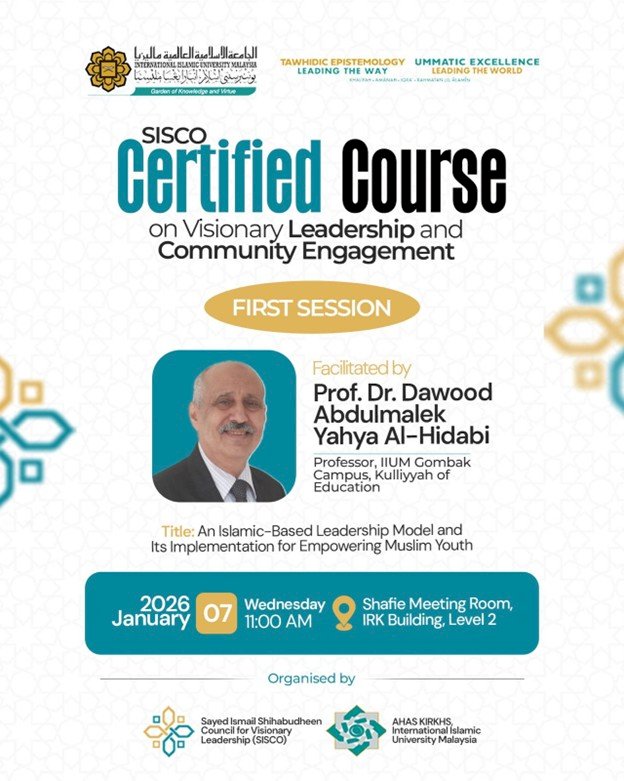
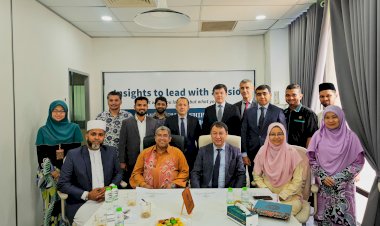
The SISCO Certified Course on Visionary Leadership and Community Engagement commenced successfully with its first session on 7 January 2026, held from 11:00 a.m. to 1:00 p.m. at the Shafie Meeting Room, IRK Building, International Islamic University Malaysia (IIUM). Designed as a four-month certified programme, the course comprises ten sessions facilitated by ten renowned scholars from diverse academic and professional backgrounds at IIUM. Running from January to April, the course aims to provide impactful insights by integrating leadership theory, real-world perspectives, and guidance from experienced facilitators.
The first session was led by Prof. Dr. Dawood Abdulmalek Yahya Al-Hidabi, Professor at the Kulliyyah of Education (KOED), IIUM, originally from Yemen. He holds a Doctor of Philosophy in Education from the University of Stirling. Prof. Dawood served as the resource person for the session entitled “An Islamic-Based Leadership Model and Its Implementation for Empowering Muslim Youth.”
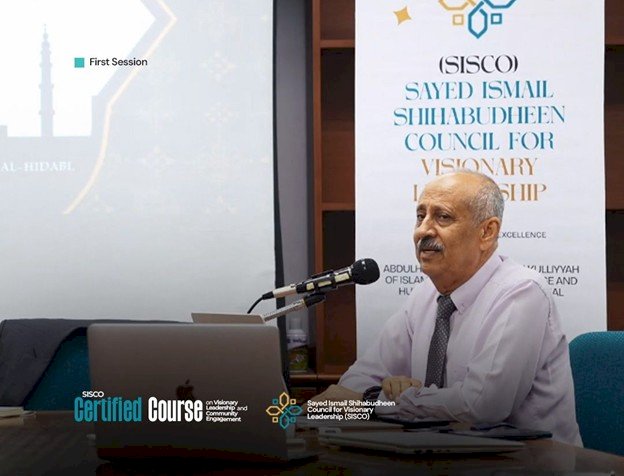
The session began with the distribution of a structured form to participants to assess their initial understanding and perceptions of leadership and community engagement. This preparatory activity enabled the facilitator to align the session content with participants’ learning needs and expectations. Prof. Dawood then reflected on selected Qurʾānic verses related to leadership, emphasising that leadership in Islam is grounded in responsibility, moral guidance, justice, and service to humanity. Drawing upon key concepts such as imāmah (moral-spiritual leadership), khilāfah (stewardship), amānah (trust), and ʿadl (justice), he highlighted that leadership is neither domination nor privilege, but a trust for which one is accountable before Allah and society.
A major highlight of the session was the introduction of the Al-Hidabi Leadership Model, a newly conceptualised framework consisting of seven integrated and sequential components, described as a leadership journey “from heart to benefit.” The model begins with the heart (al-qalb), focusing on faith, sincerity, and God-consciousness, and progresses through intellect (ʿaql), ethical character (akhlāq), personal traits, leadership competencies, righteous actions, and finally impact and benefit. Prof. Dawood emphasised that leadership effectiveness in this model is validated not merely by intention or skill, but by ethically guided actions that produce real and sustainable benefit for the community and the ummah. Special attention was given to the relevance of this model for students and young leaders, highlighting how it promotes visionary thinking, moral responsibility, emotional resilience, and active community engagement, while remaining firmly rooted in Islamic epistemology and the objectives of the Sharīʿah.
The programme concluded with an interactive question-and-answer session, during which participants actively engaged with the facilitator. The thoughtful questions and discussions reflected a high level of interest and critical reflection among the attendees, further enriching the learning experience.
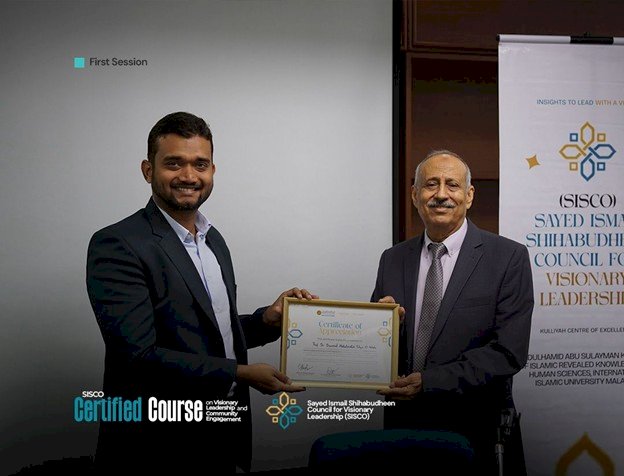
Overall, the first session successfully achieved its objectives by offering participants a holistic understanding of leadership that integrates spiritual foundations with practical application. It set a strong academic and ethical tone for the remaining sessions of the course. The session was moderated by Assoc. Prof. Dr. Sayyed Mohamed Muhsin, Head of the Department of Fiqh and Usul al-Fiqh, Coordinator of SISCO, and Director of the Certified Course. The programme was organised by the Sayed Ismail Shihabuddeen Centre of Excellence (SISCO), a Kulliyyah Centre of Excellence under AHAS KIRKHS, IIUM.
About the author:
Nidha Hashim is a postgraduate student in the Department of Psychology at the International Islamic University Malaysia (IIUM). She has completed her Bachelor’s degree in Psychology from the University of Calicut, India.
Disclaimer
The views expressed in this article are the author’s own and do not necessarily mirror Islamonweb’s editorial stance.


Related Posts





Leave A Comment