
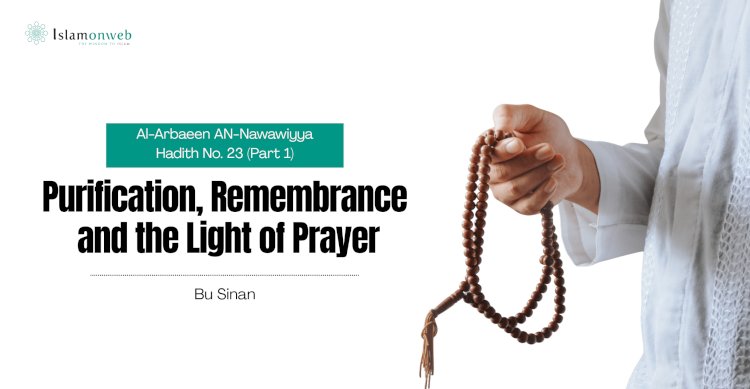
Hadith No. 23 (Part 1) Purification, Remembrance and the Light of Prayer
عَنْ أَبِي مَالِكٍ الْأَشْعَرِيِّ رَضِيَ اللَّهُ عَنْهُ قَالَ: قَالَ رَسُولُ اللَّهِ ﷺ: «الطُّهُورُ شَطْرُ الْإِيمَانِ، وَالْحَمْدُ لِلَّهِ تَمْلَأُ الْمِيزَانَ، وَسُبْحَانَ اللَّهِ وَالْحَمْدُ لِلَّهِ تَمْلَآنِ ـ أَوْ تَمْلَأُ ـ مَا بَيْنَ السَّمَاوَاتِ وَالْأَرْضِ، وَالصَّلَاةُ نُورٌ، وَالصَّدَقَةُ بُرْهَانٌ، وَالصَّبْرُ ضِيَاءٌ، وَالْقُرْآنُ حُجَّةٌ لَكَ أَوْ عَلَيْكَ، كُلُّ النَّاسِ يَغْدُو فَبَائِعٌ نَفْسَهُ فَمُعْتِقُهَا أَوْ مُوبِقُهَا».
Translation
Abū Mālik al-Ḥārith ibn ʿĀṣim al-Ashʿarī رضي الله عنه reported that the Messenger of Allah ﷺ said:
“Purification is half of faith. Saying ‘al-ḥamdu lillāh’ fills the Scale, and ‘Subḥān Allāh’ and ‘al-ḥamdu lillāh’ fill what lies between the heavens and the earth. Prayer is light, charity is proof, and patience is radiance. The Qurʾān is evidence for you or against you. Every person sets out in the morning, selling their soul, thereby either setting it free or bringing it to ruin.”
Narrated by Muslim.[1]
About the Narrator
Abū Mālik al-Ashʿarī رضي الله عنه was a Companion of the Prophet ﷺ belonging to the Ashʿar tribe of Yemen, a tribe distinguished by its early acceptance of Islam and its contribution to the transmission of Prophetic teachings. Ibn al-Athīr records that Abū Mālik arrived by sea with a group of Ashʿarīs to meet the Prophet ﷺ. He is counted among the Companions associated with al-Shām (Greater Syria), where his narrations were transmitted by subsequent generations of scholars.[2]
Early biographical authorities disagree considerably about his personal name. Imām al-Nawawī identifies him as al-Ḥārith ibn ʿĀṣim in the text of the Forty Hadiths. However, other names have been reported, including Kaʿb ibn ʿĀṣim, al-Ḥārith ibn al-Ḥārith, ʿUbayd and ʿAmr. Ibn Ḥajar al-Haytamī, in al-Fatḥ al-Mubīn, observes that al-Ḥārith is only one of several reported names and that even the father's name appears differently in some manuscripts. Ibn Ḥajar al-ʿAsqalānī is more explicit in al-Iṣābah, considering the identification as al-Ḥārith ibn ʿĀṣim mistaken and suggesting Kaʿb ibn ʿĀṣim or al-Ḥārith ibn al-Ḥārith instead.[3]
Abū Mālik was among the Companions who preserved and conveyed the practical teachings of the Prophet ﷺ. His narrations were transmitted through scholars including ʿAbd al-Raḥmān ibn Ghanm al-Ashʿarī, Abū Salām Mamṭūr and Shahr ibn Ḥawshab. One particularly interesting account, recorded by Imām Aḥmad, describes how he gathered members of his community, including women and children, to demonstrate the manner in which the Prophet ﷺ performed purification and prayer. He told them:
“O people of the Ashʿarīs, gather together, and bring your women and children, so that I may teach you the prayer of the Prophet ﷺ as he led us in Madinah.”
He then demonstrated wuḍūʾ and led them in prayer, instructing them to observe and learn its movements. This account illustrates the care with which the Ṣaḥābah transmitted the Sunnah, not merely through words but also through practical demonstration. It is particularly relevant to the present ḥadīth, in which Abū Mālik narrates the Prophet's ﷺ statement that purification is half of faith and prayer is light.[4]
Abū Mālik died during the caliphate of ʿUmar ibn al-Khaṭṭāb رضي الله عنه, in the plague of ʿAmwās in 18 AH, the epidemic that also claimed the lives of several distinguished Companions. It’s reported that he died on the same day as Muʿādh ibn Jabal, Abū ʿUbaydah ibn al-Jarrāḥ, and Shuraḥbīl ibn Ḥasanah رضي الله عنهم. [5]
A Hadith That Encompasses the Believer's Entire Life
This ḥadīth is a remarkable example of Jawāmiʿ al-Kalim: the concise, comprehensive speech granted to the Messenger of Allah ﷺ. In a few sentences, it gathers the body’s purification, the tongue’s remembrance, the heart’s sincerity, the discipline of worship, the authority of revelation and the destiny of the human soul.
Imām al-Nawawī رحمه الله remarks:
“This is a great ḥadīth, one of the foundations of Islam, encompassing important principles of the religion.”[6]
Al-Haytamī describes it as:
«أصلٌ عظيمٌ من أصول الإسلام؛ لاشتماله على مهماتٍ من قواعد الدين».
“A great foundation among the foundations of Islam, because it contains important principles of the religion.”
He then explains that, considered through its teaching on patience and on freeing or ruining the soul, its meaning embraces the religion as a whole.[7]
Ibn Rajab رحمه الله develops this breadth by explaining how the acts mentioned in the ḥadīth work together. Of prayer, charity and patience, he writes:
«فهذه الأنواع الثلاثة من الأعمال أنوار كلها».
“These three kinds of deeds are all lights.”[8]
In a few concise statements, the Prophet ﷺ brings together purification, remembrance of Allah, prayer, charity, patience, and the believer's relationship with the Qurʾān. These teachings embrace both outward actions and inward qualities, connecting everyday worship with accountability in the Hereafter. The ḥadīth concludes with a powerful reminder that every person, through daily choices and actions, is either working toward the liberation of their soul or leading it toward destruction.
Purification Is Half of Faith
«الطُّهُورُ شَطْرُ الْإِيمَانِ» “Purification is half of faith.”
The Prophet ﷺ begins this comprehensive ḥadīth by emphasising the extraordinary importance of purification in the believer's religious life. Here, ṭuhūr primarily refers to ritual purification through wuḍūʾ and ghusl. It is not merely a matter of physical cleanliness, but an essential act of worship and a prerequisite for performing ṣalāh.
The scholars discuss different interpretations of this statement, including the view that purification means abandoning sins, so that faith consists of fulfilling Allah's commands and refraining from His prohibitions. However, he favours the interpretation referring to ritual purification, particularly because other narrations explicitly mention wuḍūʾ and performing it thoroughly. He states:
“The correct interpretation, held by the majority, is that purification here means purification with water from states of ritual impurity.”[9]
But why is purification described as half of īmān?
Imām al-Nawawī رحمه الله discusses several scholarly explanations and considers the most convincing to be that īmān here refers to prayer. This understanding is supported by the Qurʾānic verse:
وَمَا كَانَ اللَّهُ لِيُضِيعَ إِيمَانَكُمْ
“And Allah would never let your faith go to waste.” (Al-Baqarah 2:143)
Here, īmān refers to the prayers Muslims had performed facing Bayt al-Maqdis before the change of the qiblah. Since purification is an indispensable condition for the validity of prayer, it is described as one of its two essential aspects. This does not necessarily imply an exact numerical half, but rather highlights the inseparable relationship between purification and prayer.[10]
The Prophet ﷺ said:
«لَا تُقْبَلُ صَلَاةٌ بِغَيْرِ طُهُورٍ»
“No prayer is accepted without purification.”[11]
This requirement applies to purification from both minor and major states of ritual impurity, through wuḍūʾ or ghusl as appropriate, or tayammum when its prescribed conditions are met.
Ibn Rajab further suggests that the sayings and deeds of faith purify the heart, while water purification cleanses the body. In this respect, faith encompasses two complementary dimensions: outward and inward purification. Ibn Ḥajar al-Haytamī رحمه الله likewise explores these dimensions and considers various explanations of the expression shaṭr al-īmān. Although he begins with a broader understanding of purification, he also acknowledges the force of the narrations explicitly mentioning wuḍūʾ and discusses how purification may be understood as one of two essential parts without requiring numerical equality[12].
Beyond preparing the believer for prayer, purification carries immense spiritual rewards. Abū Hurayrah رضي الله عنه reported that the Prophet ﷺ described how sins committed through the eyes, hands and feet are washed away with the water of wuḍūʾ, concluding:
«حَتَّى يَخْرُجَ نَقِيًّا مِنَ الذُّنُوبِ»
“Until he emerges cleansed of sins.”[13]
Thus, wuḍūʾ is more than the washing of particular limbs. It is an act of devotion through which the believer seeks Allah's forgiveness and prepares to stand before Him. The expiation mentioned in such narrations generally concerns minor sins, while major sins require sincere repentance.
The spiritual lesson extends beyond outward purification. While ritual purification removes states of impurity, inward purification requires repentance, sincerity and cleansing the heart of sinful inclinations. The Qurʾān declares:
إِنَّ اللَّهَ يُحِبُّ التَّوَّابِينَ وَيُحِبُّ الْمُتَطَهِّرِينَ
“Indeed, Allah loves those who constantly repent and loves those who purify themselves.” (Al-Baqarah 2:222)
The verse brings together repentance and purification. A believer who carefully washes his hands before prayer should also ensure that those hands do not wrong others. The one who purifies his face should guard his gaze, and the one who prepares to stand before Allah should also examine the pride, envy and resentment that may remain within his heart.
Purification, therefore, is both a religious obligation in its prescribed circumstances and a reminder of the believer's continual need for spiritual renewal. The care devoted to outward purity should inspire an equally sincere concern for the purity of the heart.
Words That Fill the Scale
«وَالْحَمْدُ لِلَّهِ تَمْلَأُ الْمِيزَانَ، وَسُبْحَانَ اللَّهِ وَالْحَمْدُ لِلَّهِ تَمْلَآنِ ـ أَوْ تَمْلَأُ ـ مَا بَيْنَ السَّمَاوَاتِ وَالْأَرْضِ»
“‘All praise belongs to Allah’ fills the Scale, and ‘Glory be to Allah’ and ‘All praise belongs to Allah’ fill—or fills—what is between the heavens and the earth.”
From the washing of the limbs, the ḥadīth turns to the remembrance of the tongue. A few words can carry a weight that worldly measures cannot reveal.
Al-ḥamdu li-llāh affirms that all praise belongs to Allah. He is praised for His perfect attributes and His gifts, for what we recognise of His wisdom and for what remains beyond our understanding. Gratitude for a blessing is part of this praise, but the meaning of ḥamd is wider than thanking Allah only when something pleasing happens.
Subḥāna Allāh declares Allah free from every deficiency and everything unworthy of His majesty. Ibn Rajab explains the complementary meanings: tasbīḥ denies imperfection, while taḥmīd affirms the attributes of perfection and majesty. Together, they teach the servant to know his Lord through both His transcendence and His perfection.[14]
The Scale, al-Mīzān, belongs to the realities of the Hereafter. Allah will establish perfect justice, and deeds that people overlooked will not be lost. The commentators discuss how deeds and their rewards are weighed.
The Prophet ﷺ said:
«كَلِمَتَانِ حَبِيبَتَانِ إِلَى الرَّحْمَنِ، خَفِيفَتَانِ عَلَى اللِّسَانِ، ثَقِيلَتَانِ فِي الْمِيزَانِ: سُبْحَانَ اللَّهِ وَبِحَمْدِهِ، سُبْحَانَ اللَّهِ الْعَظِيمِ».
“Two phrases are beloved to the Most Merciful, light upon the tongue and heavy upon the Scale: ‘Glory and praise be to Allah; glory be to Allah, the Magnificent.’”[15]
The words “fill—or fills” preserve a narrator’s uncertainty over the precise wording. They do not express uncertainty about Allah’s promise. Al-Haytamī explains this as a matter of transmission; keeping the alternative wording reflects the care with which the narration was preserved.[16]
Dhikr teaches us that reward is not measured only by physical exertion. A brief remembrance may carry immense value because of the One remembered, the truth expressed and Allah’s generosity in rewarding it. Awareness of the meaning should deepen the practice: the tongue praises Allah while the heart learns to recognise His gifts and trust His wisdom. The daily moments that easily disappear into distraction can become moments of worship.
Prayer Is Light
«وَالصَّلَاةُ نُورٌ» “Prayer is light.”
The Prophet ﷺ describes prayer in two words whose meaning reaches across the believer’s life: “Prayer is light.” He does not restrict this light to one place or one moment. The classical commentators therefore discuss its illumination of the heart, its guidance in everyday conduct and its reward in the Hereafter. Just as physical light enables a person to recognise the road ahead, prayer helps the believer recognise the path that leads towards Allah.
Imām al-Nawawī رحمه الله explains:
“It means that prayer restrains a person from sins, forbids indecency and wrongdoing, and guides towards what is right, just as light provides illumination.”[17]
This explanation draws directly upon Allah’s words:
إِنَّ الصَّلَاةَ تَنْهَىٰ عَنِ الْفَحْشَاءِ وَالْمُنْكَرِ
“Indeed, prayer restrains from indecency and wrongdoing.”
Al-ʿAnkabūt 29:45
Prayer repeatedly brings the servant before Allah. In its recitation, bowing and prostration, the believer remembers whom he worships, upon whom he depends and to whom he will return. This remembrance should accompany him beyond the prayer itself. The tongue that recites Allah’s words should become more careful about falsehood; the person who bows before Him should become less willing to act arrogantly towards His creation. Prayer’s light thus becomes visible in the direction it gives to a life.
Al-Nawawī also records that prayer brings illumination through knowledge of Allah, expansion of the heart and a clearer apprehension of spiritual truths, because the servant turns towards Allah outwardly and inwardly. He further mentions that its reward becomes light on the Day of Resurrection, and that its effects appear as radiance upon the worshipper’s face in the Hereafter and as dignified beauty in this world.[18]
Ibn Rajab رحمه الله similarly writes:
“For believers in this world, prayer is a light in their hearts and inner sight: through it their hearts shine and their insight is illuminated.”[19]
This inward light helps a person see beyond immediate desires and anxieties. A difficulty that seemed overwhelming may be approached with renewed trust; a tempting wrongdoing may be recognised for the harm it carries. Such illumination grows through sincerity, attentiveness and perseverance. A distracted prayer is an invitation to return more wholeheartedly to Allah, rather than a reason to abandon the prayer through which that return is made.
The association between prayer and light also extends to the acts that prepare the believer for it. Concerning wuḍūʾ, the Prophet ﷺ said:
«إِنَّ أُمَّتِي يُدْعَوْنَ يَوْمَ الْقِيَامَةِ غُرًّا مُحَجَّلِينَ مِنْ آثَارِ الْوُضُوءِ».
“My Ummah will be called on the Day of Resurrection with radiant faces and limbs from the traces of wuḍūʾ.”[20]
The purification performed before prayer therefore carries a promise extending beyond this life. Water passes over the limbs for a few moments, while Allah preserves the reward of that obedience for the day His servant will need it most.
Likewise, the Prophet ﷺ gave glad tidings to those who walk to the mosques in darkness:
«بَشِّرِ الْمَشَّائِينَ فِي الظُّلَمِ إِلَى الْمَسَاجِدِ بِالنُّورِ التَّامِّ يَوْمَ الْقِيَامَةِ».
“Give glad tidings to those who walk to the mosques in darkness of complete light on the Day of Resurrection.”[21]
The contrast is deeply moving: steps taken through the darkness of this world become a means of light in the next. The effort of leaving comfort behind to answer Allah’s call is neither unseen nor forgotten.
Within prayer itself, the believer recites revelation that Allah has described as light:
وَلَٰكِنْ جَعَلْنَاهُ نُورًا نَهْدِي بِهِ مَنْ نَشَاءُ مِنْ عِبَادِنَا
“But We made it a light by which We guide whom We will of Our servants.”
Al-Shūrā 42:52
Al-Fātiḥah, repeated throughout the believer’s prayers, has a particular place in this imagery. In the narration of Ibn ʿAbbās رضي الله عنهما, an angel said to the Prophet ﷺ:
«أَبْشِرْ بِنُورَيْنِ أُوتِيتَهُمَا لَمْ يُؤْتَهُمَا نَبِيٌّ قَبْلَكَ: فَاتِحَةِ الْكِتَابِ، وَخَوَاتِيمِ سُورَةِ الْبَقَرَةِ».
“Rejoice in two lights you have been given, which no prophet before you was given: the Opening of the Book and the concluding verses of Sūrat al-Baqarah.”[22]
The worshipper thus stands before Allah reciting words of guidance and repeatedly asking to be guided to the straight path. Familiarity should deepen appreciation: the verses spoken so often are among the greatest gifts entrusted to the believer.
Finally, prayer’s light reaches into the Hereafter. The Qurʾān describes the honour awaiting believing men and women:
يَوْمَ تَرَى الْمُؤْمِنِينَ وَالْمُؤْمِنَاتِ يَسْعَىٰ نُورُهُمْ بَيْنَ أَيْدِيهِمْ وَبِأَيْمَانِهِمْ
“On the Day you see believing men and believing women, their light streaming before them and on their right.”
Al-Ḥadīd 57:12
The believer therefore approaches prayer with hope for light now and light to come: guidance when choices are difficult, clarity when desires confuse the heart, and illumination on the day of return to Allah. After saying al-salāmu ʿalaykum, he carries a responsibility into the world—to allow the prayer he has performed to shape the life he is about to resume.
Reference:
[1] Muslim ibn al-Ḥajjāj, Ṣaḥīḥ Muslim, Kitāb al-Ṭahārah (The Book of Purification), Bāb Faḍl al-Wuḍūʾ (The Virtue of Ablution), no. 223
[2] Ibn al-Athīr, Usd al-Ghābah fī Maʿrifat al-Ṣaḥābah, biography of Abū Mālik al-Ashʿarī; Ibn ʿAbd al-Barr, al-Istīʿāb fī Maʿrifat al-Aṣḥāb, entry on Abū Mālik al-Ashʿarī
[3] Ibn Ḥajar al-Haytamī, al-Fatḥ al-Mubīn bi-Sharḥ al-Arbaʿīn, Hadith 23; Ibn Ḥajar al-ʿAsqalānī, al-Iṣābah fī Tamyīz al-Ṣaḥābah, biography of al-Ḥārith ibn ʿĀṣim.
[4] Aḥmad ibn Ḥanbal, al-Musnad, no. 22906 (numbering of the Muʾassasat al-Risālah edition). See also Ibn al-Athīr, Usd al-Ghābah, biography of Abū Mālik al-Ashʿarī.
[5] Ibn Ḥajar al-Haytamī, al-Fatḥ al-Mubīn, p. 393; Ibn Ḥajar al-ʿAsqalānī, Tahdhīb al-Tahdhīb, biography of Abū Mālik al-Ashʿarī.
[6] Al-Nawawī, al-Minhāj fī Sharḥ Ṣaḥīḥ Muslim ibn al-Ḥajjāj, Kitāb al-Ṭahārah, commentary on ḥadīth no. 223, vol. 3, p. 100
[7] Al-Haytamī, al-Fatḥ al-Mubīn, commentary on Ḥadīth 23,
[8] Ibn Rajab al-Ḥanbalī (d. 795 AH), Jāmiʿ al-ʿUlūm wa-l-Ḥikam fī Sharḥ Khamsīna Ḥadīthan min Jawāmiʿ al-Kalim, commentary on Ḥadīth 23, under “wa-l-ṣalātu nūr, wa-l-ṣadaqatu burhān, wa-l-ṣabru ḍiyāʾ”.
[9] Ibn Rajab al-Ḥanbalī, Jāmiʿ al-ʿUlūm wa al-Ḥikam, commentary on ḥadīth no. 23, See also al-Tirmidhī, Jāmiʿ al-Tirmidhī, no. 3517; Ibn Mājah, Sunan Ibn Mājah, no. 280
[10] Al-Nawawī, al-Minhāj fī Sharḥ Ṣaḥīḥ Muslim ibn al-Ḥajjāj, Kitāb al-Ṭahārah, commentary on ḥadīth no. 223, 3:100–101 (Dār Iḥyāʾ al-Turāth al-ʿArabī edition). See also Ibn Rajab, Jāmiʿ al-ʿUlūm wa al-Ḥikam, commentary on ḥadīth no. 23; al-Bukhārī, Ṣaḥīḥ al-Bukhārī, Kitāb al-Īmān, no. 40.
[11] Muslim ibn al-Ḥajjāj, Ṣaḥīḥ Muslim, Kitāb al-Ṭahārah, Bāb Wujūb al-Ṭahārah li al-Ṣalāh, no. 224, narrated by ʿAbdullāh ibn ʿUmar رضي الله عنهما
[12] Ibn Rajab, Jāmiʿ al-ʿUlūm wa al-Ḥikam, commentary on ḥadīth no. 23; Ibn Ḥajar al-Haytamī, al-Fatḥ al-Mubīn bi-Sharḥ al-Arbaʿīn, pp. 394–397
[13] Muslim ibn al-Ḥajjāj, Ṣaḥīḥ Muslim, Kitāb al-Ṭahārah, Bāb Khurūj al-Khaṭāyā maʿa Māʾ al-Wuḍūʾ, no. 244. See also Muslim, no. 233
[14] Ibn Rajab, Jāmiʿ al-ʿUlūm wa-l-Ḥikam, commentary on Ḥadīth 23, under “wa-l-ḥamdu li-llāhi tamlaʾu al-mīzān”; al-Haytamī, al-Fatḥ al-Mubīn, commentary on the same phrase.
[15] Al-Bukhārī, Ṣaḥīḥ al-Bukhārī, Kitāb al-Tawḥīd, no. 7563; Muslim, Ṣaḥīḥ Muslim, Kitāb al-Dhikr wa-l-Duʿāʾ, no. 2694, from Abū Hurayrah. al-Bukhārī’s wording.
[16] Al-Haytamī, al-Fatḥ al-Mubīn, commentary on Ḥadīth 23, under “tamlaʾāni aw tamlaʾu”; Ibn Rajab, Jāmiʿ al-ʿUlūm wa-l-Ḥikam, commentary on the same clause.
[17] Al-Nawawī, Yaḥyā ibn Sharaf (d. 676 AH). Al-Minhāj Sharḥ Ṣaḥīḥ Muslim ibn al-Ḥajjāj, vol. 3, commentary on Ṣaḥīḥ Muslim, no. 223, under “wa-l-ṣalātu nūr.”
[18] Al-Nawawī, Yaḥyā ibn Sharaf (d. 676 AH). Al-Minhāj Sharḥ Ṣaḥīḥ Muslim ibn al-Ḥajjāj, vol. 3, commentary on Ṣaḥīḥ Muslim, no. 223, under “wa-l-ṣalātu nūr.”
[19] Ibn Rajab al-Ḥanbalī (d. 795 AH). Jāmiʿ al-ʿUlūm wa-l-Ḥikam, commentary on Hadith 23, discussion of “wa-l-ṣalātu nūr.”
[20] Al-Bukhārī, Ṣaḥīḥ al-Bukhārī, Kitāb al-Wuḍūʾ, no. 136, from Abū Hurayrah رضي الله عنه
[21] Abū Dāwūd, Sunan Abī Dāwūd, no. 561; al-Tirmidhī, al-Jāmiʿ, no. 223, from Buraydah al-Aslamī رضي الله عنه
[22] Muslim, Ṣaḥīḥ Muslim, Kitāb Ṣalāt al-Musāfirīn wa-Qaṣrihā, no. 806, from Ibn ʿAbbās رضي الله عنهما;
More Related Articles:
Hadith No. 22: The Path to Paradise Through Faithful Obedience
Hadith No. 21 Istiqāmah: Remaining Firm on the Straight Path
Disclaimer
The views expressed in this article are the author’s own and do not necessarily mirror Islamonweb’s editorial stance.

Related Posts











Leave A Comment