
Hadith No. 21 Istiqāmah: Remaining Firm on the Straight Path
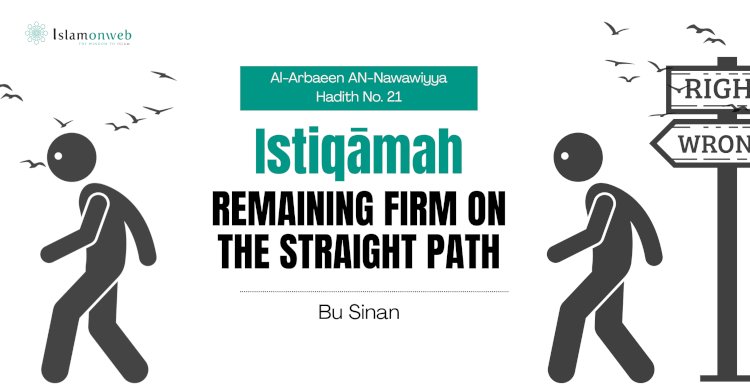
Say I Believe in Allah, Then Remain Steadfast
A Commentary on the Twenty First Hadith of Imam al-Nawawi
عَنْ أَبِي عَمْرٍو، وَقِيلَ: أَبِي عَمْرَةَ، سُفْيَانَ بْنِ عَبْدِ اللهِ الثَّقَفِيِّ رضي الله عنه قَالَ: قُلْتُ: يَا رَسُولَ اللهِ، قُلْ لِي فِي الإِسْلَامِ قَوْلًا لَا أَسْأَلُ عَنْهُ أَحَدًا غَيْرَكَ، قَالَ: «قُلْ: آمَنْتُ بِاللهِ، ثُمَّ اسْتَقِمْ». رَوَاهُ مُسْلِمٌ.
Translation
Abū ʿAmr - and it is also said Abū ʿAmrah - Sufyān ibn ʿAbdillāh al-Thaqafī رضي الله عنه reported: I said, "O Messenger of Allah, tell me something concerning Islam about which I will not need to ask anyone other than you." He ﷺ said: "Say: I believe in Allah, and then remain steadfast." Narrated by Muslim.[1]
About the Narrator
Sufyān ibn ʿAbdillāh al-Thaqafī رضي الله عنه was a Companion from al-Ṭāʾif. He belonged to the tribe of Thaqīf and is known by the kunyah Abū ʿAmr, while Abū ʿAmrah is also reported.
Before embracing Islam, Sufyān رضي الله عنه was present with his people at the Battle of Ḥunayn, where his brother ʿUthmān was killed. Overcome with grief, he was safely led away from the battlefield by his friend Abū Suwayd. Ibn Ḥajar records that Sufyān embraced Islam afterwards. Sufyān رضي الله عنه subsequently accepted Islam along with the delegation of Thaqīf.
Imām Muslim, al-Tirmidhī, and al-Nasāʾī recorded his narrations. Among those who narrated from him were his sons ʿĀṣim, ʿAbdullāh, ʿAlqamah, ʿAmr and Abū al-Ḥakam, as well as a number of other transmitters.
Sufyān رضي الله عنه was also entrusted with public responsibility. During his caliphate, ʿUmar ibn al-Khaṭṭāb رضي الله عنه appointed him to oversee the ṣadaqāt of al-Ṭāʾif—that is, to collect and administer its zakāh revenues. Ibn Abī Shaybah also records a report stating that the Prophet صلى الله عليه وسلم appointed him over al-Ṭāʾif. [2]
His question in this ḥadīth reveals the intelligence of a serious learner: he did not ask for an isolated ruling, but for a principle that could govern his whole religious life.
The Status and Comprehensiveness of the Hadith
Imam Muslim رحمه الله records this ḥadīth in the Book of Faith under a chapter devoted to a statement that gathers the qualities of Islam. Its wording is exceptionally brief, but its scope is immense. Ibn Ḥajar al-Haytamī رحمه الله describes it as one of the Prophet's ﷺ remarkable examples of comprehensive speech. In two short commands, it gathers belief, speech and action: the first establishes tawḥīd and īmān, while the second gathers every form of obedience and the abandonment of every prohibition.[3]
Sufyān رضي الله عنه asked for words that would be sufficient as a comprehensive guide to Islam. The Prophet Muhammad ﷺ did not give him a long catalogue. He gave him the root and the path: establish the heart upon Allah, then make the whole life follow that commitment.[4]
Sufyān رضي الله عنه asked for a clear, comprehensive foundation to which the many details of Islam could be returned. The best questions seek principles that shape conduct. The answer is also a lesson for teachers: when a person needs direction, a short statement that can be remembered and practised may be more transformative than a long discussion that leaves no clear point of action.
Say I Believe in Allah
The command "Say" joins the inward and outward dimensions of faith. Ibn Ḥajar al-Haytamī رحمه الله explains it as a renewal of īmān in which the believer remembers it with the heart and declares it with the tongue, recalling the full meanings of faith taught in the ḥadīth of Jibrīl. Thus, "I believe in Allah" means knowing Allah, affirming His oneness, accepting His revelation, and willingly submitting to Him.[5]
To say "I believe in Allah" is to acknowledge that Allah alone is the Lord, Creator and Sustainer; that He alone deserves worship; and that His names and attributes are received with faith and reverence. It also means directing love, fear, hope, reliance, supplication, and ultimate obedience to Him. This is why Ibn Rajab رحمه الله explains that complete tawḥīd is not confined to an intellectual claim. One who truly takes Allah as Lord does not make personal desire a competing authority.[6]
أَفَرَأَيْتَ مَنِ اتَّخَذَ إِلَٰهَهُ هَوَاهُ
"Have you seen those who have taken their own desires as their god?" (al-Jāthiyah 45:23)
Ibn Rajab's point is that disobedience contradicts the completeness of one's declared servitude because the sinner, in that moment, follows the call of desire against Allah's command. Īmān therefore has consequences. It settles in the heart, is spoken by the tongue and is confirmed through obedience. The second half of the ḥadīth makes that consequence explicit.
Then Remain Steadfast
The Arabic word istiqāmah comes from the sense of standing straight and remaining correctly aligned. The word "then" places a continuing life of obedience after the declaration of faith. A claim is made; it must then be carried faithfully through changing circumstances. Istiqāmah is therefore steadiness upon the truth, not a momentary burst of devotion.
Ibn Rajab رحمه الله gives a definition that captures the whole subject: istiqāmah is travelling the straight path, which is the upright religion, without turning away from it to the right or left. It includes every outward and inward act of obedience and the abandonment of every outward and inward prohibition. For this reason, the Prophet's ﷺ advice gathers all the qualities of religion.[7]
This meaning connects the ḥadīth directly with the prayer repeated by every Muslim in Sūrat al-Fātiḥah:
اهْدِنَا الصِّرَاطَ الْمُسْتَقِيمَ
“Guide us to the Straight Path.”[8]
The words istiqāmah (steadfastness) and mustaqīm (straight) share the same Arabic root, conveying uprightness, firmness and freedom from deviation. Thus, istiqāmah means remaining firmly upon the ṣirāṭ al-mustaqīm—the Straight Path—without turning away from it.
The Straight Path is the way of those whom Allah has blessed, rather than the ways of those who knowingly reject the truth or lose their direction. Thus, the prayer “Guide us to the Straight Path” is also a daily prayer for istiqāmah.
The Messenger of Allah صلى الله عليه وسلم illustrated this reality through a powerful parable narrated by al-Nawwās ibn Samʿān رضي الله عنه:
“Allah sets forth the example of a straight path. On both sides of the path are two walls containing open doors, with curtains hanging over the doors. At the entrance of the path is a caller saying: ‘O people, enter the path all together and do not turn aside.’ Another caller calls from above the path. Whenever someone intends to open one of those doors, he says: ‘Woe to you! Do not open it, for if you open it, you will enter it.’ The path is Islam; the two walls are the limits established by Allah; the open doors are the things Allah has prohibited; the caller at the entrance of the path is the Book of Allah; and the caller from above the path is Allah’s admonisher in the heart of every Muslim.”[9]
This parable presents the spiritual life as a journey. Islam is the clear road leading towards Allah’s pleasure. The walls represent the limits He has established to protect the traveller. The open doors are prohibited actions that appear accessible and inviting, while the curtains indicate that a person does not fall into them without first choosing to lift the covering and approach what Allah has forbidden.
The warning, “Do not open it, for if you open it, you will enter it,” teaches that deviation often begins before the sin itself. It may begin with an unlawful glance, an unchecked thought, a doubtful conversation or an apparently minor compromise. Once the curtain is lifted, entering the door becomes much easier. Steadfastness therefore requires avoiding not only the prohibited destination but also the steps that lead towards it.
The believer is guided by two calls. The first is the Book of Allah, which openly explains the Straight Path and distinguishes it from the roads of deviation. The second is the inward admonition Allah places in the believing heart—a living awareness that warns the person when he approaches wrongdoing. This inward warning must remain guided by revelation; personal feelings cannot replace the Qur’an. When the heart is alive with faith, however, it recognises danger and urges the believer to return before crossing Allah’s limits.
Thus Istiqāmah is measured by revelation, not by temperament, culture or convenience. Allah commanded His Messenger ﷺ:
فَاسْتَقِمْ كَمَا أُمِرْتَ وَمَن تَابَ مَعَكَ وَلَا تَطْغَوْا ۚ إِنَّهُ بِمَا تَعْمَلُونَ بَصِيرٌ
"So be steadfast as you are commanded, along with those who turn in submission to Allah with you. And do not transgress. Surely He is All-Seeing of what you believers do." (Hūd 11:112)
Religious steadfastness is constancy upon what Allah commanded, within the limits He set. It does not permit excess in the name of zeal, neglect in the name of ease, or innovation in the name of spiritual enthusiasm. Allah similarly says, "Be steadfast as you are commanded, and do not follow their desires" (al-Shūrā 42:15).
The believer consequently asks in every prayer to be guided along the Straight Path, listens to the Qur’an calling him toward it, observes the limits protecting it, and responds to the warning within his heart whenever temptation invites him toward one of its side doors. This is the practical meaning of the Prophet’s concise command:
“Say: I believe in Allah, and then remain steadfast.”
Ways to Achieve Steadfastness
Al-Māwardī رحمه الله presents five complementary meanings of steadfastness while explaining Allah’s words:
“Indeed, those who say, ‘Our Lord is Allah,’ and then remain steadfast.”
(Fuṣṣilat 41:30)
These meanings are:
- Remaining firm in acknowledging Allah alone as Lord.
- Persevering in obedience to Him and fulfilling His obligations.
- Maintaining sincerity in religion and righteous action until death.
- Ensuring that one’s actions conform to one’s words.
- Remaining as upright in private as in public.[10]
Abū al-Layth al-Samarqandī رحمه الله illustrates this constancy through the example of a mountain that remains firm despite heat, cold, wind and flood. Similarly, a steadfast believer can be recognised by four signs:
- Another person’s kindness does not lead him to favour that person unjustly.
- Another person’s mistreatment does not lead him to speak or act unjustly.
- His personal desires do not turn him away from the command of Allah Most High.
- The fleeting attractions and perishable gains of this world do not distract him from obedience to Allah Almighty.[11]
Al-Khādimī رحمه الله identifies five dimensions through which steadfastness becomes complete:
- The tongue remains constant in remembering and praising Allah.
- The nafs remains obedient, with modesty before Him.
- The heart remains balanced between fear and hope.
- The spirit (rūḥ) remains established upon truthfulness and purity.
- The innermost consciousness remains filled with reverence and faithfulness to Allah.[12]
The foundation of all these dimensions is the heart's steadfastness upon tawḥīd. Ibn Rajab رحمه الله explains that when the heart becomes upright in knowing Allah, fearing Him, honouring Him, loving Him, hoping in Him, calling upon Him, relying upon Him and turning away from all rivals, the limbs follow it in obedience. The heart governs the body; when its direction is sound, the limbs' actions are sound.[13]
This inward steadfastness requires constant correction of one’s intentions. An outwardly good deed may be performed for praise, truth may be defended out of pride, or a sin may be avoided merely because the opportunity is absent. The steadfast heart seeks Allah in worship and refuses to make reputation, desire, fear of people or worldly gain its master. It therefore examines what it loves most, what it fears losing, whose approval directs its choices and upon whom it relies when its plans collapse.
After the heart, the tongue requires the closest watch. In another narration, Sufyān رضي الله عنه asked, “O Messenger of Allah, what do you fear most for me?” The Prophet ﷺ took hold of his own tongue and said, “This.” Ibn Ḥajar al-Haytamī رحمه الله and Ibn Rajab رحمه الله explain that the tongue interprets the heart and most clearly expresses what lies within.[14]
Speech preserves steadfastness through truth, remembrance, recitation, teaching, reconciliation and sincere counsel. It bends a person away from the Straight Path through lying, backbiting, ridicule, obscenity, false accusation, needless argument and careless religious claims. A report in Jāmiʿ al-Tirmidhī depicts the limbs addressing the tongue each morning: if it remains straight, they remain straight; if it becomes crooked, they become crooked. Al-Tirmidhī رحمه الله regarded its attribution to the Companion as stronger, and it should therefore be cited with that qualification.[15]
Guarding the tongue today also includes guarding the typed and recorded word. A message, post, comment, forwarded rumour or edited clip can carry the same moral responsibility as spoken speech, while travelling farther and remaining longer. Before sending anything, the steadfast believer asks whether it is true, necessary, just and pleasing to Allah.
Thus, istiqāmah embraces the believer’s creed, worship, intentions, heart, speech and conduct. It means remaining faithful to Allah in word and deed, inwardly and outwardly, privately and publicly, in ease and hardship, until death.
The command to be steadfast is demanding, but Islam does not teach despair when human weakness appears. Allah joins istiqāmah with seeking forgiveness:
فَاسْتَقِيمُوا إِلَيْهِ وَاسْتَغْفِرُوهُ
"So take the Straight Way towards Him, and seek His forgiveness." (Fuṣṣilat 41:6)
Ibn Rajab رحمه الله sees in this pairing an acknowledgement that shortcomings will occur. They are repaired through istighfār, sincere repentance and a return to the straight path. The steadfast person is not one who never stumbles. It is the person who refuses to turn a stumble into a settled direction. He recognises the deviation, seeks Allah's forgiveness, restores any violated right and resumes obedience.[16]
The Prophet ﷺ said, "Remain steadfast, though you will not be able to encompass it fully. Know that the best of your deeds is prayer, and none preserves ablution except a believer." The words hold aspiration and humility together. The believer aims for complete obedience, knows personal effort will remain deficient, and depends on Allah's mercy while continuing to work.[17]
The Sunnah explains this realistic pursuit through the words sadād and muqārabah. Sadād means striking the intended target in one's words, deeds and intentions. Muqārabah means coming as close as one can when the target is missed, provided that the person truly aimed at what was right. The Prophet ﷺ said, "Aim correctly and come close."[18]
This balance protects the believer from two spiritual dangers. Complacency says, "Everyone is imperfect, so correction is unnecessary." Perfectionism says, "Because I failed once, continued effort is pointless." Istiqāmah rejects both. It demands a correct direction, serious effort and repeated return.
The Fruits Promised to the Steadfast
The wording of the ḥadīth closely reflects two passages of the Qurʾān. Allah says:
إِنَّ الَّذِينَ قَالُوا رَبُّنَا اللهُ ثُمَّ اسْتَقَامُوا تَتَنَزَّلُ عَلَيْهِمُ الْمَلَائِكَةُ أَلَّا تَخَافُوا وَلَا تَحْزَنُوا وَأَبْشِرُوا بِالْجَنَّةِ الَّتِي كُنْتُمْ تُوعَدُونَ نَحْنُ أَوْلِيَاؤُكُمْ فِي الْحَيَاةِ الدُّنْيَا وَفِي الْآخِرَةِ وَلَكُمْ فِيهَا مَا تَشْتَهِي أَنْفُسُكُمْ وَلَكُمْ فِيهَا مَا تَدَّعُونَ نُزُلًا مِّنْ غَفُورٍ رَّحِيمٍ
"Surely those who say, 'Our Lord is Allah,' and then remain steadfast, the angels descend upon them, saying, 'Do not fear, nor grieve. Rather, rejoice in the good news of Paradise, which you have been promised. We are your supporters in this worldly life and in the Hereafter. There you will have whatever your souls desire, and there you will have whatever you ask for: an accommodation from the All-Forgiving, Most Merciful Lord.'" (Fuṣṣilat 41:30-32)
The promise addresses the two great burdens of the human heart: fear of what lies ahead and grief over what has passed. Those who remain with Allah receive reassurance, companionship from the angels and the good news of Paradise. The passage does not promise a worldly life without pain. It promises that the steadfast believer is not abandoned within that pain and that the final outcome is secure by the mercy of Allah.
إِنَّ الَّذِينَ قَالُوا رَبُّنَا اللهُ ثُمَّ اسْتَقَامُوا فَلَا خَوْفٌ عَلَيْهِمْ وَلَا هُمْ يَحْزَنُونَ أُولَٰئِكَ أَصْحَابُ الْجَنَّةِ خَالِدِينَ فِيهَا جَزَاءً بِمَا كَانُوا يَعْمَلُونَ
"Surely those who say, 'Our Lord is Allah,' and then remain steadfast - there will be no fear for them, nor will they grieve. It is they who will be the residents of Paradise, staying there forever, as a reward for what they used to do." (al-Aḥqāf 46:13-14)
These verses show that istiqāmah is lifelong. A truthful beginning matters, but the promised end belongs to those who continue and meet Allah upon that faith. The central question is whether one keeps returning to Allah until the end.
Steadfastness in Contemporary Life
Modern life changes quickly, but the moral task remains the same. People are repeatedly invited to rebuild their identity around fashion, ideology, status, productivity or public approval. The ḥadīth gives the believer a stable centre: "I believe in Allah." From that centre, choices are judged by revelation rather than by the strongest pressure of the moment.
Istiqāmah also heals the division between public and private religion. A person may present a religious image while neglecting prayer, family duties, financial honesty or the rights of others. Steadfastness requires one moral direction across the mosque, home, workplace, marketplace and private screen. It is not performance before an audience; it is fidelity to Allah wherever one is.
The ḥadīth also corrects the culture of short-lived intensity. A dramatic beginning is easy to display, while quiet continuity is harder. The Prophet ﷺ taught that the deeds most beloved to Allah are those performed regularly, even when small. A modest daily practice that survives busy weeks, low motivation and changing circumstances is often a stronger sign of istiqāmah than a large effort that soon disappears.[19]
Finally, steadfastness is especially visible under pressure. It means telling the truth when lying is profitable, preserving modesty when restraint is mocked, remaining just when anger invites excess, continuing prayer when the schedule is crowded and refusing unlawful gain when it appears easy. These ordinary decisions are where a declared faith becomes a lived covenant.
Conclusion
Let’s conclude this commentary with another hadith that connects us to the idea of steadfastness.
ʿAbdullāh ibn Masʿūd رضي الله عنه reported:
The Messenger of Allah ﷺ drew a line for us and said, “This is the path of Allah.” He then drew several lines to its right and left and said, “These are other paths; upon every one of them is a devil calling people towards it.” He then recited:
{وَأَنَّ هَذَا صِرَاطِي مُسْتَقِيماً فَاتَّبِعُوهُ وَلا تَتَّبِعُوا السُّبُلَ} (الأنعام:153)
“Indeed, this is My Straight Path, so follow it; and do not follow other paths, for they will separate you from His path.”
(Al-Anʿām 6:153)[20]
Steadfastness is remaining faithful to Allah when desires pull, temptations call, hardships arise, and worldly interests invite compromise. It requires the believer to keep his heart, tongue, actions and intentions directed towards Allah, in private and public, until he meets Him. This is why the believer repeatedly asks in every prayer:
“Guide us to the Straight Path.”
(Al-Fātiḥah 1:6)
References:
[1] Imam al-Nawawī رحمه الله, al-Arbaʿūn al-Nawawiyyah, ḥadīth no. 21; Ṣaḥīḥ Muslim, no. 38. The narration is also transmitted with additional wording in Musnad Aḥmad, 3/413; Jāmiʿ al-Tirmidhī, no. 2410; al-Sunan al-Kubrā of al-Nasāʾī, no. 11425; and Sunan Ibn Mājah, no. 3972.
[2] Ibn Ḥajar al-ʿAsqalānī رحمه الله, al-Iṣābah fī Tamyīz al-Ṣaḥābah, 4/372, biography no. 3326; Ibn al-Athīr رحمه الله, Usd al-Ghābah, 2/405, biography no. 2116. See also Ibn Ḥajar al-Haytamī رحمه الله, al-Fatḥ al-Mubīn bi-Sharḥ al-Arbaʿīn, p. 386.
[3] Ibn Ḥajar al-Haytamī رحمه الله, al-Fatḥ al-Mubīn bi-Sharḥ al-Arbaʿīn, pp. 386-388, Maktabah al-Shāmilah pagination.
[4] Ibn Rajab al-Ḥanbalī رحمه الله, Jāmiʿ al-ʿUlūm wa-al-Ḥikam, 1/506-507, Maktabah al-Shāmilah pagination.
[5] Ibn Ḥajar al-Haytamī رحمه الله, al-Fatḥ al-Mubīn, p. 386.
[6] Ibn Rajab al-Ḥanbalī رحمه الله, Jāmiʿ al-ʿUlūm wa-al-Ḥikam, 1/509.
[7] Ibid., 1/510.
[8] The Qur’an, Sūrat al-Fātiḥah, 1:6-7. All English renderings of Qurʾānic verses in this article are adapted from Mustafa Khattab, The Clear Quran, in keeping with the established Islamonweb translation style.
[9] Aḥmad ibn Ḥanbal, al-Musnad, 29/181, no. 17634; al-Ḥākim, al-Mustadrak, no. 245. A similar wording is recorded by al-Tirmidhī, al-Jāmiʿ, 4/539, no. 2859, and al-Nasāʾī, al-Sunan al-Kubrā, 6/361, no. 11233.
[10] Abū al-Ḥasan al-Māwardī, al-Nukat wa-l-ʿUyūn, 5/179–180, commentary on Sūrat Fuṣṣilat 41:30
[11] Abū al-Layth al-Samarqandī, Tanbīh al-Ghāfilīn bi-Aḥādīth Sayyid al-Anbiyāʾ wa-l-Mursalīn, p. 594.
[12] Muḥammad ibn Muḥammad al-Khādimī, Barīqah Maḥmūdiyyah fī Sharḥ Ṭarīqah Muḥammadiyyah, 3/154 (Cairo: Maṭbaʿat al-Ḥalabī, 1348 AH).
[13] Ibn Rajab al-Ḥanbalī, Jāmiʿ al-ʿUlūm wa-l-Ḥikam, 1/511–512
[14] Jāmiʿ al-Tirmidhī, no. 2410, graded ḥasan ṣaḥīḥ by Imam al-Tirmidhī; Ibn Ḥajar al-Haytamī, al-Fatḥ al-Mubīn, p. 388; Ibn Rajab al-Ḥanbalī, Jāmiʿ al-ʿUlūm wa-l-Ḥikam, 1/506 and 1/512
[15] Jāmiʿ al-Tirmidhī, no. 2407. Imam al-Tirmidhī considered the mawqūf route stronger; Ibn Rajab al-Ḥanbalī, Jāmiʿ al-ʿUlūm wa-l-Ḥikam, 1/512.
[16] Ibn Rajab al-Ḥanbalī رحمه الله, Jāmiʿ al-ʿUlūm wa-al-Ḥikam, 1/510.
[17] Sunan Ibn Mājah, no. 277; Musnad Aḥmad, 5/276. The report of Thawbān رضي الله عنه is graded ḥasan in the cited Sunan edition.
[18] Ṣaḥīḥ al-Bukhārī, nos. 5673 and 6463; Ṣaḥīḥ Muslim, no. 2816. For the explanation of sadād and muqārabah, see Ibn Rajab al-Ḥanbalī رحمه الله, Jāmiʿ al-ʿUlūm wa-al-Ḥikam, 1/511.
[19] Ṣaḥīḥ al-Bukhārī, no. 6464.
[20] Musnad Aḥmad, no. 4142; Sunan al-Dārimī, no. 208; and Ṣaḥīḥ Ibn Ḥibbān, no. 6.
Disclaimer
The views expressed in this article are the author’s own and do not necessarily mirror Islamonweb’s editorial stance.


Related Posts











Leave A Comment