
Mappila Maritime Culture of Kerala: Trade, Identity, and Cultural Exchange in the Indian Ocean World
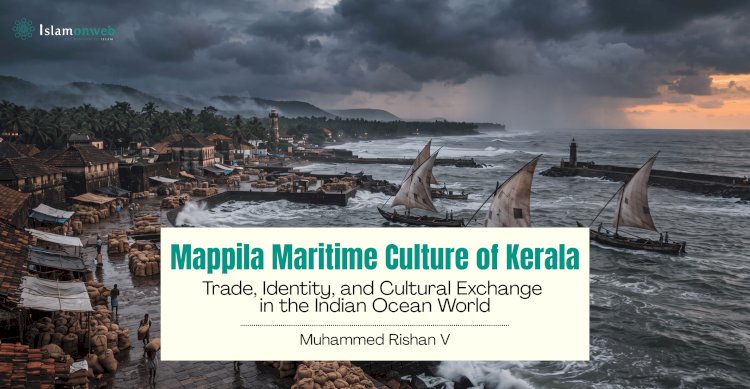
Long before modern shipping routes connected distant parts of the world, the Malabar Coast of Kerala was already an important meeting point for merchants and travellers crossing the Indian Ocean. Arab merchants, Persian traders, and other visitors came to its ports, attracted particularly by the region’s valuable spices. Their journeys connected Malabar with distant societies, creating relationships that extended beyond the exchange of goods.[1]
These historical connections shaped communities such as the Mappila Muslims of Kerala. Their history developed through long-term maritime trade, migration, conversion, and interaction with local society. While remaining deeply rooted in the Malabar region, Mappilas also maintained connections with wider Muslim communities across the Indian Ocean. These relationships contributed to the development of their social institutions, religious traditions, and intellectual life.[2]
The history of the Mappilas therefore offers an important perspective on the relationship between maritime networks and social change. This article explores Malabar’s trading connections, the emergence of the Mappila community, Islamic scholarship and literature, the Portuguese encounter, and everyday cultural traditions. Through these themes, it examines how centuries of cross-sea interaction shaped Mappila society and its place in the wider Indian Ocean world.
Malabar and the Indian Ocean Trade Network
For centuries, the Malabar Coast played an important role in the Indian Ocean maritime trade network. Situated along the Arabian Sea, its ports connected merchants from Arabia, Persia, East Africa, and other regions. Seasonal monsoon winds made long-distance voyages possible and helped sustain commercial relationships between Malabar and distant markets. These connections brought wealth to the coastal region and made its ports important centres of maritime activity.[3]
Pepper was among the most valuable commodities exported from Malabar. Demand in overseas markets attracted merchants from around the world. Alongside pepper, the region's commercial exchanges included ginger, cardamom, coconut products, and textiles. Through these activities, Malabar became connected to wider trading networks, while the movement of merchants and goods contributed to the growth of its coastal settlements.[4]
Ports such as Kozhikode, Ponnani, Kannur, and Beypore played important roles in this maritime landscape. Merchants speaking different languages met along the coast, negotiated commercial agreements, and established relationships with local trading communities. Arab merchants, in particular, developed lasting connections with the region. Some settled in coastal towns and formed family and commercial ties with local people. As a result, maritime trade became closely tied to Malabar's social life.
Accounts left by foreign travellers provide further insight into the region’s commercial importance. During the fourteenth century, the Moroccan traveller Ibn Battuta visited the Malabar Coast and described its active ports and trading communities. His observations offer a glimpse of a region linked to wider maritime networks and frequented by merchants and travellers from different parts of the Indian Ocean.[5]
However, Malabar’s trade network extended beyond the exchange of commodities. Maritime activity also created opportunities for migration, settlement, and contact between different communities. These connections shaped the historical setting in which the Mappila community developed. The following sections examine this process more closely, focusing on the role of merchants, migration, and local social relationships in the emergence of Mappila society.
Arab Merchants and the Emergence of the Mappila Community
The history of the Mappila community is closely connected with the maritime relationships that developed between the Malabar Coast and the Arabian Peninsula. For centuries, Arab merchants crossed the Arabian Sea using seasonal monsoon winds to reach Kerala's ports. Their commercial activities connected Malabar with overseas markets and created opportunities for long-term relationships between merchants and local communities.[6]
Many Arab traders did more than visit the coast for commercial purposes. Some settled in coastal towns, entered into trading partnerships, and established family relationships with local people. Through these interactions, Islamic traditions became part of Malabar's changing social landscape. Over time, the Mappila community developed through a combination of migration, intermarriage, conversion, and interaction with local society.[7]
Local traditions also preserve memories of the early connections between Malabar and the Arab world. One well-known tradition concerns Malik ibn Dinar and his companions, who are believed to have travelled to Kerala and established some of the region’s earliest mosques. These accounts form an important part of the historical memory of Kerala’s Muslims, although individual details of the tradition need to be distinguished from independently established historical evidence.[8]
The Mappila community's growth was not simply the result of foreign merchants' arrival. Islam also spread among segments of the local population, particularly in coastal areas tied to trade and maritime occupations. Commercial cooperation, religious interaction, and local social relationships all contributed to this gradual historical process. The community that emerged was therefore rooted in Kerala while maintaining connections with the wider Muslim world.
Mosques became important institutions within this developing society. Alongside their religious functions, they served as places of learning and community interaction. Scholars, merchants, and local residents participated in the religious and social life these institutions supported. Such settings helped sustain Islamic traditions while allowing them to develop within the social and cultural context of Malabar.[9]
Mappilas also became active participants in the maritime economy. Their roles included trading, sailing, and working within the commercial networks that connected Malabar to other Indian Ocean ports. Maritime activity thus shaped not only their livelihoods but also their relationships with other communities across the region.
The Mappila community emerged gradually, shaped by commerce, migration, religious change, and local social relationships. Its history illustrates how a community could develop distinctive traditions while remaining connected to a wider maritime world.
Arabi-Malayalam, Literature, and Intellectual Exchange
The maritime connections between Malabar and the wider Muslim world influenced not only trade and religious life but also the development of literature and learning. As merchants, scholars, and travellers moved between coastal communities, they helped maintain connections through which religious texts, scholarly traditions, and literary ideas circulated. These exchanges contributed to the growth of a distinctive intellectual culture among the Mappilas.[10]
One important expression of this literary development was Arabi-Malayalam, a tradition in which Malayalam was written using the Arabic script. It provided a medium through which religious teachings, literary works, and educational materials could be communicated to Malayalam-speaking Muslim communities. Arabi-Malayalam therefore represents an important example of how a local language and a wider Islamic literary tradition interacted within the historical setting of Malabar.
Ponnani became an important centre of Islamic learning in the region. Students gathered there to study religious subjects under established scholars, while mosques and educational circles supported the transmission of knowledge. Its scholarly reputation connected local Muslim society with wider traditions of Islamic learning and helped establish Ponnani as an influential centre in the intellectual history of Malabar.[11]
The Makhdoom family played a significant role in this scholarly tradition. Through their writings and teaching, family members contributed to Islamic intellectual life in Kerala. Their work reflected engagement with religious scholarship and the political and social circumstances of their time. This tradition demonstrates that Malabar’s maritime connections were accompanied by intellectual activity rooted in local institutions and scholarly networks.
The development of Arabi-Malayalam and the growth of Islamic scholarship illustrate how knowledge was preserved, taught, and adapted within Mappila society. Rather than simply receiving ideas from overseas, Malabar scholars and writers interpreted them within the local context. The result was an intellectual tradition that connected Kerala with the wider Muslim world while retaining its own regional character.
Maritime Resistance and the Portuguese Encounter
For centuries, the Malabar Coast participated in maritime trade that connected merchants from across the Indian Ocean. Its spice trade attracted overseas traders and supported established commercial relationships between local rulers and merchant communities. This situation began to change with the arrival of the Portuguese at the end of the fifteenth century.[12]
When Vasco da Gama arrived in Kozhikode in 1498, he entered a region with an established history of overseas trade. The Portuguese sought access to the profitable spice trade and attempted to exercise greater control over maritime commerce. Their expansion brought them into conflict with existing trading communities, particularly Muslim merchants who had long participated in the Indian Ocean trading networks.
These developments affected Malabar's commercial and political life. Maritime trade increasingly involved questions of power and control over established routes and markets. Local rulers and merchants had to respond to the changing situation, as Portuguese efforts to dominate the spice trade challenged existing commercial interests.
Among those who resisted Portuguese expansion were the Kunjali Marakkars, naval commanders who served the Zamorin of Calicut. Their campaigns show how the struggle over maritime trade also became a struggle over political authority and control of the coast. Zainuddin Makhdoom II’s sixteenth-century work, Tuḥfat al-Mujāhidīn, provides an important indigenous account of the Portuguese presence and the resistance it provoked. Read alongside historical studies of the Kunjali Marakkars, the work helps place these conflicts within the wider history of Malabar’s maritime networks.[13]
Language, Food, Music, and the Making of Mappila Culture
Malabar's maritime history influenced not only trade and scholarship but also the everyday lives of its coastal communities. Over centuries, interactions between local people and visitors from across the Indian Ocean shaped cultural practices within Mappila society. These influences became part of local life and adapted to Kerala's social and cultural setting.
Food is one part of Mappila cultural life. Dishes such as pathiri and biryani are familiar features of Mappila cuisine. Their place in local food traditions shows how distinctive practices became rooted in everyday life in Malabar. Specific claims about the origins and routes through which particular dishes spread would require further evidence.
Music and poetry also played an important role in Mappila cultural life. Mappila Pattu developed as a distinctive song tradition, expressing religious devotion, love, social experience, and historical memory. Through performance and oral transmission, these songs helped preserve stories and emotions across generations. They also gave communities a familiar local language and cultural form to express their experiences. A related example of Malabar’s wider song traditions is the Malayalam war-song about the Portuguese-Dutch battle of 1663, discussed by Mahmood Kooria.[14]
These cultural traditions were not simply copied from outside influences. They developed through local practices interacting with ideas and experiences arriving through travel, trade, and religious connections. Mappila culture therefore reflects a long process of adaptation and creativity within the Malabar Coast.
The history of food, music, and everyday cultural practices shows that maritime connections extended beyond ports and markets. They also entered homes, community gatherings, and forms of artistic expression. In this way, the Indian Ocean helped shape not only Malabar’s economic relationships but also the cultural experiences through which Mappila society developed its distinctive character.
Conclusion
The Mappila community's history is closely connected to the maritime history of the Malabar Coast. For centuries, trade across the Indian Ocean brought Malabar into contact with merchants, travellers, and communities from distant regions. These relationships helped shape coastal society and the historical experiences of the Mappilas.
The story, however, extends beyond commercial exchange. Maritime connections formed part of a wider process involving migration, religious learning, social interaction, and cultural change. At the same time, the Portuguese encounter showed that the sea could be a space of political competition and resistance, as well as a source of opportunity.
The Mappila experience shows how a community developed through connections with the wider world while remaining rooted in Kerala's local society. Its history provides an important perspective on the relationship between maritime networks and social change in the Indian Ocean region. The legacy of these connections continues to offer valuable insights into Malabar's historical links to the wider world.
About the author:
Muhammed Rishan V is a degree student at Manhajurrashad Islamic collage ( Darul Huda Islamic University,) Kerala, India. His academic interests include Islamic history, maritime history, cultural exchange, and the history of Muslim communities in the Indian Ocean world.
References
Dale, Stephen F. Islamic Society on the South Asian Frontier: The Mappilas of Malabar, 1498–1922. Oxford: Clarendon Press, 1980.
Ibn Battuta. The Travels of Ibn Battuta. Translated by H. A. R. Gibb. Cambridge: Hakluyt Society, 1958.
Kooria, Mahmood. “A Malayalam War-Song on the Portuguese-Dutch Battle, 1663.” In Malabar in the Indian Ocean: Cosmopolitanism in a Maritime Historical Region, edited by Mahmood Kooria and Michael Naylor Pearson, 141–171. New Delhi: Oxford University Press, 2018.
Kooria, Mahmood. “Introduction: Situating Malabar in the Indian Ocean.” In Malabar in the Indian Ocean: Cosmopolitanism in a Maritime Historical Region, edited by Mahmood Kooria and Michael Naylor Pearson, xv–xxvii. New Delhi: Oxford University Press, 2018.
Kooria, Mahmood. “Taḥrīḍ Ahl al-Īmān: An Indigenous Account against Early Modern Interventions in the Indian Ocean World.” In Taḥrīḍ Ahl al-Īmān ʿAlā Jihād ʿAbadat al-Ṣulbān, translated by K. M. Mohamed, foreword by Michael Pearson, 19–48. Calicut: Other Books, 2013.
Makhdoom, Zainuddin. Tuḥfat al-Mujāhidīn: A Historical Epic of the Sixteenth Century. Translated from Arabic with annotations by S. Muhammad Husayn Nainar. Kuala Lumpur: Islamic Book Trust; Calicut: Other Books, 2006.
Miller, Roland E. Mappila Muslims of Kerala: A Study in Islamic Trends. Madras: Orient Longman, 1976.
Nambiar, O. K. The Kunjalis: Admirals of Calicut. Bombay: Asia Publishing House, 1963.
Prange, Sebastian R. Monsoon Islam: Trade and Faith on the Medieval Malabar Coast. Cambridge: Cambridge University Press, 2018.
Ricci, Ronit. Islam Translated: Literature, Conversion, and the Arabic Cosmopolis of South and Southeast Asia. Chicago: University of Chicago Press, 2011.
Citations:
[1] Sebastian R. Prange, Monsoon Islam: Trade and Faith on the Medieval Malabar Coast (Cambridge: Cambridge University Press, 2018).
[2] Stephen F. Dale, Islamic Society on the South Asian Frontier: The Mappilas of Malabar, 1498–1922 (Oxford: Clarendon Press, 1980).
[3] Sebastian R. Prange, Monsoon Islam: Trade and Faith on the Medieval Malabar Coast (Cambridge: Cambridge University Press, 2018).
[4] Mahmood Kooria, “Introduction: Situating Malabar in the Indian Ocean,” in Malabar in the Indian Ocean: Cosmopolitanism in a Maritime Historical Region, ed. Mahmood Kooria and Michael Naylor Pearson (New Delhi: Oxford University Press, 2018), xv–xxvii.
[5] Ibn Battuta, The Travels of Ibn Battuta, trans. H. A. R. Gibb (Cambridge: Hakluyt Society, 1958).
[6] Sebastian R. Prange, Monsoon Islam: Trade and Faith on the Medieval Malabar Coast (Cambridge: Cambridge University Press, 2018).
[7] Stephen F. Dale, Islamic Society on the South Asian Frontier: The Mappilas of Malabar, 1498–1922 (Oxford: Clarendon Press, 1980).
[8] Roland E. Miller, Mappila Muslims of Kerala: A Study in Islamic Trends (Madras: Orient Longman, 1976).
[9] Stephen F. Dale, Islamic Society on the South Asian Frontier: The Mappilas of Malabar, 1498–1922 (Oxford: Clarendon Press, 1980).
[10] Ronit Ricci, Islam Translated: Literature, Conversion, and the Arabic Cosmopolis of South and Southeast Asia (Chicago: University of Chicago Press, 2011).
[11] Mahmood Kooria, “Introduction: Situating Malabar in the Indian Ocean,” in Malabar in the Indian Ocean: Cosmopolitanism in a Maritime Historical Region, ed. Mahmood Kooria and Michael Naylor Pearson (New Delhi: Oxford University Press, 2018), xv–xxvii.
[12] Sebastian R. Prange, Monsoon Islam: Trade and Faith on the Medieval Malabar Coast (Cambridge: Cambridge University Press, 2018).
[13] O. K. Nambiar, The Kunjalis: Admirals of Calicut (Bombay: Asia Publishing House, 1963); Zainuddin Makhdoom, Tuḥfat al-Mujāhidīn: A Historical Epic of the Sixteenth Century, trans. S. Muhammad Husayn Nainar (Kuala Lumpur: Islamic Book Trust; Calicut: Other Books, 2006).
[14] Mahmood Kooria, “A Malayalam War-Song on the Portuguese-Dutch Battle, 1663,” in Malabar in the Indian Ocean: Cosmopolitanism in a Maritime Historical Region, ed. Mahmood Kooria and Michael Naylor Pearson (New Delhi: Oxford University Press, 2018), 141–171.
AI Use Declaration
AI tools were used to assist with grammar checking, language clarity, and structural refinement.
Disclaimer
The views expressed in this article are the author’s own and do not necessarily mirror Islamonweb’s editorial stance.
Related Posts










Leave A Comment