
Digital Epistemicide: The Occupation of Attention and the Colonial Politics of Reel Culture
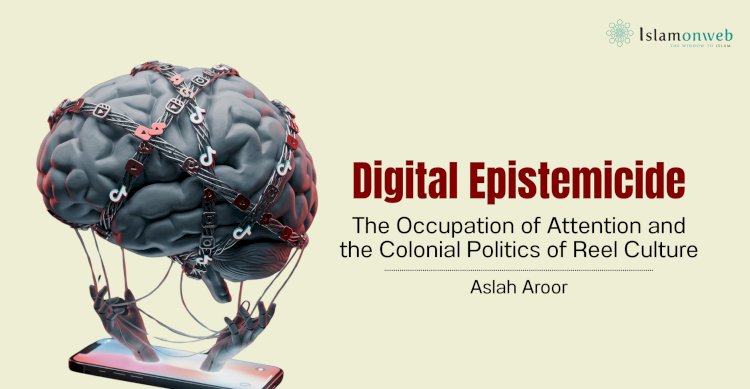
In his seminal work Epistemologies of the South, Boaventura de Sousa Santos introduced the critical concept of epistemicide, which is the systematic and intentional destruction of a people's knowledge systems, along with the socio-cultural contexts in which that knowledge is produced. Moving beyond mere destruction, it represents the forceful imposition of the colonizer's own cultural and epistemic frameworks onto the colonized. Historical colonialism did not merely conquer physical territories; it subjugated entire civilizations. Through this process, indigenous worldviews were systematically erased, delegitimized, and branded as "superstitions" or "uncivilized."
Today, the digital revolution we face, particularly the overwhelming proliferation of short-form video content (Reels, Shorts), presents this epistemicide in its most lethal contemporary avatar. Twenty-first-century colonialism operates through algorithms. This is not a simple technological evolution; it is a calculated, systematic occupation targeting human cognition, attention, and political conviction.
The Attention Economy and the Colonization of Mind
As early as 1971, Herbert Simon observed that a wealth of information creates a poverty of attention. Today, attention has become the world’s most lucrative commodity. This modern Attention Economy thrives by trapping the user’s gaze on the screen for the maximum duration possible, operating through two primary mechanisms.
The first is algorithmic governance, where social media platforms are fundamentally designed not for intellectual enlightenment, but for perpetual engagement. The algorithms engineered for this purpose deliberately exploit innate human vulnerabilities by prioritizing and promoting content that triggers primal emotional responses such as fear, anger, hyper-sexuality, and tribalism. Consequently, polarizing and xenophobic content gains massive traction.
The second mechanism relies on digital dopamine loops, where the psychological architecture behind infinite scrolling mimics the exact mechanics governing casino slot machines. The structural anticipation of the next video, a psychological phenomenon known as Variable Reward, triggers continuous surges of dopamine in the brain. This design traps the user in a state of behavioral addiction, functioning as a colonial infrastructure where the user voluntarily transforms into a subject who commodifies and sells their own attention. Short-form content dramatically accelerates this entire process of subjugation.
Cognitive Deterioration: The Extinction of Thought
Emerging neuroscience explicitly demonstrates that the culture of short-form video consumption physically alters brain architecture, a phenomenon we can term cognitive deterioration, or the systematic decay of the capacity for deep thought. Excessive algorithmic overstimulation leads directly to the exhaustion of the prefrontal cortex, which is the region of the brain responsible for rational critique, long-term planning, and moral discernment. As the prefrontal cortex weakens, the amygdala, which processes raw and simplistic emotional impulses, becomes hyperactive.
This shift has catalyzed a catastrophic crisis in human attention spans. A generation conditioned exclusively by 15-to-60-second video clips progressively loses the cognitive endurance required to read a 500-page book or engage with a one-hour academic lecture. This "2x Speed" culture reduces holistic knowledge to fragmented bytes and fosters an active aversion to intellectual complexity.
A stark example can be drawn from a recent Legislative Assembly election context. A political leader’s statement that "religion, religion, religion is the problem" was weaponized by numerous Gen Z influencers to summarily brand him a communalist. They largely succeeded in shifting public perception to frame his stance as entirely anti-secular. However, comprehending the actual structural nuances of Indian secularism, and recognizing why the counter-argument that "religion should never be an element of consideration" actually contradicts constitutional philosophy, demands exhaustive, historical explanation. Such necessary structural explanations are fundamentally incompatible with, and silenced by, the very architecture of current algorithms.
Consequently, individuals grow content with shallow fragments of information. Genuine knowledge is inherently a product of time, making it an exercise in Slow Knowledge. Conversely, reels offer instant information, comforting the consumer with a dangerous illusion of literacy through superficial data. This environment rapidly diffuses structural attitudes of hyper-individualism and reductionism, which are foundational features of colonial logic.
Digital Epistemicide and Indigenous Knowledge Systems
The Colonial Matrix of Power, popularized by Walter Mignolo, manifests within contemporary digital spaces as the algorithm. Algorithms act as modern gatekeepers, dictating which forms of knowledge are permitted to survive and circulate. Crucially, they operate on training data rooted heavily in Western, Eurocentric, and neo-liberal values.
Traditional indigenous knowledge systems, such as the classical Dars curricula or Sufi epistemologies, inherently demand rigorous contemplation, deep textuality, and slow learning. Because they refuse to conform to the frantic velocity of the algorithm, these profound intellectual traditions face algorithmic suppression, rendering them functionally invisible within the digital ecosystem. In classical Islamic intellectual discourse, foundational concepts such as Waqt (sacred time), the Shaykh/Guru (lineage-bound guidance), and Adab (spiritual and intellectual etiquette) are paramount. The architecture of modern digital algorithms directly stultifies this capacity for serious reflection.
From the 'Reel' Generation to the Far-Right
Recent sociological studies reveal an alarming shift toward far-right ideologies among Gen Z and the younger demographic, as the contemporary digital environment provides the ideal ecosystem for far-right politics. This is sustained largely through simplistic narratives, where far-right ideology expertly reduces intricate historical grievances and complex sociological realities into binary, 30-second "Us vs. Them" equations that algorithms naturally amplify to ensure virality. Take the Palestinian crisis as a case in point: many digital users still perceive it merely as a symmetrical "war" because short-form content inherently fails to convey the reality of a systematic, decades-long occupation and genocide that predates October 7, leaving users blind to crucial historical context.
This structural landscape feeds directly into a digital radicalization pipeline. A young user who enters the platform seeking benign entertainment is gradually guided by recommendation engines toward hyper-nationalism, alt-right rhetoric, and hate speech, where every 'like' and 'share' pulls them deeper into insular, radicalized digital echo chambers. Within these spaces, the normalization of alterity becomes commonplace. The colonial-era concept of the "White Man’s Burden" effectively re-emerges under the guise of civilizational superiority within daily reel content, allowing misinformation targeting minorities and marginalized "Others" to be routinely consumed and normalized under the palatable cover of humor and satire.
Internalizing Ultra-Colonial Ideology
Frantz Fanon famously observed that colonialism achieves its ultimate triumph when the colonized subject internalizes the consciousness of the colonizer as their own. When today's youth dismiss their traditional, ancestral knowledge systems as outdated or useless, they are exhibiting a worldview manufactured entirely by algorithmic design.
A collective psyche asserting that "if it does not exist on Instagram, it is not knowledge" is rapidly gaining dominance. Through this mechanism, scientism, neo-liberal individualism, and Eurocentric aesthetics are continuously normalized via short-form consumption. This is not a harmless shift in lifestyle or fashion; it is a highly effective ultra-colonial project designed to dismantle indigenous cultural defenses and historical resistance.
The Kerala Context and the Crisis of Attention
When reviewing the intellectual history of Kerala, the concept of Sabr (meticulous patience) held an exalted position. The traditional Dars culture, the exhaustive, months-long mastery of classical texts, and rigorous dialectical debates demanded a massive, sustained investment of human attention.
Today, however, the Kerala Muslim intellectual landscape is deeply entangled in this global attention crisis. Comprehensive, nuanced discourses are increasingly abandoned in favor of fragmented "bit videos." A troubling reality has emerged where certain public educators and preachers appear far more preoccupied with expanding their digital followers than nurturing serious readers. Complex debates in Fiqh (jurisprudence) are systematically reduced to sensationalized, bite-sized controversies on social media reels. This shift accelerates a form of intellectual regression, leaving a generation drifting toward systemic Brainrot and cognitive sterility.
Conclusion: Reclaiming Attention as Resistance
Attention is an individual's most sacred and sovereign asset. Surrendering it to corporate algorithms represents a contemporary iteration of epistemic slavery. Recognizing the profound digital epistemicide engineered by reel culture is the most urgent political and intellectual imperative of our time.
To prevent our minds and collective consciousness from being mortgaged to colonial algorithms, we must consciously return to structural complexities, deep textual reading, and patient, disciplined study. Attention is a decolonial site. Reclaiming sovereignty over it is nothing less than a battle for civilizational survival.
Author:
Aslah Aroor
Translated by: Muhammed Fayiz Alanallur
Disclaimer
The views expressed in this article are the author’s own and do not necessarily mirror Islamonweb’s editorial stance.



Related Posts




















Leave A Comment