
Al-Qaṣwāʾ: The Camel That Journeyed Through the Sīrah
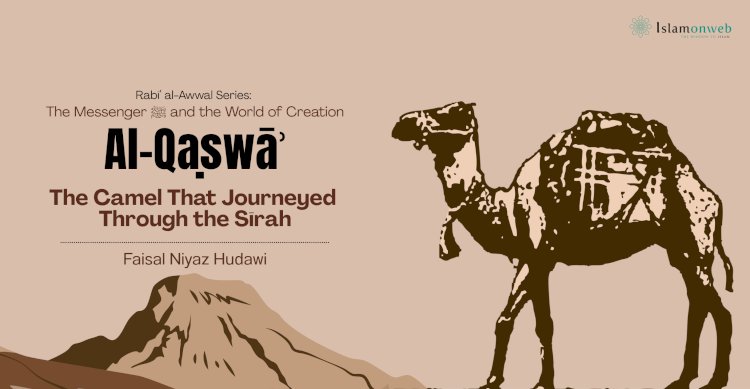
The Prophetic Sīrah is not made up of human encounters alone. Its landscape is filled with animals, trees, mountains, valleys, deserts and other elements of the natural world, many of which appear at decisive moments in the life of the Messenger ﷺ. Some become closely associated with particular journeys, acts of sacrifice, moments of revelation, or memories preserved by the Companions. The world around the Prophet ﷺ is therefore more than a background to the Sīrah; at times, it becomes part of the story itself. Among the creatures that accompany this Prophetic story most frequently are the camels.
For the Arabs, the camel was never simply an animal passing through the landscape. It was woven into the landscape itself—and into almost every sphere of human life. It carried the traveller across vast stretches of desert, bore merchandise between distant markets, provided milk and meat, accompanied armies and pilgrims, and represented wealth, livelihood and security.
Its place in the Arabic imagination is also reflected in the extraordinary richness of the language surrounding it. Arabic dictionaries and literary works contain an enormous vocabulary for camels: terms based on sex, age, colour, physical features, condition, gait, behaviour and use. A study estimates that words and expressions describing camels and their physical forms number around 10,046[1].
The Sīrah tradition preserves a striking dream attributed to the mūbadhān, the chief Zoroastrian priest of Persia, he saw restive camels leading Arabian horses across the Tigris and spreading through the lands of Persia. When Kisrā asked what it meant, he replied that it pointed to a great event arising from the Arabs. Later Muslim historians understood the vision as a symbolic foreshadowing of the far-reaching changes that would follow the coming of the Prophet [2]ﷺ.
Camels in the Early Life of the Prophet ﷺ
Camels enter the Prophetic story even before the birth of Muḥammad ﷺ. Ibn Isḥāq, as transmitted by Ibn Hishām, relates the well-known account of ʿAbd al-Muṭṭalib’s vow and the drawing of lots that repeatedly fell upon his son ʿAbdullāh, the future father of the Prophet ﷺ. To spare him, camels were placed against him in successive drawings, beginning with ten and increasing until the number reached one hundred. Only then did the lot fall upon the camels, which were sacrificed while ʿAbdullāh was spared.[3] Ibn Kathīr later viewed this preservation in the light of what Allah had decreed: from ʿAbdullāh would come the final Messenger ﷺ.[4]
The camel appears again during his infancy in the household of Ḥalīmah al-Saʿdiyyah. During a severe drought, her family travelled with an aged she-camel (shārif) that yielded no milk. After she accepted the orphaned Muḥammad ﷺ into her care, the Sīrah reports an immediate change: her own milk became sufficient, and when her husband approached the she-camel, «فَإِذَا هِيَ حَافِلٌ»—it was found full of milk. The family drank until satisfied, and after returning to Banū Saʿd, they continued to witness abundance in their livestock.[5]
Years later, the young Muḥammad ﷺ entered the caravan world of Arabia through his commercial journey on behalf of Khadījah رضي الله عنها. The Sīrah describes him travelling with Maysarah and returning upon his camel, while later accounts preserve reports of unusual signs witnessed during the journey.[6]
Al-Qaṣwāʾ: From the Hijrah to the Farewell Ḥajj
Among the many camels that appear in the Sīrah, one name returns again and again at some of its most memorable moments: al-Qaṣwāʾ[7]. Her story begins with the Hijrah.
For months, Abū Bakr al-Ṣiddīq رضي الله عنه had kept two riding camels ready. ʿĀʾishah رضي الله عنها recalled that they had been specially prepared and fed in anticipation of a journey whose time had not yet been revealed. Then the Messenger of Allah ﷺ came to their house at an unusual hour and informed Abū Bakr that Allah had given him permission to leave Makkah.
Abū Bakr asked the question for which he had been waiting:
Would he accompany the Messenger ﷺ?
When the Prophet ﷺ answered in the affirmative, Abū Bakr wept with joy. He then offered one of the two mounts he had prepared. The Prophet ﷺ accepted it, but insisted that it be taken “for its price.”[8]
There could hardly have been a more momentous road for a camel to travel.
Makkah was being left behind because his own people had made it impossible for him to remain. Behind him stood the Kaʿbah, his childhood memories, Khadījah رضي الله عنها, Abū Ṭālib, the years of preaching, rejection and persecution. Ahead lay an uncertain road through the desert and a city whose future was still unknown.
Al-Qaṣwāʾ carried him on that passage from one chapter of the Sīrah to another.
He ﷺ left Makkah with only a small company around him. The Quraysh were searching for him. The journey required concealment, careful planning, unfamiliar routes and great trust in Allah.
Yet the camel beneath him was carrying more than a traveller seeking refuge. She was carrying the Messenger ﷺ towards the city from which the Muslim community would take shape.
The Place Where She Knelt
When the Prophet ﷺ finally approached Madīnah, the atmosphere had completely changed.
The man whom Quraysh had driven from his home was now being awaited eagerly by men, women and children who longed to receive him. The Anṣār hoped that he would stay among them, and as he passed through their neighbourhoods, different families wished for the honour of hosting the Messenger of Allah ﷺ.
But his mount continued.
The Ṣaḥīḥ narration records that the Prophet ﷺ rode until his camel knelt at a place then used for drying dates. When she settled there, he said:
«هَذَا إِنْ شَاءَ اللَّهُ الْمَنْزِلُ»
“This, if Allah wills, is the place.”[9]
That unremarkable patch of ground belonged to two orphan boys, Sahl and Suhayl. It would soon become the site of al-Masjid al-Nabawī.
There is something deeply moving in the scene when viewed from the later history of Islam. A camel carrying a migrant Prophet ﷺ kneels on an ordinary piece of land in Yathrib. There is no great structure there, no minaret, no dome, no indication visible to the eye of what that place will become. Yet from there the Messenger ﷺ would teach, lead prayer, receive delegations, reconcile communities, send letters to rulers and prepare generations who would carry Islam far beyond Arabia.
The journey of Hijrah effectively came to rest where a new civilisation was about to begin.
Al-Qaṣwāʾ had carried him out of Makkah. Her resting place now marked the heart of Madīnah.
Roads of Struggle
The years that followed were not years of ease. Madīnah brought community and security, but also battles, expeditions, treaties and long journeys.
On the journey to Badr, the Muslims had far fewer camels than men. ʿAbdullāh ibn Masʿūd رضي الله عنه reports that three men would take turns using a single camel. The Prophet's ﷺ also share his camle, Al-Qaṣwā with two companions. When the two Companions (Ali bin Abi Talib & Abu Lubaba) sharing the Prophet's ﷺ mount, offered to walk during his turn so that he could remain riding, he refused:
«مَا أَنْتُمَا بِأَقْوَى مِنِّي، وَمَا أَنَا بِأَغْنَى عَنِ الْأَجْرِ مِنْكُمَا»
They were not stronger than him, he told them, nor was he less in need of the reward than they were.[10]
“That Is Not Her Character”
In the sixth year after the Hijrah, the Prophet ﷺ set out with his Companions intending ʿUmrah. They were not marching to wage war. They had brought sacrificial animals and entered the state of iḥrām. Yet Quraysh were determined not to allow them into Makkah.
As the Muslims approached al-Ḥudaybiyyah, al-Qaṣwāʾ suddenly stopped and knelt.
The people tried to urge her forward:
«حَلْ حَلْ»
But she remained where she was.
Some began saying:
«خَلَأَتِ الْقَصْوَاءُ»
“Al-Qaṣwāʾ has become stubborn.”
The Prophet ﷺ immediately rejected their judgement:
«مَا خَلَأَتِ الْقَصْوَاءُ، وَمَا ذَاكَ لَهَا بِخُلُقٍ، وَلَكِنْ حَبَسَهَا حَابِسُ الْفِيلِ»
“Al-Qaṣwāʾ has not become stubborn, nor is that her character. Rather, she has been restrained by the One who restrained the elephant.”[11]
The theological meaning of the moment was profound: Allah was preventing an armed confrontation in the sacred precinct just as He had protected Makkah from the army of the elephant.
But within that great historical moment lies another small and touching detail:
“Nor is that her character.”
The Messenger ﷺ knew his camel.
When others interpreted her behaviour negatively, he defended what he knew of her disposition. At a moment when negotiations with Quraysh, the fate of hundreds of Companions and access to the Sacred House were all at stake, the Sīrah still preserves this brief sentence about the character of an animal.
Al-Qaṣwāʾ had stopped. History itself was about to pause with her.
The Muslims would not enter Makkah that year. The Treaty of al-Ḥudaybiyyah was concluded, and many Companions initially found its terms difficult to accept. Yet the Qurʾān described what appeared to them as disappointment as a clear victory.
Al-Qaṣwāʾ had knelt at the threshold of that victory.
Returning to the City She Had Left
The following year, the scene changed again.
The Muslims returned for ʿUmrat al-Qaḍāʾ. This time they entered the city from which the Messenger ﷺ had once departed in secrecy.
The Sīrah describes the Prophet ﷺ entering Makkah upon his mount, with the Muslims around him reciting the talbiyah. Ibn Rawāḥah رضي الله عنه is described as holding the rein of the Prophet's ﷺ camel as they entered.[12]
For al-Qaṣwāʾ, the road was familiar.
But everything else had changed.
Years earlier, she had carried the Messenger ﷺ away from Makkah while Quraysh searched the roads for him. Now she entered the same valley surrounded by believers openly proclaiming:
Labbayka Allāhumma labbayk.
The return was still limited by the treaty. The Muslims would remain only for the agreed period before departing again.
But another return was approaching.
From the Hijrah to the Conquest
In Ramaḍān of the eighth year after the Hijrah, the Messenger of Allah ﷺ returned to Makkah once more.
This time, he did not approach as a refugee, nor merely as a pilgrim permitted three days by treaty. He came at the head of a vast Muslim force.
Authentic reports explicitly place al-Qaṣwāʾ with him during the conquest. Ibn ʿUmar رضي الله عنهما recalls the Prophet ﷺ arriving while Usāmah ibn Zayd رضي الله عنه rode behind him upon al-Qaṣwāʾ.[13]
Another Ṣaḥīḥ report preserves one of the most beautiful images of Fatḥ Makkah: the Prophet ﷺ riding his she-camel while reciting Sūrat al-Fatḥ.[14]
The contrast with the Hijrah is difficult to miss.
The same Messenger ﷺ who had once departed Makkah under threat now entered it after Allah had granted him victory. Yet the triumph did not turn into arrogance. The Sīrah describes him lowering his head in humility before Allah as he entered the city.
This was no emperor returning to humiliate defeated enemies.
It was the Messenger of Allah ﷺ returning to the sanctuary, proclaiming the greatness of Allah, forgiving many of those who had persecuted him, and cleansing the Kaʿbah of idols.
And there again was the camel.
The road that had once carried him away in vulnerability had brought him back in victory.
If one wished to trace that change through a single image, it would be difficult to find one more striking than this:
the Messenger ﷺ leaving Makkah upon a camel as a persecuted emigrant, and returning years later upon the same camel as the victorious Prophet—his head lowered before Allah.
Revealing the Hypocrite
During the expedition of Tabūk, the Prophet ﷺ once lost his camel, al-Qaṣwāʾ. The Companions began searching for it, when a hypocrite named Zayd ibn al-Luṣayt remarked mockingly, “Muḥammad claims to be a prophet and tells you about news from heaven, yet he does not know where his camel is.”
When this remark reached the Prophet ﷺ, he said:
«وَإِنِّي وَاللَّهِ مَا أَعْلَمُ إِلَّا مَا عَلَّمَنِي اللَّهُ»
“By Allah, I know only what Allah has taught me.”
He then told the Companions that Allah had shown him where the camel was. It was in a nearby valley, with its rein caught in a tree. They went to the place and found the camel exactly as he had described[15].
The Final Great Journey
Yet the most magnificent scene involving al-Qaṣwāʾ was still to come.
In the tenth year after the Hijrah, word spread that the Messenger of Allah ﷺ would perform Ḥajj. People began arriving in Madīnah from different regions, longing to accompany him and learn directly from him.
Jābir ibn ʿAbdillāh رضي الله عنه describes what happened when they reached Dhū al-Ḥulayfah. The Prophet ﷺ prayed, then:
«ثُمَّ رَكِبَ الْقَصْوَاءَ»
“Then he mounted al-Qaṣwāʾ.”
When she reached the open ground of al-Baydāʾ, Jābir looked around.
As far as he could see in front of him were riders and people walking. To his right were more. To his left were more. Behind him were more.
And in their midst was the Messenger of Allah ﷺ.[16]
What a distance the story had travelled from the Hijrah.
Then, a handful of people had crossed the desert with him while enemies pursued them.
Now the horizon itself seemed filled with believers following him.
And beneath him was al-Qaṣwāʾ.
At ʿArafah, the Prophet ﷺ ordered that she be prepared, rode upon her and addressed the gathering. From that journey come some of the most consequential teachings of the Farewell Ḥajj.
When the sun set and the pilgrims began leaving ʿArafah, the crowds pressed forward. The Prophet ﷺ restrained al-Qaṣwāʾ and repeatedly called:
«السَّكِينَةَ، السَّكِينَةَ»
“Calmly, calmly.”
Then Jābir preserves an almost intimate detail. Whenever al-Qaṣwāʾ came to an incline, the Prophet ﷺ:
«أَرْخَى لَهَا قَلِيلًا حَتَّى تَصْعَدَ»
loosened the rein slightly so that she could climb.[17]
It is an extraordinarily small detail to survive from such an immense day.
Around him were thousands. The rituals of Ḥajj were unfolding. The Prophet ﷺ was approaching the completion of his mission. Yet the narrator noticed—and remembered—how the Messenger ﷺ handled the reins of his camel on the rising ground.
Al-Qaṣwāʾ then carried him towards al-Mashʿar al-Ḥarām at Muzdalifah. His mount remained part of the living classroom of that final pilgrimage, while the Companions watched closely and preserved what he did for generations yet unborn.
The Prophet ﷺ told them:
«خُذُوا عَنِّي مَنَاسِكَكُمْ»
“Learn your rites from me.”[18]
They did.
And they also remembered the camel upon which many of those rites were performed.
Perhaps this is where the story of al-Qaṣwāʾ becomes most touching.
She had been present when he came to Madīnah and the site of his mosque was chosen. She had halted at al-Ḥudaybiyyah before a treaty that changed the course of the mission. She had returned with him to Makkah after exile. She had carried him in victory. And finally she carried him through the pilgrimage in which he taught a vast community how to complete one of the great pillars of Islam.
The traveller was the same.
The camel was the same.
But the world around them had changed.
References:
[1] Muḥammad b. Ḥusayn al-Ḥārithī al-Sharīf, “al-Ibil fī Ḥayāt Rasūl Allāh ﷺ min al-Wilādah ḥattā al-Wafāh: Dirāsah Tārīkhiyyah,” Dawrīyat Kān al-Tārīkhiyyah, vol. 18, no. 67 (March 2025), pp. 89–98
[2] The report is narrated by al-Bayhaqī in Dalāʾil al-Nubuwwah, 1:126–127; Ibn Kathīr in al-Bidāyah wa-al-Nihāyah, 2:273–274; and al-Suyūṭī in al-Khaṣāʾiṣ al-Kubrā, 1:91–92.
[3] Ibn Hishām, al-Sīrah al-Nabawiyyah, ed. Ṭāhā ʿAbd al-Raʾūf Saʿd, 1:140–143; al-Suhaylī, al-Rawḍ al-Unuf, 2:84–87; Ibn Kathīr, al-Bidāyah wa al-Nihāyah, 3:11–13.
[4] Ibn Kathīr, al-Bidāyah wa al-Nihāyah, 3:35
[5] Ibn Hishām, al-Sīrah al-Nabawiyyah, 1:151; al-Suhaylī, al-Rawḍ al-Unuf, 2:103; Ibn Kathīr, al-Bidāyah wa al-Nihāyah, 3:55
[6] Ibn Hishām, al-Sīrah al-Nabawiyyah, 1:173; al-Suhaylī, al-Rawḍ al-Unuf, 2:152; Ibn Kathīr, al-Bidāyah wa al-Nihāyah, 3:86
[7] The identification of the Hijrah mount with al-Qaṣwāʾ is found in the Sīrah and later biographical tradition. See Ibn al-Qayyim, Zād al-Maʿād fī Hady Khayr al-ʿIbād, 1:129; Ibn Ḥajar al-ʿAsqalānī, Fatḥ al-Bārī, commentary on al-Bukhārī no. 3905. Ibn Ḥajar also transmits al-Wāqidī's information concerning the purchase and history of al-Qaṣwāʾ. Classical sources differ over whether al-Qaṣwāʾ, al-ʿAḍbāʾ and al-Jadʿāʾ were different animals or different names associated with the same camel
[8] Al-Bukhārī, Ṣaḥīḥ al-Bukhārī, Kitāb Manāqib al-Anṣār, Bāb Hijrat al-Nabī ﷺ, no. 3905.
[9] Al-Bukhārī, Ṣaḥīḥ al-Bukhārī, account of the Prophet's ﷺ arrival in Madīnah, no. 3906. For the wider Sīrah account of the camel's progress through the quarters of the Anṣār, see Ibn Hishām, al-Sīrah al-Nabawiyyah, 2:98–104; al-Zurqānī, Sharḥ al-Mawāhib al-Ladunniyyah, 2:160.
[10] Al-Nasāʾī, al-Sunan al-Kubrā, no. 8807; also Aḥmad, al-Musnad, narration of ʿAbdullāh ibn Masʿūd.
[11] Al-Bukhārī, Ṣaḥīḥ al-Bukhārī, Kitāb al-Shurūṭ, Bāb al-Shurūṭ fī al-Jihād wa al-Muṣālaḥah maʿ Ahl al-Ḥarb, nos. 2731–2732.
[12] Ibn Hishām, al-Sīrah al-Nabawiyyah, 4:3–5; Ibn Saʿd, al-Ṭabaqāt al-Kubrā, 2:120, in their accounts of ʿUmrat al-Qaḍāʾ.
[13] Al-Bukhārī, Ṣaḥīḥ al-Bukhārī, no. 4400, from Ibn ʿUmar رضي الله عنهما, describing the Prophet ﷺ during the year of the conquest with Usāmah riding behind him on al-Qaṣwāʾ
[14] Al-Bukhārī, Ṣaḥīḥ al-Bukhārī, Kitāb al-Maghāzī, no. 4281; Muslim, Ṣaḥīḥ Muslim, from ʿAbdullāh ibn Mughaffal رضي الله عنه, describing the Prophet ﷺ on his she-camel reciting Sūrat al-Fatḥ on the day of the conquest. See also Ibn Hishām, al-Sīrah al-Nabawiyyah, 4:30, and Ibn al-Qayyim, Zād al-Maʿād, on the entry into Makkah.
[15] The report is transmitted in the Sīrah literature, including al-Wāqidī, al-Maghāzī, 3:1010, and al-Maqrīzī, Imtāʿ al-Asmāʿ, 1:211.
[16] Muslim, Ṣaḥīḥ Muslim, Kitāb al-Ḥajj, Bāb Ḥajjat al-Nabī ﷺ, no. 1218, from the long narration of Jābir ibn ʿAbdillāh رضي الله عنهما.
[17] Ibid. Al-Nawawī, al-Minhāj fī Sharḥ Ṣaḥīḥ Muslim, commentary on the narration of the Farewell Ḥajj.
[18] Muslim, Ṣaḥīḥ Muslim, Kitāb al-Ḥajj, no. 1297, from Jābir ibn ʿAbdillāh رضي الله عنه.
Disclaimer
The views expressed in this article are the author’s own and do not necessarily mirror Islamonweb’s editorial stance.

Related Posts






Leave A Comment