
Abu Obeida: The Masked Voice That Became a Symbol
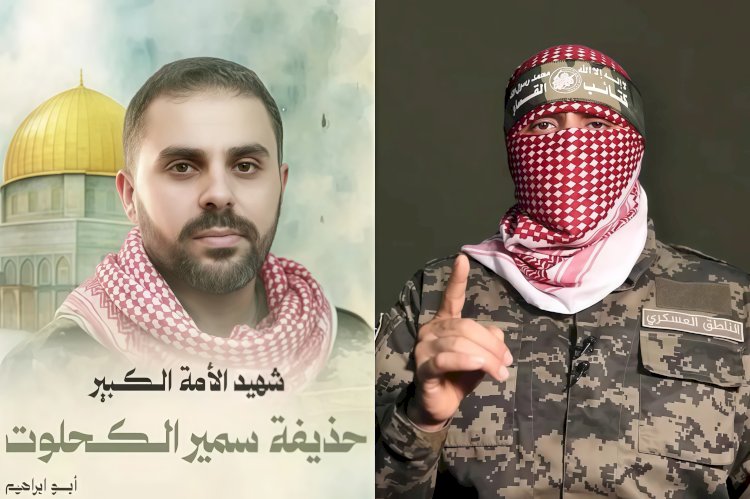
On December 29, 2025, the military wing of Hamas, the Izz ad-Din al-Qassam Brigades, officially announced the martyrdom of their long-time military spokesman, Abu Obeida. Known for decades only by his pseudonym and his persistent presence behind a mask, the Brigades revealed his real identity for the first time: Hudhayfa Samir Abdullah al-Kahlout, also known as Abu Ibrahim.
The following is a detailed account of his life, role, and legacy based on the sources:
The “Masked Leader” and Psychological Warfare
Abu Obeida served as the military spokesman for the al-Qassam Brigades for many years, becoming a pivotal figure in Hamas’s psychological warfare apparatus. His deliberate mystery—characterized by his masked face and red keffiyeh—turned him into a unique icon who gained symbolic strength from his anonymity.
For supporters across the Arab and Islamic worlds, he was regarded as an “icon for all free people of the world” and the “roaring voice of the nation,” a presence that spoke not just to supporters but to wider audiences attuned to his measured tone and impactful delivery.
The question of Abu Obeida’s true identity has long been contested, adding a further layer of complexity to his persona and embedding it within the very dynamics of the conflict itself. Israeli and Western sources identified him as Hudhayfa Samir ʿAbdullah al-Kahlout, born on 11 February 1985, noting that he received his early education in schools run by UNRWA before pursuing higher studies at the Islamic University of Gaza, where he earned a Master’s degree in Qur’anic exegesis (tafsīr).
Yet the preservation of his concealed identity was never merely a security precaution; it formed the core of a deliberate psychological strategy. By transforming himself from a tangible individual into an elusive symbol, he ensured that targeting a person would not equate to erasing meaning. Attempts to “unmask” him, most notably through the publication of alleged images, sought to reduce the symbol to an ordinary figure and thus weaken its impact, but these efforts failed, as Abu Obeida had already been etched into public consciousness as the masked man, whose power lay precisely in that abstraction.
Significantly, his academic grounding in tafsīr shaped the intellectual and rhetorical foundation of his speeches, explaining his precise and consistent use of Qur’anic verses and religious allusions, and strengthening his credibility among Arab and Muslim audiences who shared the same religious and cultural reference points.
Role During Operation Al-Aqsa Flood
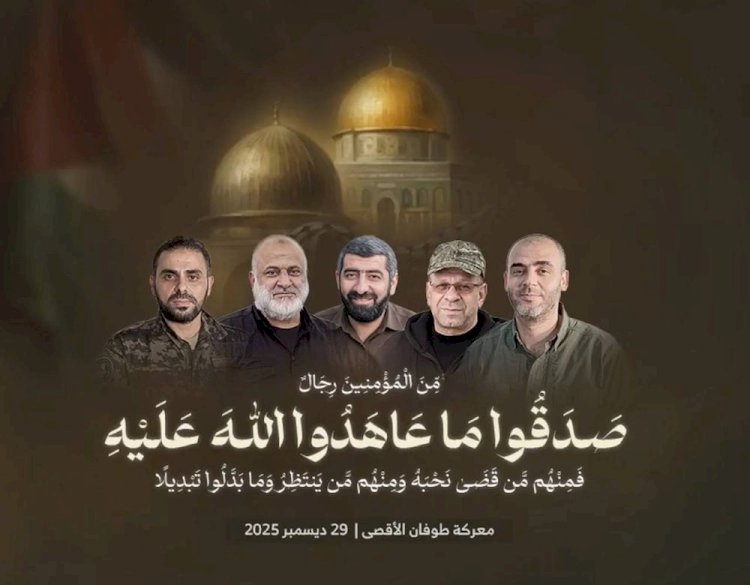
While he had been a prominent figure for many years, Abu Obeida gained massive momentum across the Arab and Islamic worlds following the October 7, 2023 “Al-Aqsa Flood” operation, during which he articulated and communicated the resistance’s positions to the world.
For the two years following the start of the conflict, he maintained a near-daily presence, narrating the details of military operations and presenting what the Brigades termed “certain news” regarding the course of battle. His speeches were designed to:
• Narrate the course of the battle: He provided frequent detailed accounts of ongoing military developments.
• Inspire and console: He was described as a leader who addressed his people from the heart of the battle to bring them glad tidings and patience, despite personal danger and repeated targeting.
• Direct communication with the adversary: His statements were often highly anticipated not only by his own supporters but also by opposing audiences who watched closely.
Legacy and Impact
Abu Obeida’s career spanned two decades, during which he led the al-Qassam media system and became a defining voice in the conflict’s information and psychological dimensions. The Brigades’ eulogy described him as a “knight” who never abandoned his people in the most difficult circumstances and whose words had a profound impact on the “souls of the nation.”
During his tenure, he was credited with helping bring the Palestinian cause back to the forefront of global attention and exposing actions in the conflict through his media leadership.
According to the available reporting, he “alighted” after around twenty years of service, having fulfilled his role in leading the media front of the resistance. His final known activities occurred amid ongoing operations in August 2025, when he was reportedly killed in an Israeli airstrike in Rimal, Gaza City on 30 August 2025—a fact later confirmed by multiple sources, including the Israeli military and, subsequently, the Qassam Brigades’ own announcement months later.
The continuation of the name “Abu Obeida” by the newly appointed military spokesman was itself a deliberate message. As Bilal Shobaki, Head of the Department of Political Science at Hebron University, explained, Israel sought not only the physical elimination of the al-Qassam spokesman but his symbolic assassination as well. Retaining the same name for the new spokesman directly undermines that objective, reaffirming that Abu Obeida was never merely an individual but a symbolic role that transcends persons and remains firmly embedded in the collective consciousness of the resistance.
Disclaimer
The views expressed in this article are the author’s own and do not necessarily mirror Islamonweb’s editorial stance.

Related Posts












Leave A Comment