
From Tawḥīd to Tribal Custodianship: The Early History of the Kaʿbah
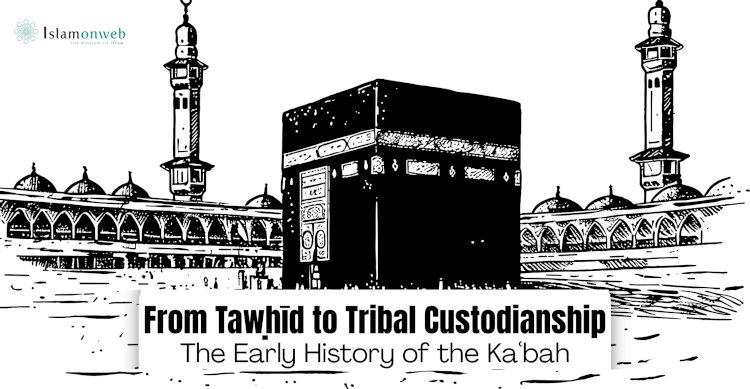
The Kaʿbah is the most sacred House appointed for worship, the qiblah towards which prayers are directed, and the spiritual centre around which millions gather in ṭawāf during Ḥajj and ʿUmrah.
The Qur’an describes the Kaʿbah as al-Bayt al-ʿAtīq, the Ancient House, and declares: “Indeed, the first House [of worship] established for mankind was that at Bakkah—blessed and a guidance for the worlds” (Āl ʿImrān 3:96). This verse places the Kaʿbah at the beginning of humanity’s sacred geography.
Some historians attributed the earliest building of the Kaʿbah to the angels. ʿAlī Ḥusayn al-Kharbūṭlī, in his book Tārīkh al-Kaʿbah, records the view of those who say that the angels built the House before the descent of Ādam عليه السلام. According to this narration, when Allah informed the angels that He would place a khalīfah on earth, they said:
“Will You place upon it one who causes corruption therein and sheds blood, while we glorify You with praise and declare Your holiness?”
(al-Baqarah 2:30)
The narration then states that the angels sought refuge around the Throne and circumambulated it seven times, seeking forgiveness. Thereafter, Allah placed for them al-Bayt al-Maʿmūr, the Much-Frequented House, beneath the Throne, and commanded them to perform ṭawāf around it. Then, according to the same report, the angels were commanded to build a House on earth corresponding to al-Bayt al-Maʿmūr in heaven, so that the inhabitants of earth could perform ṭawāf just as the inhabitants of heaven did. It is further narrated that when Ādam عليه السلام later performed Ḥajj to the House, the angels said to him: “May your Ḥajj be accepted, O Ādam; we performed Ḥajj to this House two thousand years before you.”
A similar sacred-historical imagination appears in what Aḥmad ibn Faḍl Allāh al-ʿUmarī transmits in Masālik al-Abṣār fī Mamālik al-Amṣār from ʿAbdullāh ibn ʿAmr ibn al-ʿĀṣ رضي الله عنهما. He is reported to have said that Allah created the House two thousand years before the earth, while His Throne was upon water. The report further mentions that when the Flood came, Allah raised the House and protected it from the punishment that befell the people of the earth, until Ibrāhīm عليه السلام later traced its site and rebuilt it.
Other historians connect the early building of the Kaʿbah to Shīth ibn Ādam عليه السلام. Ibn Qutaybah al-Dīnawarī states in al-Maʿārif that Shīth was among the most noble and beloved of Ādam’s children, his successor and heir, and that he built the Kaʿbah with clay and stone. Some reports also mention that there had been a tent placed for Ādam عليه السلام from Paradise at the site. Al-Masʿūdī, in Murūj al-Dhahab, records that the people of ʿĀd came to Makkah during a period of drought and that they honoured the place of the Kaʿbah before Ibrāhīm عليه السلام rebuilt it. He also mentions that an ancient sanctuary of the ʿAmālīq once stood there but disappeared before the arrival of Ibrāhīm عليه السلام in the Ḥijāz.
The Qur’anic expression itself is significant. Allah says:
“And [mention] when We designated for Abraham the site of the House…”
وَإِذْ بَوَّأْنَا لِإِبْرَاهِيمَ مَكَانَ الْبَيْتِ
(al-Ḥajj 22:26)
The wording “the site of the House” has led many scholars to understand that the place had a sacred designation before Ibrāhīm عليه السلام raised its foundations. Another verse says:
“And [mention] when Abraham was raising the foundations of the House and [with him] Ishmael…”
وَإِذْ يَرْفَعُ إِبْرَاهِيمُ الْقَوَاعِدَ مِنَ الْبَيْتِ وَإِسْمَاعِيلُ
(al-Baqarah 2:127)
The phrase “raising the foundations” may suggest that the foundations were already known or divinely marked. However, the Qur’an does not give a detailed architectural history before Ibrāhīm عليه السلام. For this reason, it is safer to say: the sacredness of the site is established by revelation, while the clearest Qur’anic account of its construction begins with Ibrāhīm and Ismāʿīl عليهما السلام.
Ibrāhīm and Ismāʿīl Raise the Foundations
The story of the Kaʿbah is inseparable from the story of Makkah. The Qur’an preserves the prayer of Ibrāhīm عليه السلام:
“Our Lord, indeed I have settled some of my descendants in an uncultivated valley near Your Sacred House, our Lord, that they may establish prayer…”
(Ibrāhīm 14:37)
This verse shows that Makkah was not chosen because of agricultural richness, political power, or worldly advantage. It was a barren valley, outwardly lacking the usual conditions for settlement. Yet divine selection transformed it into the spiritual heart of the world. What seemed empty became full; what seemed remote became central. History, in Qur’anic perspective, does not always begin where human beings expect it to begin.
Allah then opened for Hājar and Ismāʿīl عليهما السلام a door of mercy through Zamzam. The spring became the beginning of settled life in that empty valley. Islamic historical sources mention that the presence of water attracted the tribe of Jurhum to the area. ʿAlī Ḥusayn al-Kharbūṭlī, in Tārīkh al-Kaʿbah, mentions that Jurhum passed by the place and saw birds circling above it, realising that water must be nearby. They had known the valley as barren, so the sight surprised them. When they came near Hājar, they sought her permission to settle beside the well, and she allowed them. Ismāʿīl عليه السلام then grew up among Jurhum and learnt Arabic from them.
This background matters because the Kaʿbah was not built in a social vacuum. By the time Ibrāhīm عليه السلام returned to build the House, Ismāʿīl عليه السلام had grown in Makkah and lived among Jurhum. Thus, the House of Allah arose in a valley where divine care had already prepared both the place and the people.
The most authentic and central account of the Kaʿbah’s building is the Qur’anic account of Ibrāhīm and Ismāʿīl عليهما السلام raising its foundations:
“And [mention] when Abraham was raising the foundations of the House and [with him] Ishmael, [saying], ‘Our Lord, accept [this] from us. Indeed, You are the Hearing, the Knowing.’”
(al-Baqarah 2:127)
This verse is brief, but it contains a complete theology of sacred work. Ibrāhīm عليه السلام builds, Ismāʿīl عليه السلام assists, and both ask Allah for acceptance. The Qur’an does not focus on the size of the stones, the height of the walls, or the technical design of the structure. It focuses on intention, obedience, and acceptance. The first lesson of the Kaʿbah’s construction is that even the noblest deed requires divine acceptance.
Historical reports mention that Ibrāhīm عليه السلام built while Ismāʿīl عليه السلام passed stones to him, and that they repeated the prayer recorded in the Qur’an. IslamWeb, in its summary of the stages of the Kaʿbah’s construction, also identifies the building by Ibrāhīm and Ismāʿīl عليهما السلام as the most established and central stage in the sacred history of the House.
The Kaʿbah, therefore, begins in the Qur’anic narrative as a family act of worship: a father and son obeying Allah together. This gives the House a deeply human meaning. It is not a monument to empire; it is a monument to submission. It is not founded on conquest; it is founded on duʿāʾ.
After the building of the House, Allah commanded Ibrāhīm عليه السلام:
“And proclaim to the people the Ḥajj; they will come to you on foot and on every lean camel; they will come from every distant pass.”
(al-Ḥajj 22:27)
The Kaʿbah was therefore not meant to remain a local sanctuary. From the beginning, it was linked to a universal call. The valley of Makkah, once “uncultivated,” became the meeting place of humanity. People would come from every direction, across deserts and mountains, generation after generation, answering a call first proclaimed by Ibrāhīm عليه السلام.
This call is one of the great wonders of sacred history. A House built in a barren valley became the destination of millions. It is as if the Qur’an teaches us that when Allah grants meaning to a place, geography bends before divine will. Makkah did not become central because it had worldly power; it gained power because Allah made it sacred.
Jurhum, the ʿAmālīq, and Early Rivalries Around the Kaʿbah
After Ibrāhīm and Ismāʿīl عليهما السلام raised the foundations of the Kaʿbah, the Sacred House entered a new phase of history: the question of custodianship. Who would serve the House? Who would regulate access to Makkah? And who would benefit from the growing movement of people and trade around the sanctuary?
Historical sources mention that Ismāʿīl عليه السلام remained connected to the Kaʿbah after its construction. Following his death, its care passed to his son Nābit. However, over time, the tribe of Jurhum gained control over the affairs of the House from the descendants of Ismāʿīl. This shift marks one of the earliest examples of how the honour of serving the Kaʿbah could become entangled with tribal power and worldly interest.
ʿAlī Ḥusayn al-Kharbūṭlī mentions that al-Ḥārith ibn Muḍāḍ assumed responsibility for the affairs of the Kaʿbah. He lived near Makkah in a place known as Quʿayqiʿān. According to the report, anyone who entered Makkah with merchandise was required to pay one-tenth of it. This indicates that the custodianship of the Kaʿbah was not only a religious responsibility; it also brought social authority and economic advantage.
At that time, the ʿAmālīq also had influence in the region. Their king, al-Sumaydaʿ ibn Hawbar, was said to have settled in the lower part of Makkah, where he too took a tenth from the trade entering from his direction. This created rivalry between two centres of authority: Jurhum on one side and the ʿAmālīq on the other. The dispute eventually led to fighting, before both sides inclined towards settlement.
The reported agreement gave the ʿAmālīq authority over the Kaʿbah for a period. Later, however, Jurhum regained their influence and continued to oversee the House for nearly three hundred years. Their last ruler is mentioned as al-Ḥārith ibn Muḍāḍ al-Aṣghar. Historical reports also state that Jurhum made additions to the structure of the Kaʿbah and raised it higher than the construction of Ibrāhīm عليه السلام.
According to ʿAlī Ḥusayn al-Kharbūṭlī, the tribe of Jurhum eventually became oppressive, neglected the great responsibility entrusted to them, and misused the wealth of the Kaʿbah.
Khuzāʿah, and the Entry of Idolatry
This decline opened the way for further conflict. As the Kaʿbah became both a religious centre and a source of social and economic influence, other tribes began to seek authority over it. Historical accounts mention a conflict between the tribes of Muḍar and Iyād. When Iyād sensed defeat, they took al-Ḥajar al-Aswad and buried it. The Black Stone, which had been placed in the Kaʿbah as part of its sacred history, thus became part of a wider struggle for control.
A woman from the tribe of Khuzāʿah is reported to have seen where al-Ḥajar al-Aswad had been buried. When she informed her people, they used this knowledge as leverage. They agreed to reveal its location on the condition that the custodianship of the Kaʿbah be recognised for Khuzāʿah. In this way, the discovery of the Black Stone became connected to a new transfer of authority over the House.
The rise of Khuzāʿah marks one of the most significant and painful turning points in the religious history of Makkah. Under their leadership, especially through ʿAmr ibn Luḥayy al-Khuzāʿī, idolatry entered the sacred precincts of the Kaʿbah. The House that Ibrāhīm and Ismāʿīl عليهما السلام had raised upon tawḥīd gradually became surrounded by idols.
Al-Kharbūṭlī, citing earlier historical material, states that ʿAmr ibn Luḥayy travelled to Syria for treatment. There he saw people worshipping idols and asked them about their practice. They told him that they sought help and rain through these idols. Influenced by what he saw, he brought an idol called Hubal to Makkah and placed it near, or according to some reports inside, the Kaʿbah. From there, idolatry spread among the Arabs and began to replace the pure religion associated with Ibrāhīm and Ismāʿīl عليهما السلام.
This was not a minor change in ritual practice. It was a transformation of the religious identity of Makkah. The Kaʿbah remained honoured, pilgrimage continued, and the Arabs still recognised the sanctity of the House, but its spiritual meaning was corrupted. The structure remained, but the theology around it was wounded. The House of tawḥīd was made to stand beside symbols of shirk.
The gravity of this change is captured in lines attributed to Shaḥnah ibn Khalaf al-Jurhumī, who is said to have protested against ʿAmr ibn Luḥayy’s innovation:
O ʿAmr, you have introduced various gods
around the House in Makkah as idols.
The House had always had One Lord,
but you have made many lords for people around it.
Quṣayy ibn Kilāb and the Rise of Quraysh in Makkah
Long before the coming of Islam, Makkah had become more than a settlement in the Ḥijāz. Because of the Kaʿbah, it had grown into a sacred destination for Arab tribes, a place where religious devotion, social prestige, and trade met together. Pilgrims came to the House from different regions, and with them came commerce, alliances, poetry, and tribal negotiation. Whoever held authority over the Kaʿbah did not merely guard a building; he held a key to honour, influence, and leadership among the Arabs.
After the period of Jurhum and the later dominance of Khuzāʿah, the tribe of Quraysh gradually emerged as the leading power in Makkah. Georgi Zaydān, in Tārīkh al-Tamaddun al-Islāmī, describes Makkah as one of the most famous cities of the Ḥijāz because it was the destination of pilgrims who came from distant places to visit the Kaʿbah. Over generations, this religious position also made Makkah a centre of trade. Naturally, the eyes of powerful tribes turned towards it, for the custodianship of the Kaʿbah brought both sanctity and worldly advantage.
According to Zaydān, Makkah was first under the influence of the descendants of Ismāʿīl عليه السلام, who served as the custodians of the Kaʿbah. Later, Khuzāʿah migrated from Yemen after the flood of al-ʿArim and gained control over Makkah, overpowering the Ismāʿīlī or ʿAdnānī tribes. For a time, the descendants of Ismāʿīl were too weak to resist them. But history turned once again: Khuzāʿah weakened, while the ʿAdnānī line regained strength. From this line came Kinānah, and from Kinānah emerged Quraysh.
The central figure in Quraysh’s rise was Quṣayy ibn Kilāb ibn Murrah, one of the most important ancestors of the Prophet Muhammad ﷺ. Historical accounts describe him as a man of intelligence, ambition, and political insight. He understood that the future of leadership in Makkah depended on control of the Kaʿbah and the organisation of the city around it.
Quṣayy’s path to authority was gradual and strategic. He married the daughter of the man who was then responsible for the Kaʿbah, a leader from Khuzāʿah. This marriage connected him directly with the household that held custodianship of the Sacred House. After the death of that custodian, authority passed to his son. Historical reports then mention that Quṣayy used his political skill to obtain the custodianship from him, and through this, the authority over the Kaʿbah passed from Khuzāʿah to Quraysh.
This transfer was a turning point in the history of Makkah. Under Quṣayy, Quraysh did not remain scattered groups on the edges of the city. He gathered them, organised them, and gave them a central position around the Kaʿbah. For this reason, some historians consider him the true founder of Quraysh’s political order in Makkah.
Quṣayy is also associated with several key institutions connected to the Kaʿbah and Makkah’s leadership. Among them were:
- al-Sidānah / al-Ḥijābah: custodianship and guardianship of the Kaʿbah.
- al-Siqāyah: providing water for pilgrims.
- al-Rifādah: feeding pilgrims.
- Dār al-Nadwah: the council house where Quraysh discussed major affairs.
- al-Liwāʾ: the banner of leadership in war and public matters.
Through these institutions, Quṣayy turned custodianship into a structured system of authority. The Kaʿbah remained the sacred centre, but around it grew a political and social order. This order would later shape the world into which Prophet Muhammad ﷺ was born.
After Quṣayy, the responsibilities connected to the Kaʿbah passed to his descendants. Reports mention that his son ʿAbd Manāf inherited honour after him, and that the line later continued through Hāshim and then ʿAbd al-Muṭṭalib, the grandfather of the Prophet ﷺ. This lineage is significant because it shows that the Prophet ﷺ was born into a family already deeply connected to the service of the Kaʿbah, especially through the honour of providing water and care for pilgrims.
The Age of Quraysh: Makkah as a Centre of Worship and Trade
Under Quraysh, Makkah grew into the most important religious and commercial centre in Arabia. The Kaʿbah gave the city its sacred prestige, while pilgrimage gave Quraysh economic strength and social influence. The barren valley that Ibrāhīm عليه السلام had described as “an uncultivated valley” became, by Allah’s decree, a gathering place for tribes, traders, poets, and pilgrims.
Georgi Zaydān, in Tārīkh al-Tamaddun al-Islāmī, notes that Quraysh were people of trade, and much of their trade was connected to the pilgrims who came to Makkah. It was therefore in their interest to make the routes to Makkah easier and to encourage the Arabs to continue visiting the Kaʿbah. Pilgrimage was not only a religious event but also the economic lifeline of the city.
This explains why Quraysh paid great attention to the affairs of the Kaʿbah. They organised services for pilgrims, provided water and food, and maintained the sacred status of the surrounding area. They also treated the land around the Kaʿbah as a ḥaram, where fighting was forbidden. This protection made Makkah a rare space of security in a tribal world often marked by conflict and revenge.
However, this sacred order was mixed with serious religious corruption. By this time, idolatry had spread widely among the Arabs. Many tribes had their own idols, and they would come to Makkah during the pilgrimage season to visit them, make offerings, and perform inherited rituals. Historical sources note that the number of idols associated with the Kaʿbah increased significantly; a well-known report states that during the conquest of Makkah, the Prophet ﷺ found hundreds of idols around the Kaʿbah and removed them. Thus, the House built by Ibrāhīm and Ismāʿīl عليهما السلام for tawḥīd had become surrounded by symbols of shirk.
This contradiction defined the religious life of Quraysh before Islam. They honoured the Kaʿbah, served pilgrims, respected the ḥaram, and preserved certain traces of Ibrāhīmī tradition. Yet they also tolerated and defended idol worship. The outer structure of sacred service remained, but its inner meaning had been deeply distorted.
Yet Makkah’s importance also made it an object of envy and ambition. Powerful forces outside the city understood that whoever controlled the Kaʿbah could command religious prestige over Arabia. In the middle of the sixth century CE, the Abyssinian army advanced towards Makkah with elephants, intending to attack the Kaʿbah. This event became known as ʿĀm al-Fīl, the Year of the Elephant. It occurred during the time of ʿAbd al-Muṭṭalib, the grandfather of the Prophet Muhammad ﷺ.
The Qur’an later immortalised this event in Sūrah al-Fīl, reminding Quraysh that the Kaʿbah was protected not by their strength, but by Allah:
“Have you not considered, [O Prophet], how your Lord dealt with the companions of the elephant?”
(al-Fīl 105:1)
The Year of the Elephant became a turning point in Arabian memory. It confirmed the sanctity of the Kaʿbah in the eyes of the Arabs and further raised the prestige of Quraysh. But it also carried a warning: the true Protector of the House was not Quraysh, nor any tribe or ruler. The House belonged to Allah.
This period, therefore, prepares us for the next major stage in the Kaʿbah’s history: the rebuilding by Quraysh before the prophethood of Muhammad ﷺ. In that event, Quraysh would show both reverence for the Kaʿbah and limitation in fulfilling its original form. Most importantly, the young Muhammad ﷺ would appear in that episode as a figure of wisdom and trust, resolving the dispute over al-Ḥajar al-Aswad before revelation had even begun.
References
- The Qur’an Sūrah Āl ʿImrān 3:96 , Sūrah al-Māʾidah 5:97, Sūrah Ibrāhīm 14:37 , Sūrah al-Ḥajj 22:26–27 , Sūrah al-Baqarah 2:127 , Sūrah al-Ṭūr 52:4 , Sūrah Quraysh 106:1–4 , Sūrah al-Fīl 105:1–5
- Ṣaḥīḥ al-Bukhārī , Reports on Hājar, Ismāʿīl, Zamzam, Jurhum, and the building of the Kaʿbah, Reports on ʿAmr ibn Luḥayy , Reports on the idols around the Kaʿbah during the conquest of Makkah
- Ṣaḥīḥ Muslim, Reports from ʿĀʾishah رضي الله عنها regarding the Kaʿbah, the Ḥijr, and the Prophet’s ﷺ wish to rebuild it on the foundations of Ibrāhīm عليه السلام
- Ibn Hishām , al-Sīrah al-Nabawiyyah
- al-Ṭabarī , Tārīkh al-Rusul wa al-Mulūk
- Ibn Kathīr , Tafsīr al-Qurʾān al-ʿAẓīm , al-Bidāyah wa al-Nihāyah
- al-Azraqī , Akhbār Makkah wa Mā Jāʾa Fīhā min al-Āthār
- al-Fāsī Shifāʾ al-Gharām bi Akhbār al-Balad al-Ḥarām
- Ibn Qutaybah al-Dīnawarī , al-Maʿārif
- al-Masʿūdī , Murūj al-Dhahab wa Maʿādin al-Jawhar
- Aḥmad ibn Faḍl Allāh al-ʿUmarī , Masālik al-Abṣār fī Mamālik al-Amṣār
- ʿAlī Ḥusayn al-Kharbūṭlī , Tārīkh al-Kaʿbah
- Georgi Zaydān , Tārīkh al-Tamaddun al-Islāmī
Disclaimer
The views expressed in this article are the author’s own and do not necessarily mirror Islamonweb’s editorial stance.

Related Posts













Leave A Comment