
Honouring Friday: The Sunnahs and Etiquettes of Jumuʿah
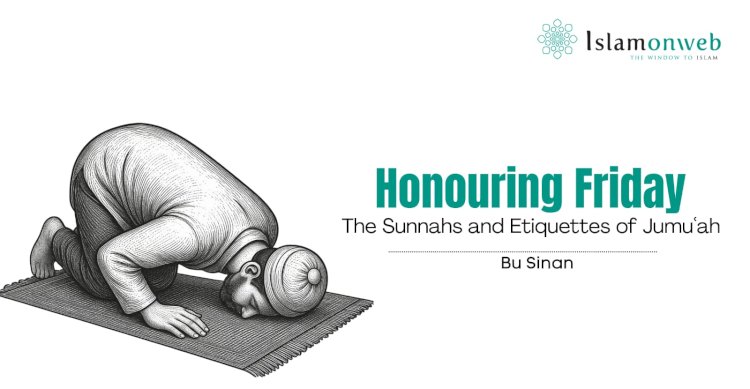
Friday occupies a distinctive place in the weekly life of a Muslim. It is not simply the day on which the noon prayer is replaced by Jumuʿah. The Prophetic teachings give the day a character of its own: purification, dignified appearance, early attendance at the mosque, attentive listening, remembrance of Allah, recitation of the Qurʾān, ṣalāh upon the Prophet ﷺ, and duʿāʾ.
Abū Hurayrah رضي الله عنه reported that the Messenger of Allah ﷺ said:
“The best day on which the sun has risen is Friday. On it Adam was created, on it he was admitted into Paradise, and on it he was expelled from it. And the Hour will occur only on a Friday.”[1]
Friday therefore brings together remembrance of human beginnings, the Hereafter, communal worship and spiritual renewal. Its etiquettes are not isolated rituals. Together, they prepare the believer outwardly and inwardly for one of the most important gatherings of the Muslim week.
Responding to the Call of Jumuʿah
The central act of Friday is the congregational prayer. Allah says:
“O you who have believed, when [the adhān] is called for the prayer on the day of Jumuʿah, then proceed to the remembrance of Allah...”
(Al-Jumuʿah 62:9)
The verse continues by instructing believers to leave trade. The command conveys something deeper than merely being present before the prayer begins: ordinary business is deliberately interrupted so that the believer can turn towards the remembrance of Allah.
Jumuʿah should therefore not become a hurried interruption squeezed between appointments. The Sunnah encourages preparation before leaving home and early arrival at the mosque. Friday is honoured by giving it time.
Begin with Purification
Among the most emphasised practices of Friday is ghusl, or bathing before attending Jumuʿah. Abū Saʿīd al-Khudrī رضي الله عنه narrated that the Prophet ﷺ said:
“Bathing on Friday is for every adult, along with using the siwāk and applying whatever perfume he is able to.”[2]
The wording of some narrations describes the Friday bath as wājib. Jurists differed over whether this indicates legal obligation or strong emphasis. According to the well-known position of the Shāfiʿī school, as stated by Imam al-Nawawī, the Friday bath is an emphatic Sunnah for one intending to attend Jumuʿah, rather than an obligation whose omission is sinful.[3]
The purpose is also evident. Jumuʿah gathers a large number of people in close proximity. Personal cleanliness therefore becomes part of consideration for others. Al-Nawawī, while discussing the relevant narrations, connects the practice with avoiding unpleasant odours when entering the mosque or sitting among people.
The same preparation includes cleaning the teeth with the siwāk, using permissible fragrance, grooming oneself appropriately and wearing clean and presentable clothes. Friday should visibly differ from an ordinary working day where circumstances allow.
This is not a call to extravagance. The Prophetic ideal is cleanliness, dignity and consideration.
Wear Good Clothes
The Qurʾān teaches:
“O children of Adam, take your adornment at every mosque.”
(Al-Aʿrāf 7:31)
Although the verse applies generally to prayer, Friday deserves particular attention because Muslims gather in greater numbers.
The Prophet ﷺ encouraged having suitable clothes for Jumuʿah apart from ordinary work clothes when a person was able to do so.[4] Someone coming directly from physical work may understandably have limited options, but where preparation is possible, Friday deserves that preparation.
The underlying etiquette is simple: one should not come to the house of Allah in a manner that unnecessarily inconveniences or repels others.
Go Early
One of the repeatedly emphasised Sunnahs of Jumuʿah is arriving at the mosque early.
Abū Hurayrah رضي الله عنه reported that the Prophet ﷺ described those arriving successively for Jumuʿah as being rewarded like those offering, respectively, a camel, a cow, a ram, a chicken and an egg in charity. He then said that when the imam comes out, the angels close their records and listen to the remembrance.[5]
The description gives Friday morning a sense of expectancy. The believer does not wait for the khuṭbah to begin before rushing towards the mosque. He goes early enough to settle his heart before the sermon begins.
Another narration from Aws ibn Aws رضي الله عنه associates going early, walking to the mosque, sitting close to the imam and listening without engaging in idle speech with an exceptionally great reward.[6]
Walking to Jumuʿah is therefore recommended where it is practical and does not involve genuine difficulty. Where distance, health, climate or other circumstances make walking unsuitable, the larger principle remains: make an effort to reach Jumuʿah calmly and early.
Do Not Harm People While Seeking a Good Place
Coming late and then pushing through the congregation defeats something of the very etiquette Jumuʿah is meant to teach.
ʿAbdullāh ibn Busr رضي الله عنه reported that while the Prophet ﷺ was delivering the khuṭbah, a man came stepping over people's shoulders. The Prophet ﷺ told him:
“Sit down, for you have caused harm.”[7]
Similarly, one should not separate two people unnecessarily in order to create a place for oneself. The narration of Salmān al-Fārisī رضي الله عنه links the forgiveness associated with Friday with bathing, purification, perfume, coming to the mosque, not separating two people, praying what is written for a person and then listening when the imam speaks.[8]
The mosque is a place of worship, but worship does not suspend good manners. Reaching the first row is meritorious; disturbing half the mosque to get there is not.
Nor should a person make another worshipper stand so that he may occupy his place. The Prophet ﷺ instructed people instead to make room for one another.[9]
Pray Before the Khuṭbah
A person who arrives early may perform voluntary prayers before the imam comes out. Salmān's narration states that the worshipper “prays whatever is written for him” before listening to the imam.[10]
If someone enters while the imam is already delivering the khuṭbah, he should not simply sit down without performing Taḥiyyat al-Masjid, the two units of prayer for greeting the mosque. Jābir ibn ʿAbdullāh رضي الله عنه reported that the Prophet ﷺ instructed a man who entered while he was preaching to perform two rakʿahs.[11]
They should be kept brief so that the person may quickly turn his attention to the khuṭbah.
Listen to the Khuṭbah
The khuṭbah is not background sound before the prayer. Listening to it is one of the central etiquettes of Jumuʿah.
The Prophet ﷺ said:
“If you say to your companion on Friday, while the imam is delivering the khuṭbah, ‘Be quiet,’ you have engaged in idle speech.”[12]
The example is striking. Telling another person to listen to the sermon appears to be a good action. Yet even that instruction is discouraged because the khuṭbah requires one's attention.
If saying “be quiet” is considered laghw—idle or distracting speech—then ordinary conversation deserves even greater avoidance.
In contemporary settings, this naturally includes unnecessary use of mobile phones: checking messages, scrolling through social media, answering non-urgent calls, taking photographs, recording people around us or repeatedly looking at notifications. The device may be silent while the mind remains elsewhere.
Listening to the khuṭbah means more than remaining physically quiet. It means giving the speaker one's attention and allowing the reminder to reach the heart.
Send Abundant Ṣalāh upon the Prophet ﷺ
Friday is particularly associated with sending blessings and peace upon the Messenger of Allah ﷺ.
Aws ibn Aws رضي الله عنه narrated that the Prophet ﷺ said:
“Among the best of your days is Friday… so send abundant blessings upon me on that day, for your blessings are presented to me.”[13]
Ṣalāh upon the Prophet ﷺ should therefore have a visible place in the believer's Friday. It does not require an elaborate formula created specifically for the day. The authentic forms taught by the Prophet ﷺ are sufficient, including the well-known Ṣalāh Ibrāhīmiyyah recited in prayer.
Friday reminds the Muslim that love for the Messenger ﷺ is expressed not merely through emotion but through remembrance, obedience and following his Sunnah.
Read Sūrat al-Kahf
Another established Friday practice is the recitation of Sūrat al-Kahf.
Abū Saʿīd al-Khudrī رضي الله عنه reported:
“Whoever recites Sūrat al-Kahf on Friday will have a light for him between the two Fridays.”[14]
The narration has been transmitted by al-Ḥākim and al-Bayhaqī and has been graded authentic by a number of later ḥadīth scholars.[15]
Rather than racing through the sūrah merely to complete a weekly habit, Friday provides an opportunity to revisit its enduring lessons: steadfast faith, the danger of worldly deception, humility before divine knowledge, the responsibilities of power, and the limits of what human beings can see and understand.
The Sunnah of reciting Sūrat al-Kahf can thus become a weekly return to the Qurʾān.
Look for the Hour When Duʿāʾ Is Answered
Among the remarkable virtues of Friday is the presence of a period in which duʿāʾ receives a special response.
Abū Hurayrah رضي الله عنه reported that the Messenger of Allah ﷺ mentioned Friday and said that there is an hour during it in which a Muslim who asks Allah for something good will be granted it.[16]
Scholars differed considerably over the exact time. Two positions are especially well known. One places it during the period from the imam's sitting on the minbar until the completion of the prayer, based upon a narration from Abū Mūsā al-Ashʿarī رضي الله عنه. Another identifies it with the final period after ʿAṣr before sunset.[17]
The latter position is supported by the narration of Jābir ibn ʿAbdullāh رضي الله عنه in which the Prophet ﷺ instructed believers to seek it in the last hour after ʿAṣr.[18]
There is no need for the believer to turn the disagreement into anxiety. Both periods can be honoured. Friday itself invites more duʿāʾ, and the period before sunset is especially suitable for withdrawing from distractions and asking Allah for one's needs in this world and the next.
Do Not Invent Special Worship for Friday
Honouring Friday also means observing its limits.
The Prophet ﷺ prohibited singling out Friday for fasting unless it coincides with someone's normal pattern of fasting or is joined with another day.[19] He likewise instructed Muslims not to single out Friday night from other nights for a special voluntary night prayer.[20]
This offers an important principle. The excellence of Friday is established through what Allah and His Messenger ﷺ prescribed, not through continually adding new rituals merely because the day is virtuous.
Following the Sunnah includes knowing what to do as well as what not to invent.
A Weekly Renewal
The etiquettes of Friday form a remarkable sequence.
The body is washed. The clothes are prepared. The mouth is cleaned. Fragrance is applied. Ordinary work is set aside. The believer leaves early for the mosque, tries not to inconvenience anyone, prays quietly, listens to the khuṭbah, joins the congregation, remembers the Prophet ﷺ, reads the Qurʾān and ends the day with duʿāʾ.
None of these practices is difficult in itself. Their power lies in their regularity.
The Prophet ﷺ connected proper observance of Friday with forgiveness. In the narration of Salmān رضي الله عنه, the person who bathes, purifies himself, uses fragrance, avoids separating people, prays what he can and listens attentively is promised forgiveness between that Friday and the next.[21] Another authentic narration states that the five daily prayers and one Friday prayer to the next are expiation for what occurs between them, provided major sins are avoided.[22]
Friday is therefore more than the end of the working week. For the Muslim, it is a recurring opportunity to put life back into order: body, time, worship, community and heart.
When these Sunnahs are preserved, Jumuʿah ceases to be something we merely “attend.” It becomes what the Prophetic guidance intended it to be—a weekly gathering of remembrance, purification and return to Allah.
Endnotes
[1] Muslim ibn al-Ḥajjāj, Ṣaḥīḥ Muslim, no. 854.
[2] Ṣaḥīḥ Muslim, no. 846; see also Ṣaḥīḥ al-Bukhārī, no. 880.
[3] Al-Nawawī, al-Majmūʿ Sharḥ al-Muhadhdhab, discussion of the recommended baths; and Sharḥ Ṣaḥīḥ Muslim, Kitāb al-Jumuʿah. Al-Nawawī states that the well-known Shāfiʿī position recommends the bath for anyone intending to attend Jumuʿah.
[4] Abū Dāwūd, Sunan, and Ibn Mājah, Sunan, in the reports encouraging separate clothing for Jumuʿah for one who has the means.
[5] Al-Bukhārī, Ṣaḥīḥ, no. 881; Muslim, Ṣaḥīḥ, no. 850.
[6] Abū Dāwūd, Sunan, no. 345; al-Tirmidhī, Sunan, no. 496. The narration is among the principal texts cited regarding early attendance and walking to Jumuʿah.
[7] Abū Dāwūd, Sunan, report of ʿAbdullāh ibn Busr concerning the man who stepped over people's shoulders.
[8] Al-Bukhārī, Ṣaḥīḥ, no. 883.
[9] Muslim ibn al-Ḥajjāj, Ṣaḥīḥ Muslim, no. 2178.
[10] Al-Bukhārī, Ṣaḥīḥ, no. 883.
[11] Al-Bukhārī, Ṣaḥīḥ, no. 1170; the same incident is transmitted in Ṣaḥīḥ Muslim.
[12] Al-Bukhārī, Ṣaḥīḥ, no. 934; also narrated by Muslim.
[13] Abū Dāwūd, Sunan, no. 1047.
[14] Al-Bayhaqī, al-Sunan al-Kubrā, no. 6209; al-Ḥākim, al-Mustadrak, no. 3392, from Abū Saʿīd al-Khudrī رضي الله عنه.
[15] The report is recorded with a grading of ṣaḥīḥ in later ḥadīth verification; al-Buhūtī also describes its chain as ḥasan.
[16] Al-Bukhārī, Ṣaḥīḥ, no. 935; Muslim, Ṣaḥīḥ, no. 852.
[17] See the discussion of the two prominent views concerning the hour of response in the supplied Islamweb reference.
[18] Abū Dāwūd, Sunan, no. 1048. The report is graded ṣaḥīḥ by al-Albānī.
[19] Al-Bukhārī, Ṣaḥīḥ, no. 1985; Muslim, Ṣaḥīḥ, no. 1144.
[20] Muslim ibn al-Ḥajjāj, Ṣaḥīḥ Muslim, no. 1144.
[21] Al-Bukhārī, Ṣaḥīḥ, no. 883.
[22] Muslim ibn al-Ḥajjāj, Ṣaḥīḥ Muslim, Kitāb al-Ṭahārah, on the five prayers, Friday to Friday, and Ramaḍān to Ramaḍān as expiation when major sins are avoided.
Disclaimer
The views expressed in this article are the author’s own and do not necessarily mirror Islamonweb’s editorial stance.


Related Posts

















Leave A Comment