
A Response to Shukran Abdul Rahman and Haslina Hassan (2025) article, “Tawhidic Epistemology and the Affirmation of Oneness: Understanding the Notions of Aḥad, Waḥid, and Tawḥid”
In their recent article, “Tawhidic Epistemology and the Affirmation of Oneness: Understanding the Notions of Aḥad, Waḥid, and Tawḥid,” Shukran Abdul Rahman and Haslina Hassan (2025) aim to provide conceptual clarity to the core theological tenets of Islam within a contemporary framework. However, despite their good intentions, the authors, in framing their entire study around the hybrid phrase “Tawhidic Epistemology,” fall into the trap of what the sociologist Syed Hussein Alatas famously diagnosed as “the captive mind.” Their arguments show how modern Muslim academia remains a handmaiden to the linguistic and structural Western secular paradigm even while attempting to investigate its ultimate sacred concepts.
The Hybrid Trap
The primary flaw of the paper lies in its basic terminology. “Tawhidic Epistemology” is an artificial compound phrase—a structural calque that forces al-Ḥaqq into a Western philosophical container. The word “epistemology” carries deep European historical baggage, borne out of an Enlightenment tradition that systematically severed faith from reason to study the limits of human knowledge in isolation from the Divine. The English word “epistemology” was coined in 1847 by the reviewer of the German philosopher Johann Gottlieb Fichte’s Wissenschaftslehre for The Eclectic Magazine of Foreign Literature. It was simply a direct English equivalent for Fichte’s German term—a “doctrine of science” or “theory of knowledge.” James Frederick Ferrier translated it into English as “epistemology” in 1854, giving it philosophical substance, making it the foundation of his metaphysics, and establishing it as a recognised field of inquiry (Britannica Editors, 2026). Hence, the term did not emerge in a vacuum but from specific historical and metaphysical contexts of the West—the Renaissance (14th–17th Century), the Reformation (16th Century), the Scientific Revolution (16th–17th Century), culminating in the Enlightenment (18th Century). With each period, a Western cosmos with a once-vertical, multi-layered hierarchy became increasingly flattened onto a flat, material, and horizontal world. With the gradual flattening of its hierarchy, the Western world basically surrendered itself to the Cartesian split and the laws of physics. Western languages adapted to serve this horizontal mechanics, becoming highly specialized in describing separation, manipulation, and substance.
When the term “epistemology” was imported into the Islamic discourse, it carried this ontological baggage—the Cartesian subject, the isolated knower, and the secularisation of knowledge—all fragmented, reduced, and flat, with no transcendent Being. It was explicitly designed to answer a specific question: How can the isolated human mind achieve certainty about the material world using only reason and sensory data, independent of divine revelation?
Furthermore, in appending the anglicized Arab term as adjective “Tawhidic” (forcing the English suffix -ic onto Tawḥid), the authors mimic Western classifications like Aristotelian or Kantian epistemology. But Tawḥid is a classical Arabic, Quran concept signifying the absolute unity, sovereignty, and oneness of God. It is the “vision of reality and truth” (al-Attas, 2014, p. 2) from which all knowledge flows. Hence, slapping “tawhidic” onto “epistemology” can be seen as an attempt to use a secular, human-centric tool to measure an absolute, God-centric reality, subordinating the sacred to the secular. As Syed Hussein Alatas observed, a “captive mind” is an uncritical, imitative mind dominated by an external source, whose thinking is entirely deflected from an independent perspective (1972). By forcing a sacred reality into a Western conceptual container, the language itself exposes that exact intellectual captivity. It reveals a subconscious desire for external validation, operating as if a word in the classical tradition is only acceptable if it is dressed in Western terms.
This captivity shows itself in the second half of the article’s title “…and the Affirmation of Oneness.” In classical Arabic thought, Tawḥid is an active verbal noun signifying the declaration and realisation of oneness. It is an act of affirmation, but in this case, “who affirms”? The living human being has already been removed from the cosmos by the Cartesian split of subject and object!
This is why importing such terms into an Islamic university is not merely a linguistic borrowing. It is a metaphysical displacement. The Arabic word may be retained, but the concept is foreign. The native word is forced to carry a worldview it was never meant to take. The result is a hybrid that mirrors Islam, but its thinking is not. So, the student learns the Arabic vocabulary but absorbs the Western understanding. These two systems are not compatible, and they cannot be merged without one shaping the other. In other words, using a Western system in an Islamic university subtly reshapes the vision of the Quran. The university becomes a place of domains and disciplines. The student becomes a hybrid, the dīn becomes a subject, and the qalb is forgotten. This is the problem because the worldview of the Quran is built on Tawḥid that holds reality in a single vision, where both ‘ālam al-shahādah and ‘ālam al-ghayb are real, created and sustained by Wahid, and returned to Ahad. Nothing is outside of Ahad. In short, this is the coloniality of language because “language reflects ontology” (al-Attas, 2014, p. 20), and importing a foreign term is like importing a world.
Flattening the Hierarchy of Being and Reclaiming the Vocabulary of Certainty
The authors make a profound error in making “epistemology” an isolated domain. In the classical tradition, scholars like Al-Ghazali and Ibn Sina never operated under a singular, secularized silo like Naẓariyyat al-Maʿrifah1 (Theory of Knowledge). Instead, questions of knowing were embedded within Usul al-Fiqh (Principles of Jurisprudence), Kalam (Theology), and Tasawwuf (Spiritual Psychology). More importantly, they relied on a rich, value-laden vocabulary that fundamentally resists the passive, abstract nature of European philosophy.
In the classical tradition, Wujud always precedes ‘Ilm. ‘Ilm is an attribute of the Absolute Being (Wajib al-Wujud). Human beings are never detached from reality to “theorise” knowledge from a distance; rather, one’s capacity to know through reason (‘Aql) and revelation (Wahy) is entirely dependent on one’s metaphysical hierarchy being mawjud. Instead of Naẓariyyat al-Maʿrifah, the original vocabulary is ‘Ilm al-Ma‘rifah (Knowledge of Gnosis), a completely unfragmented, prior and integral epistemology. This is a knowledge born entirely from immersion in Being,2 the ultimate hierarchy—epistemology in the absolute service of ontology, where the act of knowing is never separate from the state of being. In other words, true knowing is not an act of doing; it is a property of who one is. So, when the authors traded this active, sacred vocabulary for the Western calque of “epistemology,” they adopt the secular presupposition that knowledge is just a speculative theory to be studied from a distance. By isolating “Tawhidic Epistemology” as a standalone academic category, the authors flatten this metaphysical hierarchy and implicitly adopt the Western premise that the human subject is the ultimate judge of reality, thereby obscuring the living Reality of the Being that gives Tawḥid its entire meaning.
This is the trap of the modern academic scholars—being captive in a horizontal labyrinth of their own making because they operate entirely within a flat, post-Enlightenment Western epistemology.
The Bottom-up Integration Approach Versus the Top-down Integral Approach
The authors attempt to apply the highly sophisticated, classical theological distinctions of Aḥad (the absolute, indivisible Oneness) and Waḥid (the manifestations of Oneness in qualities) and automatically fit them into the bottom-up strategy of the modern university structure. In doing so, the authors end up reordering data within a secular framework rather than liberating the mind from it.
Put differently, the methodology that underlies Abdul Rahman and Hassan’s work reflects the broader crisis of the “Islamization of Knowledge” movement, specifically echoing the bottom-up integrating approach popularised by Isma’il Raji al-Faruqi. Al-Faruqi, coming from the West, accepts the existing, fragmented categories of modern secular academia as a baseline, and he attempts to weld values of Islam onto them, framing his project around Islamiyyat al-Ma‘rifah (the Islamization of Knowledge).
In contrast, Al-Attas argues that Western academic disciplines are fundamentally corrupted at their metaphysical roots; hence, they must be completely de-secularised from the top because the crisis of the Muslim world is the secularisation of knowledge and language. As such, in his worldview of ruʿyāt al-islam li al-wujūd (1995, p. 2), he calls upon a total top-down restructuring, starting with the absolute primacy of the Necessary Being (Wajib al-Wujud), the cultivation of Right Action (Adab), and allowing that metaphysical light to filter downwards to organically strip empirical data of its materialistic assumptions.
The diagram below summarises the difference between al-Attas’ top-down approach and al-Faruqi’s bottom-up approach to the Islamization movement.
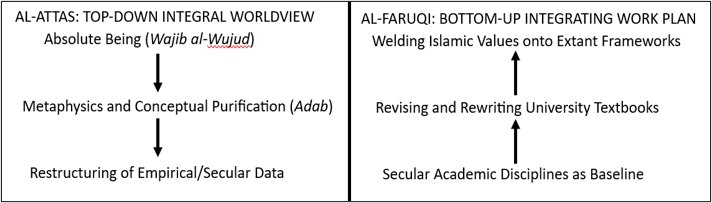
What Abdul Rahman and Hassan are doing, however, is attempting to rescue the bottom-up secular categories by pasting a sacred veneer of Aḥad, Waḥid, and Tawḥid, while leaving the structural captivity intact.
More serious, however, is their blatant misattribution of the compound phrase “Tawhidic epistemology” not only to al-Attas and al-Faruqi, but also to the historical giant al-Ghazali, all of whom fundamentally rejected its underlying philosophy.3 By forcing Abu Hamid al-Ghazali into the parameters of an “epistemological framework,” the authors commit a profound anachronism, viewing an 11th-century mujaddid and Ḥujjat al-Islām through the lens of a 19th-century European secular discipline.
Even more striking is the misattribution to the two modern figures: al-Attas and al-Faruqi. Neither al-Faruqi nor al-Attas ever used the anglicized, compound phrase “Tawhidic Epistemology.” Both expressed the synthesis of revealed (wahy) and rational (aql) knowledge using distinct, precise terms. In his Islamization of Knowledge: General Principles and Work Plan (1989), al-Faruqi frames this synthesis as “The Principle of al-Tawḥid,” not “epistemology.” Similarly, al-Attas in his Prolegomena to the Metaphysics of Islam (2014) frames the entire argument around “The Metaphysics of Islam” and “The Islamic Worldview.” In short, both relied on traditional Arabic terms rooted in the Quran and the classical tradition. Indeed, al-Attas fiercely criticised the uncritical adoption of Western philosophical terminology, arguing that words such as “epistemology” carry Cartesian ghosts that actively colonise the Muslim mind. By using this phrase, the authors inadvertently dilute the very language of decolonisation championed by the thinkers they cite.
Hence, the authors’ statement “Tawhidic Epistemology forms the philosophical basis for synthesizing revealed and rational knowledge” cannot be attributed to either al-Attas or al-Faruqi (Al-Attas, 1995; al-Faruqi, 1982). While they laid the conceptual foundation by tying knowledge directly to Tawḥid, they referred to it using phrases like the “Unity of Truth” (al-Faruqi) or the “Worldview of Islam” (al-Attas).
The term “Tawhidic epistemology” in contemporary Islamic philosophy is credited to Osman Bakar, who, over decades of academic writing, propagated and cemented it in his works (2012a, 2012b, 2014). He uses the term to translate and systematise his ideas for a Westernised academic audience.
And this is the irony—both al-Attas and al-Faruqi were trying to de-secularise the Muslim mind. Al-Attas explicitly warned against using Western concepts and language blindly because they carry secular presuppositions. Yet, the generation of scholars who followed them ended up using an English-structured calque, “Tawhidic epistemology” to describe their philosophy.
Breaking the Yoke
Ultimately, the critique of Rahman and Hassan’s paper is not a rejection of their theological accuracy regarding Aḥad and Waḥid, but a critique of their intellectual submissiveness to Eurocentric structures. To free themselves from this captivity, contemporary Muslim scholarship must abandon the tyranny of the calque. True intellectual autonomy requires reclaiming the expansive Quran vocabulary, starting with the metaphysical hierarchy of the human being as the first principle, moving from being → knowing → doing, not epistemology → mind → society. The latter, in putting knowing before being, has made the human being a product of the epistemological project rather than its foundation.
Thus, Muslim scholars must stop writing to satisfy the metrics of secular peer-reviewed journals and global university ranking systems. The captive mind can only be shattered and restored to an authentic, autonomous tradition of thought when they stop stuffing the sacred reality of Tawḥid into the secular containers of the West.
About the author:
Noraini M. Noor is Professor Emerita in Psychology, who served as a professor at the International Islamic University before her retirement. She holds a D.Phil. in Psychology from the University of Oxford, and specialises in Work, Family, Individual Differences, and Well-Being. She now explores the nature of Man from the perspective of Islam, contrasting them with modern psychology.
Endnotes
1 Again, the phrase naẓariyyat al-maʿrifah, نظريّة المعرفة, is a modern synthetic term—a calque, created during the Arab Nahḍah (renaissance) translation movement of the 19th and early 20th centuries to name the Western philosophical field of epistemology. It combines the classical Arabic notion of naẓarī (inferential knowledge) with maʿrifah (knowledge/cognition) to form a phrase that had no exact precedent in the classical tradition of Islam, reflecting the era’s effort to integrate Western philosophical categories into Arabic.
2 Here, ‘Ilm (عِلْم) is a dynamic reality that demands action (‘Amal) and connects the physical world to its metaphysical source, Wujud. It refers to the reception of intelligibles (ma‘qulat) into the rational soul, where facts and moral values are completely inseparable. Ma‘rifah (مَعْرِفَة), on the other hand, represents experiential recognition and direct spiritual certainty (Yaqin), which is distinct from raw cognition.
3 The exact sentences in the article read: “Tawhidic Epistemology forms the philosophical basis for synthesizing revealed and rational knowledge (Al-Attas, 1995; al-Faruqi, 1982);” and “Tawhidic Epistemology seeks to unify dispersed bodies of knowledge, avoid fragmentation, and integrate truth across disciplines, reflecting the metaphysical unity of creation and the indivisible source of knowledge, God (al-Ghazālī, 2000).”
References
Syed Muhammad Naquib Al-Attas. (2014). Prolegomena to the Metaphysics of Islam: An Exposition of the Fundamental Elements of the Worldview of Islam. UITM.
Syed Hussein Alatas. (1972). “The captive mind in development studies: Some neglected problems and the need for an autonomous social science tradition in Asia.” International Social Science Journal, 24 (1), 9-25.
Isma’il Raji Al-Faruqi. (1982). Al-Tawhid: Its Implications for Thought and Life. IIIT.
Isma’il Raji Al-Faruqi. (1989). Islamization of Knowledge: General Principles and Work Plan (2nd ed.). IIIT.
Britannica Editors. “James Frederick Ferrier.” Encyclopedia Britannica, 12 June 2026, https://www.britannica.com/biography/James-Frederick-Ferrier. Accessed 24 September 2026.
Osman Bakar (2012). “The Quranic identity of the Muslim Ummah: Tawhidic Epistemology as its foundation and sustainer.” Islam and Civilisational Renewal, 3(3), 438-454.
Osman Bakar (2012). “The identity crisis of the contemporary Muslim ummah: The loss of Tawhidic Epistemology as its root cause.” Islam and Civilisational Renewal, 3(4), 637-653.
Osman Bakar (2014). Islamic Civilization and the Modern World: Thematic Essays. UBD Press: Universiti Brunei Darussalam.
- Minimal usage of AI was used to check for references.
Disclaimer
The views expressed in this article are the author’s own and do not necessarily mirror Islamonweb’s editorial stance.

Related Posts












Leave A Comment