
Islam, Buddhism and the 2025 Asian Floods: Religious Reflections in a Time of Climate Catastrophe
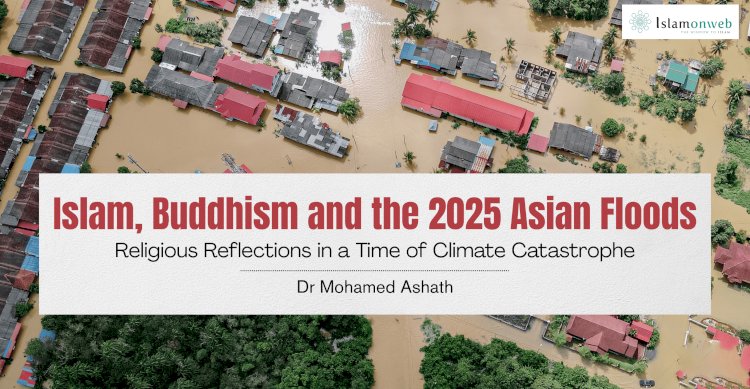
The catastrophic floods and landslides that swept across Indonesia, Sri Lanka, Thailand, and parts of South and Southeast Asia in late November and early December 2025 have left more than 1,250 people dead, millions displaced, and entire communities buried under mud. Cyclone Senyar in Sumatra, Cyclone Ditwah in Sri Lanka, and Typhoon Koto in the Philippines created an unprecedented chain of destruction, with experts warning that this level of extreme rainfall is directly linked to climate change.
In Indonesia’s North Sumatra, journalists reported landslides in every village they passed through. Sri Lanka declared a state of emergency, with its Disaster Management Centre describing the situation as a “humanitarian crisis of historic proportions.” Across the region, the single common factor was the record-breaking rainfall, intensified by warmer air and warmer seas, conditions scientists have repeatedly identified as climate driven.
This tragic scenario provides an important moment to re-examine how Buddhism and Islam, the two major faith traditions in the affected region, understand natural disasters, human responsibility, and environmental ethics.
Buddhism: Natural Disasters as Expressions of Universal Law in a Changing Climate
Buddhism teaches that natural phenomena, including storms, landslides, and floods, are governed by utu niyama, the natural law of physical processes. Winds, rains, and earth movements follow cycles shaped by energy, heat, and elemental imbalance. From a Buddhist perspective, this 2025 floods are not “punishments” but expressions of a natural world in flux.
However, early Buddhist texts also warn that human greed (lobha) and destructive behavior disturb ecological balance. When forests are cleared, mountains destabilized, rivers obstructed, and coastlines destroyed, the natural equilibrium is disrupted. This feeds into the consequences we see today:
- Deforestation in Indonesia increases landslide risk
- Loss of mangroves in Sri Lanka and Thailand reduces flood resistance
- Rapid development without environmental concern amplifies disaster impact
Thus, while Buddhism sees natural disasters as part of the impermanent nature of existence (anicca), it also teaches that human choices worsen their severity.
Modern climate science confirms this: rising temperatures fuel heavier rainfall, more intense storms, and more unstable weather systems, exactly the pattern seen in the 2025 Asian floods.
Buddhism invites people to reflect, are we living in harmony with nature, or in conflict with it? The recent tragedies urge a return to simplicity, moderation, compassion, and ecological mindfulness.
Islam: Calamities as Tests, Warnings, and Calls for Moral Responsibility
Islamic teachings explain natural disasters through a moral-spiritual lens. Calamities are tests from Allah, reminders of humility, opportunities for reflection, and sometimes consequences of human wrongdoing, not as direct punishment, but as part of a spiritual and ethical ecosystem.
The Qur’an states:
“Whatever affliction befalls you is because of what your own hands have committed. And He pardons much.” (Qur’an 42:30)
This verse resonates powerfully in today’s climate context. Muslim scholars increasingly interpret environmental catastrophes as consequences of human negligence:
- Burning fossil fuels
- Destroying forests
- Polluting rivers and oceans
- Exploiting nature without restraint
These actions disturb the balance (mīzān) that Allah established on earth.
The Qur’an also commands:
“Do not spread corruption in the land after it has been set in order. And call upon Him with hope and fear. Indeed, Allah’s mercy is always close to the good doers.” (Qur’an 7:56)
From this perspective, this 2025 floods are not just natural events, they are collective wake-up calls, urging humanity to reconsider its lifestyles, consumption patterns, and disregard for the environment.
At the same time, Islam teaches that calamities are not only moments of hardship but also opportunities for spiritual growth and ethical responsibility. They call believers to serve those who are suffering, to help rebuild communities, and to strengthen qualities such as faith, patience, and compassion. Disasters also become occasions for standing in solidarity with victims, reaffirming the moral duty to support one another in times of crisis. In this way, every calamity becomes a moment for renewed ethical action and sincere self-examination.
Bridging Religious Wisdom and Climate Reality
Buddhism and Islam offer profound ethical insights that speak directly to the climate challenges of our time. Both traditions begin from a shared recognition that human beings are inseparably connected to the natural world. Buddhism’s principle of dependent origination teaches that every action triggers consequences across the web of life, while Islam’s concept of khilāfah frames humanity as trustees responsible for safeguarding the Earth. In both worldviews, environmental harm is ultimately self-harm, returning to affect the very communities that inflict or ignore it.
Equally important is the moral responsibility embedded in both faiths. Islam repeatedly warns against fasād, corruption and destruction on land and sea, caused by human excess and irresponsibility. Buddhism, for its part, cautions that greed, unchecked desire, and exploitation are root causes of both personal suffering and ecological imbalance. These teachings remind us that the climate crisis is not only a scientific or economic issue, but also a profound ethical failure requiring a recalibration of human behaviour.
Compassion stands at the heart of both religions and offers a powerful lens for climate action. Generosity, solidarity, and standing with those who suffer are core moral duties in Buddhism and Islam. As more than 1.1 million Sri Lankans have been displaced by extreme weather events in recent years, these teachings call communities to respond not with indifference but with empathy, shared responsibility, and collective resilience.
Both traditions interpret disasters as moments of awakening. For Buddhists, calamities reveal the truth of impermanence and the fragile nature of existence, inviting deeper mindfulness and wiser living. In Islam, such events are reminders of divine tests, prompting reflection, accountability, and renewal of moral commitments. Together, these spiritual perspectives encourage societies to turn crises into opportunities for ethical transformation and environmental stewardship grounded in timeless religious wisdom.
The 2025 Floods: A Warning for the Future
Experts like Professor Steve Turton, an adjunct professor of environmental geography at Central Queensland University in Australia, explains that tropical storms today produce more rain than ever before because the warming atmosphere holds more moisture. Even moderate cyclones now result in catastrophic flooding.
This scientific insight aligns with the ethical teachings of both religions:
- Unchecked human consumption is unsustainable
- Climate change is accelerating disaster cycles
- The poor and vulnerable suffer disproportionately
If the region continues its current path, deforestation, urban expansion without planning, fossil fuel dependence, Buddhist and Islamic ethical warnings will become reality at an even greater scale.
A Shared Interfaith Call for Ecological Responsibility
With vast Buddhist and Muslim communities across South and Southeast Asia, this 2025 climate catastrophe highlights the urgent need for a united interfaith response rooted in shared moral principles. Central among these is compassion, karuṇā in Buddhism and raḥma in Islam. Both traditions teach that compassion must extend beyond human beings to the environment itself, calling believers to protect the land, water, and living ecosystems that sustain life. Caring for the Earth is therefore an expression of spiritual mercy and ethical responsibility.
Another shared foundation is the commitment to stewardship and mindful living. Islam’s concept of khilāfah frames humans as trustees of the Earth, while Buddhism encourages conscious awareness of how our choices affect the natural world. These parallels emphasise that environmental responsibility is not optional but integral to religious duty.
Both Buddhism and Islam also emphasise moderation as a guiding principle. In Buddhism, the Majjhimāpaṭipadā, the Middle Path, advocates balance and avoidance of excess, aligning closely with Islam’s wasatiyyah, which promotes moderation and restraint. Together, these teachings challenge the unchecked consumption and destructive habits that fuel ecological crises.
These shared values further include the protection of all living beings and a profound respect for natural laws and ecosystems. When brought together, they form a powerful interfaith ethic supporting climate justice, environmental accountability, and equitable disaster response. In harmony with climate advocates’ call to “move from awareness to accountability,” Buddhist-Muslim cooperation becomes not only timely but essential for shaping a more resilient and compassionate future for the region.
Conclusion: Faith in a Time of Floods
The devastating this 2025 floods across Asia are not isolated natural events. They are part of a larger pattern driven by human-induced climate change. Buddhism and Islam help communities make sense of these tragedies while offering powerful moral guidance for the future.
Buddhism reminds humanity that nature follows laws of impermanence and equilibrium, laws we disrupt at our peril. Islam reminds humanity that calamities are tests, warnings, and moments for repentance and renewed responsibility.
Together, they offer a path toward ecological healing, spiritual resilience, and ethical action. In a time of unprecedented climate disaster, these teachings are not abstract, they are urgently practical, deeply human, and profoundly necessary.
About the author:
Dr. Mohamed Ashath serves as an Assistant Professor in the Department of Fundamental and Inter-Disciplinary Studies (FIDS) at the International Islamic University Malaysia (IIUM).
Disclaimer
The views expressed in this article are the author’s own and do not necessarily mirror Islamonweb’s editorial stance.


Related Posts













Leave A Comment