
Tawhidic Epistemology and the Affirmation of Oneness: Understanding the Notions of Aḥad, Waḥid, and Tawḥid
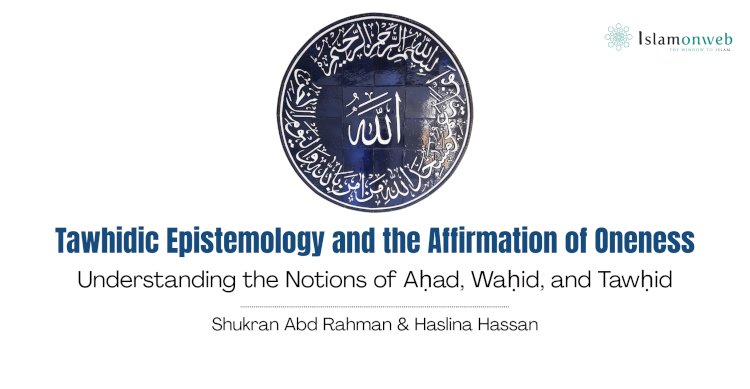
This article examines two Qur’anic concepts, namely Aḥad and Wāḥid, linking them to the concept of Tawḥīd, and their epistemological implications for understanding the foundation of knowledge. It explains how these concepts shape Tawhidic Epistemology (TE), the worldview foundational to intellectual integration in Islamic scholarship. The framework presented is expected to support the broader discourses on the integration of knowledge, aligning with IIUM’s educational philosophy, which emphasizes unity, coherence, and holistic understanding.
Epistemology as the Foundation of Knowledge
The concept of epistemology refers to the study of the nature, sources, and validation of knowledge. It forms the foundation upon which all other domains of knowledge are built (al-Ghazālī, 2000). When scholars speak of Tawhidic Epistemology, the grammatical structure indicates that Epistemology is the subject, while Tawhidic functions as its modifier. Thus, the phrase Tawhidic Epistemology refers to an epistemology which is shaped by the principle of Tawḥīd.
To describe an epistemology as “Tawhidic” is to affirm that the act of gathering, generating or searching for knowledge must be conducted through the process of integration, coherence, and unification, reflecting the imperative to affirm the oneness of God.
In other words, the “Tawhidic” element does not merely refer to the divine unity but it represents the human act of aligning all branches of knowledge into a coherent whole as part of the affirmation of that unity (Ibn Taymiyyah, 1997). Integrating knowledge, avoiding fragmentation, and recognizing the interconnectedness of truths are themselves expressions of Tawḥīd in epistemic practice.
Integration of knowledge in Islamic scholarship begins with the epistemological premise that all knowledge originates from Allah, whose Oneness shapes the orientation, purpose, and structure of intellectual inquiry. Tawhidic Epistemology forms the philosophical basis for synthesizing revealed and rational knowledge (Al-Attas, 1995; al-Faruqi, 1982).
A search in the Qur’an index database shows that the word tawḥīd does not appear explicitly in any verse, yet the entire Qur’an is filled with the theme of tawḥīd, all are affirming the Oneness of Allah. Understanding the Qur’anic notions of Aḥad, Wāḥid, and Tawḥīd is essential to grasp the metaphysical foundations of this epistemological unity. This frame sets the stage for understanding the deeper distinctions between Aḥad, Wāḥid, and Tawḥīd, and their implications for a Tawhidic approach to knowledge.
Understanding Aḥad, Wāḥid, and Tawḥīd: Clarifying Oneness and the Act of Affirming It
Scholars often define Tawhidic Epistemology by linking it with the Oneness of God, yet the term Tawḥīd itself does not directly mean Oneness. Rather, it refers to the act of affirming oneness (Ibn Taymiyyah, 1997). The state of divine oneness is conveyed more precisely by Aḥad and Wāḥid, such as in the verse “Allāhu Aḥad” (Qur’an 112:1). Distinguishing between (a) God’s attribute of oneness and (b) the human act of affirming it is essential for theological clarity and for avoiding ambiguity in philosophical and epistemological discourse.
Aḥad (أحد): Absolute, Incomparable Oneness
The linguistic meaning of the term Aḥad (Say: He is Allah, Aḥad” (Qur’an 112) denotes Allah’s unique, indivisible, and incomparable Oneness. The uniqueness that cannot be divided or replicated (Lane, 1863/1984). The term Aḥad represents divine uniqueness in the absolute sense (al-Ash‘arī, 1953). It affirms that divine reality cannot be fragmented, multiplied, or analogised (Izutsu, 2002). Classical Arabic reserves its positive form almost exclusively for God (Ibn Manẓūr, 1290/1990). Epistemologically, Aḥad establishes the principle that truth is singular and originates from a unified Divine source. The term Ahad is not numerical oneness but metaphysical singularity
Wāḥid (واحد): One in Contrast to Multiplicity
The linguistic meaning of Wāḥid is “one” in contrast to “many” which is the first in a numerical sequence (Ibn Manẓūr, 1290/1990). Theologically, when applied to God, Wāḥid asserts His sole divinity and negates plurality or partners (al-Ghazālī, 2000; Qur’an 2:163). Because it carries numerical implications, theologians pair it with Aḥad to emphasize God’s transcendence beyond numerical categories (Ibn Taymiyyah, 1997). The term Wāḥid refers to Allah as “The One” whose Oneness structures and sustains the cosmic order (Qur’an 2:163). This expresses unity-in-multiplicity, where diverse phenomena remain interconnected under one governing truth (Nasr, 1996). Epistemologically, Wāḥid suggests that knowledge fields are distinct yet interrelated, reflecting an ordered universe.
Tawḥīd (توحيد): The Human Act of Affirming Divine Oneness
The linguistic meaning of the term Tawḥīd comes from waḥḥada: to make one, or to declare something as one (Lane, 1863/1984). It is therefore an action, not an attribute. Theologically, Tawḥīd refers to the human affirmation of divine unity through belief, intention, and worship (Ibn Taymiyyah, 1997). Classical scholarship identifies three dimensions, namely Tawḥīd al-Rubūbiyyah (affirming God’s sole lordship); Tawḥīd al-Ulūhiyyah (worship directed exclusively to God); and Tawḥīd al-Asmā’ wa-l-Ṣifāt (affirming God’s names and attributes) Hence, Tawḥīd is the human act of recognising, affirming, and living by the Oneness of Allah. It is both a theological statement and an ethical-civilizational framework (Kamali, 2017). Epistemologically, Tawḥīd entails integrating all forms of knowledge, action, and discipline toward the singular purpose of serving Allah.
Relationship of Aḥad, Wāḥid, and Tawḥīd in Epistemology
While the terms Aḥad (Divine uniqueness) and Waḥid (unity reflected in creation) refer to nouns or states of being that describe the existence of God, the term Tawḥid refers to the act of human affirmation and the ordering of knowledge. Tawḥīd describes what humans do; and when this act is applied to the process of sourcing knowledge, the concept of Tawhidic Epistemology emerges.
Broadly, epistemology concerns how we know; tawḥid concerns how we affirm Divine unity through knowing; and Tawhidic Epistemology therefore concerns knowing in a way that affirms unity. Tawhidic Epistemology seeks to unify dispersed bodies of knowledge, avoid fragmentation, and integrate truth across disciplines, reflecting the metaphysical unity of creation and the indivisible source of knowledge, God (al-Ghazālī, 2000).
It entails a process of learning and thinking grounded in the awareness that everything is interconnected and rooted in the Oneness of God. In other words, the way we seek, understand, and use knowledge must reflect the belief that all truth comes from one unified source, Allah. This approach produces an epistemology that is hierarchical, coherent, and purpose-driven, forming a foundational pillar of Islamic scholarship.
Tawhidic Epistemology
Within Islamic intellectual tradition, epistemology (naẓariyyat al-maʿrifah) serves as the foundation upon which all other dimensions of knowledge stand. Tawhidic Epistemology frames this foundation by grounding all processes of knowing in the principle of Tawḥīd, that is the affirmation that all truth originates from a single Divine Source (Ibn Taymiyyah, 1997).
The phrase Tawhidic Epistemology therefore contains two important layers, namely Epistemology which is the subject matter, referring to how humans acquire, validate, and integrate knowledge. The othe layer is Tawhidic which stands as the modifier to the subject epistemology, indicating that the epistemic process must be unified, integrated, and oriented toward affirming the oneness of God.
The modifier “Tawhidic” is not merely doctrinal; it signifies an intellectual, integrative act, which entails the deliberate unification of multiple forms of knowledge (empirical, intuitive, revelational, rational) into a coherent whole rooted in divine unity. Thus, Tawhidic Epistemology is inseparable from the spiritual and intellectual task of affirming the Oneness of God.
About the author:
Shukran Abd Rahman is a Professor of Industrial and Organizational Psychology at the Department of Psychology, AbdulHamid AbuSulayman Kulliyyah of Islamic Revealed Knowledge and Human Sciences, International Islamic University Malaysia.
Haslina Hassan is an Associate Professor at the Department of Arabic Language and Literature, AbdulHamid AbuSulayman Kulliyyah of Islamic Revealed Knowledge and Human Sciences, International Islamic University Malaysia
References
Al-Attas, S. M. N. (1995). Prolegomena to the metaphysics of Islam: An exposition of the fundamental elements of the worldview of Islam. ISTAC.
Al-Faruqi, I. R. (1982). Islamization of knowledge: General principles and workplan. IIIT.
Al-Faruqi, I. R. (1982). Al-Tawhid: Its implications for thought and life. International Institute of Islamic Thought
Al-Ghazālī, Abū Ḥāmid. (2000). The Incoherence of the Philosophers (M. E. Marmura, Trans.). Brigham Young University Press.
International Islamic University Malaysia (IIUM). (2020). IIUM philosophy, vision and mission. IIUM Press.
Izutsu, T. (2002). Ethico-religious concepts in the Qur’an. McGill-Queen’s University Press.
Kamali, M. H. (2017). The higher objectives of Islamic law. Islamic Texts Society.
Nasr, S. H. (1996). Religion and the order of nature. Oxford University Press.
Disclaimer
The views expressed in this article are the author’s own and do not necessarily mirror Islamonweb’s editorial stance.


Related Posts



















Leave A Comment