
THE POWER OF PATIENCE: CULTIVATING INNER STEADFASTNESS AND STRENGTH
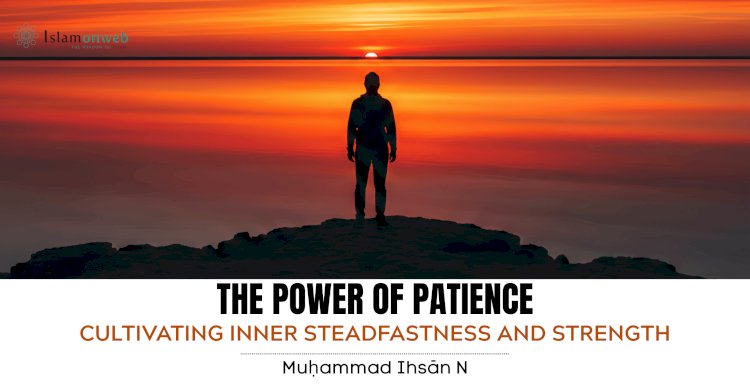
Patience is one of the most central and frequently emphasised virtues in Islam. It reflects a believer’s ability to restrain the self, govern inner impulses, and maintain composure during hardship or provocation. This quality accompanies a person throughout every stage of life, from childhood to old age. An infant must patiently endure dependence and care, while an elderly person learns patience in adjusting to changing relationships with children and relatives.
The Qur’an and the Prophetic teachings repeatedly highlight patience as a cornerstone of character formation, sound relationships, and a deeper bond with Allah. It is not merely passive endurance, but a conscious strength that shapes behaviour and inner balance. This article explores the concept of patience in Islam, its different forms, and the practical means through which one can cultivate it in daily life.
Patience in the Qur’an
The Qur’an discusses patience repeatedly across its chapters, presenting it as a virtue of profound beauty and inner strength. One of its most moving expressions appears in Sūrat Yūsuf, in the words of Prophet Yaʿqūb (عليه السلام):
فَصَبْرٌ جَمِيلٌ
“So, beautiful patience.” (Qur’an 12:18)
Prophet Yaʿqūb (عليه السلام) endured years of grief after losing his beloved son, Prophet Yūsuf (عليه السلام). He wept for so long that he eventually lost his eyesight. Yet, to him, blindness was lighter than the pain of separation, for he believed he would never see his son again. What followed, however, was a sequence of divine mercies. He was reunited with Yūsuf (عليه السلام), and through that meeting, his sight was restored. His story is a lesson in ṣabr jamīl—patience without complaint, anchored in trust in Allah.
The life of Prophet Ayyūb (عليه السلام) offers another striking example of steadfast patience. Allah tested him with the loss of wealth and livestock, the barrenness of his land, the death of his children, and finally, severe illness that left his body weakened and wounded. Abandoned by all except his devoted wife, Ayyūb (عليه السلام) remained firm in worship and gratitude. Not once did he turn away from his Lord. His patience was not passive suffering, but unwavering devotion.
The stories of Yaʿqūb (عليه السلام) and Ayyūb (عليه السلام) remind us that true patience is often a deeply personal journey. At times, no one fully comprehends our pain except ourselves—and Allah. Through patience, a person discovers the deeper meaning of life and the richness of the inner self.
وَٱصْبِرُوا۟ ۚ إِنَّ ٱللَّهَ مَعَ ٱلصَّـٰبِرِينَ
“And be patient; indeed, Allah is with the patient.” (Qur’an 8:46)
The greatest embodiment of patience is found in the life of Prophet Muḥammad ﷺ. Throughout his 23 years of prophethood, he faced rejection, mockery, persecution, and loss—yet his response remained rooted in patience and mercy. One of the most painful moments was his journey to Ṭāʾif after facing rejection in Makkah. He was met with cruelty and humiliation, yet when Jibrīl (عليه السلام) offered to destroy the people of Ṭāʾif, the Prophet ﷺ refused. He restrained his grief and anger, choosing hope over vengeance.
This patience reached its peak during the conquest of Makkah. Returning as a victor, the Prophet ﷺ held the power to seek retribution. Instead, he declared to his former persecutors:
ٱذْهَبُوا فَأَنتُمُ ٱلطُّلَقَاءُ
“Go, for you are free.”
This moment captures the essence of Islamic patience—strength guided by mercy, restraint born of faith, and victory without bitterness.
Types of Patience
ليس الشديد بالصرعة، إنما الشديد الذي يملك نفسه عند الغضب
“The strong person is not the one who overcomes others by strength, but the strong one is he who controls himself at the time of anger.”
(Ṣaḥīḥ al-Bukhārī, Ṣaḥīḥ Muslim)
There are many different types of classification for patience. It can broadly be understood in three forms: patience during hardship, patience in awaiting outcomes, and patience in self-control. Each reflects a different dimension of inner strength. The first highlights resilience in adversity, the second nurtures perseverance and long-term effort, and the third, self-restraint, is directly connected to the Prophetic teaching mentioned above.
1. Patience in Difficult Times
James Clear, the author of Atomic Habits, shares a powerful personal experience in the preface of his book. During a baseball game in his university days, a bat slipped from a player’s hands and struck him directly in the face. His nose was broken, his eye sockets shattered, and he had to be airlifted to hospital. What seemed like a single moment of disaster turned into months of recovery and pain. Yet, his spirit remained intact. After nearly nine months, he returned to the field, and that long struggle eventually became the motivation behind writing Atomic Habits.
Clear speaks about the idea of a “cue”, a trigger or turning point that initiates change. Life-altering moments, though painful, often become the very signals that redirect a person towards growth and success.
From an Islamic perspective, this meaning runs even deeper. The One who decrees the trial is also the One who has already decreed the way forward. Allah, who leads a servant through difficulty, has also placed within that hardship a new opening, another path towards elevation and success. Tragedy is not a dead end; it is often a concealed beginning.
Many people collapse inward when calamity strikes, blaming themselves or surrendering to despair. This response, however, is unjust to the wisdom of divine decree. What is required is to recognise the moment, identify the turning point, and move forward with trust and effort. In other words, find the cue—and hold onto it with patience.
2. Patience in Waiting for Results
Outcomes often resemble the growth of a newborn. They do not arrive instantly, nor do they take shape overnight. Just as a child needs time to grow, understand, and respond, results too require nurturing, repetition, and endurance. One may instruct, hope, and strive—but the fruit may appear only after years of quiet persistence.
Imam al-Shāfiʿī (رحمه الله) beautifully captures this reality:
لو كان حبك صادقًا لأطعته
إنَّ المحبَّ لمن يحبُّ مطيعُ
“If your love were true, you would have obeyed Him;
for the one who truly loves is always obedient to the one he loves.”
This line reflects how genuine love fuels commitment. When love is real, compromise fades. We do not negotiate with what we truly love; we devote ourselves to it. In everyday life, a mother offers the clearest example. She carries her child for nine months, endures pain and exhaustion, and sacrifices comfort, simply because love makes hardship meaningful.
Likewise, patience in waiting for results requires finding something worthy of love: a purpose, a value, or a path that gives life meaning. When love anchors effort, waiting no longer feels like punishment; it becomes part of the journey.
There is a popular saying that we eventually become the result of the five people closest to us. While there is truth in influence, this idea can be dangerous if accepted blindly. Influence works both ways - good or bad - and without conscious patience and direction, a person may drift rather than grow.
Even the smallest, consistent change can reshape an entire life. A one-percent shift, if sustained, leads to remarkable transformation. Consider an aeroplane at take-off: if its direction deviates by even a single centimetre at the start, its final destination could be hundreds or even thousands of kilometres away from the intended point. A tiny adjustment, or a tiny error, can carry enormous consequences over time.
There is a simple yet profound story that captures this spirit. A man once asked his wife why she regularly prayed to Allah during Tahajjud. He said, “If Allah loves you, why do you still pray so intensely?” She replied, “Allah loves me—that is precisely why I pray Tahajjud.”
This is patience in waiting for results: loving the process, trusting the One who grants outcomes, and remaining faithful long before success becomes visible.
3. Patience in Self-Control
ليس الشديد بالصرعة، إنما الشديد الذي يملك نفسه عند الغضب
“The strong person is not the one who overpowers others, but the one who controls himself at the time of anger.”
(Ṣaḥīḥ al-Bukhārī, Ṣaḥīḥ Muslim)
In this section, we encounter two refined arts taught by Prophet Muḥammad ﷺ: the art of peaceful restraint and the art of wise management of situations. True self-control grants a person dignity and gives their personality a quiet radiance. It teaches us to restrain ourselves when temptation arises or when someone provokes us without justification.
At times, we may feel fully entitled to anger. Yet, having a right to anger does not always make anger the right response. When a person restrains himself at that very moment, he achieves a moral victory—without raising his voice or striking back. This is where the art of peaceful restraint truly lies.
Religious and social leaders offer a clear example of this quality. They face countless problems, hear stories of hardship and tragedy from people daily, and carry heavy emotional burdens. Still, through self-control and patience, they manage these pressures calmly and decisively. The result is relief and reassurance for many—real happiness that emerges from the patience they have cultivated over time.
Another profound Prophetic teaching captures this essence:
الصبر عند الصدمة الأولى
“Patience is at the first shock.”
(Ṣaḥīḥ al-Bukhārī, Ṣaḥīḥ Muslim)
The Prophet ﷺ once visited a household where a child had passed away. He found the mother overwhelmed with grief, crying loudly. He gently advised her to remain patient. In her pain, she responded, “I am the one who lost the child, not you.” The Prophet ﷺ calmly replied, reminding her that true patience is shown at the moment of the first shock.
Her grief was real, and her pain undeniable. Yet uncontrolled emotion at that moment could not change the decree, nor bring the child back. What carries true weight before Allah is restraint at the instant when the heart is struck hardest. Such patience is immensely rewarded.
Islam does not deny human emotion, nor does it suppress natural feelings of sorrow or pain. But it guides believers to rise above impulsive reactions, especially in moments of crisis. While emotions may seem justified in worldly terms, what ultimately matters for a believer—who looks beyond this life—is responding in a way that aligns with faith, dignity, and the hereafter.
That is the essence of patience in self-control: strength without aggression, calm without weakness, and faith that leads the heart before emotion takes the lead.
The Five-Second Rule
The five-second rule is a simple yet powerful principle in communication. It teaches us to pause for five seconds before responding—to think rather than react. A reaction is driven by raw emotion, while a response is guided by wisdom. Both emerge in the same moment, but they lead to very different outcomes.
This idea can be understood through a simple example. The price of a bottle of water is vastly different at a local shop and at an airport. The product is the same, but the context changes its value. Likewise, the same words or actions, when delivered in different emotional states, produce entirely different effects. Calmness reflects maturity and depth, while uncontrolled temper often strips a person of dignity.
Islam beautifully summarises this balance with the saying:
الصبر نصف الإيمان
“Patience is half of faith.”
In essence, a person is recognised as wise and refined not merely through outward traits such as generosity or eloquence, but through patience and self-control. These qualities anchor the soul during moments of pressure and prevent regret born of haste.
Therefore, striving to pause, reflect, and respond—especially in situations that feel overwhelming—is not weakness; it is strength. This is precisely the heart of the Prophetic wisdom: patience is not just a virtue among many, it is the backbone of faith itself.
About the author
Muḥammad Ihsān N is a postgraduate student at Darul Huda Islamic University. He is also pursuing a Bachelor’s degree in English through IGNOU. His academic interests include Islamic ethics, character formation, and the integration of spiritual values with contemporary self-development thought.
References
The Qur’an. Al-Qur’ān al-Karīm [The Noble Qur’an].
Al-Bukhārī, Muḥammad ibn Ismāʿīl. Ṣaḥīḥ al-Bukhārī. Compiled in the 3rd century AH.
Muslim ibn al-Ḥajjāj. Ṣaḥīḥ Muslim. Compiled in the 3rd century AH.
Clear, James. Atomic Habits: An Easy and Proven Way to Build Good Habits and Break Bad Ones. New York: Avery, 2018.
Disclaimer
The views expressed in this article are the author’s own and do not necessarily mirror Islamonweb’s editorial stance.


Related Posts














Leave A Comment