
The Post-Human Interface: Artificial Intelligence, Memory Extraction, and the Islamic Definition of Human Rūḥ (Soul)
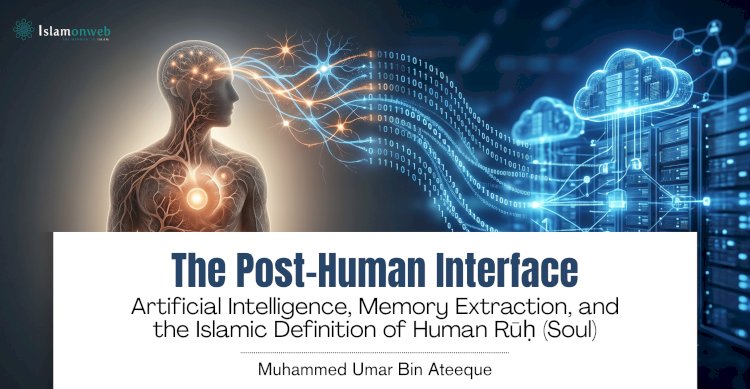
Silicon Valley transhumanism currently whispers an intoxicating promise into the ear of a weary, mortality-bound civilisation: that death is merely an engineering flaw, and that human identity, complete with autobiographical memory, personality markers, and cognitive processes, can soon be extracted, digitised, and uploaded to cloud-based matrices to achieve secure digital immortality.
This techno-utopian ambition rests upon a radical materialist premise: that the human being is nothing more than an advanced biological computer, an intricate network of data points, algorithms, and neurochemical processes waiting to be backed up onto silicon.
As contemporary technological trajectories rapidly converge toward this post-human horizon, they challenge the very definition of what it means to be human. This article examines the philosophical and theological tension between digital reductionism and the classical Islamic framework of human anthropology, with a focus on the metaphysical reality of the rūḥ (soul). By contrasting algorithmic memory replication with the sacred interiority protected by Islamic epistemology, this study argues that the human soul remains an irreducible, divinely created reality that fundamentally defies digital capture.
The Technicist Reduction: Dataism and the Erasure of Interiority
To understand the ideological foundations of the post-human project, one must critically examine the worldview commonly described as "Dataism". Dataism evaluates phenomena, including subjective human consciousness, through the framework of data processing, measurement, and algorithmic output.[1]
Within this framework, human memories, emotions, and personality characteristics are reduced to quantifiable information. If memory is understood merely as biological data storage, then the technological assumption follows that extracting, storing, and reproducing those patterns on artificial systems would constitute the preservation of human identity.
However, philosophical critiques of digital reductionism argue that this approach overlooks the qualitative dimensions of human existence. Byung-Chul Han observes that digital systems transform human experience into measurable information, weakening the hidden interior dimension of human life where reflection, meaning, and authentic subjectivity exist.[2]
From this perspective, the post-human ambition commits a fundamental philosophical error: it confuses the observable functions associated with human behaviour with the deeper metaphysical reality of consciousness itself.
The Islamic Metaphysics of the Rūḥ (Soul)
In contrast to materialist reductionism, Islamic anthropology understands the human being as a creation consisting of both a physical dimension and a transcendent spiritual reality. The human body originates from earthly elements, while the rūḥ represents a higher reality created by Allah.
The Qurʾān addresses the mystery of the rūḥ when Allah says:
"And they ask you concerning the rūḥ. Say, 'The rūḥ is of the affair of my Lord, and mankind have not been given of knowledge except a little.'"[3]
This verse establishes an important epistemological boundary: although human beings may investigate biological processes, the ultimate nature of the rūḥ remains beyond complete human comprehension.
Classical Muslim scholars emphasised that the rūḥ is not merely a physical mechanism or a collection of information patterns. Abū Ḥāmid al-Ghazālī described the inner reality of the human being through concepts such as the qalb (heart) and the spiritual faculty that connects humanity with divine knowledge and moral awareness.[4]
Therefore, from an Islamic perspective, consciousness cannot be reduced entirely to neurological activity. Human awareness, moral responsibility, spiritual yearning, and relationship with Allah represent dimensions that exceed material explanation.
Memory Extraction versus Sacred Remembrance (Dhikr)
One of the major developments within contemporary transhumanist research is the attempt to create advanced brain-computer interfaces capable of recording, analysing, and reproducing aspects of human memory.
Such technologies may provide valuable medical benefits, particularly in treating neurological disorders. However, the philosophical implications of these technologies raise deeper questions about identity, personhood, and the nature of human consciousness.
In Islamic thought, memory is not merely a storage mechanism. It is connected to moral accountability (taklīf), repentance (tawbah), gratitude (shukr), and remembrance of Allah (dhikr).
Human memories carry ethical and spiritual meaning. A person's recollection of wrongdoing may lead to repentance, while remembrance of blessings may inspire gratitude. A digital copy of memory may preserve information, but it cannot reproduce the spiritual transformation that occurs within the human heart.
Similarly, Islamic scholars have traditionally understood the intellect (ʿaql) and heart (qalb) as spiritual faculties rather than merely computational systems. Although artificial intelligence may imitate language, recognise patterns, and generate responses, it does not possess genuine reliance upon Allah (tawakkul), humility before Him (khushūʿ), or experiential spiritual knowledge (maʿrifah).
The Post-Human Illusion: Simulating Consciousness versus Possessing a Soul
The central philosophical problem of post-humanism lies in confusing simulation with reality.
Artificial intelligence systems can imitate human conversation, reproduce emotional expressions, and analyse enormous amounts of information. A sufficiently advanced digital replica may appear outwardly similar to a human being.
However, Islamic theology maintains a distinction between genuine creation (khalq) and artificial imitation.
Ibn Taymiyyah, in his discussions on human nature and intellect, emphasised the unique status of human beings as creatures honoured by Allah with moral responsibility, understanding, and free will (irādah).[5]
A machine, regardless of its computational power, operates through programmed structures. It does not possess an inner spiritual awareness or experience reverence before Allah (khashyah).
Therefore, uploading human consciousness into a digital system would not represent true immortality. Instead, it would represent the creation of a technological imitation that lacks the spiritual reality that gives human existence its meaning.
Conclusion
The post-human pursuit of artificial intelligence integration and memory extraction represents one of the most ambitious expressions of modern materialist thought. By attempting to reduce human identity to information patterns, technological reductionism overlooks the deeper dimensions of human existence.
The Islamic worldview provides a profound alternative by affirming the transcendent reality of the rūḥ. Human beings are not merely biological machines awaiting technological enhancement; they are divinely created beings entrusted with moral responsibility, spiritual purpose, and a unique relationship with their Creator.
The mysteries of human consciousness, conscience, and spiritual longing ultimately remain beyond the reach of algorithmic replication. The rūḥ cannot be uploaded, copied, or engineered, because its reality belongs to a higher order of existence established by Allah.
About the author:
Muhammed Umar Bin Ateeque is a degree student at Darul Huda Islamic University with interests in Islamic theology, philosophy, AI ethics, and contemporary Islamic thought. He engages in academic writing, Islamic studies, and research on emerging intellectual challenges
Endnotes
- Yuval Noah Harari, Homo Deus: A Brief History of Tomorrow (London: Harvill Secker, 2016), 380–395.
- Byung-Chul Han, Psychopolitics: Neoliberalism and New Technologies of Power (London: Verso, 2017), 45–52.
- The Qurʾān, Sūrah al-Isrāʾ (17):85. Translation adapted from Ṣaḥīḥ International.
- Abū Ḥāmid al-Ghazālī, Iḥyāʾ ʿUlūm al-Dīn, vol. 3 (Beirut: Dār al-Maʿrifah, n.d.), 3–11.
- Aḥmad ibn Taymiyyah, Majmūʿ Fatāwā Shaykh al-Islām Aḥmad ibn Taymiyyah, vol. 9 (Riyadh: Maṭābiʿ al-Riyāḍ, 1963), 302–308.
Disclaimer
The views expressed in this article are the author’s own and do not necessarily mirror Islamonweb’s editorial stance.


Related Posts












Leave A Comment