
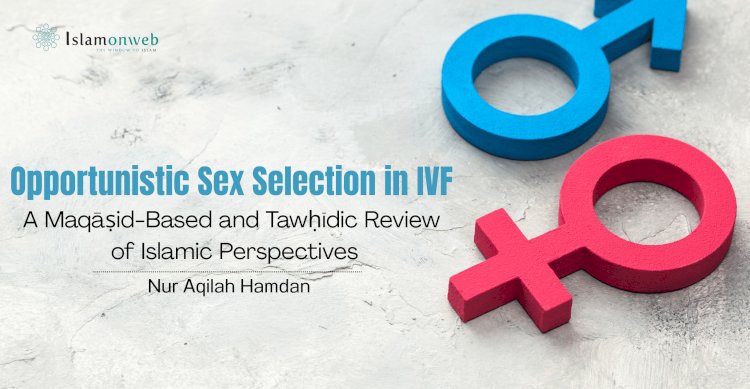
Opportunistic Sex Selection in IVF: A Maqāṣid-Based and Tawḥīdic Review of Islamic Perspectives
Article Reviewed:
Muhsin, S.M., Arab, S.Z. & Chin, A.H.B. Islamic Viewpoints on Opportunistic Sex Selection of IVF Embryos upon doing Preimplantation Genetic Testing for Preventing Genetic Diseases. ABR 16, 223–232 (2024). https://doi.org/10.1007/s41649-023-00258-1
https://link.springer.com/article/10.1007/s41649-023-00258-1#citeas
Introduction
This article examines Islamic perspectives on the use of preimplantation genetic testing (PGT) in in vitro fertilisation (IVF), particularly with the intention of selecting the sex of embryos for purposes other than medical reasons. It explores the moral dilemmas raised using PGT to determine a baby's gender in societies where having sons is frequently preferred and how that can conflict with Islamic principles. This topic is particularly important to address since it directly impacts Muslim society, patients and medical practitioners, and it has significant implications for their religious commitments in an era of rapidly improving medical advancements. Clear fiqh decisions and well-founded Islamic perspectives become crucial as biomedical advancements continue to develop and spread throughout the world, particularly when handling sensitive and challenging medical practices. Examining this matter through an Islamic perspective not only clarifies the ethical boundaries established by the Sharīʿah but also provides crucial guidance for Muslim healthcare professionals and patients, enabling them to make right decisions that align with Islamic principles.
Summary
With the rapid growth of medical technology particularly in the field of reproductive medicine, several procedures have been developed to avoid genetic diseases. One of these developments is Preimplantation Genetic Testing (PGT), a process used to screen and diagnose genetic abnormalities in embryos before implantation, including genetic diseases such as Down syndrome. However, this procedure also unintentionally reveals the sex of embryos developed through in vitro fertilisation (IVF), hence offering an opportunity for choosing the sex of embryos beyond medical reasons. This creates serious ethical challenges within Islamic bioethics, particularly when parents determine the sex of embryos without acceptable medical reasons. Such practice often referred to as opportunistic sex selection. Thus, it is crucial to discuss especially when it is involving Muslims, and it has become a debatable and hot topic within Muslim society as it is related to the religious issue. This is mostly due to the gender discrimination that certain culture is more preferring to have sons over daughter to inherit the family heirs, as well as the need for male or sons to support family financial in the future. These reasons may encourage opportunistic sex selection, which raises the possibility of gender imbalance in Muslim communities. The imbalance not only creates urgent ethical concerns but also provides deeper societal and moral challenges that deserve thorough evaluation within the framework of Islamic bioethics in order to make sure that decisions made by Muslim patients and medical practitioners are compatible with Islamic ethical values. Therefore, this paper intends to analyse the permissibility of opportunistic sex selection by PGT in IVF treatments and to determine whether such methods are consistent with Islamic ethics and its principles.
Presentation Styles
The article adopts an effective presentation style that is systematic, simple and straightforward, ensuring that the complex topics of Islamic bioethics discussion can be followed even by non-specialist audience. The logical arrangement of the framework makes it simple for readers to follow the flow of the main points. Additionally, a highly useful aspect is the use of a comparison table to clearly outline the arguments for and against non-medical sex selection. This visual tool makes it easier for readers to comprehend and compare the opposing perspectives on the issue at hand. For overall of the study, it is easier to understand as the language is kept at a level of clear and straightforward English.
Critical Review
The authors have successfully addressed the distinction between medical and non- medical reasons of sex selection and the methods available for this medical technique. It indicates that while developments in technology have enabled sex selection, their acceptability differs among cultures and religions, particularly in Islamic contexts. The discussion is focused on the main purpose of Islamic law and the significance of aligning reproductive techniques to the principles of Islam. The authors outline several Islamic opinions based on Quran and Sunnah in viewing this issue. Islam has emphasized and stated in Quran and Sunnah that only Allah has the authority and power to determine the gender or sex of the offspring, viewing human attempts at sex selection especially for non-medical reasons as it is interfering in divine authority. The Quran stated that: “Indeed, Allah alone has the knowledge of the Hour. He sends down the rain and knows what is in the wombs” (Luqman: 34). In addition, the reasons against non-medical sex selection also point out by the authors that this technique is similar to the attempt to change and alter Allah’s creation, which is clearly prohibited in Islam and will lead to the social imbalance such as widespread of gender imbalance and unregulated sex selection.
Although the article ultimately leans towards prohibiting opportunistic sex selection, it provides several arguments made by researchers who believe non-medical sex selection potentially lawful. These include the belief that as all human activities are regulated by divine decree, medical intervention does not conflict with Allah's decision. As a result, the use of technology to choose embryo sex does not violate Allah's authority. Furthermore, some contemporary jurists allow sex selection for family balancing where it fulfils a genuine purpose, while others argue that because there is no specific scriptural restriction, such practices fall under the default rule of permissibility if no harm is done. Finally, those who support non-medical sex selection claim that the technology itself is ethically neutral, and its permissibility depends on the intention and consequence rather than the method alone.
The article also continues discussing the permissibility of sex selection, categorizing it between medical interventions and without medical intervention. It points out that the natural methods (without medical intervention) are generally seen as permissible based on a story mentioned in Quran when Prophet Jacob prayed to grant him an heir which obviously refer to a male and based on the Hadith from Sahih Bukhari regarding this. Thus, majority Muslim jurists concluded that sex selection without medical intervention appears to be permissible considering the Islamic legal maxims of “the basic original ruling of all things is permissibility or halal” and there is no proof from Quran and Sunnah that seeks to change this original ruling.
Additionally, sex selection with medical intervention also been addressed successfully by the authors. It indicates that contemporary Muslim jurists agree that sex selection at the mass or community level is illegal since it might lead to instability and gender ratio imbalance, both of which are seen as a threat to social order. However, there are two different opinions regarding sex selections with medical interventions when performed at an individual level. The scholars view that this practice is prohibited by arguing that interfering with creation is expressly forbidden in the Quran and only Allah has the power to decide the sex of offspring and such intervention violates Allah's divine jurisdiction. Conversely, some scholars believe individual situations are permissible when there is a genuine difficulty, such as families desire a male heir for financial future support and societal reasons. They explain this by referring to the hadith that related to children resemblance and also supported by the hadith from Sunan Al-Tirmidhi Hadith No. 1726.
For the conclusion, the article outlines the main argument by pointing out that Islamic law generally permits actions or practices that are not explicitly prohibited, while emphasizing the ethical status of sex selection varies on circumstances, purpose and potential societal effects. In addition to ensuring social equity and preventing demographic imbalance, it highlights the necessity of preventing harm, preserving societal stability, and upholding divine authority. The article concludes by stating that non-medical sex selection is generally forbidden by Islamic beliefs based on the Qur'an and Sunnah since it violates Allah's divine right to determine offspring. However, it acknowledges that sex selection using PGT to prevent significant genetic illnesses may be acceptable. Additionally, the authors also suggest the practical recommendations for Muslim countries that allow non-medical sex selection by PGT in severe cases to set up ethics committees consisting of physicians, Islamic jurists, and IVF scientific experts to review and approved it based on the severity of their needs. This concise suggestion has enhanced the overall discussion of this article.
In writing this article the authors demonstrated the article’s strength, which can be emulated by other authors and researchers. However, there are significant weakness of the article is its restricted application of a maqāṣid al-sharīʿah based analytical framework in examining the permissibility and ethical consequences of sex selection by PGT. Although the authors address the issues of demographic imbalance and societal harm, they do not specifically ground their arguments in fundamental maqāṣid concepts like preserving religion, preserving lineage, preserving life and preventing harm. This absence weakens the ethical grounding of their argument, particularly when contemporary biomedical developments like this medical practice of sex selection in PGT require serious engagement and thorough analyses with higher objectives of the Sharīʿah to evaluate ethical acceptability.
Besides, another important gap in the article is its lack of discussion of Tawḥīdic epistemology, a fundamental component of the Islamic worldview that unifies revelation, intellect, and scientific knowledge under Allah's authority, is another notable flaw. The authors do not situate the topic within the Tawḥīdic idea that all knowledge, including scientific and medical achievements, ultimately comes from Allah, like already been stated that “and they encompass not a thing of His knowledge except for what He wills” (Al- Baqarah:255). Incorporating this perspective would have strengthened the ethical analysis by reminding readers that technological proficiency does not inevitably justify unrestricted application. A Tawḥīdic framework would highlight that although modern reproductive technologies are helpful tools, Muslims must stay conscious of divine restrictions and moral boundaries, ensuring that every medical decision in line with the higher objectives and ideals of the Sharīʿah. Without this Tawḥīdic epistemology dimension, the paper misses the opportunity to emphasise the need of positioning current medical decisions in a sense of divine authority and ethical responsibilities that accompany human understanding especially in this development of the medical field. This missing component of epistemology limits the article’s capacity to give a holistic Islamic perspective on sex selection using PGT.
Another significant shortcoming of the article is it failed to address two important ethical aspects which are the principle of sadd al- dharā’iʿ (blocking a way to harm) and also gender justice in Islam. Even though the authors briefly acknowledge the potential of demographic imbalance, they do not expressly apply sadd al-dharā’iʿ, a core juristic concept used to prevent action that may lead to significant short or long-term harm. This is particularly crucial because sex selection technologies especially beyond medical reasons have the potential to promote discriminatory attitudes, upset gender ratios, and put families at further risk. These risks include the possibility of psychological harm to a child who later finds out they were sex-selected, preferential treatment for children of the preferred sex, or parental disappointment if a child of the opposite sex is eventually born (Sunita et al., 2010). Furthermore, by allowing non-medical sex selection could divert limited medical resources from actual medical needs. In addition to these issues, the paper does not create a comprehensive discussion on gender equity founded in the Qur’an and Sunnah. Islamic condemnations of female infanticide that stated in Qur’an, “Whenever one of them is given the good news of a baby girl, his face grows gloomy, as he suppresses his rage. He hides himself from the people because of the bad news he has received. Should he keep her in disgrace, or bury her alive in the ground? Evil indeed is their judgment!” (An-Nahl: 58–59) and prophetic teachings that honour and dignify daughters could have offered a stronger ethical framework for opposing sex-biased reproductive decisions. The lack of these viewpoints restricts the article's ethical analysis's broadness and ignores significant Islamic principles that have directly related to the sex selection issue.
Although the authors recommend the establishment of ethics committees to review and approved the requests for sex selection by PGT especially for non-medical sex selection, the study does not present a thorough or systematic set of guidelines established in Islamic law for clinicians, legislators, or healthcare organisations. This highlights a crucial gap, as contemporary reproductive technologies require clear, context-specific guidance to enable ethical decision-making that aligns with Islamic beliefs. A recent review of legislation and ethical standards relevant to assisted reproduction in 14 Muslim countries identified widespread deficits in structure, depth, and regulatory clarity on the controversial and sensitive issue within this context including sex selection (Kooli, 2020). The absence of such framework restricts the practical effectiveness of the authors’ suggestions, particularly for Muslim practitioners who must deal with sensitive bioethical issues while following to the boundaries of halal and haram in Islam. In order to ensure that technological advancements do not overshadow the ethical and legal obligations of the Sharīʿah, further research is required to develop comprehensive Islamic guidelines that can guide policy, regulate medical practice, and support decision-making in a rapid changing of biomedical setting.
Conclusion
In summary, the authors have properly tackled this sensitive yet crucial topic and present an important ethical dilemma for parents who must choose between following religious prohibitions on sex selection and seeking the social acceptance associated with having a son (Bokek-Cohen & Tarabeih, 2020). By integrating the above-mentioned enhancements to the article would help Muslim patients and medical professionals make decisions that are strongly compatible with Islamic values. In the context of contemporary reproductive technologies, such improvements would not only make the underlying logic of Islamic regulations more understandable, but they would also assist people in making well-informed decisions, free from ethical conflict, doubt, or confusions.
About the author
Nur Aqilah Hamdan is a postgraduate student in the department of Fiqh and Usul Fiqh at International Islamic University Malaysia and holds a bachelor's degree in Fiqh and Usul Fiqh from Yarmouk University, Jordan.
References
Kooli, C. (2020). Review of assisted reproduction techniques, laws, and regulations in Muslim countries. Middle East Fertil Soc J 24, 8 https://doi.org/10.1186/s43043-019-0011-0.
Puri, S., & Nachtigall, R. D. (2010). The ethics of sex selection: a comparison of the attitudes and experiences of primary care physicians and physician providers of clinical sex selection services. Fertility and sterility, 93(7), 2107–2114. https://doi.org/10.1016/j.fertnstert.2009.02.053
Ya'arit Bokek-Cohen, & Tarabeih, M. (2020). Forbidden medically assisted sex selection in Sunni Muslims: A qualitative study. Reproductive BioMedicine Online, 41(3), 534–542. https://doi.org/10.1016/j.rbmo.2020.05.018
Disclaimer
The views expressed in this article are the author’s own and do not necessarily mirror Islamonweb’s editorial stance.

Related Posts















Leave A Comment