
Qur'an 4:34, Nushūz, and the Question of Domestic Violence: An Islamic Perspective
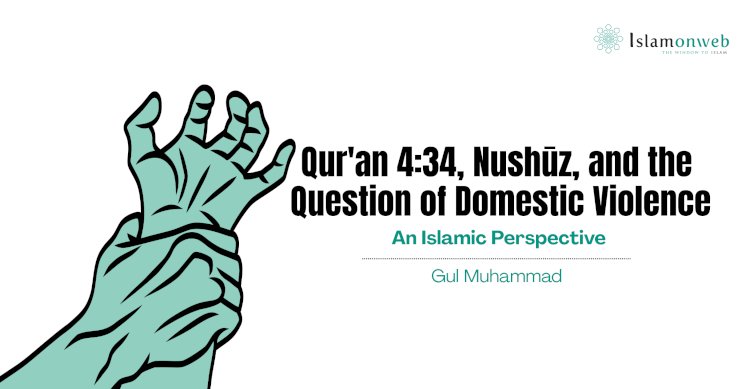
Domestic violence is one of the most serious problems affecting families today. In discussions of Islam and women's rights, Qur'an 4:34 is often presented as one of the most controversial verses in the whole Qur'an. Critics claim that it gives husbands the right to physically discipline their wives. Muslim scholars, however, have long argued that this reading ignores the language of the verse, its historical background, the strict conditions jurists placed on it, and above all the conduct of Prophet Muhammad ﷺ, who is reported never to have struck a woman.[1]
The debate around Qur'an 4:34 centres on three connected ideas: qiwāmah (a husband's responsibility toward his household), nushūz (serious marital breakdown), and the disputed final measure named in the verse, wa-iḍribūhunna. This article looks at how these terms have been understood in classical exegesis (tafsīr), Islamic law (fiqh), and modern scholarship. It also compares several recognised English translations of the disputed phrase, and explains why scholars from very different schools of thought still arrive at the same basic conclusion: Islam does not permit domestic abuse.
Marriage in the Qur'an
Before turning to Qur'an 4:34, it helps to recall how the Qur'an describes marriage in general. Spouses are described as a source of comfort for one another:
وَمِنْ ءَايَـٰتِهِۦٓ أَنْ خَلَقَ لَكُم مِّنْ أَنفُسِكُمْ أَزْوَٰجًۭا لِّتَسْكُنُوٓا۟ إِلَيْهَا وَجَعَلَ بَيْنَكُم مَّوَدَّةًۭ وَرَحْمَةً
"And among His signs is that He created spouses for you from among yourselves, so that you might find comfort in them, and He placed between you affection and mercy." (Qur'an 30:21)
Husband and wife are also described as garments for one another (Qur'an 2:187), and believers are told to live with their spouses in kindness (Qur'an 4:19). Prophet Muhammad ﷺ put this simply: "The best among you are those who are best to their families, and I am the best among you to my family."[2] Qur'an 4:34 has to be read inside this framework. It cannot be pulled out of it.
The Text of the Verse
ٱلرِّجَالُ قَوَّٰمُونَ عَلَى ٱلنِّسَآءِ بِمَا فَضَّلَ ٱللَّهُ بَعْضَهُمْ عَلَىٰ بَعْضٍۢ وَبِمَآ أَنفَقُوا۟ مِنْ أَمْوَٰلِهِمْ ۚ فَٱلصَّـٰلِحَـٰتُ قَـٰنِتَـٰتٌ حَـٰفِظَـٰتٌۭ لِّلْغَيْبِ بِمَا حَفِظَ ٱللَّهُ ۚ وَٱلَّـٰتِى تَخَافُونَ نُشُوزَهُنَّ فَعِظُوهُنَّ وَٱهْجُرُوهُنَّ فِى ٱلْمَضَاجِعِ وَٱضْرِبُوهُنَّ ۖ فَإِنْ أَطَعْنَكُمْ فَلَا تَبْغُوا۟ عَلَيْهِنَّ سَبِيلًا ۗ إِنَّ ٱللَّهَ كَانَ عَلِيًّۭا كَبِيرًۭا
"Men are the caretakers of women, as men have been provisioned by Allah over women and tasked with supporting them financially. Righteous women are devoutly obedient and, when alone, protective of what Allah has entrusted them with. And if you sense ill-conduct (nushūz) from your women, advise them first; if they persist, do not share their beds; if they still persist, [wa-iḍribūhunna]. But if they change their ways, do not be unjust to them. Allah is Most High, All-Great."[3] (Qur'an 4:34)
Wa-iḍribūhunna is left untranslated above on purpose. Its exact meaning is precisely what scholars disagree about, and that disagreement is explained later in this article.
The verse presents three progressively more serious measures: admonition, withdrawal from the marital bed, and the disputed final measure. Classical exegetes generally understood these as stages intended to address continuing marital discord rather than as measures to be undertaken impulsively
The verse first speaks about a husband's financial responsibility (qiwāmah), then turns to nushūz and lays out three steps in order: verbal admonition, temporary withdrawal from the marital bed, and a third, disputed measure. Classical and modern scholars agree on one thing here: this is a graduated sequence, not a set of options a husband can pick from freely. Its purpose is to slow a conflict down, not speed it up.[4]
Qiwāmah: Responsibility, Not Superiority
Classical exegetes generally understood qiwāmah as involving financial maintenance, responsibility for the family, and a degree of household authority. Modern reformists such as Muhammad ʿAbduh and Rashīd Riḍā emphasised its functional character, linking it closely to the husband’s financial obligations rather than treating it as an affirmation of men’s inherent superiority. [5]
The Meaning and Scope of Nushūz
Nushūz comes from the Arabic root n-sh-z, meaning "to rise" or "to become elevated." Ibn Manẓūr's Lisān al-ʿArab explains that it describes a spouse who rises up against the other through hostility.[6] Jurists built more specific legal definitions on top of this. Shāfiʿī fiqh manuals define nushūz as the wife overstepping the duties she owes her husband; Ḥanbalī manuals define it in a similar way, as disobedience regarding the obligatory rights of marriage.[7] Classical fiqh also recognised nushūz on the husband's side — emotional neglect, harshness, or mistreatment of a wife — and the Qur'an addresses this possibility directly in a later verse.[8]
In Tafsīr al-Manār, ʿAbduh and Riḍā treat nushūz as a serious disturbance of marital life requiring a gradual and restrained response, rather than as justification for reacting harshly to ordinary disagreements.[9] Modern scholarship narrows the term further. Khaled Abou El Fadl similarly argues that nushūz should not be extended to ordinary domestic friction or used to legitimise arbitrary marital authority. A husband has no basis, he stresses, to treat a burnt meal or an unironed shirt as nushūz.[10] These are related but distinct positions. ʿAbduh and Riḍā read nushūz through the Qur'an's careful choice of language; Abou El Fadl reads it through the lens of harm and misused authority.
Historical Setting and the Reformative Direction of the Verse
Pre-Islamic Arabia was a deeply patriarchal society. Female infanticide, forced marriage, unrestricted polygyny, and arbitrary treatment of women were common, and women were often excluded from inheritance and denied any legal standing.[11] Islamic legislation intervened directly against several of these practices. It prohibited female infanticide, gave women independent inheritance rights, required a wife's consent to marriage, and secured her right to mahr (dower) as her own property. [12] The Prophet ﷺ also prohibited marrying a previously married woman without consulting her or a virgin without obtaining her permission[13]. Many scholars place Qur'an 4:34 within this same reforming direction, as a restriction placed on a practice that already existed and was previously unregulated, not as the introduction of something new.[14]
Asma Barlas develops this point at length. She argues that the Qur'an's overall direction moves toward justice and away from oppression, and that gender-related verses have to be read as part of that direction rather than on their own.[15] Amina Wadud makes a related but separate argument. She proposes reading such verses through the Qur'an's own principles of human equality and dignity, rather than through the assumptions of any one exegetical tradition, classical or modern.[16] Barlas's approach is historical and contextual. Wadud's is a hermeneutic built from Qur'anic principles. Both differ again from the maqāṣid-based approach discussed below, and the three should be treated as separate methods rather than lumped together as "the feminist view."
Comparing Translations of Wa-iḍribūhunna
The Arabic root ḍaraba has a wide range of meanings in the Qur'an: to strike, to travel, to set forth an example, to turn away, to separate. Because of this, English translations of wa-iḍribūhunna diverge sharply from one another. The comparison below shows how genuinely contested the term is:
Abdullah Yusuf Ali (1934) translates it as "beat them (lightly)."[17] Marmaduke Pickthall (1930) translates it as "scourge them," though Pickthall himself later expressed doubts about reading the term as physical contact at all.[18] M. A. S. Abdel Haleem (2004) translates it as "hit them," with a note explaining that classical commentators restricted this to a light, non-injurious gesture, and that many jurists regarded avoiding it altogether as preferable.[19] Mustafa Khattab, The Clear Qur'an (2015), renders it "discipline them [gently]," with the bracketed word signalling the restrictions built into the exegetical tradition.[20] Ahmed Ali renders the sequence as advising them, leaving them alone in bed and then returning to marital relations when they are willing, reading ḍaraba through its sense of separation rather than striking, though his own Urdu translation of the same verse renders it "strike them" — which shows how unsettled the term remains even for a single translator.[21] Laleh Bakhtiar, The Sublime Qur'an (2007), renders it "go away from them," treating the final measure as a further stage of separation rather than a physical act.[22]
Although the dominant classical interpretation understood wa-iḍribūhunna as a restricted and non-injurious form of striking, some contemporary scholars and translators have proposed non-physical meanings such as ‘leave’ or ‘separate.’ These modern readings remain contested and do not represent the mainstream classical interpretation.
Classical Juristic Interpretation
Most classical jurists read wa-iḍribūhunna as permitting a form of light, symbolic striking, but they hedged it with restrictions severe enough to limit it drastically in practice. Al-Ṭabarī's Jāmiʿ al-Bayān records, on the authority of Ibn ʿAbbās, that "striking without severity" means striking with a siwāk (a small tooth-stick) or something similar.[23] Al-Jaṣṣāṣ, the Ḥanafī jurist, cites a ruling from Ata that the blow must be of this same non-violent kind, while some later scholars explain that striking by any other means is not permitted.[24] Ibn Kathīr's Tafsīr al-Qurʾān al-ʿAẓīm moves quickly, in its comments on this verse, to record the Prophet's statement, "Do not strike the female servants of Allah," along with a report that when men were later permitted to strike their wives, the Prophet observed that "those men are not among the best of you."[25] Ibn al-ʿArabī, in Aḥkām al-Qurʾān, goes further still, recording the position that a husband should not strike his wife even when she disobeys a direct command, but should instead show his displeasure in other ways.[26]
Al-Rāzī, in Mafātīḥ al-Ghayb, records al-Shāfiʿī's ruling directly: "striking is permitted, but leaving it is preferable [afḍal]."[27] Al-Nawawī states the same preference even more forcefully: "Striking a wife, a servant, or an animal — even where it is nominally justified as discipline — it is still better to avoid."[28] Taken together, these are not marginal or minority opinions. They are the recorded positions of some of the most authoritative names in Sunni jurisprudence, and they converge on treating the disciplinary measure as discouraged in practice, even where it is not formally forbidden.
Reformist and Contemporary Reinterpretation
A separate strand of modern scholarship goes further and asks whether ḍaraba should be read as physical striking at all in this verse. Asma Barlas points to Qur'an 38:44, where the Prophet Ayyūb is instructed to fulfil an oath by striking with "a small bundle of grass," and argues that the Qur'an itself uses ḍaraba elsewhere to mean a symbolic, non-injurious gesture rather than genuine violence. She takes this as support for reading Qur'an 4:34 the same way.[29] She adds that a marriage the Qur'an itself describes as built on affection and mercy cannot coherently authorise violence within it.[30] Other scholars and translators, including Ahmed Ali and Laleh Bakhtiar, propose "to separate" or "to leave" as the intended meaning, arguing that this fits the escalating pattern of the two earlier measures — admonition, then withdrawal from the bed — better than an abrupt turn to physical force.[31] This reading remains contested. Other exegetes reject it on contextual and grammatical grounds, pointing out that classical usage of ḍaraba with a direct human object overwhelmingly means physical contact, albeit subject to extensive restrictions. [32] The disagreement here is real and unresolved, and this article does not claim that either side has become the scholarly consensus.
Abdul Hamid Abu Sulayman takes a different route again. Instead of reinterpreting ḍaraba linguistically, he argues that whatever the term originally meant, its application today has to be governed by the maqāṣid (higher objectives) of Islamic law — chiefly the preservation of human dignity and the prevention of harm (ḍarar) — which he says rules out any application that causes injury, fear, or humiliation. [33] This is a maqāṣid-based argument. It differs from both Barlas's historical-contextual argument and the classical jurists' restriction-by-condition approach described above.
Feminist Muslim Scholarship: Two Distinct Methods
Barlas and Wadud are often grouped together, but their arguments work differently. Barlas's central claim, discussed above, is that Qur'an 4:34 has to be read inside the Qur'an's own historical intervention against pre-Islamic patriarchal violence. [34] Wadud's Qur'an and Woman instead develops what she calls hermeneutics attentive to Qur'anic principles of justice and human equality established elsewhere in the text. She cautions against any reading of Qur'an 4:34 that places one spouse's dignity beneath the others’.[35] Both scholars reject readings of the verse that authorise abuse, but they reach that conclusion through different interpretive methods. That distinction is worth keeping, not collapsing.
The Conduct of Prophet Muhammad ﷺ
For scholars across all the approaches surveyed above, the Prophet's own conduct is the decisive interpretive key. ʿĀʾishah reported:
مَا ضَرَبَ رَسُولُ اللَّهِ ﷺ خَادِمًا وَلَا امْرَأَةً قَطُّ
"The Messenger of Allah ﷺ never struck a servant or a woman."[36]
In another narration the Prophet ﷺ said:
لَا تَضْرِبُوا إِمَاءَ اللَّهِ
"Do not strike the female servants of Allah."[37]
He is also reported to have asked pointedly:
أَيَضْرِبُ أَحَدُكُمُ امْرَأَتَهُ ضَرْبَ الْعَبْدِ ثُمَّ يُجَامِعُهَا فِي آخِرِ الْيَوْمِ
"Does one of you beat his wife as a slave is beaten, and then embrace her at the end of the day?"[38]
In his Farewell Sermon, even while acknowledging the disciplinary measure named in the verse, he restricted it heavily. He told men to treat women kindly, and said that in the event of open, proven misconduct, a husband should withdraw from the marital bed and, only if it came to that, strike lightly, in a way that causes no pain, never striking the face or leaving a mark.[39] The Prophet is reported never to have struck a wife himself, and he discouraged the practice consistently in his teaching. For this reason, scholars across the classical, reformist, feminist, and maqāṣid traditions treat his conduct, not the bare permission recorded in the verse, as the model believers are meant to follow.
Arbitration Over Escalation
The verse immediately after 4:34 turns the discussion toward mediation rather than further discipline:
وَإِنْ خِفْتُمْ شِقَاقَ بَيْنِهِمَا فَابْعَثُوا حَكَمًا مِّنْ أَهْلِهِ وَحَكَمًا مِّنْ أَهْلِهَا
"And if you fear a breach between the two, send an arbiter from his family and an arbiter from hers." (Qur'an 4:35)
Classical and modern jurists read this as evidence that the Qur'an's preferred response to serious marital conflict is mediation and, where necessary, judicial intervention, not further escalation. Classical fiqh manuals also record that a wife suffering harm, neglect, or abusive treatment from her husband could seek redress from a judge, who could order separation, financial penalties, or dissolution of the marriage, depending on the school of law and the severity of the harm.[40] The wider legal tradition is anchored by a maxim central to Islamic law:
لَا ضَرَرَ وَلَا ضِرَارَ
"There is to be neither harm nor reciprocating harm."[41]
Contemporary scholars invoke this maxim directly against domestic violence. Any interpretation of Qur'an 4:34 that results in injury or fear, they argue, defeats its own purpose, producing exactly the harm the wider Sharīʿah exists to prevent.
Islam's Rejection of Domestic Abuse
This point deserves to be stated plainly, since it can get lost in the debate over a single Arabic verb. Across every approach surveyed in this article — classical jurists such as al-Shāfiʿī and al-Nawawī, reformists such as ʿAbduh and Riḍā, feminist scholars such as Barlas and Wadud, and maqāṣid-oriented scholars such as AbuSulayman — there is no disagreement on the underlying point. Injury, bruising, blows to the face, humiliation, coercive control, intimidation, and repeated or severe violence are excluded under every reading of Qur'an 4:34 surveyed here, and they contradict the Prophetic model of marriage described above. Where scholars disagree is on a narrower question: whether the verse's final, symbolic measure, already restricted heavily by the classical jurists themselves, should be read literally at all, or whether it should be understood as a form of separation. That disagreement should not be mistaken for disagreement about domestic abuse, which the Islamic legal and ethical tradition treats as a violation of the marriage contract across every school represented here.
Conclusion
Qur'an 4:34 remains one of the most debated verses in contemporary discussions of Islam and gender. Read on its own, cut off from its linguistic range, its historical background, the restrictions classical jurists placed on it, and the Prophet's own conduct, it can look like a licence for violence. Read the way Muslim scholars have generally read it across thirteen centuries — as part of a graduated, reconciliation-focused process, hedged by strict juristic conditions, corrected by the Prophetic example, and answerable to the Qur'an's own preference for mediation and its prohibition on causing harm — it is not.
Classical jurists, reformists, feminist Muslim scholars, and maqāṣid-based scholars differ in their methods, and sometimes in their conclusions about how wa-iḍribūhunna should be translated. But they converge on rejecting any interpretation that authorises abuse. Domestic violence, in every school of thought surveyed here, contradicts the moral spirit of Islam.
About the author:
Gul Muhammad is a student and independent researcher with an interest in Qur'anic studies, Islamic thought, and contemporary Muslim intellectual discourse. He is affiliated with Qurtuba Leaders' Academy and focuses on Islamic ethics, scriptural interpretation, and the challenges facing Muslim societies today.
Reference
Tafsir al-Manar, Muhammad 'Abduh and Rashid Rida
"Believing Women" in Islam, Asma Barlas
Qur'an and Woman, Amina Wadud
Speaking in God's Name, Khaled Abou El Fadl
Marital Discord: Recapturing the Full Islamic Spirit of Human Dignity, AbdulHamid AbuSulayman
Women and Gender in Islam, Leila Ahmed
Citations:
[1]Sahih Muslim, no. 2328.
[2]Jami' al-Tirmidhi, no. 3895; graded hasan sahih.
[3]Qur'an 4:34; translation adapted from Mustafa Khattab, The Clear Qur'an (Lombard, IL: Book of Signs Foundation, 2015), compared against M. A. S. Abdel Haleem, The Qur'an (Oxford: Oxford University Press, 2004).
[4]Ibn Kathīr, Tafsīr al-Qurʾān al-ʿAẓīm, commentary on Qur’an 4:34; Muhammad El-Arabawy Hashem, “Wife Beating: Modern Readings of the Qur’an (4:34),” Journal of the Faculty of Languages 3, no. 2 (2012): 6–46.
[5]Muhammad 'Abduh and Rashid Rida, Tafsir al-Manar, on Qur'an 4:34 (Cairo: al-Hay'a al-Misriyya al-'Amma lil-Kitab, repr.).
[6]Ibn Manzur, Lisan al-'Arab (Beirut: Dar Sadir, 1990), s.v. "n-sh-z."
[7]On the Shafi'i and Hanbali definitions of nushuz within comparative fiqh literature on family law, see the survey in Abdulla Hassan, "The End to Hitting Women: The Qur'anic Concept of Darb" (MuslimMatters Research), https://muslimmatters.org/2013/12/21/end-hitting-women-islamic-perspective-domestic-violence-imam-abdullah-hasan/5/
[8]Qur'an 4:128.
[9]'Abduh and Rida, Tafsir al-Manar, on Qur'an 4:34.
[10]Khaled Abou El Fadl, Speaking in God's Name: Islamic Law, Authority and Women (Oxford: Oneworld, 2001).
[11]Leila Ahmed, Women and Gender in Islam: Historical Roots of a Modern Debate (New Haven: Yale University Press, 1992).
[12]Qur'an 4:4, 4:7, 4:19, 81:8-9.
[13]Ṣaḥīḥ al-Bukhārī, no. 5136; Ṣaḥīḥ Muslim, no. 1419.
[14]“Wife Beating: Modern Readings of the Qur’an (4:34),” Journal of the Faculty of Languages, vol. 3, no. 2 (2012), pp. 6–46.
[15]Asma Barlas, "Believing Women" in Islam: Unreading Patriarchal Interpretations of the Qur'an (Austin: University of Texas Press, 2002).
[16]Amina Wadud, Qur'an and Woman: Rereading the Sacred Text from a Woman's Perspective (New York: Oxford University Press, 1999).
[17]Abdullah Yusuf Ali, The Holy Qur'an: Text, Translation and Commentary (Lahore, 1934-38), on Qur'an 4:34.
[18]Marmaduke Pickthall, The Meaning of the Glorious Qur'an (1930), on Qur'an 4:34; on Pickthall's reservations about a literal physical reading, see "Concerning Qur'an 4:34," The Mahometan's Soteria (2016).
[19]Abdel Haleem, The Qur'an, on Qur'an 4:34 and accompanying note.
[20]Khattab, The Clear Qur'an, on Qur'an 4:34.
[21]Ahmed Ali, Al-Qur'an: A Contemporary Translation (Princeton: Princeton University Press, 1984), on Qur'an 4:34.
[22]Laleh Bakhtiar, The Sublime Qur'an (Chicago: Kazi Publications, 2007), on Qur'an 4:34.
[23]Al-Ṭabarī, Jāmiʿ al-Bayān ʿan Taʾwīl Āy al-Qurʾān, commentary on Qur’an 4:34, including the report transmitted from Ibn ʿAbbās explaining ghayr mubarriḥ as “with a siwāk or something similar.”
[24]Al-Jassas, Ahkam al-Qur'an, with explanation of ‘Abd al-Halim Abu Shuqqa, Tahrir al-Mar'a fi 'Asr al-Risala, vol. 5, page 247.
[25]Ibn Kathir, Tafsir al-Qur'an al-'Azim, on Qur'an 4:34.
[26]Ibn al-'Arabi, Ahkam al-Qur'an, on Qur'an 4:34.
[27]Fakhr al-Din al-Razi, Mafatih al-Ghayb (al-Tafsir al-Kabir), on Qur'an 4:34.
[28]Al-Nawawi, Sharh al-Nawawi 'ala Sahih Muslim, 15:84.
[29]Qur'an 38:44; Barlas, "Believing Women" in Islam.
[30]Barlas, "Believing Women" in Islam; cf. Qur'an 30:21.
[31]Ahmed Ali, Al-Qur'an: A Contemporary Translation, on Qur'an 4:34; Bakhtiar, The Sublime Qur'an, on Qur'an 4:34.
[32]Ayesha S. Chaudhry, Domestic Violence and the Islamic Tradition: Ethics, Law, and the Muslim Discourse on Gender (Oxford: Oxford University Press, 2013), especially the discussion of premodern exegesis and jurisprudence concerning Qur’an 4:34.
[33]AbdulHamid AbuSulayman, Marital Discord: Recapturing the Full Islamic Spirit of Human Dignity (Herndon, VA: International Institute of Islamic Thought, 2003).
[34]Barlas, "Believing Women" in Islam.
[35]Wadud, Qur'an and Woman.
[36]Sahih Muslim, no. 2328.
[37]Sunan Abi Dawud, no. 2146.
[38]Sahih al-Bukhari, no. 5204.
[39]Jami' al-Tirmidhi, no. 1163 (Farewell Sermon); cf. Sahih Muslim, no. 1218.
[40]See classical fiqh discussions of judicial khul' and faskh in cases of harm (darar) in standard Hanafi and Maliki manuals of family law.
[41]Sunan Ibn Majah, no. 2340.
Disclaimer
The views expressed in this article are the author’s own and do not necessarily mirror Islamonweb’s editorial stance.

Related Posts









Leave A Comment