
Qiwāmah, Marital Authority and Gender Justice in Qur’an: A Critical Study in Light of Classical and Contemporary Scholarship
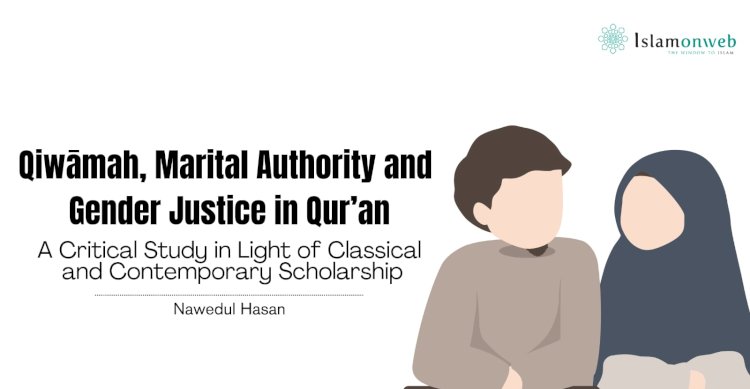
The discourse on gender justice in Islam has become a central issue in contemporary scholarship, particularly in discussions surrounding Qur’anic verses related to the roles of men and women in social and family life. Among the most debated verses in both academic and public discourse is Sūrah al-Nisāʾ (4:34). This verse states that men are qawwāmūna over women and outlines certain measures a husband may take in cases of serious marital discord or persistent disobedience. The verse has frequently been interpreted as endorsing patriarchal authority and male dominance, leading some critics to argue that it suppresses women’s autonomy. However, many such readings stem from decontextualized interpretations that overlook the linguistic, legal, and ethical frameworks within which classical Muslim scholars understood the verse.
This article addresses questions related to gender justice in Islam, with particular focus on the meaning and implications of qiwāmah through the lens of both classical exegetical traditions and contemporary Islamic interpretations. It examines the concept of qiwāmah from an Islamic perspective, especially as articulated by traditional Qur’anic commentators, while also engaging with modern scholarly discussions on marital authority, responsibility, and gender relations.
Aḥmad Yār Khān Naʿīmī, the renowned twentieth-century Islamic revivalist scholar, emphasised that the interpretation of this verse requires great caution and a strong command of Arabic grammar. He notes that the definite article (al) in both al-rijāl (men) and al-nisāʾ (women) is not used in the sense of istighrāq (absolute universality or comprehensiveness), but rather as lām jins, which refers to a particular category or class. According to Imām Naʿīmī’s interpretation, the verse does not imply the superiority of every individual man over every woman; rather, it indicates a general distinction in social and familial roles between the two genders.
Thus, the verse suggests a functional differentiation of responsibilities rather than an absolute preference of men over women. The term qawwām also conveys meanings such as maintaining, managing, protecting, supporting, and providing sustenance. Linguistically, it refers to one who administers and takes responsibility for the affairs of others. Accordingly, the verse implies that men are entrusted with the responsibility of being maintainers, protectors, and providers for women within the family structure.
The word nisāʾ is the plural form used for woman, although its pluralisation does not follow the regular linguistic pattern derived from a singular noun. In essence, the verse indicates that men are entrusted with the organisation, protection, maintenance, and management of women’s affairs within the family structure.
The latter part of the verse further clarifies that this responsibility primarily concerns the relationship between husband and wife. It does not imply that every man is superior to every woman. For instance, a son cannot claim authority or superiority over his mother, grandmother, or women of her status and age. Rather, the verse addresses marital responsibility and household leadership within the context of marriage.
The verse itself mentions two reasons for this qiwāmah. First, Allah has granted men certain responsibilities and capacities that relate to leadership and public obligations. Classical scholars also discussed distinctions in certain religious and social roles assigned to men within the Sharīʿah framework. Second, men are obligated to bear the financial responsibility for the family, including the maintenance and support of their wives and children.
Therefore, the core message of the verse is not the unrestricted granting of authority to men over women. Rather, it primarily addresses family responsibilities and outlines how a husband should respond to serious marital discord and persistent disobedience within the ethical and legal boundaries established by Islam.[1]
Responses to Common Allegations Against the Concept of Qiwāmah
One of the common arguments raised against the Islamic concept of qiwāmah is that granting men authority or leadership within the family structure constitutes injustice, since both men and women are creations of Allah and should therefore be treated identically in every aspect of life. However, absolute sameness does not exist within creation. Throughout nature, different beings are assigned different functions and responsibilities. The various parts of the human body perform distinct tasks: the eyes see, the ears hear, and the hands carry out physical actions. Similarly, the roots of a tree serve a different purpose from its branches. Difference in role, therefore, does not necessarily imply injustice or superiority.
Human society also functions through differentiated responsibilities. The duties and obligations of individuals vary according to their capacities and roles. From an Islamic perspective, men and women are equal in human dignity and spiritual worth before Allah, yet they are not identical in every responsibility. Women are naturally entrusted with certain roles such as pregnancy, childbirth, and aspects of nurturing that men cannot perform biologically, while men are assigned responsibilities such as financial maintenance and protection of the family. Within this framework, qiwāmah is understood as a responsibility connected to duty and accountability rather than unrestricted authority or domination.
Another allegation raised against the concept of qiwāmah is that Islam places the responsibility for financial maintenance on the husband rather than making it equally obligatory on the wife. Islamic scholars generally explain this in relation to the natural differences in physical constitution and responsibilities between men and women. Biologically, women experience conditions such as menstruation, pregnancy, childbirth, and postnatal recovery, all of which can affect their physical capacity for continuous and demanding labour.
For this reason, Islam places the obligation of financial maintenance primarily upon the husband, while relieving the wife from this burden. The husband is required to provide for the family's needs, including food, clothing, shelter, and other essential expenses. This responsibility is viewed not as a privilege of authority, but as a duty and accountability placed upon him within the family structure[2].
Ibn Jarīr al-Ṭabarī explains the concept of qiwāmah, stating that men have been made responsible for women, in that their authority and responsibility within the family structure are recognised and effective in matters related to household management and maintenance. In this context, he describes the husband as being entrusted with responsibility and decision-making within the family system.
Another common allegation raised against the Islamic concept of qiwāmah concerns the permissibility of striking a wife and how this can be reconciled with the principles of gender justice. Regarding this issue, Aḥmad Yār Khān Naʿīmī explains that any form of striking mentioned in the verse is strictly restricted and must not be severe, harmful, or leave marks on the body. Some scholars stated that it should be extremely light, such as with a folded cloth or a miswāk (tooth-stick). Others permitted the use of the hand while strictly prohibiting striking the face or causing injury.
From the context of the verse, the process is presented as gradual and reformative rather than punitive. The first step is sincere counsel and advice. If this proves ineffective, the second step is separation within the home through abandonment of bed-sharing and limiting communication, without expelling the wife from the house. Only if these measures fail and serious marital discord continues do some scholars permit a light symbolic strike intended solely for reconciliation and reform, not for humiliation, hostility, or revenge.
Some scholars further explained that minor faults should be addressed only through advice, while more serious and persistent misconduct may lead to temporary separation and distancing. The final measure is discussed only in the context of continued disobedience and with the intention of restoring harmony within the marriage.
It should also be noted that wherever the Qur’an prescribes corporal punishments, it clearly specifies the instrument and the number of strikes, such as the punishment of one hundred lashes for unmarried adulterers. In this verse, however, neither the instrument nor the number of strikes is specified. Many scholars understood this as an indication that the verse does not command physical punishment but merely permits a symbolic, non-harmful measure under strict ethical limitations.
Regarding the term “striking” mentioned in the Qur’an after the stages of admonition and abandonment, Ibn Kathīr explains that it is permitted only in a manner that is neither harmful nor severe and must not leave marks or cause injury. As narrated in Ṣaḥīḥ Muslim from Jābir, the Prophet ﷺ said during the Farewell Pilgrimage:
“Fear Allah concerning women, for they are entrusted to your care. You have rights over them, namely that they do not allow anyone you dislike to enter your private spaces. If they do so, then strike them, but in a manner that is not severe. And they have the right to their provision and clothing according to what is customary.”[3]
Likewise, Ibn ʿAbbās and other scholars interpreted the term as ghayr mubarriḥ (غير مبرح), meaning non-severe and non-injurious. Al-Ḥasan interpreted it as striking that causes no injury. Many eminent jurists further clarified that it must not leave marks, break bones, or cause physical harm.
ʿAlī ibn Abī Ṭalḥah narrates from Ibn ʿAbbās:
“Allah has permitted you to strike, but not severely; you are not to break any bone. If she responds, then that is sufficient. Otherwise, separation through khulʿ becomes permissible.”
Another narration reported by Sufyān ibn ʿUyaynah states that some women had become difficult towards their husbands, after which striking was permitted within strict limits. However, many women later came to the family of the Messenger of Allah ﷺ complaining about their husbands. The Prophet ﷺ then said:
“Many women have come to the family of Muḥammad complaining about their husbands. Those men are not the best among you.”[4]
These narrations demonstrate that even where limited permission was discussed, Islamic teachings strongly discouraged harshness and emphasised good conduct, restraint, and ethical treatment within marriage.
Regarding the issue of striking, it is reported from Ibn ʿAbbās that any such act must be extremely light, such as with a miswāk or folded cloth. One of the strongest pieces of evidence emphasising restraint in this matter is the practice of the Prophet Muhammad ﷺ himself, who never struck any of his wives throughout his life, despite occasions of disagreement or difficulty within the household.
Tadabbur-i Qurʾān and the Functional Understanding of Qiwāmah
Regarding the interpretation of Amīn Aḥsan Iṣlāḥī in Tadabbur-i Qurʾān, he views this verse as laying down the principles of family discipline and household management. According to him, the family is a small social unit that may be understood as a “mini-state.” Just as every state requires leadership for its maintenance and survival, every family also requires a responsible head to ensure order and stability.
According to Iṣlāḥī, the Qur’an assigns this responsibility to men based on two primary considerations mentioned in the verse itself. The first is that Allah has granted men certain qualities that make them more suited to external responsibilities associated with leadership and protection. These include physical strength, the ability to provide protection and defence, and the capacity to engage in demanding and continuous labour in the outside world. The second reason is the financial responsibility placed upon men for maintaining the household.
However, some people misunderstand this verse by interpreting qiwāmah merely as superiority or domination. In reality, Iṣlāḥī explains that it refers to a functional responsibility rather than unrestricted authority. It includes the burden of earning, maintaining, protecting, and managing the affairs of the family. Thus, qiwāmah is more a responsibility than a privilege.
He further argues that women also possess qualities and forms of excellence that men do not possess, particularly in areas such as nurturing children, emotional care, and household management. Therefore, the verse should not be understood as establishing an inherent hierarchy similar to master-servant relations or caste-based superiority. Rather, it points to complementary roles and responsibilities within the family structure. In this sense, both men and women possess strengths and distinctions in different aspects of life, while qiwāmah specifically refers to the responsibility entrusted to men to maintain and manage the family.
The second aspect of qiwāmah mentioned in the verse concerns the husband's financial responsibility towards his wife and family. This is not a responsibility voluntarily assumed by men; rather, it is an obligation imposed by Allah upon them because they possess the physical capacity and social responsibility to fulfil it. Thus, financial maintenance is presented as a duty attached to qiwāmah, not as a privilege of superiority.
Amīn Aḥsan Iṣlāḥī also discussed the limitation of striking the wife from the term ḍarb. According to him, this measure is mentioned only after the first two steps — sincere advice and separation in bed-sharing — fail to resolve the issue. Even then, the striking must remain within strict limits similar to the light disciplinary measure traditionally permitted to a teacher during guidance. When the Prophet Muhammad ﷺ was asked about this matter, he described it as ghayr mubarriḥ (غير مبرح), meaning non-severe and non-injurious. It should not wound, leave marks, or cause lasting harm. This clearly indicates that only a light symbolic disciplinary act is discussed within the verse.[5]
Allah has created human beings as male and female and paired them, as pairing is a fundamental principle of creation itself. A mother carries the responsibilities of pregnancy, childbirth, and nursing, all of which require physical endurance, emotional resilience, and psychological preparedness. Since these responsibilities are naturally borne by women, Islamic family structure places corresponding external responsibilities upon men, such as financial support, protection, and maintenance of the family. In this way, responsibilities are distributed between both partners according to their respective capacities and roles, allowing each to fulfil their essential functions within the family structure.
It would be unjust to burden women simultaneously with the hardships of pregnancy, the pain of childbirth, the responsibilities of nursing and child-rearing, and at the same time impose upon them the full burden of labour and financial maintenance for the family. Therefore, the division of responsibilities in Islam is based on the physical, emotional, and natural capacities of both men and women. The responsibilities assigned to women correspond to their natural disposition and abilities, while men are entrusted with duties suited to their physical strength, external responsibilities, and financial obligations.
Islam thus seeks to establish balance between the two partners without burdening either beyond their capacity. For this reason, women are naturally endowed with qualities such as gentleness, compassion, emotional responsiveness, and the ability to attend closely to children's needs. These qualities emerge naturally within motherhood rather than being acquired merely through education or training. In contrast, men are generally characterised by physical toughness and endurance suited to external responsibilities and protection.
It is also important to understand that the guardianship or supervision assigned to men does not negate a woman’s personality, dignity, or civil status within the family. Rather, this guardianship refers to a responsibility entrusted to men to manage, protect, and maintain the family institution. Being responsible for an institution does not grant the right to abolish others' rights within it. Instead, it refers to accountability for ensuring the family's proper functioning and welfare in matters of financial and social maintenance. Islamic teachings also clearly define the ethical limitations and responsibilities of the husband in his treatment of his wife and children.[6]Top of Form
At the same time, the Qur’an contains numerous verses affirming the spiritual equality and mutual relationship between men and women. The Qur’an presents believing women and men primarily as equal believers before Allah (Q. 33:35). It also describes believing men and women as protectors and supporters of one another (Q. 9:71). Marriage in the Qur’an is founded upon love, mercy, and tranquillity (Q. 7:189; 30:21), while spouses are described as garments for one another (Q. 2:187), symbolising intimacy, protection, comfort, and mutual support.[7]
About the author
Nawedul Hasan, from Sitamarhi, Bihar, is a first-year postgraduate Islamic scholar in the Department of Law, Justice, and Governance at the PG Campus of Darul Huda Islamic University, Chemmad, Kerala
Bibliography
Naʿīmī, Aḥmad Yār Khān. Tafsīr Naʿīmī. Vol. 5. Delhi, India: Maktaba Razawiyyah, n.d.
Quṭb, Sayyid. Fī Ẓilāl al-Qurʾān. Vol. 3. Delhi, India: Panicker Patent Publication Company, n.d.
Daryābādī, ʿAbd al-Mājid. Tafsīr-e-Mājidī. Lucknow, India: Kakori Offset Press, n.d.
Ibn Kathīr, Ismāʿīl ibn ʿUmar. Tafsīr Ibn Kathīr. Translated by Aḥmad Aḥmad al-ʿArīfī. Vol. 2. Riyadh, Saudi Arabia: Darussalam, 2003.
Iṣlāḥī, Amīn Aḥsan. Tadabbur-i Qurʾān. Vol. 2. Delhi, India: Taj Company, n.d.
Footnotes:
[1] Naeemi, A. Y. K. (n.d.). Tafseer Naeemi (Vol. 5). Delhi, India: Maktaba Razwiyya.
[2] Naeemi, A. Y. K. (n.d.). Tafseer Naeemi (Vol. 5). Delhi, India: Maktaba Razwiyya.
[3] Daryabadi, A. M. (n.d.). Tafseer-e-Majidi. Lucknow, India: Kakori Offset Press.
[4] Ibn Kathir, I. (2003). Tafsir Ibn Kathir (A. A. Al-Areefi, Trans.; Vol. 2). Riyadh, Saudi Arabia: Darussalam.
[5] Islahi, A. A. (n.d.). Tadabbur-e-Qur’an (Vol. 2). Delhi, India: Taj Company.
[6] Qutb, S. (n.d.). Fi Zilal al-Qur’an (Vol. 3). Delhi, India: Panicker Patent Publication Company.
[7] Daryabadi, A. M. (n.d.). Tafseer-e-Majidi. Lucknow, India: Kakori Offset Press.
Disclaimer
The views expressed in this article are the author’s own and do not necessarily mirror Islamonweb’s editorial stance.

Related Posts












Leave A Comment