
Millions Gather at Arafah as Hajj Reaches Its Peak
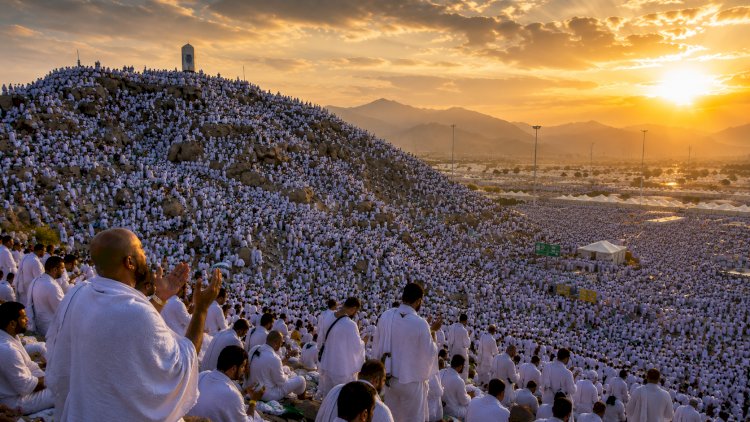
The sacred pilgrimage of Hajj reached its most significant and emotional stage today as millions of pilgrims moved from Mina to the plains of Arafah in a historic gathering marked by devotion, prayer, and spiritual reflection.
From the early hours after Fajr prayer, pilgrims began arriving in Arafah through organized transport systems including buses and the Al-Mashaaer Metro. The roads between Mina and Arafah witnessed a continuous flow of worshippers dressed in white ihram garments, chanting the Talbiyah: “Labbaik Allahumma Labbaik, Labbaika La Shareeka Laka Labbaik.”
Saudi authorities implemented one of the world’s largest crowd-management operations to ensure smooth movement between the holy sites. Thousands of security officers, volunteers, healthcare workers, and emergency personnel were deployed across the pilgrimage routes, while advanced surveillance systems monitored crowd density and transportation in real time.
The Day of Arafah is regarded as the heart and soul of Hajj. Standing at Arafah known as Wuquf is the greatest pillar of pilgrimage, without which Hajj is not valid. Pilgrims remain within the boundaries of Arafah from noon until sunset engaged in worship, dua, repentance, and remembrance of Allah
Islamic tradition holds immense virtues for this day. Prophet Muhammad ﷺ said : ‘’الحج عرفة’’“Hajj is Arafah.”
The plains of Arafah carry deep historical and spiritual significance. It was here, near Jabal al-Rahmah (Mount of Mercy), that Prophet Muhammad ﷺ delivered his Farewell Sermon during his final Hajj more than 1,400 years ago. The sermon emphasized justice, equality, mercy, and the sanctity of human life.
Today, pilgrims from every part of the world stood together in one of the most powerful displays of unity in Islam — regardless of nationality, race, language, or social status.
Across Arafah, emotional scenes unfolded as pilgrims raised their hands in prayer, many in tears seeking forgiveness and mercy from Allah. Some sat quietly reading the Qur’an while others continuously recited Talbiyah and dhikr throughout the day.
Near Jabal al-Rahmah, thousands gathered in worship despite the intense heat. Scholars describe the Day of Arafah as one of the greatest days in Islam — a day of forgiveness, acceptance of prayers, and liberation from sins.
Many pilgrims described the experience as overwhelming and life-changing.
At Namirah Mosque, the annual Hajj sermon was delivered before the combined Dhuhr and Asr prayers by Sheikh Ali Al-Hudhaify. Millions around the world followed the sermon through television broadcasts and digital platforms translated into multiple languages.
The sermon highlighted themes of taqwa (God-consciousness), Muslim unity, compassion, honesty, patience, and obedience to Allah. Pilgrims later performed the shortened and combined prayers following the Sunnah of the Prophet ﷺ.
After prayers, pilgrims continued their Wuquf by dedicating the remaining hours before sunset entirely to supplication and worship.
With temperatures crossing 45°C, Saudi authorities intensified heat-protection measures throughout Arafah and Mina. Thousands of cooling fans, shaded pathways, mist-spraying systems, and cold-water stations were installed to assist pilgrims.
The Saudi Ministry of Health confirmed the deployment of hospitals, mobile clinics, ambulances, and emergency response teams throughout the holy sites. Medical workers continuously monitored pilgrims for heat exhaustion and dehydration.
After sunset, pilgrims will leave Arafah and proceed toward Muzdalifah, marking the next major ritual of Hajj. In Muzdalifah, pilgrims will perform Maghrib and Isha prayers, spend the night under the open sky, and collect pebbles for the symbolic stoning ritual (Ramy al-Jamarat) that will take place in Mina.
The movement from Arafah to Muzdalifah is considered one of the largest synchronized human migrations in the world and is carried out according to carefully planned transportation schedules.
In the coming days, pilgrims will perform the stoning ritual, offer sacrificial animals, shave or trim their hair, and complete Tawaf al-Ifadah at Masjid al-Haram in Makkah.
Scenes from Arafah were broadcast across the world as millions of Muslims watched the emotional gathering live from their homes and mosques. For Muslims not performing Hajj, the Day of Arafah is also highly significant, with many observing fasting and increasing acts of worship and dua.
As sunset approaches over the plains of mercy, millions of pilgrims continue praying with hope that their Hajj will be accepted and their sins forgiven.
Disclaimer
The views expressed in this article are the author’s own and do not necessarily mirror Islamonweb’s editorial stance.
Related Posts

















Leave A Comment